

Agenda Preview: May 21 School Committee Meeting.
The next school committee meeting is scheduled for Thursday, May 21. Executive session starts at 5 p.m. and the regular meeting is scheduled to start at 6 p.m. The actual start time depends on how long the executive session takes. See the agenda here. You can watch it via zoom or Youtube Live. Spanish translation is available on zoom.
Here’s what’s on the agenda:
¡Public Petitions!
The fact that there are five public petitions on the agenda, the most I’ve seen in my 150+ hours of watching meetings, says something important about the current moment. When community members feel heard and included in decision-making, they usually don’t need to turn to public petitions to have their concerns acknowledged. The irony is, a year ago the school committee approved new core values for the district, which were developed after extensive surveys and conversations with students, families and community. I tried to find them on the WPS website, but a search for “core values” did not turn them up, so I’ll just leave them here:
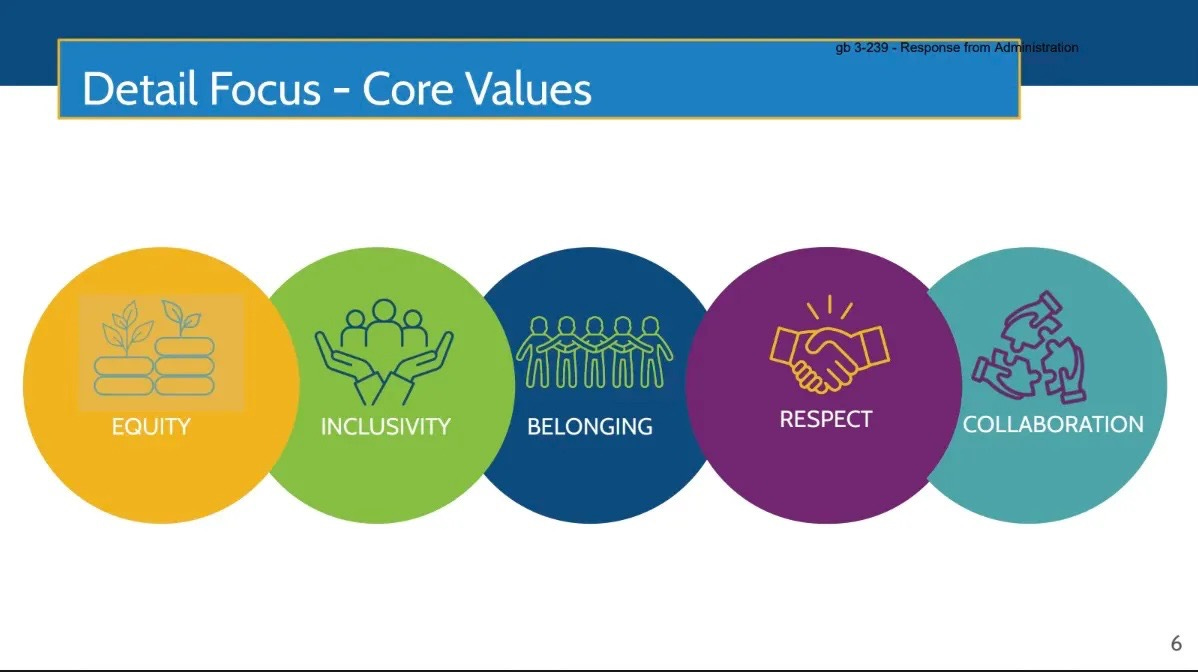
As Brian Allen said in his first message as Superintendent, “Our work will remain grounded in the core values that define us: belonging, respect, inclusivity, collaboration, and equity. These aren’t just words — they are principles that guide our actions and shape our culture.” The public petitions serve as a reminder that many community members are still looking to see those values reflected in practice
The petitions are in reference to:
Alternative Schools.
Three petitions refer to the closing of Worcester’s alternative schools: the Academic Center for Transition (grades K-6) and Worcester Alternative (grades 9-12). Students attending those schools will be offered a spot at the Central Massachusetts Collaborative.
Bullying.
Another petition asks for accountability around the district’s bullying prevention and intervention plan. There has been an uptick of items about bullying on the school committee agenda this year.
Voluntary transfer policy.
One petition refers to clarification on the voluntary transfer policy. Voluntary transfer is the process families use to request that their child attend a different WPS school than the one they are assigned to. Students are accepted on a “case-by-case” basis, and transportation is only provided if a student receives specialized transportation as a related service through an IEP or 504. As happens each year in May, voluntary transfers are denied and rescinded and people get frustrated by the black box that is the voluntary transfer process. While not explicitly stated in the policy, which can be found on page 5 of the student handbook, families are told in practice that voluntary transfer can be rescinded for “lack of seats, attendance, or other issues.”
That kind of case-by-case decision making, combined with the ability to rescind a placement for essentially any reason, means there is no real transparency around how many seats are available at different schools and how the decision is made about who gets them. As part of the school realignment process, data was released on the percentage of students attending schools on voluntary transfer, and it’s bonkers: 38% of students attending Roosevelt live outside its zone, as do 25% of students attending Doherty, and 20% of students attending Flagg Street.
There’s been cases of families feeling that their child’s voluntary transfer was rescinded as retaliation for advocating for their students. And I have heard stories of favoritism in the voluntary transfer process, including seats being held for gifted athletes, district employees’ kids, students that school committee members advocate for, or for certain arts magnet students. But it is hard to verify these stories because the process itself is not transparent. And that is a problem: when there is no clear system for who gets access and why, families are left to rely on rumors, relationships, and luck.
Report of the Superintendent.
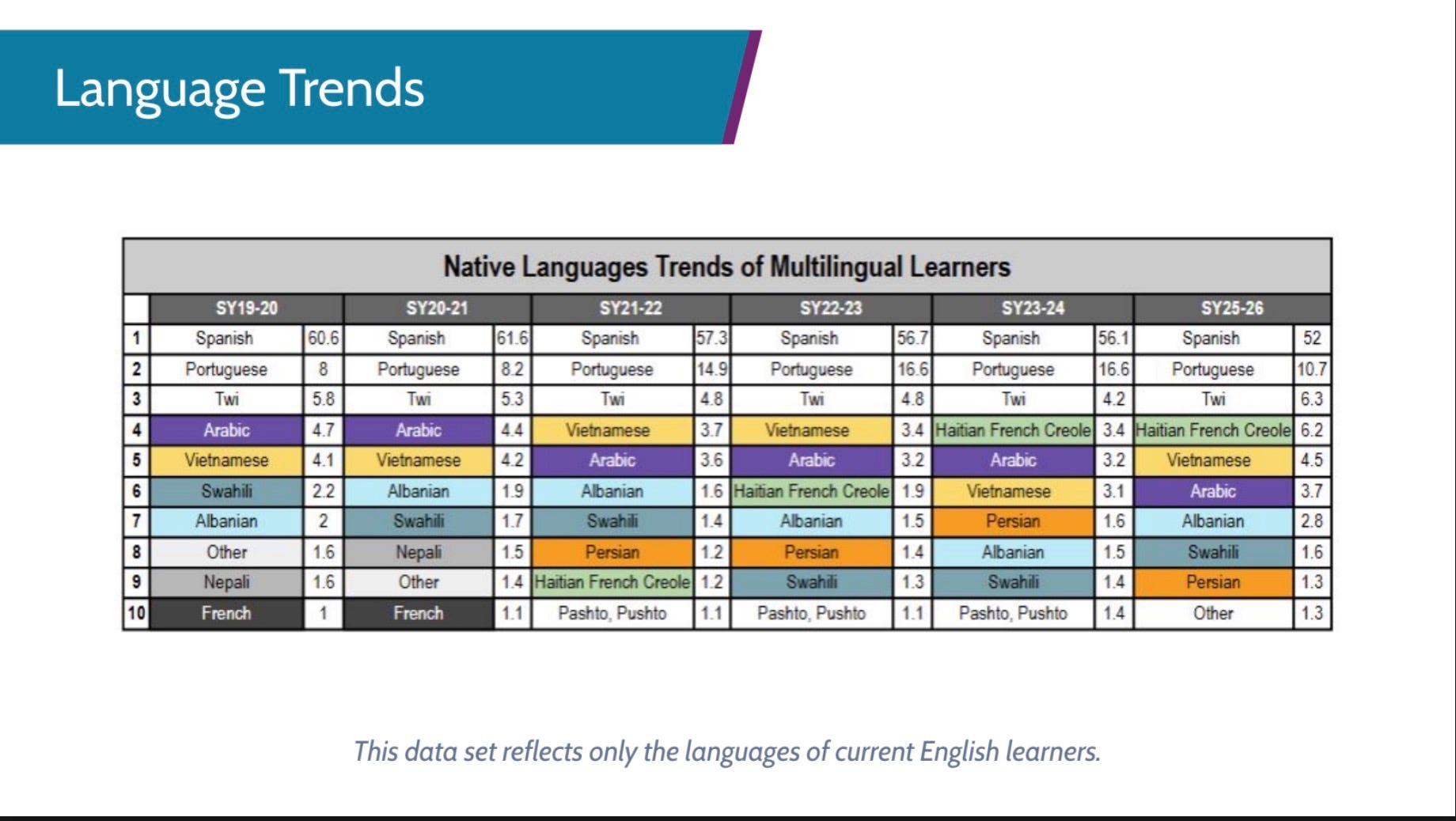
This meeting’s Report of the Superintendent is on Multilingual Learners. As demonstrated by the chart above, the majority of English learners in WPS are Spanish speakers, although that percentage has dropped in the last six years. (40% of the district’s Hispanic students are English learners, and 35% of elementary students are English learners, down from 49% last year).
One-to-One Device Lease.
The district is requesting approval to enter a five year lease for Chromebook replacement to remain a one student to one device district. According to this somewhat confusing chart, and discussion from previous school committee meetings, I think the district is already leasing 6,000 chromebooks for $2.9 million over the next five years (these are solely used at the middle school level). This request is to lease an additional 6,000 chromebooks at a cost of $3.6 million over five years. If approved, by 2030 the district will be paying $5.2 million a year in technology leases for 30,000 chromebooks, 5,000 Macbook Airs, and 4,000 ipads.
School Bus Ticketing.
Alex Guardiola (District D) has an item on the agenda requesting “an update on the status of school bus stop-arm camera enforcement technology for Worcester Public Schools, including whether the City of Worcester and Worcester Public Schools have opted into the Commonwealth’s recently authorized school bus camera enforcement program, the timeline for implementation, projected costs and revenues, vendor selection process, and how the program would improve student safety.”
It has now been a year and a half since Governor Maura Healey signed a bill into law allowing municipalities and school districts to install bus-mounted cameras and issue tickets to drivers who illegally pass stopped school buses. Both the Worcester City Council and School Committee voted to opt into the program in January 2025. At a November 10, 2025 Finance, Operations, and Governance Subcommittee meeting, Director of Transportation Mike Freeman said that a vendor bid was out and that implementation would come at no cost to the district, since expenses would be covered through ticket revenue. After asking for updates every few months, my understanding is that implementation is largely outside the district’s control. Police departments across Massachusetts appear to still be working through questions about how third-party vendors can issue violations using Massachusetts Uniform Citations, even when those citations are reviewed and approved by a certified officer. This is due to the “No Fix Law” which mandates strict procedures for issuing motor vehicle citations. Chicopee, for example, is the only municipality to install cameras so far, but has not yet begun issuing fines.
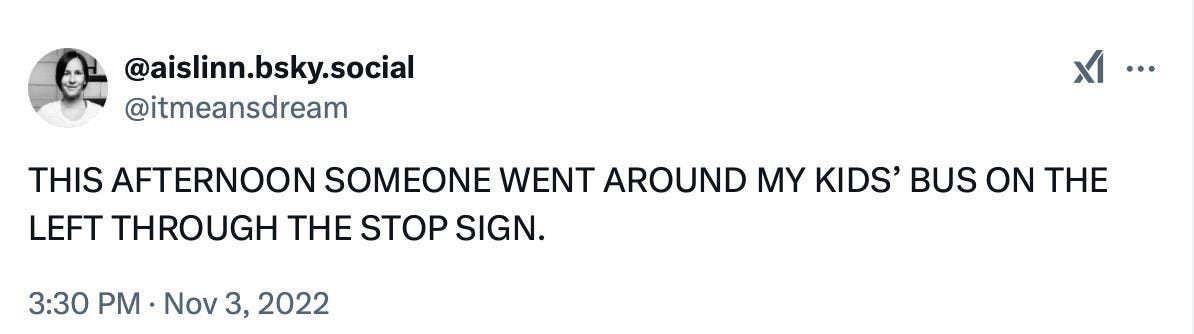
Even knowing that a 12-year-old child was hit by a landscape van while getting off a school bus in 2021, I was still shocked by how many drivers ignored stop signs at my kids bus stop on Pleasant Street when my oldest started kindergarten. Every single week for the last four years, I have watched cars speed through bus stop signs, or accelerate to try to beat the flashing yellow lights, which is exactly the behavior this law is meant to address. As Sergeant James Foley explained in a Worcester school bus safety video: “What we have been seeing throughout the city of Worcester is a lot of people are picking up their speed when they see the yellow lights thinking that they don’t have to slow down or come to a full stop. That is not the case.” PLEASE SLOW DOWN AND STOP FOR BUSES!
That’s it. If you have feedback you can always get in touch: aislinn.doyle@me.com