


This week, the district shared with families at Worcester Dual Language Magnet School that the school will be expanding into a pre-K through 8 model. Since then, I’ve been part of a lot of conversations with fellow elementary parents about Worcester middle schools — and wowwww, there is so much confusion and misunderstanding out there. That’s what motivated me to put together this guide to middle school enrollment.
For this guide I’ve pulled all the scattered info into one place and will break down the biggest sources of confusion: how magnet programs work, how voluntary transfers are handled, and the practical details like transportation, school hours, and extracurriculars.
If you know other parents with older elementary kids who are confused about middle school, please share this guide with them! Here is a PDF version as well.
I’m just a parent sharing what I’ve pieced together from five years of watching school committee meetings and talking with other parents. To the best of my knowledge, this is as accurate as possible, but my own family hasn’t gone through this process yet. I highly recommend checking out the district’s specialized programs page and enrollment videos, and definitely contact the district directly if you have specific questions. I’d also really appreciate any clarifications or insights from families who have been through it. And one final thing I’ve learned over the years: policy and what actually happens in practice are not always the same thing…
Let’s start with the basics.
A student’s official middle school assignment is determined by the district’s street list, which assigns every address to a middle school. *Update that the district has released a new tool that allows you to search by your address which is way more user friendly than the street list. It also includes distance from school which is helpful to know whether your address qualifies for a bus or not (for the secondary, elementary school transportation is not so clear cut.) Here are some examples of the results:


There are five middle schools a student can be assigned to: Burncoat Middle, Claremont Academy, Forest Grove Middle, Sullivan Middle and Worcester East Middle. There is also a line in the student handbook that states: “Spanish Bilingual, Structured English and Special Education Programs are offered in certain schools. Any student requiring these services will be enrolled in the school that will meet their assessed needs.”
But, as I wrote about in my district realignment piece, ”the pathways students take through the system don’t always line up neatly. Chandler Elementary, for example, feeds into three different middle schools, while several others — including City View, Belmont, May Street, Norrback, Quinsigamond, and Vernon Hill — feed into two.” It’s always good to double check the street list and never make assumptions of where your student is assigned!
There’s also a bunch of middle school options that are citywide magnets or programs that require applications. They are: Goddard Scholars Academy, Hanover Insurance Academy of the Arts, Visual and Performing Arts Magnet at Burncoat Middle School, Worcester Dual Language Magnet School, and University Park Campus School. We’ll take a look at each of them, but let’s start with the first middle school opportunity for students.
Goddard Scholars Academy.
While middle school in Worcester starts in seventh grade for the vast majority of students, 50 students each year start in 6th grade at Sullivan Middle School as part of the Goddard Scholars Academy. According to the website, “Goddard Scholars Academy (GSA) provides a rigorous and accelerated academic program in a safe, nurturing, and personalized atmosphere. The student body is a select group of Worcester Public Schools’ students, grades 6-8, who have demonstrated academic proficiency.” That academic proficiency is determined by Star scores. Star is a private standardized testing company that the district contracts with, and students take Star tests in September, December, and May each year starting in first grade.
Each March, about 300 to 350 fifth grade students are invited to “apply” for the program if they have Star scores in reading and math above the 75th percentile (some students take Star tests in Spanish, but those scores do not count towards GSA eligibility). I put apply in quotes, because it’s not really an application in the way most of us think of one —students simply check a box saying whether they want to be considered. Students are ranked based on their highest Star score from May of fourth grade, or September or December of fifth grade, and offers are made in that order. What’s not clear is exactly how that ranking is calculated, and families also aren’t told where their child falls on the list, so a student could be near the top or way down at #275 and the family would have no idea. I’ve heard this is a major frustration for families, especially given how many invitation letters go out for so few spots.
If accepted, students have to maintain at least an 80 average in all subjects and should expect one to two hours of homework each night. GSA students are guaranteed a spot in the high school Goddard Scholars program that continues at South High.
Hanover Insurance Academy of the Arts.
Hanover Insurance Academy of the Arts is a second honors program, established in 2017, that is available at Burncoat Middle School, and continues on to Burncoat High School. (It is different from the Burncoat Middle School Arts Magnet program, which I’ll get into next.) Like Goddard, there are 50 spots and acceptance is based on Star scores. But unlike Goddard, it doesn’t begin until 7th grade, so eligibility is based on scores from spring of 5th grade and fall and winter of 6th grade. Hanover, as the program is often shortened to, also differs from Goddard because students take honors academics, but can also participate in the Performing, Visual, and Media Arts Magnet Classes at Burncoat High. If you want to understand the history and some of the questions around how this program was created, I highly recommend reading former School Committee member Tracy Novick’s blog. She has written about this a bit and, among other things, has pointed out that there does not appear to be any formal arrangement around the Hanover Insurance name being attached to the program.
It’s also worth noting that at a November 2024 Teaching, Learning and Student Support subcommittee meeting school committee member Sue Mailman (at-large) raised concerns that the honors programs in the district are not following similar acceptance criteria as Worcester Tech, like having allocations by quadrant, for example.
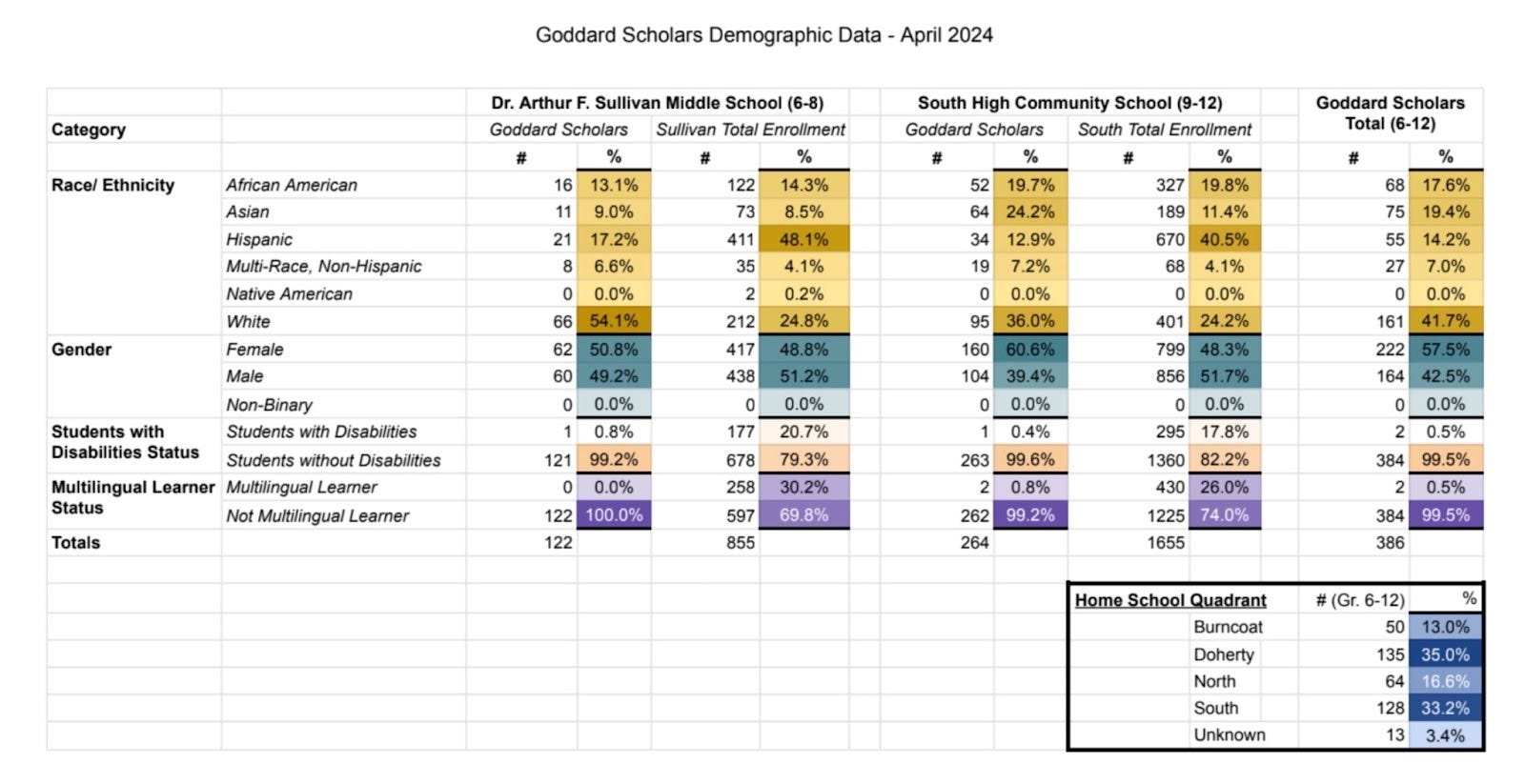
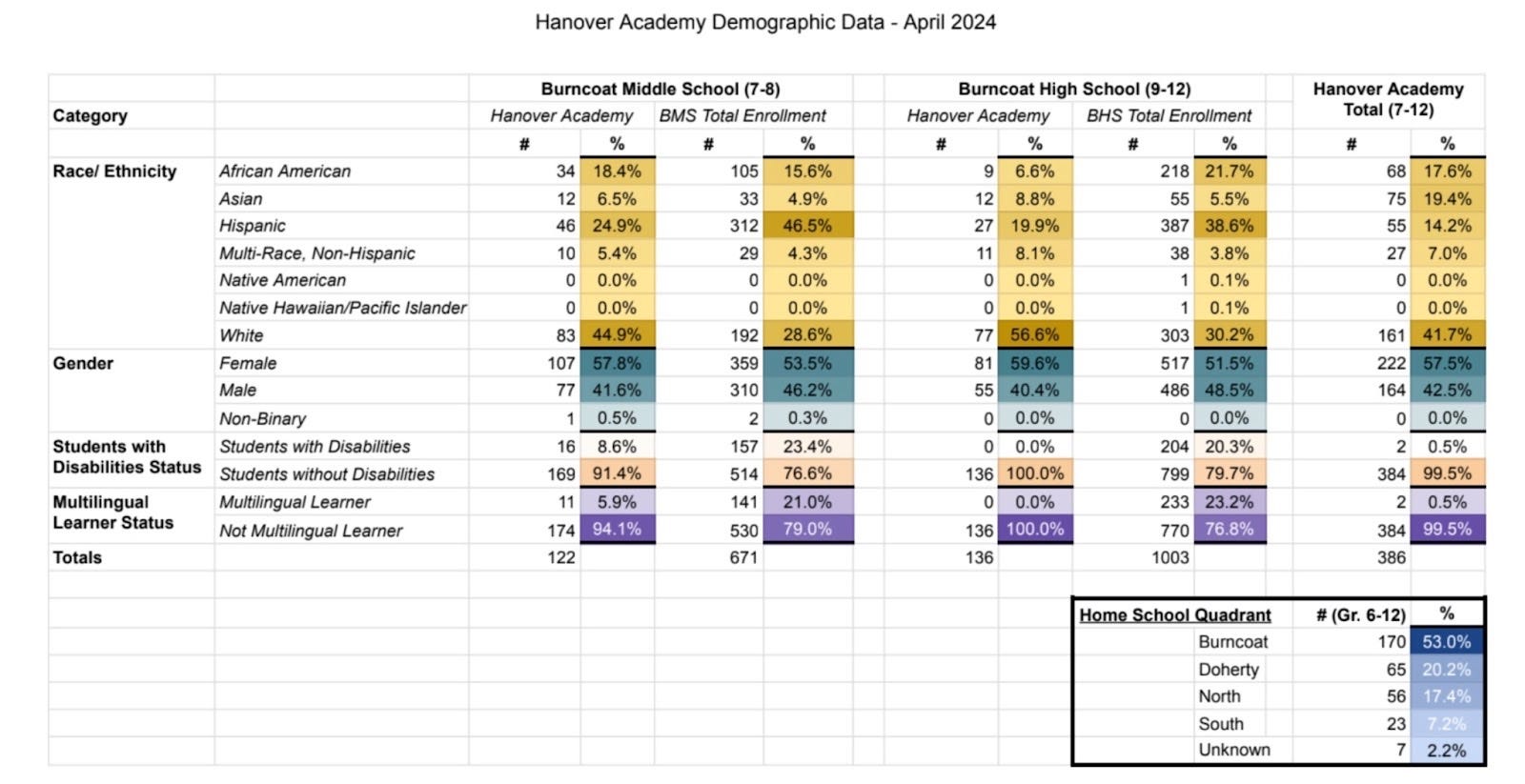
And that concern makes sense when you look at the demographic data reported back in April 2024 for both the Burncoat Hanover Insurance honors program and the Goddard Scholars honors program (see above). Enrolled students in those programs do not reflect the WPS student body and disproportionately come from the Burncoat and Doherty quadrants. One data point that wasn’t included, but that I’d really want to see, is how many students are low-income versus non-low-income. At a recent school committee meeting Mailman requested updated demographic data for these programs and I will include that here when it is released.
Visual and Performing Arts Magnet at Burncoat Middle School.
The longest standing K-12 magnet program in the city (dating back to around 1985), the Visual and Performing Arts Magnet at Burncoat Middle and High School is a continuation of the K-6 Worcester Arts Magnet (WAMs). Students can concentrate in dance, media arts, music, visual arts and theater.
It’s my understanding that students who go to WAMs automatically get a spot in the magnet at Burncoat Middle, but I could not find that in writing anywhere. If your kid wants to join the magnet, but doesn’t go to WAMS, they can be a part of the arts magnet program if Burncoat Middle is their assigned middle school. If you don’t live in the Burncoat quadrant, you would need to submit a voluntary transfer request to attend. As far as I can tell, this is less of a separate admissions process and more about whether Burncoat is your assigned school or whether you’re able to transfer in.
Voluntary transfer is the process families use to request that their child attend a different WPS school than the one they are assigned to. Students are accepted on a “case-by-case” basis, and transportation is only provided if a student receives specialized transportation as a related service through an IEP or 504.
While not explicitly stated in the policy, which can be found on page 5 of the student handbook, families are told in practice that voluntary transfer can be rescinded for “lack of seats, attendance, or other issues.” That kind of case-by-case decision making, combined with the ability to rescind a placement for essentially any reason, creates an inequitable process for families. It means there is no real transparency around how many seats are available at different schools, who gets them, or who decides.
I have heard stories of favoritism in the voluntary transfer process, including seats being held for gifted athletes, district employee’s kids, students that school committee members advocate for, or for certain arts magnet students. But it is hard to verify these stories because the process itself is not transparent. And that is a problem: when there is no clear system for who gets access and why, families are left to rely on rumors, relationships, and luck. A public school system should not have a process this consequential operating this informally.
Worcester Dual Language Magnet School.
The district recently announced that the Spanish/English dual language program 7th and 8th grade will no longer be at Burncoat Middle, but will be at Worcester Dual Language Magnet School. If space is available, students can join in 7th or 8th grade if they speak, read and write in both English and Spanish. This is a big change, but one that could create a stronger and more cohesive pathway for students continuing in dual language through middle school.
University Park Campus School.
University Park Campus School (UPCS) is a 7-12 school and the application is open to students who live within the UPCS zone. According to the district, the school’s partnership with Clark University means student teachers provide individualized support, students have access to Clark’s athletic facilities, and upperclassmen can take courses at Clark and could qualify for the Neighborhood Scholarship, which covers four years of free tuition as long as they have lived in the UPCS zone for at least five years before enrolling. Enrollment for students who live in the zone is determined by a blind lottery, with sibling preference.
A few other things to keep in mind.
High School Career Technical Education Admission: Admission to Worcester Tech is determined in part by the middle school a student attends. Lottery seats are distributed to each middle school based on its share of the total WPS 8th-grade enrollment. Below is the slot distribution for Worcester Tech’s incoming 9th graders (Class of 2030).
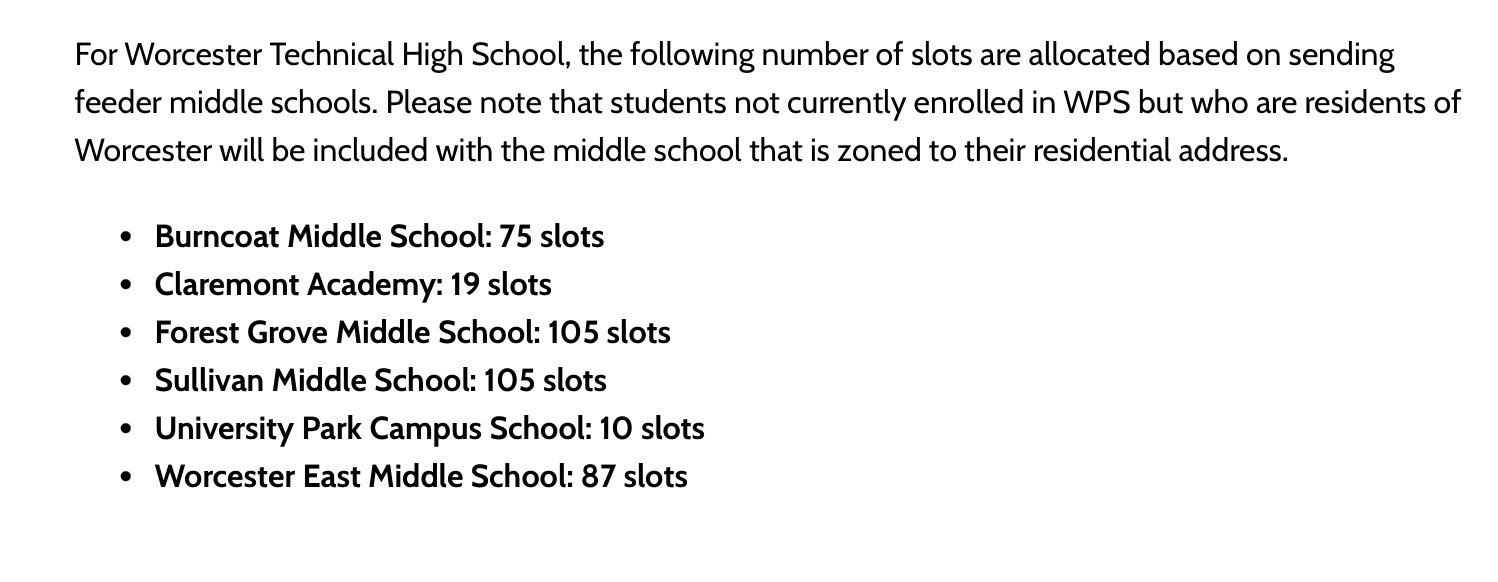
For the CTE programs at Doherty, North and South High Schools, there are no seat allocations based on where students attend or live.
School hours: You can find school hours on each individual school’s website. The middle school day is 18 minutes longer than elementary school, and start times vary— some as early as 7:20 a.m. and others as late as 8:47 a.m. (This is also one of the things that could potentially change through the district’s realignment process.)
Transportation. If you live within two miles of the school, your kid will need to walk, take the city bus, or you’ll need to drive them; unless they qualify for specialized transportation services as written in their IEP or 504. If you live two miles or more away, they will generally be assigned a bus, assuming they are not a voluntary transfer student. Two miles is a lot, and one expressed goal in the realignment process is to create more transportation efficiencies, so that more students can get access to busing. But as of right now, two miles is the rule.
Extra-Curriculars: Every middle school has extra-curricular offerings, but what’s available may vary by school. You can check out athletics here, and here are examples of what’s offered at Worcester East Middle and the clubs offered at Burncoat Middle. I could not find similar sites for Sullivan and Forest Grove.
Star Scores. The district does not automatically send parents their students’ star scores, and they are not available in Woo Edu. You can sign up to get your student’s Star scores emailed to you when they take them. To do that, log in to their Clever account and then click on the Renaissance app. If you scroll to the bottom it says “For parents and guardians” and click “get email updates.” The only way you can get past Star scores is to ask your child’s teacher to send you the reports. If you do not know how to log in to your child’s clever account, it’s their school email as the username (student.studentidnumber@worcesterschools.net where studentidnumber is the 6 digit number assigned to your child) and the password is their birthday (DDMMYYYY).
I hope this is a helpful starting point for families trying to make sense of Worcester’s middle school options. If you’ve been through this process and have anything to add or correct, please share. I’d genuinely love to make this guide more useful and accurate for other families. You can reach me at aislinn.doyle@me.com