

During this time of backsliding and derangement led by a political machine that is explicitly attempting to shrink and inhibit the public consciousness, hiding our nation’s history as it disappears the people who make up our future, I felt that it was a good time to debut a monthly history column: How Did We Get Here? It’s the question I can’t stop asking myself, so I thought together we might try to find some answers. I will write to you about where we live, who our predecessors were, and what they did. I am very excited. And, as it is Black History Month, I thought it would be the perfect time to start this new project.
And Bill here real quick to say our paid subscribers are the only reason we can put out vital and interesting local journalism like this! If you think it’s valuable, consider $5 a month.
How Did We Get Here #1: The Woman’s Progressive Club
In 1898, a group of women parishioners at the Belmont Street A.M.E. Zion Church gathered together to found an organization dedicated to directly assisting elderly people within their community. They called themselves the Woman’s Progressive Club.1
The turn of the century was the heyday of a national Black women’s club movement, which developed, predictably, as a response to the segregation of mainstream women’s clubs.2 While the Woman’s Progressive Club was a part of this movement, it was different from many women’s groups at the time. Other clubs sought to promote women’s issues, or advance the standing of their members as women—this wave of political self-organization was the origin of the fight for women’s suffrage and first-wave feminism. On the other hand, the WPC acted primarily as a mutual aid organization, run by a group of women who felt empowered enough to meet the needs of others. It says something about the standing of these women in their own community when many felt that they had very little agency; political, social, or otherwise.
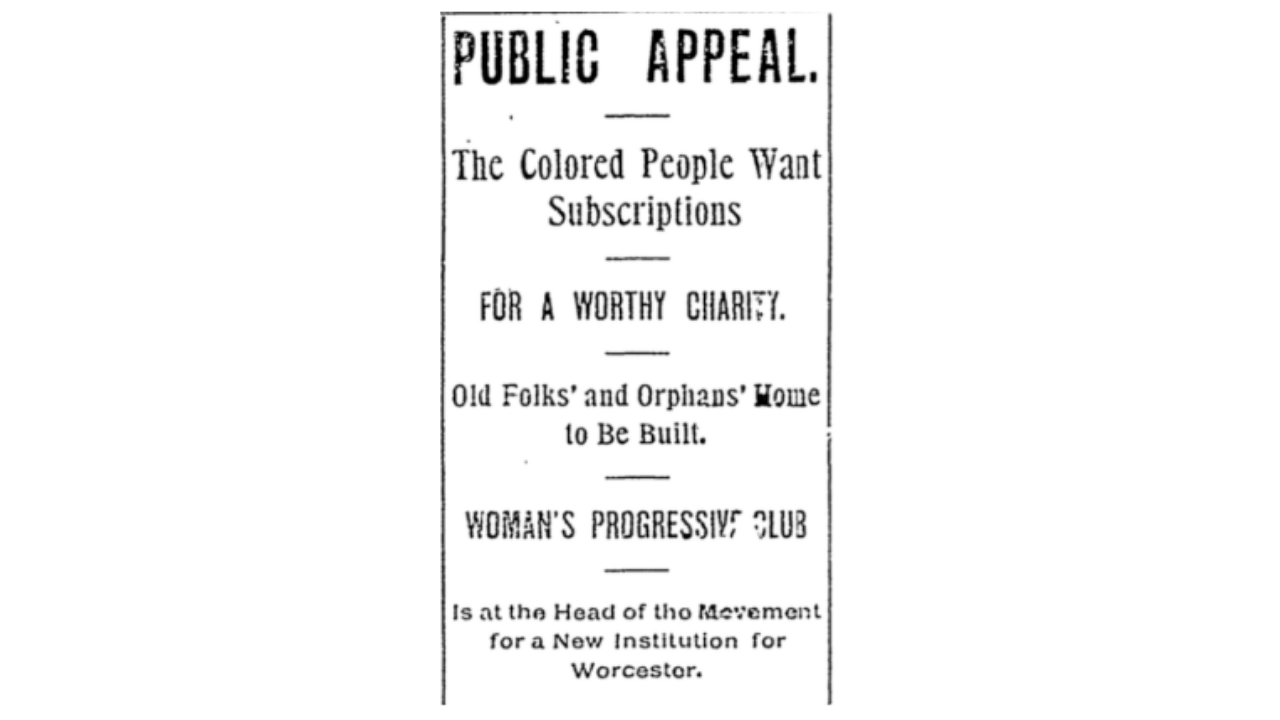
Most of the research for this column comes from the Museum of Worcester’s archive. If you’ve never had a reason to visit the research library there, I highly recommend finding one and making an appointment. The head librarian, Wendy Essery, is extremely knowledgeable and helpful, and the library itself is the perfect place to get lost in old documents, which is my version of heaven. I was there for hours just looking through boxes. There’s something incredibly humbling about handling a handwritten record from 1898; it feels like the author just walked out of the room, and she might come back for it at any moment. These records, donated to the museum by the late Stanley Holmes Gutridge, are where I began with this piece.
In the beginning, the Woman’s Progressive Club set out to raise money from within the Black community. This made them distinct: other women’s groups in the city solicited their funding from white patrons, including another Black women’s group, the Lucy Stone Club.3 Their fundraising strategy was an intentional choice by the members of the original Woman’s Progressive Club—self determination and autonomy was a grounding ideal for the organization. One member of the WPC expressed pride in her club’s ability to provide for her community “without appealing to the sympathies of white people.” They sought to sustain themselves mostly from the investment of the community in which they served, which, in their eyes, allowed them to operate with a level of uncompromising principle and agency. Politically, they were several decades ahead of their time.
Their strategy paid off: in 1902, despite the small size of Worcester’s Black community, the Woman’s Progressive Club had secured the funding to purchase a home on Liberty Street where they began running a care facility for the elderly, providing food and housing to those who needed it. During this time, publicly-run assisted living facilities in Worcester did not accept elderly people of color, and there was a dire need for services that did not solely cater to whites. Because of this, the WPC soon expanded their program, purchasing another home on Parker Street. As they transitioned into their new space they chose to change their organization’s name to the Home Association for Aged Colored People, though the original women’s club remained active as a Women’s Auxiliary within the Home Association. Finally, in 1952 they opened another property on Pleasant Street, dubbed Sunnyview Manor. At that point, the organization began employing several staff, including a nurse, a cook, a housekeeper, and an on-call doctor.
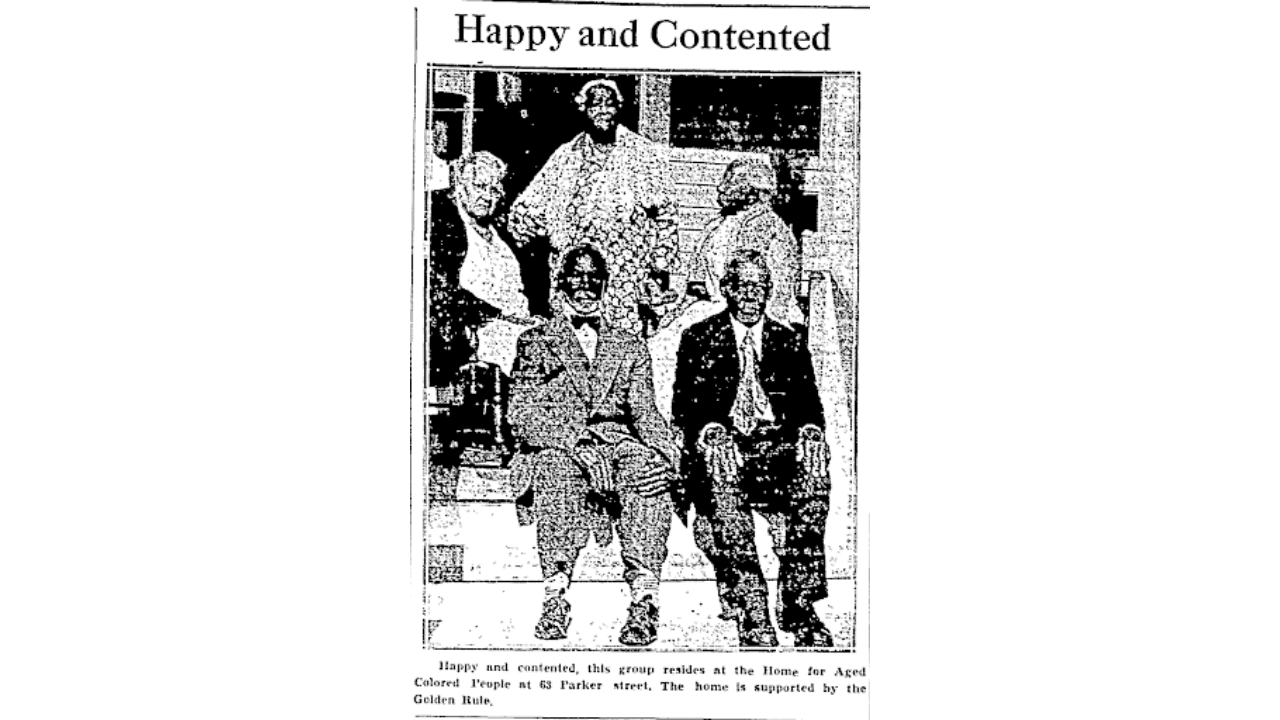
During their heyday, between 1910 and 1965, the Home Association was active in the community beyond their elder care services. There was public programming held at the Pleasant Street facility—english classes, cooking classes, job preparedness, and others. They also engaged with the growing movement for Civil Rights in the early 60’s. When D’Army Bailey was expelled from Southern University in 1962 for civil rights organizing activity, the Home Association helped fund a scholarship for him to attend Clark University. Bailey went on to lead a great deal of Worcester’s activism during this time, becoming the director of the Worcester Student Movement. Under his leadership, the WSM successfully organized to change Denholm’s policies against hiring Black clerks, among other things. Bailey was the first to receive scholarship money from the Home Association, but he would not be the last.
As the ‘60s marched on, the organization’s purpose had to shift. When anti-discrimination legislation passed nationwide and facilities were no longer segregated, the need for the Home Association waned. That, coupled with stricter federal rules that broadly standardized elder care, meant change was coming. By the 70’s, there were no more people being cared for in the Sunnyview facility. In order to keep it from standing vacant, two of the long-time caretakers, both members of the Women’s Auxiliary, moved in. Eventually, they sold the property, and the Home Association went in a new direction, becoming primarily a scholarship organization for the rest of its existence. In 1972, the organization changed its name to the Association of Colored Peoples, which it kept until its closing in 1995, just three years shy of its 100th birthday.
The Association did not remain a mutual aid organization; I would argue that its turn to a scholarship organization separated it from the direct needs of the community it was formed to serve. But during its heyday, the first 65 years of its existence, it was a group run by women for all those in their community who needed it. Without compromising their autonomy they were able to purchase and maintain multiple properties, pay for several skilled staff members, and fund events, classes, and services that extended beyond the original scope of their mission.
They were far ahead of their time—when the Woman’s Progressive Club first incorporated, Kwame Ture’s mother wasn’t even a twinkle in his grandmother’s eye, and yet the club operated on principles that harkened to the future philosophies of the Black Panthers. The program they led was autonomous, led by Black women, for Black people, and was similar in flavor to the BPP’s free breakfast programs. In 1966, when Ture introduced Black Power to the nation, describing it as a “call for Black people to define their own goals, to lead their own organizations,” he was just catching up to their work and their politics.
Note: All my thanks and appreciation to the Museum of Worcester’s archive for providing access to their collections for this piece, and to the late Stanley H. Gutridge. His care in maintaining these records, and subsequent work documenting the Association of Colored Peoples, has allowed me to share this piece of Worcester’s Black history with a new audience.
Gillian Ganesan (@gillianganesan) is a Worcester-based organizer, writer, and concerned citizen.
The names of the founders of the Woman’s Progressive Club are as follows: President Jane B. Collins, Anna N. Bryant, Emma E.P. Brogden, Sylvia A. Kennard, Ella E. Edwards, Gertrude Brogden, Jane Everett, Nary A. Folson, Addie P. Jones, Lizzie Walker, Jennie Johnston, and Narcissa Tossit.
Interestingly, the Worcester Woman’s Club, the large and well-known white women’s group associated with Tuckerman Hall, was explicitly anti-segregation within the larger women’s club movement—there was an incident at a national convention where the president of the General Federation of Women’s Clubs rescinded the credentials of a delegate upon learning that she was Black. The WWC denounced the action and later voted to withdraw its membership from the national federation. However, the group was not necessarily a strident ally to women of color. It was consistently an all-white organization, and the club never sought to foster relationships with the other Black women’s clubs in the city, namely the Woman’s Progressive Club, the Lucy Stone Club, the Standard Social Club, and the YWCA’s Negro Women’s Club.
The Lucy Stone Club was formed by a disgruntled member of the Woman’s Progressive Club (after the club presidential election didn’t go her way), and their feud was enthusiastically covered by local outlets. Fundraising strategy was the main difference between the two clubs, and a point of contention. Otherwise, Lucy Stone tried to compete with the WPC in almost every area, even going so far as to purchase a home themselves just a little further down Liberty Street. A member of the Progressive Club referred to Lucy Stone as a “secessionist movement” which is one of the shadiest reads I have ever heard. Janette Thomas Greenwood covers the drama in Chapter 5 of her book First Fruits of Freedom: The Migration of Former Slaves and Their Search for Equality in Worcester, Massachusetts, 1862-1900.

Loved Gillian Ganesan's column. Such a fascinating history and it shows what can be accomplished by ordinary people. Today we look to government programs or some huge NGO to solve a problem in our communities. These women couldn't even vote and were frequently banned from businesses and organizations, yet they created their own organization and took care of their community's needs. Amazing!
Awesome addition! Looking forward to future columns.