

What’s up everyone! Katie and I are going to see Gelli Haha at Sonia. I am beyond excited. This is their first tour on their first record. They sold out their first couple shows in LA but I don’t know what the Boston draw will be like.
Musically I think they’re onto something special: Kate Bush and DEVO hanging out in Peewee’s Playhouse with a modular system they lifted from Tangerine Dream’s tour bus. Gotta check out this live set they put up recently if that tickles your craw. Feels like the sort of band we’ll be looking back on in a few years saying I cannot believe we saw them in a 300-cap venue.
Getting this out then hitting the road. Nothing too crazy this week but a few things that are pretty funny: the specialized stretch code drama especially, but other smaller dramas and odities, like the following report from the esteemed Standing Committee on Economic Development, put in the hands of Freshman Councilor Satya Mitra by Mayor Joseph M. Petty.

Yes, you read that right. The chairman of economic development is asking the city manager to print out the train schedule for him... Brother... the city manager is not a search engine. Here problem solved: Worcester Framingham Line Schedule.
Before we get any further, a major announcement for those of you who do not listen to the podcast or open the emails: we’re doing a live event on Friday May 8—one year to the day since the Eureka Street ICE raid that changed the city forever. It’ll be a “live podcast” with a really stellar roster of guests (full lineup to be announced ahead of the event). We’re doing it at Hunchback Gallery, Travis Duda’s wonderful warehouse hub for the dark arts of the Worcester Underground at the capital building of that micro-community (75 Webster Street). Check out this stellar flyer Katie drew up for us!

Since space is limited and we want to have the ability to deny assholes entry, we’re doing tickets. You can get them here . Think of it like a way to reserve your seat (figuratively, mind you, we don’t have, like, usher money) and also kick LUCE some money. All proceeds are going straight there once collected. And LUCE will be part of the event in one way or another! Hopefully two ways! Still working out a lot of details. Stay tuned I’ll be plenty annoying about it over the next week and a half.
The through-line of the night will be two general questions: what did we learn about power in this city from Eureka Street and the subsequent months of fallout? And what can we do with that knowledge to make our community stronger?
If you have thoughts on that, we’d love to hear from you, and they may make the show! I’ve set up a secure virtual phone number where you can leave a voicemail, and I’m going to stitch together some of the best ones to be played at the event.
The Outdoor Cats Secure Tip Line number is 508-205-9520 or you can send a voice memo to outdoorcats@sudomail.com. A written reflection is not as good but I will take it! Same email address. Can’t wait to hear from you!
Exciting!
The whole thing came out of a conversation I was having with Etel Haxhiaj and Kevin Ksen about something related a few weeks ago, and all of us going you know we really should do something to mark the occasion. And then I remembered that Chris and I publicly committed to doing a live show at some point so... here we are! Fun fun! Haven’t put on an event in a while I do enjoy it quite a bit.
And grab a ticket if you want to come! Right now!
Also this is a good time to quickly ask that you consider helping support this little outlet that could! Always free to read, never free to produce. Reader funding is 100 percent of our business model such as it is.
Innovators in the do-nothing sector
In the newest Harpers, the lead column takes to task our country’s sick little billionaire fetish. “Billionaire Blues” by Thomas Frank. The following segment is worth reading in full.
There is an enormous body of literature considering the social arrangements a country needs to guarantee innovation and hence progress and prosperity. In-deed, the huge political changes of the Seventies and Eighties that made our current oligarchy possible were enacted in order to revive our entrepreneurial spirits. So of course some argue that we just haven’t gone far enough in our long campaign of “billionaire positivity,” to use Matthew Yglesias’s felicitous phrase. Our captains of industry, they say, should be accorded even more earthly power. In order to coax more creativity from them, there will need to be a complete cessation of antitrust enforcement, perhaps, or an allowance for private governance zones where our titans can innovate and exploit without interference from the bane of labor laws.
I am no innovation consultant, but to me that all seems completely and obviously backward. The branches of innovation at which modern-day, billionaire-positive America excels most remarkably are things like bailouts, monopo-lies, executive compensation, luxury-home design, and fraud. Especially fraud. From the president on down, the United States is home to the world’s greatest innovators in fraud, endlessly cranking out new models of stock market hype, toxic securities, bogus bond ratings, and fake inventions. We develop amazing new forms of insider trading; of make believe currencies; of junk fees and dynamic pricing. We dream up self-serving ideologies that everyone momentarily believes. Forms of populism that strengthen the ruling class and forms of antipopulism that strengthen it even more. These things have made America a kind of Renaissance Florence of fraud, a civilization in which everyone wants to become a billionaire by way of some creative new rip-off.
And it occurred to me this “innovation in all the wrong areas” theory finds purchase in our little municipal Petri dish. It’s present in the way the political class has seized onto the YIMBY idea of “just build more housing” as a way to mask its do-nothing response to the housing crisis, which, as I broke down in my last post, revolves around a willfully misportrayed document called the Housing Production Plan. The YIMBY philosophy is well-meaning but necessarily carries with it a neoliberal framework of cities in competition, a race to deregulate harder than the guy next door. It’s the tacit, if uncomfortable, underpinning of the Abundance message.
The innovation on display here is how to co-opt that rhetoric in service of an explicitly deregulatory agenda. The way to solve the housing crisis, our city and state officials say, is to bend as far backwards as we can for real estate speculators, offering maximum incentives and demanding minimal concessions, so as to inspire a supply-side solution to a simple market imbalance. Then, eventually—fingers crossed!—rents will come down. Kindergarten crayon portrait of supply and demand. Conveniently, this is the same approach they were taking before the crisis became something they had to acknowledge, when they were aiding and abetting it with full throat and open heart. Now, we’re made to swallow the idea that what brought on the speculative bubble will also pop it.
More innovative still, they’ve laundered this trickle down theory through something that sounds like a planning document but is a consultant-produced real estate industry brief (the housing plan) to wrap all the deregulatory posturing in the veneer of a plan. When they say “we need 12,000 more units of housing by 2030” or whatever, that’s what they’re doing. Deregulation presented as responsible planning, a compliance document invented for suburbs to wiggle out of affordable housing presented as the guiding light toward more of it.
That’s how Joe Petty goofily “clarified,” via a MassLive article the other day, how he told Progressive Massachusetts he was in favor of rent control to get their endorsement ahead of the election last year, then came out against it a few weeks ago as part of a mayor-based PR stunt put on by the real estate lobby and their rent control opposition campaign.
“I never said it was for rent control,” Petty said about his answer. “I did say that I want the state to bring people together from the business side and the community side to come up with a solution. Because it’s not lost on me that rent is very expensive.”
For the record, he wrote “yes” on a yes-or-no question about supporting rent control. But the fact he’s lying in the above quote isn’t what makes it interesting. It’s how he uses “bring people together” to mean nothing and everything at the same time, allowing the status quo to proceed unaltered. He knows it means “I will not support any alteration to the current arrangement,” at a frequency that only the speculator class can really hear, and to everyone else it’s either inaudible or unintelligible. Just words. That’s why he says it. Another innovation!
Later in the story, he’s quoted saying the people who need help are the developers, actually.
“I think the short-term one is making sure we get these developers there,” Petty said when asked about short-term relief. “We have 1,200 (housing units) that are ready to go and altogether, 2,500 on the books in different stages.”
And that does what exactly for my rent?
The real magic of this innovation is they never have to answer that question, punting by way of a passing reference to “supply and demand,” as if the conclusion is self evident and sufficient.
Hold onto this innovation in doing nothing idea as we move into a breakdown of the SNAFU over the “specialized stretch code” and Moe Bergman’s ongoing meltdown about it.
A quick timeline:
Two years ago, the council, including Moe Bergman, voted to adopt a “specialized stretch code” for new construction—a relatively dry and innocuous environmental regulation mandating new construction meets modern energy efficiency standards.
Last month, Bergman advocated, apropos nothing, for a “pause” in that specialized stretch code, claiming some developers found it onerous. Bergman is a real estate attorney, remember. All of a sudden the Chamber of Commerce set started going on the assault about the burdensome nature of this regulation no one else was talking about.
As if in keeping with a plan laid out privately (that would be crazy), the Chamber’s campaign was answered by the city manager. A few weeks ago City Manager Eric Batista recommended a pause, repeating the claims made by Bergman and the Chamber of Commerce set in a memo to city council.
At the city council meeting a few days later, the majority of councilors got behind the idea it was the stretch code that was to blame for the development slowdown. But Khrystian King held it to the next meeting, laying out a set of unanswered questions. Gary Rosen tried to bully him into taking the hold back. It didn’t work.
On Monday, a coalition of environmental and housing experts and advocates held a press conference about the need to keep the regulation. Then, on the same afternoon, City Manager Eric Batista issued a terse decree via Twitter that the stretch code is staying actually.
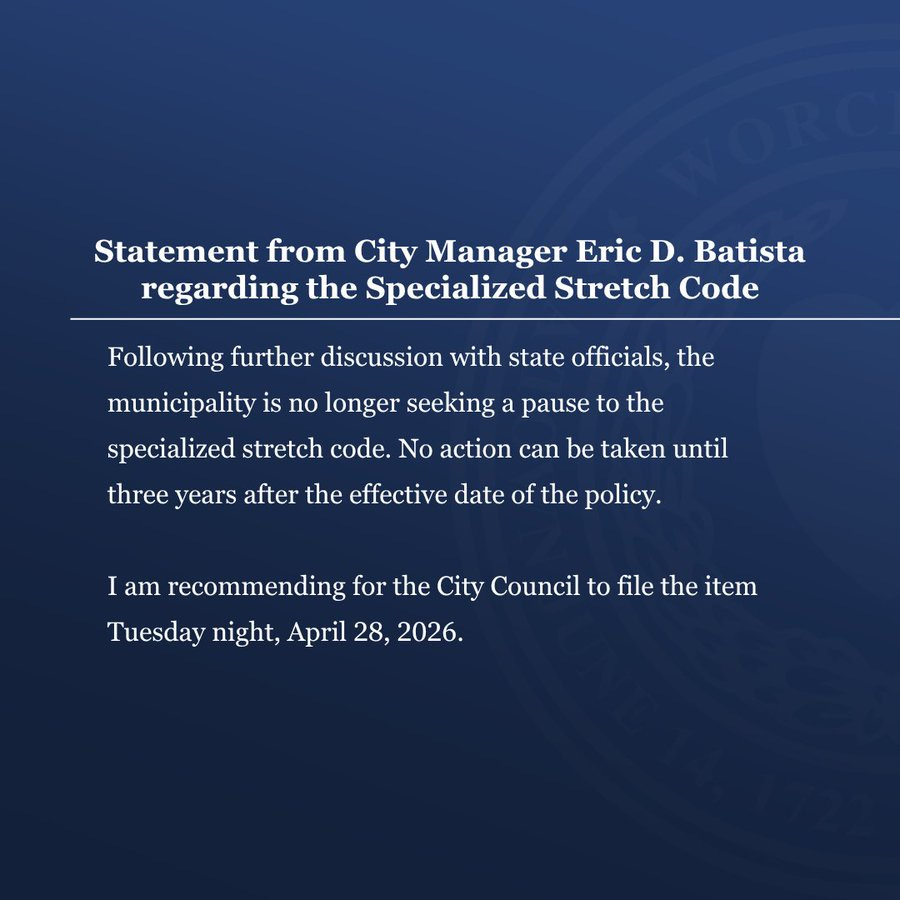
In an advance story on this surprise reversal as it headed to the council, the Telegram got Moe Bergman’s reaction.
Of the code, he said, “It’s unfair and unproductive to expect developers to spend considerable resources on getting products to comply and long wait times. It doesn’t help create new [housing] units.”
Ahhhh there it is again! Ding ding ding. Bergman employing Petty’s innovation on YIMBY rhetoric to position deregulation as benevolence. It’s particularly gross to see Bergman do this, as he’s long been the staunchest, most vocal, and most reactionary proponent of single family zoning, at a time when the one thing that would actually help create new housing units is zoning reform. The large swaths of the city walled off from increased density by single family zoning restrictions need to be pried open, and the perception that multi-family housing compromises the ‘character of the neighborhood’ needs to be challenged in the public discourse and ignored by city planners. Bergman will vote against anything that even sniffs of zoning reform. He will stoke the reactionary panic that single family zoning is under attack. He’s made that clear over the years.
You cannot claim to care about the housing crisis while also being a single family zoning absolutist. But here Bergman is, in the Telegram, talking about what will “help” create housing and what won’t. Kindergarten Republican, registered Massachusetts Democrat.
But anyway back to the timeline. At the meeting Tuesday, Bergman had a meltdown. In the middle of that meltdown, he articulated the whole game they’re playing rather bluntly.
Now we’re stuck with something for the next year and a half that none of us or I don’t believe I shouldn’t say none of us I don’t believe benefits anyone because if our goal is to develop more units that is going to be impeded by the specialized stretch code we have to put Worcester in a place Mr. Chairman where developers look at Worcester differently than other communities and say Worcester has something that other communities don’t have. Being one of 19 or so communities that have adopted the specialized stretch code my opinion not only isn’t going to get us the interest from the developers that the other 351 minus 19 communities are going to get without having the specialized stretch code.
There it is, the cities-in-competition framework. The race to the bottom it forces the municipality into entering. What I like most about Bergman’s blunt articulation of this logic is the “if” in front of “if our goal is to develop more housing units.” While in context it was just a turn of phrase Bergman employed for aesthetic purposes—to sound lawyerly, as Bergman often does, putting a bit too much mustard on the hot dog if you ask me—it happens to be the best question asked last night. Is our goal to develop more housing units? Is it really? If it is, there are hundreds of better discussions to be had than this one environmental regulation. So, Occam’s Razor, I’m inclined to believe this whole thing about the stretch code has nothing at all to do with housing. Bergman, all worked up and embarrassed by the state saying the city can’t do his little pause, came the closest to saying out loud that it isn’t. And toward the end of his second rant, he almost spilled all the beans.
“I’m going to be extra vigilant particularly when it comes to a couple departments, not every department in the city, when the information is presented to me by what I perceive is to be people that might be more activists than policy makers.”
Ah now we’re getting closer to telling the truth! That maybe just maybe this whole fracas over the stretch code is just the same old culture war bullshit the city council is always engaged in, looking for any little way they can to dick down on the left for the sake of it.
Maybe next time, Moe, you’ll find a way to do so that doesn’t end in your own public humiliation. Better luck next time, bud.
Toomey says chickens are inequitable
Mastermind that she is, Kate Toomey tried to argue her opposition to chickens was a stance rooted in drum roll equity. Only middle to upper class people have the “yardage” she said to keep chickens, whereas those in the “inner city” will, due to their cramped conditions, keep chickens unsafely, inviting disease into these inner city communities. That’s me being generous with the paraphrasing by the way. The real quote is much worse:
“For me the biggest issue is equity. The majority of people who have the yardage and, and the land, and the ability and to, to have the space and, uh, for these chickens... And most people who are living in the inner city do not have that.”
You can watch what she actually said via this little clip show I made. It gets spicy when Luis Ojeda rightly objects to Toomey’s assessment of who can and cannot keep a chicken coop.
And it ends in a shouting match when Toomey gets up to say she objects to being called racist, when neither King nor Ojeda said that, though they certainly could have and they would have been right in doing so.
This, by the way, is Toomey trying and failing where Petty succeeds, to innovate in the space of doing nothing besides what you were already doing and portraying it as responsible and/or benevolent.
“My heart breaks for people,” she said, padding her equity argument against chickens and you’re left to wonder who she meant.
For more on this, Giselle Rivera-Flores has a great breakdown of this moment in her Hispanic-ish newsletter: “When A Correction Becomes An Accusation”
The misuse of equity language can make exclusion sound reasonable. When someone says, “This is not an equity issue,” they are not automatically accusing anyone of racism. They may simply be correcting the use of a term that has a real meaning. They may be pointing out that equity cannot be used as a reason to deny a community access to something that responds to a real barrier, harm, or need. Equity is not a way to say, “If everyone cannot have it in the exact same way, then no one should have it at all.” Equity asks us to look honestly at who is impacted, what barriers exist, and what fairness would actually require.
Fund The DPW!!
My fellow Fund The DPW heads rise up! And read this line of a report on snow and ice removal filed by DPW Commissioner John Westerling.
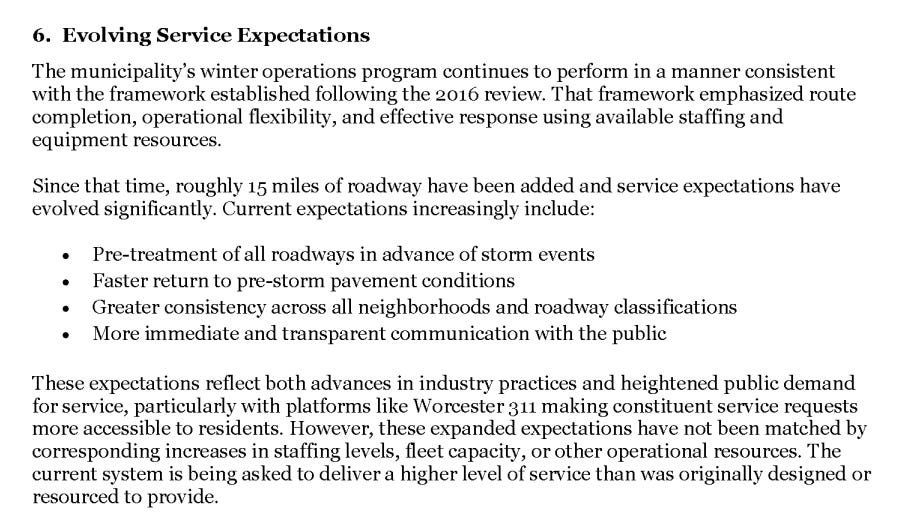
In particular I’m looking at the line...
“These expectations have not been matched by corresponding increases in staffing levels, fleet capacity, or other operational resources.”
...and I’m thinking to myself hmmm what is the one notably over-resourced department. You know where I’m going with this, dear reader. But shhhh. That’s between us. We should know by now there’s no good can come from saying it directly. Anyone asks, you say “some light restructuring in other departments.” But the emphasis: Fund The DPW, baby. One day, when we’ve wrested the city from the greasy palms of the developer class we’ll have the best DPW in the nation—we’ll have the strike team from “The Shield” but for potholes, we’ll have parks to rival real cities, rewilding initiatives of the kind they have in Europe, real forward-thinking non-reactive infrastructure improvements all over the place. We’ll finally put a few cracks in Lurie’s Dome. And yeah there will be some reductions elsewhere, but they were made for sake of efficiency. Like good little neoliberal boys and girls, we targeted redundancies. We streamlined.
The present moment, in which every week the city council is essentially a five hour grievance-airing on the subject of minute flaws in public infrastructure, includes very little talk of how to give the DPW “what they need.” It is insane. The present reality is insane, in this way among others. We have crime at a historic low and—ohp. There I go. Breaking my own rule.
Odds and Ends
Thank you for reading! Please consider throwing us a couple bucks if you like what we do here, if you learned something, if you left knowing more about the city than when you arrived. It’s free to read but not free to produce, as rent has not yet been abolished.
Anyone watching season two of “Beef” on Netflix? Kicks ass. The synth work in the score and the loser washed up musician jokes throughout the script are both tremendous, hitting extremely close to home.
We talked about it on the most recent podcast but I’ll add it again because it’s so good: the whippet squirrel at Big Y, courtesy Reddit user Cerimeadar…

Decades from now this image will be a prerequisite study for photography students across the world. Gahd damn.
One more plug to get your tickets for the Friday May 8 live Outdoor Cats event!! And hit the tip line with your Eureka Street thoughts and observations. The Outdoor Cats Secure Tip Line number is 508-205-9520 or you can send a voice memo to outdoorcats@sudomail.com. A written reflection is not as good but I will take it! Same email address.
Ok to Boston now!
I want to Zoom into the next Council meeting and blast clucking chicken noises for two full minutes. What an idiot. How quickly can you record "Inner City Chicken Coop Blues?"
The PotHole Strike Team is a literal stroke of genius.