

Paulie Walnuts voice: Whaddaya hear whaddaya say?
Today we’re talking housing.
As an amuse-bouche, let’s head up I-190 toward one of Worcester’s two beautiful step sisters, and read a real-life headline out of Leominster a few days ago: “Homeless man arrested for stealing beef jerky, chili, and Snickers from Leominster Walmart”
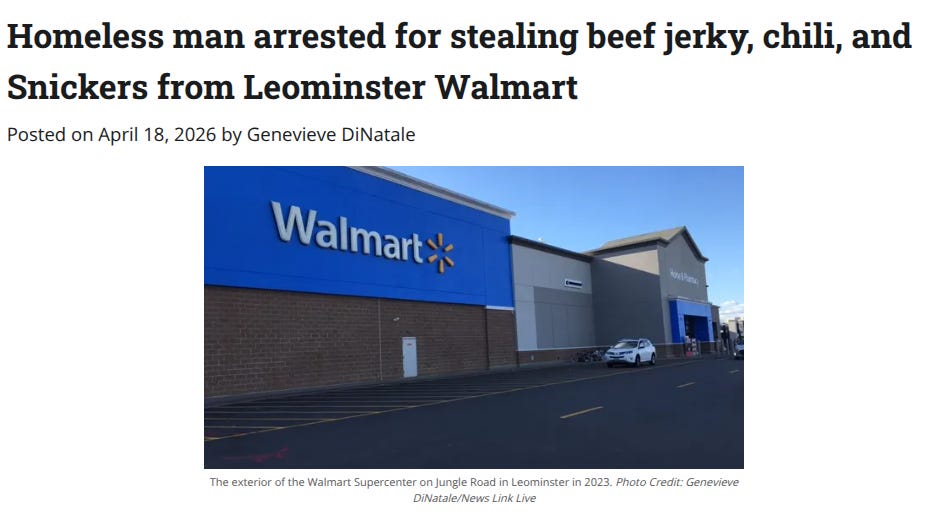
In painfully acute fashion (the Walmart loss prevention specialist’s first name appears, giving the character a Buckley-like quality), the arrest of a homeless man for shoplifting what was obviously the evening’s dinner is described in the sort of detail you’d only get from reading the raw arrest report, which the reporter in question apparently FOIA’d for, for some reason. It includes the man’s full name, which for a minor crime like shoplifting is in my opinion both shitty on a moral level and inexcusable journalistic malpractice. Also there’s a weird qualifier right after the lede…
(The account and quotations in this article were sourced from the printed Personnel Narrative of Officer Michael Dingman for the incident and do not reflect any political perspective or personal opinion of News Link Live, which is strictly a business entity.)
Uhhh… ok. ‘I have absolutely zero opinions about this thing I and I alone went out of my way, to the point of a legal public records request, to publish.’ Sure.
The story does paint a valuable portrait of just how hard the cop in question worked on behalf of Walmart, in public-private communion with Travis the Walmart loss prevention specialist, to solve this “crime.” He tracked down the man, opened his backpack, compared the wares inside to the security footage provided by Travis the loss prevention specialist. Put him in cuffs. Took him to the station. Did the paperwork for charges that will make the man’s life harder in perpetuity all but ensuring he shoplifts again—job security right there for Officer Dingman if you really think about it, as this is the task he apparently spends his time doing, which definitely makes the community safer. (Also, lmao re: “Officer Dingman.” Mike Judge would approve.)
Officer Dingman stated that he opened [NAME]’s bag at Walmart and found unopened food items belonging to the store, including two bags of beef jerky valued at $30.76, three cans of chili valued at $9.51, and three bags of Snickers valued at $23.64.
“The total of the stolen merchandise was $63.91,” Officer Dingman said. Later adding, “I gave those items back to Walmart…I radioed Officer Zylyftari that [NAME] was under arrest at this time.”
Two bags of Walmart beef jerky costs $30 and I am supposed to believe Walmart is the victim here?
The layers of spiritual rot informing this ~police action~ and the subsequent decision to assign it news value… it’s hard not to hate it here. I’ll leave it at that. On to the task at hand.
First, consider supporting an outlet that would never ever fucking write that story and has the full freedom to call out an outlet that does…
I’ve been losing subscribers lately for understandable reasons… times are tougher and the financial outlook is dimmer than they have been in some time. But it would be nice if a few readers could step up to cover for those who had to tighten their belts. This outlet doesn’t exist without the readers who throw it a few bucks a month or a few dozen bucks a year. I know it sucks especially to pay attention to Worcester right now, believe me I know, but the thing about building an institution is you gotta slog on and you gotta survive through the periods where it all feels especially sisyphean. You know what, here’s a discounted rate to get anyone on the fence over that thing and into the light.
Joe finally showed us who he is
The running criticism I’ve kept of Lifelong Mayor Joseph M. Petty has been at odds with the sentiment of the public at large. I know I’m not alone in that. In fact we ran a whole guest piece on the issue last August from the esteemed local writer Brett Iarabino: “How do we make the anti-Petty case to well-meaning liberals?”. In that piece Brett does a nice job capturing the weird disconnect between the national and the local informing the stock opinion of Mayor Petty.
As I thought about Eric Batista’s press release commending WPD’s presence and his outright lie that there was no collusion between the department and ICE, I began a chant at the Common. It was as much a warning to the chair of the council that handpicked Batista’s ascension to the City Manager role as it was an invitation for every Worcester resident repulsed by Eureka Street to turn their outrage into action. To my pleasant surprise, it picked up quite a bit of steam: “VOTE PETTY OUT! VOTE PETTY OUT! VOTE PETTY OUT!” It rippled through the crowd, briefly getting in the way of a speaker (sorry, 50501), and causing a white woman in her 60s or 70s standing right in front of me to shoot back some serious daggers.
I had a feeling my chant would ruffle feathers—anyone who’s served fourteen consecutive terms of governance in a small pond like ours would surely have a wide sphere of influence. And something told me that there was a Venn diagram between that circle and the crowds that frequently show up to rage against an abuse of power at the national level, one they believe is perpetrated exclusively by the far right. Sure enough, after the chant ran its course, this attendee staring at me set down her anti-ICE sign to inform me that she happens to know and like Mayor Petty. She said she finds him to be a great guy; she knows for a fact that he is “in fumes” over what the Trump Administration is up to, and he actually adopted children from China. (It’s not immediately clear what this had to do with the conversation, but she felt compelled to throw it in there, so why do her the disservice of a misquote?)
Most people, if they know a thing about him, know that he’s a nice guy. That he showed up for this one thing one time and shook everyone’s hand. That his heart is in the right place or something like that. That he’s a Democrat and thus one of the good guys. He can be, and largely is, all of those things. But he is at the end of the day attendant to a coalition of speculators who see the city not as a home or a community but rather an abstract sort of financial mine.
The interests of the regular Worcester people he shakes hands with and the speculators he truly serves come into particularly direct conflict on the matter of rents. The main engine of the speculation machine, but also one of the most widely felt pain points of his public-facing constituency. Questions of where he’d land were answered last week when he brazenly threw up the banner of the speculator class, appearing next to 11 other mayors opposing rent control in an April 15 press release disseminated by the deceptively named “Housing For Massachusetts” campaign—an entity created and thus far entirely funded by the real estate lobby to oppose the very same measure. The release, right in the lead, said these mayors have “joined” the anti-rent control campaign. As we’ll get to, Petty joined that campaign a long time ago. But signing on to this press release was, for Petty, an exceptionally brazen fuck you.
For those who do not know, there is a ballot question initiative on track to make it for November that would ask residents to pass the state’s first rent control measure since banning it back during the Clinton years. The year 1994, to be exact, same year they signed the North American Free Trade Agreement and in doing so killed Worcester’s manufacturing output for good. Since, the runaway train of free market fundamentalism that NAFTA rode in on kept picking up speed, kicking up new ways to financialize everything to the point where now we’re made to believe the only sort of housing projects that are at all feasible are bougey-branded wood frame all-in-one boxes put on one super block with an equally-sized parking garage on a second super block, financed by investors who expect a windfall return and the only way to provide that to them is exorbitant rents. The previously unprecedented rent prices encourage the landlords of other smaller and older wood frame boxes to try and get the same. And all of a sudden you’re looking at an artificial surge in the value of a crappy two bedroom apartment, with no consumer choice on offer to counteract it because unlike buying a different brand of soda you have to radically upend your life to exercise your consumer choice in where you live.
It’s a bubble like any other bubble but it can’t pop like the other ones because homes are fundamentally not a commodity. People are not rational market actors when they sign a lease because they’re not buying a thing among other things in a thing store. The concept of “home” cannot be priced and tracked like a carton of eggs. Rents, set on vibes in the first place, stay high. There is no countervailing force the consumer can exercise, short of a collective action to astroturf a market perception that a neighborhood is dangerous. (I am so down, by the way, and with shotspotter it’s never been easier). There is no incentive for developers to overbuild and every incentive for them to collude in controlling the supply-demand balance. And short of a state intervening in that practice there’s nothing to stop them from doing so. It’s their land, after all. So the rents only ever go up. This becomes a major problem when wages don’t keep up with rents in the going-up-forever department. Exactly the situation we are in right now, as the free market has proven very adept at depressing labor value at the same time as it juices land value.
So the need for a state intervention is obvious. The market left to its own devices has produced a housing crisis. People across the state are more cost burdened by rents than ever and the only new construction is on the luxury end, producing the trickle-down socioeconomic turnover outward from the central node (Boston, in our case) we call gentrification. It’s destroying communities first of all, the main thing, and second of all it’s bad for the industry these jokers claim to want: the labor pool leaves when working class people are priced out of a community. Cue the hospital on Nantucket that had to build its own worker housing just to keep the thing running.
A state functioning as a state would find its role in this moment obvious. It would build the housing needed directly, competing with the equity firms and other profiteers who drove us to this point. The state can, has, and should build housing. In other parts of the world, even some select parts of the United States, it does. But our state does not function as a state so much as a captured state—one that sees itself as an attendant facilitator of development rather than the entity that uhhhh governs development, mitigates its impact, generally presumes to have a handle on the shape of growth. In lieu of a strong state that can make developers compete for land parcels, the state competes with other states to “not lose” development by selling off the company store. This is a nice racket for the development community. It makes a lot of money for anonymous yacht owners and island-visitors and industry disruptors. For the state bureaucrats who prove themselves useful, there are a few cushy ‘jobs in the private sector’ waiting for them—a revolving door based on the cultivating and trading on loyalty. Hey Siri what’s the definition of a cartel?
Ed Augustus for instance was the lead author of the Polar Park deal on the city side, and now serves as CEO of Unibank, one of the three banks that put up the financing for the Madison Properties development package around Polar Park that, Augustus famously said at the time, would make the park pay for itself. Of course the park is no longer paying for itself, a fact well known when Augustus left his job as head of housing policy for the state to work at a bank vested in the deal he authored, and that gets paid back first on said investment no matter who’s paying. For the city Augustus was representing ostensibly when he authored the deal, the inverse is true. The services and jobs it provides city residents are the final bag holder in the whole deal, the largest and most vulnerable of course being the public schools. This is a good example of how to prove yourself useful to the not-a-cartel.
Those left in the public sector, from the governor on down to Mayor Joe Petty, are trying to make us swallow the line that deregulation = salvation. Like insecure lovers we’re told our sticking up for ourselves will cause the developers to leave, and then it’ll get worse. Abuser logic! And logic that our mayor, city manager, and actual mayor (Tim Murray) all trade in, unabashedly. The Worcester Regional Chamber of Commerce is, of course, a member of the anti-rent control coalition. Batista, by nature of his debt to Petty as the man who unilaterally made the decision to hire him, is functionally a member as well.
The rent control measure on the way to the ballot would cap rent increases at 5 percent annual or the increase of the consumer price index, whichever number is smaller, and it exempts public housing authorities and small rental buildings like triple deckers (less than five units). It’s not radical in any way, it’s just an actual state intervention and we’ve been conditioned to believe that it’s impossible for the state to intervene.
Anyone surprised by Petty’s early public anti-rent control stance should consider it an entry point to understanding the true contours of Petty’s coalition, his politics, his worldview. He’s the nice-enough-shows-up-to-everything-remembers-your-name-how’s-your-mother guy and he’s hostile as a political entity to the interests of most working people in this city. Call it a product of his political nurturing: he’s going to side with the real estate lobby, the developers and the police at every turn that matters. That’s his coalition. Their interests are opposite to our interests. Their definition of the city is not our definition. Their claim to the right to said city comes necessarily at the forfeiture of ours. The old renter-rentier divide. Simple as that. The only thing interesting about Petty in this moment is he’s saying it out loud, whereas in the past he’d have tried harder to obfuscate it. That he’s no longer bothering is refreshing, I think. It would be nice if these people stopped lying to us so much. But, then again, the coalition he joined has the name Housing for Massachusetts, a cynical and condescending framing that fits nicely into a both-sides news story, that tees up a guy like Joe to say things like hey look we’re all after the same thing here. But we’re not—that’s the root lie.
Our ability to live comfortably in this city interferes with their fiduciary responsibility to extract from it. So long as that fiduciary responsibility animates power, the people who live here will always necessarily find their concerns to be, at best, secondary.
Here’s an example of what I’m talking about, from Petty’s campaign contribution data, courtesy what looks like some sort of campaign event on July 9, 2025 of the “invite only” variety.
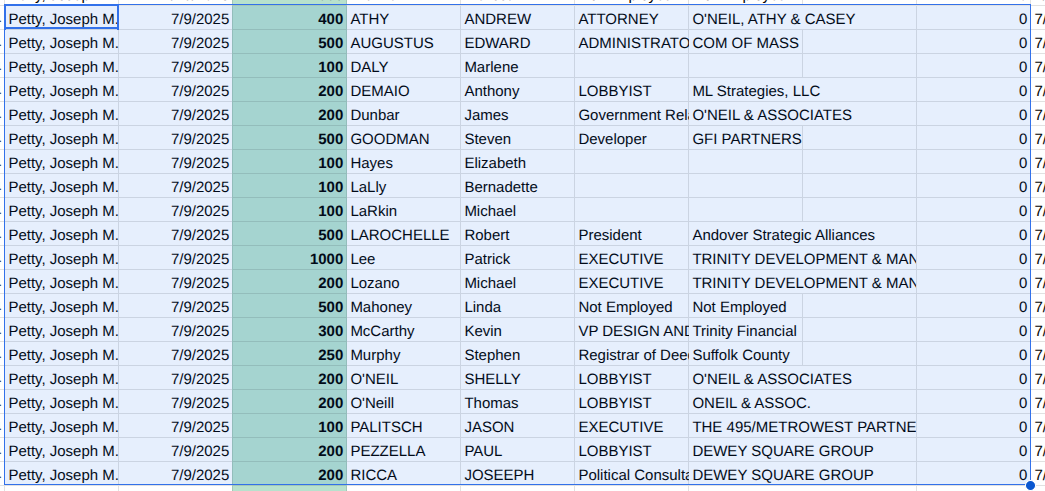
In which we see a run of attorneys, state bureaucrats (turned banking executives), lobbyists, developers, the financiers of lobbyists, the heads of public private development partnerships and their paid political consultants. This is a representative sample of Petty’s entire career. His bread, as they say, is buttered by the diffuse, blob-like consortium of “interested parties” we might call the “developer community.” The ML Strategies donation toward the top of the screenshot is a good point on which to extrapolate out, into the blob. The organization is a registered lobbyist in Massachusetts, and state records show it has done work on behalf of everyone’s favorite local company Charter Spectrum, as well as Trinity Financial (also in the above screenshot) and WinnCompanies, a large Boston area developer caught up in the Real Page rent fixing scandal that also just so happens—this is a crazy coincidence!—to employ former City Manager Mike O’Brien in its executive suite. The blob in action.
The blob stands to lose money if the state suddenly rediscovers its ability to intervene in the housing market on behalf of its struggling residents—something that hasn’t happened since before I was alive, or before someone who’s 10 years older than me was alive now that you mention it... The blob has done a very good job keeping its good friend the state hooked on a steady supply of free market fundamentalism. It is rightly worried that, should the state come down just once, and feel the clarity of sobriety, it might want to get clean. Another way to think of it is they’re acting like Wormtongue when Gandalf shows up.
Pick your metaphor, but expect the media market to be awash in this powerful “free enterprise” narcotic. It will appear as much in the allegedly objective news stories and nightly spots as it will in the paid advertisements. It will all be, to a word, utter bullshit.
So here’s what Petty actually said in the anti-rent control campaign’s release…
“In the housing plan we laid out in 2025, we found that Worcester needs to create 12,000 new homes by 2033 to keep up with demand. In other places with rent control policies, it has been found to discourage the production of new homes. Worcester cannot afford any additional barriers to housing creation.”
His choice of “afford” here is particularly cynical or stupid depending on the credit you’re willing to give the man.
What Worcester can afford apparently has no consideration of what Worcester residents can afford… because 52 percent of Worcester renters can’t afford what they’re currently paying. They’re (we’re) considered cost burdened, that is: we spend more than 30 percent of our income on rent. Of that 52 percent, half are “extremely cost burdened,” meaning they spend more than half of their income on rent. I myself am rapidly on the way from burdened to extremely burdened. I’m sure there’s a good percentage of the people reading this in the same boat.
So what does “afford,” the way Joe uses it, even mean? The cynical answer is “as close to nothing as possible.” And that just so happens to be the recommendations made by the firm that put together this “housing production plan” that Petty and Batista treat as gospel.
The firm’s name is RKG Associates and on their website they advertise a range of housing-related consultancy work for the public and private sector alike. One particularly honest pitch reads:
RKG has conducted hundreds of residential market studies for communities across the country helping our clients identify their market potential and how best to position land and building assets to capture additional demand for residential and mixed use development.
Housing Production Plans are a state compliance document, and since every town needs one, they’re a source of steady work for the RKGs of the world. They are not the future-looking gospel of benevolent city planning that Petty and Batista make them out to be. They are a concession offered by the state to communities that want more power to reject affordable housing proposals under the 40b statute. (The most nauseating classism I’ve ever seen was in my time covering Ashland and Holliston for the MetroWest Daily News, observing the way “40b” was cast in their localized discourse to a position of obvious villainy—that which will obviously destroy the town.) The housing production plan, if submitted and certified by the state, grants the municipality more power to say no to development proposals. That is the reason why the “housing production plan” exists. It’s like how developers don’t have to actually build affordable units if they just kick some money into the city’s housing trust fund. The plan has to show they’ve got 10 percent of their housing stock falling under the loose definition of “affordable” set by HUD, or else they have to prove they’re trying.
In a city like Worcester, where more than 10 percent of the stock already organically meets the criteria of affordable, the housing production plan is a redundant measure of bureaucratic compliance. So why do Petty and Batista elevate it so much in their rhetoric? Perhaps they do so on the bet that no one who’s not already in on the game will bother to look into what a housing production plan actually is, they just hear it and check out.
Perhaps they do that because they had the thing drafted by the real estate lobby for the real estate community. The firm advertises that their housing production plans go the extra mile: where the state is only looking for baseline information on affordable stock, they throw in a supply and demand analysis. Pay attention to the “as well as” clause in this next bit of advertising literature.
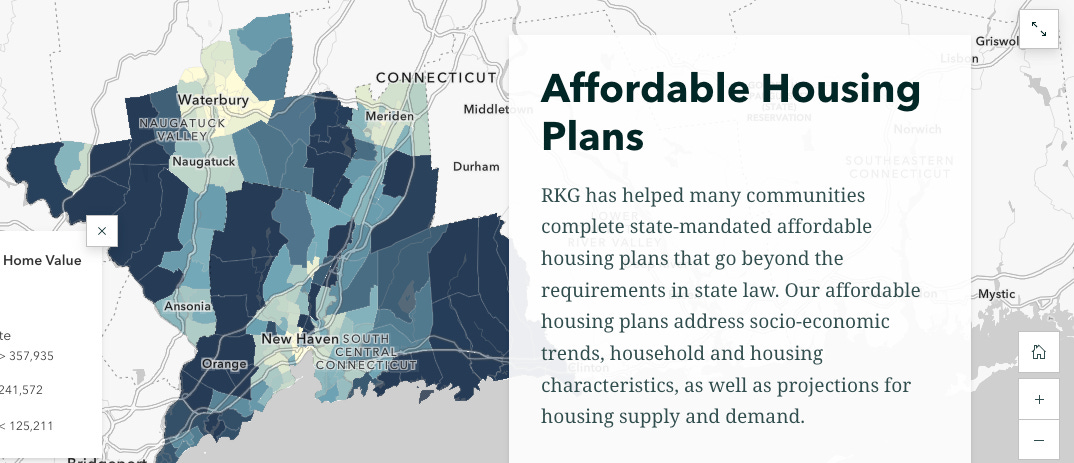
When Petty said Worcester “needs” to meet this goal and “cannot afford” not to, he is harkening back to this special add on—what amounts to a real estate industry brief slapped onto an otherwise dry compliance document that lawyerly types use to protect their gated communities in lawyerly fashion.
That the brief is then used by local officials as a cudgel against any attempt to intervene in the market on behalf of renters is, you have to imagine, part of the appeal. It takes an inherently Reaganist trickle down argument and wraps it in the veneer of responsible stewardship. It isn’t naked deregulation for the benefit of a rentier class, it’s following the plan. Because the consultant goes unmentioned, the presence of the rentier class is obscured in the public facing premise of the “housing production plan” city officials are offering. Instead, it’s implied the document is a product of local government in action—a strategy democratically arrived at that holds the citizens of the city as its prime concern. But it just isn’t. And these city officials, either already rentiers themselves or on their way there, (look at where Augustus and O’Brien landed), know that. At least they should know that. And so there’s Joe in the Globe, talking about the housing production plan and how Worcester can’t “afford” to get in the way of it, and he either knows that he’s lying or he’s regurgitating the lie he’s been told. Doesn’t much matter which one. The result is the same.
For further reading, some good responses from the Worcester Affordable Housing Coalition, Councilor Khrystian King, past and hopefully future council candidate Keith Linhares.
Odds and ends
That’s all I had for ya today. Like I said up top, please consider supporting this outlet we need just a few people stepping up to contribute to keep me from freaking out.
Good stuff from This Week In Worcester: “The Worcester City Council Circles the Drain; Pt. 1”
Good story on working at a tax center over at Flaming Hydra.
Kate Wagner on the defining architecture of the Trump Admin being warehouses converted to ICE detention is the best thing I’ve read in a while.
Gotta hand it to the Strokes too.
I did my taxes last week sorta (extension) and was trying to get to Direct File for a bit until I learned on deadline day that doesn’t exist anymore because of course. So I’m scrambling trying to figure out how to put in for an extension—I’ve got like maybe 15 minutes on the clock—and the IRS website is sending me through two different equally sketchy third party verification services, which I rushed through because of the time constraints and my brain’s inability to focus on bureaucratic form filling
So there I was punching in my information to two scam-like entities with absurd security protocols, keeping me stuck in a frustrating loop of captchas and two factor verification tab flipping—phone email webpage phone email—and it all felt so dumb and cruel and stupid and difficult.
A few days later I got legit hacked for the first time in my life and lost $200 dollars off someone who was able to get into my Amazon and my Paypal and order themselves a couple gift cards. And then to settle that, back I went into the frustrating loop of captchas and two factor verification tab flipping this time with the bank and the payment services—phone email webpage phone email—and it all felt so dumb and cruel and stupid and difficult. And I still don’t know if I’m getting any of that money back.
Rocko’s Modern Life, baby.
On the most recent Outdoor Cats we covered a wide range of recent news topics I didn’t hit on today so make sure you catch up on that before getting mad at me for missing something or other.
Episode 61: Say Hello To My Little Friend

Catching up on our little police city-state hiding in plain sight: the annual salary reveal, Fresolo does townie direct action, Dive Bar to Cop Bar via a Brady Lister turned entrepreneur from Framingham who definitely didn’t get caught doing a Scarface. We’d never baselessly allege something like that…
We’ll have some pretty major Outdoor Cats news but in a few days probably it’s not quite ready yet but stay tuned!
Lastly S.G. Goodman put out a Butthole Surfers cover and it freakin rocks.
Ok talk soon!
Dare I comment on the macro picture? Income inequality affects most. And folks who can pay the rent or mortgage typically don't care about others financial difficulties. It will get worse.
Worcester politics is just a side show. The development class, trading favors and connections under the direction of our unelected mayor, continue to carry the day. It will get worse.
Thanks for keeping us posted, Bill. And thanks for the Officer Dingman episode. Indeed, if Bobby Hill got pinched by Dingman, Hank would lose his shit. "No son of mine will be apprehended by a nitwit named Officer Dingman." Hey, did the thief just grab what he could, or did he make choices? If he just settled for the Snickers, would he be a free man today? Amyrrhica.
I share your frustration with how broken the housing system is. But your proposal for the state or city to build housing directly at scale needs to look at the math.
Look at the $97 million it took to redevelop Curtis Apartments, with an average cost of $750,000 per unit (and the state didn’t even need to buy the land). Lakeside Apartments cost more than $ 500,000; Residences on Lincoln Square providing affordable apartments for seniors is projected to cost over $600,000 per unit.
At those costs, even with financing spread over decades, the rents required to fully carry those costs would be far above what most residents can afford. That gap has to be filled with an ongoing subsidy. That means higher taxes, reallocation of scarce public dollars, or both.
So while it’s fair to criticize outcomes, local governments can’t, on their own, change the underlying economics of construction or the incomes needed to support those costs. The levers that would shift that equation largely sit at the federal level.
Where cities and states do have real leverage is on the supply side: Reform zoning to allow more density where people want to live; streamline permitting and approvals to reduce time and cost; Revisit building requirements, including pausing elements of the stretch code; Remove barriers to manufactured and modular housing.
Those steps won’t solve everything, but they can meaningfully reduce costs and so increase supply. But we can’t pretend the math works for the state and its taxpayers when it doesn’t or that the state or city can fix what must be fixed at the national level.