

No time for niceties I need to get this out while tomorrow is still tomorrow otherwise I have to change a few words around and we can’t have that now can we?
News you can use today (tonight). Please subscribe.
And please show up to city hall 5:30 p.m. tomorrow (Tuesday) if you can! The city council meeting will be actually interesting for the first time in a while: the big promise made in the wake of the DOJ report has at long last been made an empty one. On Friday, City Manager Eric Batista announced that he’s not going to move forward with the civilian review board recommendation after all. It comes as no surprise and heads to a city council that would, at best, vote down a real civilian review board proposal by a 7-4 margin.
But that doesn’t mean it’s not infuriating. Just the opposite. This is a major moment in this city’s dramatic slide to the right since the DOJ report was released in December, 2024. A 38-page report explaining the decision stands as an intellectually insulting document, one that will surely be celebrated by the majority of the city council on Tuesday night. Because it’s intellectually insulting, mind you, not despite it being that way.
I’ve been an out-and-out doomer about our city government since the last election. But this is a meeting to show up for, to speak at, if only for the sake of letting these people know we see them. Understand what they’re doing. That they can’t just lie to us like this. That the recommendations in this report are not a suitable replacement. They’re nothing.
Toward that end, there’s a press conference happening at city hall tomorrow at 5:30 p.m., organized by a dozen or so community groups.
The council meeting starts at 6:00 p.m. (Here’s the agenda.) It’d be nice to see you there! Ideally at both.
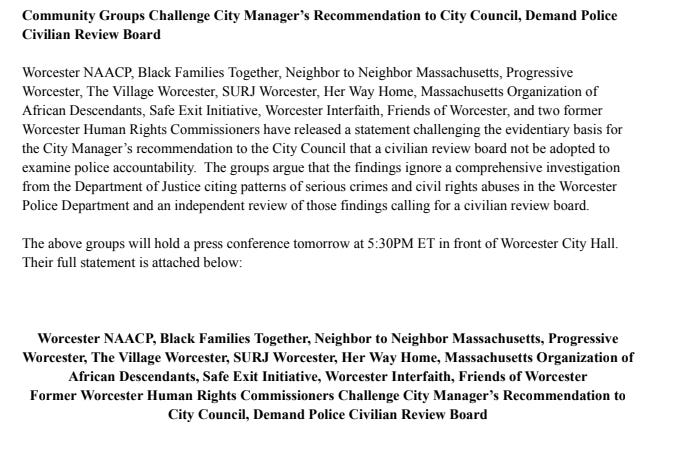
You can read the statement in full here.
Here’s my favorite part.
The City Manager’s decision ignores the mountains of advice and evidence as well as the lived reality of his constituents. His suggestion—that body-worn cameras and a diversity officer can solve the deeply rooted problems identified by the DOJ and the report he himself commissioned—is void of all reason. By ignoring the evidence and refusing to recommend a civilian review board, the city manager has effectively said that he is willing to shield a small minority of bad cops from accountability.
That right there is exactly what he’s effectively said! The only question left is whether he won’t hold the cops accountable or he can’t. It’s about the last question you’re bound to hear answered, at least honestly. It’s in the best interest of the manager, the chief of police and the police unions, in different yet complementary ways, to have the real contours of the power dynamic remain hidden from view. But an interesting thought experiment: is the alternate timeline Batista, who does in this moment what he said he’d do—presents a CRB proposal to the council, in accordance with the recommendations of both the Worcester Regional Research Bureau and the Human Rights Commission—is that Batista on his way to getting run off the third floor? Is he already gone?
Back when the DOJ report was released, in 2024 (approximately a decade ago) I started presenting the question of whether the police control the city. Reading this report over the weekend, reflecting back on the last two years, I think I can safely answer that question: yes. The Civilian Review Board proposal really died last November, when the police achieved (or, perhaps, restored?) a comfortably secure regulatory capture of the city council. The manager’s recommendation merely formalizes the position of absolute political fealty that comes with an eight-vote majority of councilors who are unambiguously, and, for the most part, proudly, beholden to the police unions.
In the report, Batista (and, Kevin Lovaincy, the city’s chief diversity officer and Batista’s appointed cabinet member, who technically gets the byline on the main document) spend a lot of time articulating things they’ve done in lieu of a civilian review board, and much less time articulating why they can’t or shouldn’t do a civilian review board as well. Both arguments are light on specifics, and throughout, the circular language of bureaucracy stands in the place where some concrete facts should be. For instance, “administrative costs” were cited as a reason a civilian review board can’t happen, but the report doesn’t include even a ballpark estimate, either by position numbers or annual budget. That it doesn’t include such information suggests they did not get far enough in the process to put together a few hypotheticals. If you’re arguing it’s too expensive, why not chuck a round number into the discourse?
Of all the insults in Batista’s withering explanation, the worst is its reliance on the Human Rights Commission as a suitable alternative to a civilian review board.
From the report:
Within Worcester’ s existing accountability framework, the HRC serves as an important avenue for community participation and engagement. One of HRC’ s foundational responsibilities includes oversight and review of issues involving WPD. Over time, this relationship has continued to develop through increased communication, collaboration, and structured opportunities for dialogue.
This is the same Human Rights Commission that Batista battled with and ultimately neutered for their insistence on doing police accountability work against his recommendation that they drop the subject. This is the same Human Rights Commission he appointed the Police Chaplain to after letting go two of its most talented and hard working members, in a transparent sop to the Thin Blue Line set.
Let’s play the hits: In November, 2023, Batista refused to provide the HRC with records they requested about incidents of officer misconduct. A month later, Batista pulled the catty move of skipping a planned meeting with the HRC after they voted to continue their police oversight work against his request that they stop.
In December, 2024, around the time the DOJ report was released, Batista refused to post HRC minutes with attached supporting documents for two meetings, which happened to take up the matter of police oversight. But in his report Friday, he wrote…
Additionally, HRC meetings are conducted in accordance with Massachusetts Open Meeting Law requirements, providing public access to meeting discussions and opportunities for public comment. This ensures that residents have the ability to observe these conversations, remain informed about accountability discussions, and provide feedback on issues affecting the community.
May 2025, Batista refused to reappoint then-chairperson Ellen Shemitz and Elizabeth O’Callahan, two of the commission’s members most doggedly pursuing its police oversight responsibility. As a replacement, he appointed Father Jonathan Slavinskas, the literal chaplain of the Worcester Police Department and a close friend, others have said, to Anthony Petrone, the police union official and shadow city councilor and also landlord of several 4-8 unit rental properties that may or may not have sprinkler systems.
This past March, Chairperson Guillermo Creamer Jr. announced he was stepping down. A few months earlier, Creamer brought the HRC to vote on recommending the city manager craft a proposal for a civilian review board. The vote passed 5-1. Creamer didn’t publicly say why he chose to step away.
In Batista’s report, he writes that the HRC “represents an existing mechanism for community participation and accountability by creating a structured opportunity for appointed community representatives to review information, ask questions, and engage directly with police leadership.”
Of course that’s what the HRC is in theory. But in practice? The only member who’d likely agree with him is Slavinskas.
For instance, a late breaking story from the Brad Petrishen over at the Telegram: One of the longest serving members of the Human Rights Commission, Jacqueline Yang, resigned today due to the manager’s decision.
“This is the straw that broke the camel’s back,” longtime Human Rights Commissioner Jacqueline Yang told the Telegram & Gazette, adding she’s been extremely frustrated since Batista last May declined to reappoint two members who’d pushed for police accountability.
Yang confirmed she resigned July 20, and used an expletive to describe any suggestion that the Human Rights Commission plays a serious role in police oversight.
Any guesses which expletive? Here’s mine.
Brad: Do you believe the HRC plays a serious role in police oversight?
Jacqueline: Fuck no.
I think we have the HRC pretty well covered. On to the WRRB.
Back in October, the Research Bureau put out the report, that Batista himself had requested, on civilian review boards. The organization’s findings were more definitive than usual. Headline? All caps. “OVERDUE FOR CIVILIAN OVERSIGHT” they wrote (I’m summarizing) not only is it imperative Worcester adopts a civilian review board, it’s weird that it hasn’t yet. It stands—and will stand, now, for god knows how long—as the only city in the area of any substantial size that lacks one.
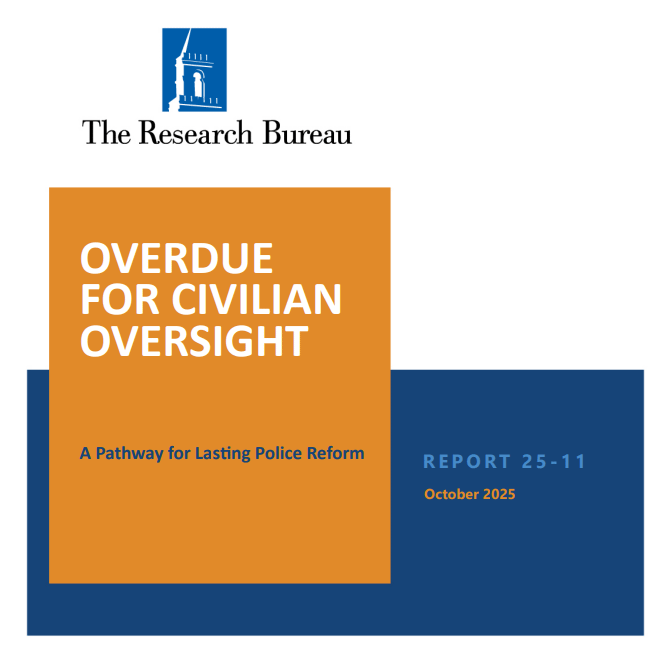
The second graf is unambiguous:
Today, Worcester stands as the 114th largest city in the United States and the second largest in New England, yet it remains one of the few major cities in the nation without a civilian review board or comparable oversight structure. More than half of the 200 largest U.S. cities have adopted such mechanisms, and within the region, Boston, Providence, Cambridge, Hartford, and New Haven all operate oversight entities. Worcester’s absence is striking in this context—and even more so in light of the December 2024 U.S. Department of Justice findings report, which identified systemic weaknesses in the city’s internal accountability systems.
It goes on to list 14 bare minimum requirements for such a board to be effective, including full powers to access data and subpoena for records, a sufficient and sustained budget, and a mandate for the police department to take some sort of action on its disciplinary recommendations.
So it’s jarring to read Batista write that the WRRB’s report was the “foundation” on which he built his report, about doing the exact opposite of what the WRRB recommended.
Batista’s report details at length an investigation process apparently in place in the Office of Diversity, Equity and Inclusion, wherein staff investigate complaints of discrimination alongside the police’s internal Bureau of Professional Services. But it’s carefully worded. While it details a dozen or so investigations the DEI office undertook from 2022-2025, it doesn’t make it clear whether these investigations yielded results that were any different from what BOPS would have administered. The investigations themselves can only ever end in recommendations to the police department, and there’s no formal mechanism compelling the police to listen. None of it occurs in public, nor is it reported out to a public entity. Right there, in that short summary, are at least five of the deficiencies the WRRB argued the city must solve.
In the introduction, Batista writes that the WRRB “provided valuable insights into strengthening transparency, accountability, and collaboration within the municipality’s oversight framework. In fact, the WRRB’ s findings serve as the foundation for the Executive Office of Diversity, Equity, and Inclusion’ s ( EODEI) own report.”
Tomorrow, we’ll get to see how the council reacts to this report. Expect a lot of lauding, a lot of talk about how the new chief has done such a good job, a lot of “that’s in the past now.” All of it will amount to a show of fealty.
See you at 5:30 p.m. sharp tomorrow!
That’s all for me today. More later in the week. Hopefully I’ll be sharing the essay on my recent jury duty experience in ‘ol Worcester District Court I was going to publish over the weekend, before Batista dropped the big news. It’s very related.
As always please consider supporting this outlet. It’s not an easy way to make a living, which feels at times like it’s by design. But politely asking for a little money every time I post has worked out well so for, so I’ll keep at it.
Oh one thing I forgot to mention: Also on the agenda tomorrow, Candy Mero-Carlson getting appointed to the Worcester Redevelopment Authority. Lol.
Good reporting in BINJ by man about town Chris Faraone about the way Boston hoovered up all the world cup money. Worcester’s mentioned a few times.
The initial February solicitation stated an intent to fund “up to five watch parties at no more than $400,000 each” in geographically diverse areas. In practice, the program funded at least nine separate watch party projects in round one alone (Easthampton, Everett, Greenfield, Worcester, Lowell, Burlington, Lexington, Weymouth, and the Haitian Community series). Instead of a few large grants, most were small allocations ranging from $10,000 to $120,000.
Keep on keepin’ on, folks. Oh, I’m going to see Twisted Teens at the Stone Church in Brattleboro on Wednesday. Beyond stoked. This track right here has a line that drops my jaw.
and every now and then i think about what tommy said
that we’re chained to the world, and we all gotta pull
Thanks for your reporting, Bill!
I was hardly surprised by the language the City Manager used to defend his decision in the T&G:
"“Put simply, the multilayered framework that the municipality has built to strengthen its oversight, transparency, and review mechanisms is working,” Batista wrote in his letter to councilors, listing a number of reforms including body cameras and increased equity office review of police."
The Human Rights Commission, as its title suggests, IS NOT a "multilayered framework". Therefore, without an effective HRC or a CRB, protecting human rights and getting to the truth of an issue will require confronting a strong, "multilayered framework" brought to bear on the citizenry. Perhaps a more rapid slide to the right, Bill.
And speaking of frameworks, thanks for mentioning Candy Mero-Carlson's assured appointment to the WRA. Let's not forget Kate Toomey's husband, Stephen Toomey, sits on the Planning Board. His seat expires 5-31-29.
I'm looking forward to a robust turnout by the opposition tonight. And although Joe, Kate and Moe will likely be offended by the lack of decorum, I hope they understand that the verbal rock throwing in their direction is because they neither care about nor represent the people they are supposed to serve.
"when the wire get cut" is a gas. Great riff. Great vocal.