

It’s been a little less than two weeks since the city council’s first meeting on the civilian review board proposal... or rather the un-proposal... “de-proposal” maybe?
If you’re coming in cold: The city manager said “nope, actually” to the civilian review board he pitched after the DOJ report in 2024 made problems in the police department more difficult to ignore. After two years of allegedly working on this, the manager came back with a rather terse report, at 30 some odd pages, which was heavy on repackaged information and light on details about this CRB model they allegedly thought long and hard about.
At that meeting last week, more than 100 people showed up to speak in favor of a civilian review board, the need for police accountability, and the longstanding issues with the WPD.
Since, there have been some very interesting developments. Lawsuit developments, the continued suppression of the HRC, despite the role the manager claims it plays vis-a-vis civilian review, a pressure campaign on Kate Toomey’s Standing Committee on Public Safety, an amazing George Russell quote—Worcester’s a little bit fun to report on again!
We’ll get to it all, but first I want to bring your attention to a few things. I’ve been hard at work since in the video editor, where I feel very much like a chimpanzee happening upon a Nintendo Switch, but I’ve got a playlist of about 20 of what I thought were the best public comments up on YouTube.
Such as my man Andrew Marsh right here, who yields back the balance of his time like no one I’ve ever seen, this clip being no exception.
And I whipped up a few quick-cut reels reels for the newsletter’s Instagram.
Part 1 — Emphasis on lawsuit costs ft. Giselle Rivera Flores, Janet Davis, Andrew Marsh, Roberto Diaz, Tom Marino
Part 2 — Emphasis on Eureka Street, ft. Sue Mailman, Etel Haxhiaj, Ashley Spring
Part 3 — Built around Jermoh Kamara’s white-hot testimony about the way the Ghanaian community is used for political purposes while their concerns are ignored. This is the one that really “took off,” which is great. “Many of you out here parade yourself in the Ghanaian community, in our African communities, in our Black community, thinking that you care,” she said, “but you don’t give a damn about these communities.”
Jermoh’s full comments are worth a watch if you ask me. Oh look at that they’re in a playlist readily available on the internet along with everyone else’s.
36 votes, man…
It took me a long ass time to get all that done and while it may not have been a newsletter post per se, it was very much part of the goal of this newsletter. I’ve found that video editing is at its core a form of writing, or can be treated as such, once you get past the layers and layers of additional technical considerations. You’re making the same decisions: what to keep, what to cut, how to arrange it for the reader’s (viewer’s) benefit. And reels “meet the people where they are” a whole lot better than these written posts do, unfortunately. The Instagram has more followers than the newsletter has subscribers, (we just hit 6,000 thanks in large part to Kelly Cashman, our poster-in-chief ~salute emoji~) and all three of the reels “did numbers” as they say.

Sheesh!
But Instagram does not pay the bills. So think of it this way: your subscription gave me the time and energy and mandate and platform to get clips of a lot of solid community members talking about the real problems of the WPD in front of 30,000 people and counting.
Since, there’s been a few updates:
—Details were released of the settlement the city reached with the 12 protesters the WPD brutalized in June, 2020, at the tail end of a BLM rally downtown, during which then-police chief Steven Sargent took a performative knee outside the courthouse. The city now owes those 12 individuals a lump sum of $825,000 in damages. The Telegram‘s Brad Petrishen—he’s been absolutely busting ass lately on this WPD stuff, much respect—got the details from Hector Pineiro, the attorney representing the demonstrators. Brad’s story is worth a read because right next to Pineiro saying, essentially, “yup this is a public document here ya go,” the city’s main spokesman is issuing a litany of excuses as to why the city can’t provide the settlement details.
Pineiro...
“For all intents and purposes, this case is over,” Hector E. Pineiro, the plaintiff’s lawyer, told the T&G July 22, saying that he, in addition to already receiving the funds, gave the city approval to file the final stipulation July 8.
...versus the city:
The city on July 20 told the T&G it would need an extra 15 days to “search for and review” the settlement agreement to fulfill a request the newspaper had filed under Public Records Law July 6.
The excuses are of the sort the city often employs when it has no standing to keep something from the public but wants to—like a candy apple, where the apple is the lie and the candy is the circular and purposefully vague lexicon of municipal governance and the stick used to twirl that apple around in the hot candy goo is a one-time local journalist who now makes much more money than he did and knows what he has to do to keep making all that money: he has to be a good sturdy stick.
—The police unions praised the manager for dropping the CRB proposal, per the Telegram.
“We’ve made a lot of changes,” Capt. Matthew Early, head of International Brotherhood of Police Officers Local 504, said, opining that the current level of oversight is already making it difficult to recruit and retain officers.
He also said he’s against a CRB because it could potentially “alienate” police officers. Snowflake aura.
Worcester’s favorite son Tommy Duffy II “deferred” to a New England Police Benevolent Association Facebook post he definitely didn’t write and doesn’t all read in his exact speaking cadences. It reads, in part, that the a CRB would “(inject) politics into policing while duplicating oversight that already exists.”
The most politically powerful man in the city, made that way because of his leadership role in the city’s king-making political institution, says we can’t have any politics in policing.
The sad part is he likely believes what he says... Like he’s not lying on purpose.
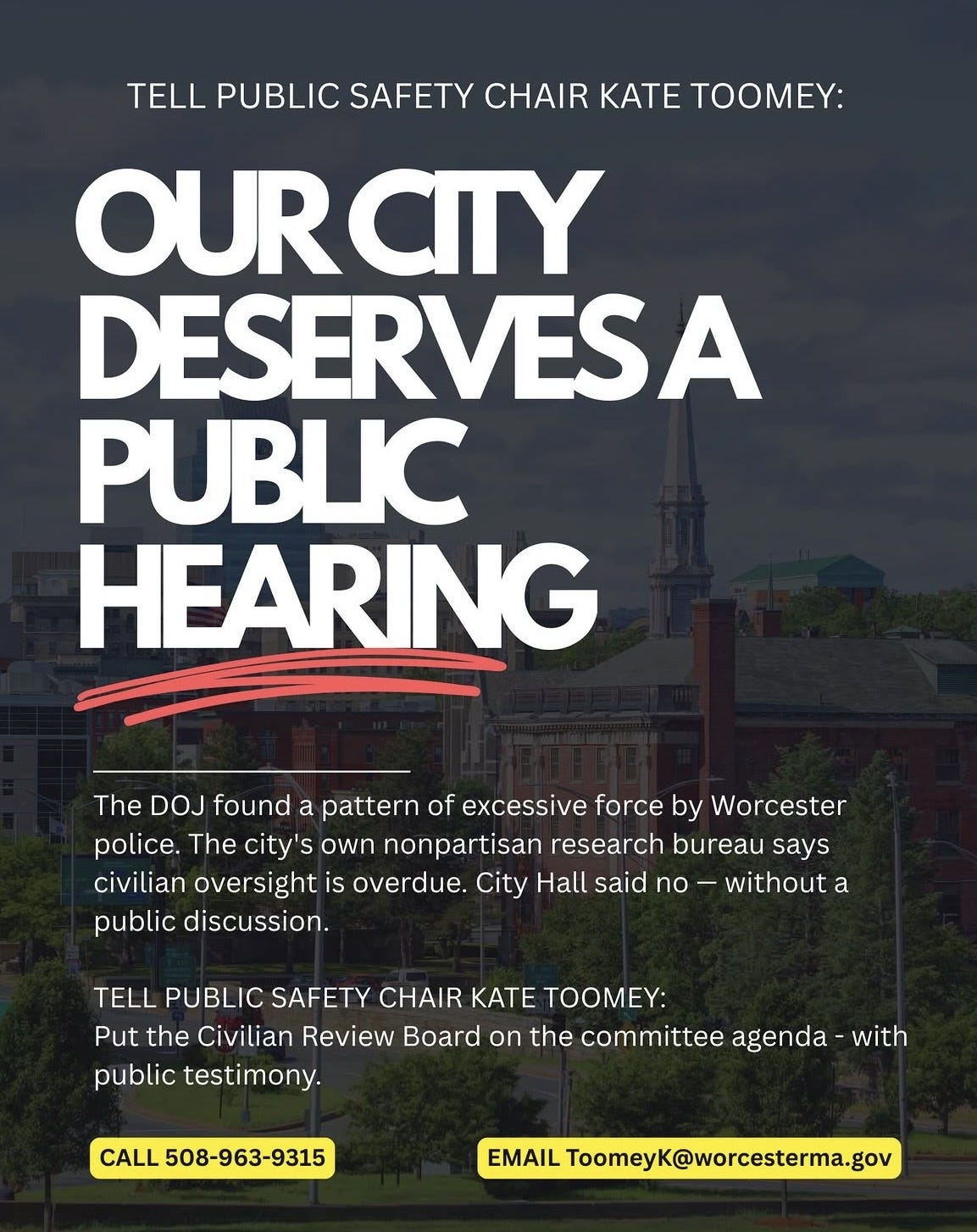
—Organizers have started a campaign to call Kate Toomey, chairwoman of the public safety subcommittee, to pressure her to put the CRB on an agenda—any agenda! So far, nada.
Fun fact: Toomey is personally named in a federal lawsuit filed in May by community organizer Gordon Davis, over a petition urging the police to look into systemic racism that Toomey tabled in 2024 and the city council has since left to collect dust. I pulled all the docs from PACER: Davis v. Toomey PACER docs
Way back in May of that year, Davis filed a petition that read...
“Whereas the Disparities in Arrests Report shows a disproportionate number of Black and Latino people arrested in Worcester. The police chief has said that this systemic racism harms Black and Latino people.
Whereas the statement by the Worcester Police Chief is evidence of a clear and present danger.
We ask the City Council to assign to the Public Safety Committee the task of investigating the issue of systemic racism and public safety. The investigation should include public hearings.
Toomey tried to file it but then-Councilor Thu Nguyen (miss you) pushed it to a vote, and the motion to file failed, 6-4. So Toomey squirmed for a bit, vaguely invoking the “inaccuracies” in Davis’ five-sentence petition before tabling it.
I wrote a whole subsection about it at the time in a post with the evergreen headline “A Town Full of Babies.”
Since Toomey tabled it, Davis’ order has appeared at the bottom of every single city council agenda, in the “tabled” section that the council under Mayor Joe Petty has used as a sort of public trash folder.
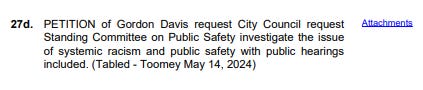
It appears, every meeting, next to orders that are often years old, like a 2019 item from then-councilor Konnie Lukes.
Toomey or any other councilor could at any time take it off the table and file it, thus ridding themselves of the burden of carrying it from agenda to agenda. But no one bothers— or perhaps dares?—to do that. So it stands as a sort of running metaphor: systemic racism is the item of business on every agenda that they can be relied upon to not address.
Davis’ lawsuit is one worth following. Will update when there’s an update.
For now, just something to call and/or text or email Kate about when hitting her up.
It’s truly one of the marquee ways Mayor Joe Petty demonstrates he’s dabbing on us, in the Matt Christmanian use of the term. Kate Toomey is an out-and-out police apologist, using what is probably the single most important (in theory) publicly elected seat for police accountability to cheer lead and claim valor.
—Speaking of Joe, last week he went on Talk of the Commonwealth and made it clear he’s a hard no on civilian review board, not that we were surprised.
“Passing something like that undermines everything the chief has done and his authority,” he said.
Then, a few days later, former District 3 City Council George Russell, Mr. Peppers and Onions himself, was on the radio, and he delivered a surprisingly accurate summary of the situation on the city council in this new term.
Host Hank Stolz framed the dynamic of the council as progressive versus centrist. Russell corrected him.
The only thing I would disagree with you, Hank, is that you refer to the council as a centrist. … But the bottom line is, is that they’re not centrist. This council is a very conservative council. It’s made a real move to the right.
And when I think of centrist, I think Sean Rose, I think of Joe Petty, I think of myself, that people that were able to take stands on liberal issues and on conservative issues both and be able to do it. I don’t I don’t see that in the majority of the council right now. Majority of the council right now is is more to the right and more more conservative.
You do, I think, have to hand it to him.
—On Monday night the Human Rights Commission met for an hour or so, and on display were many of the concerns former members expressed during public comment.
First, the meeting opened with the board’s staff liaison, Patricia LaFore, the city’s director of human rights and accessibility, actively suppressing a conversation about the civilian review board report. Chairman Randy Feldman came prepared with a letter he’d written about the matter and LaFore prevented him from sharing it.
Then they moved on to a discussion of the highest profile currently open lawsuit against WPD, the mental health response model lawsuit filed in March, concerning the fact that cops, untrained in mental health response techniques, are almost always the first and often the only responders to a mental health emergency.
Feldman walked through the fine points of the lawsuit in careful detail only to be bludgeoned by a know-nothing comment from Father Jonathan Slavinskas, the literal chaplain of the WPD and out-and-out cheerleader for police. Feldman ended his summary on the remarkable fact that WPD training includes just one course in the 20-week training regimen that deals with mental health emergencies, and that the 40 hours of mandatory online training a year, as proscribed by the state, has only one mental health course—on the wellness of the officers themselves. Less than 25 percent of Worcester officers have participated in the voluntary trainings on offer.
To which Slovinskas asked, “Is that something we should confirm with the Worcester police, just to make sure all those... that’s accurate?”
In the manager’s report, he described the HRC thusly:
Within Worcester’s existing accountability framework, the HRC serves as an important avenue for community participation and engagement. One of HRC’s foundational responsibilities includes oversight and review of issues involving WPD. Over time, this relationship has continued to develop through increased communication, collaboration, and structured opportunities for dialogue.
But at the meeting earlier this week, we saw city staff openly working to make sure none of that happens.
From there the HRC members tried to wrap their heads around the confusing way that city staff have constricted their ability to actually ask the WPD questions at the annual meeting coming up next month. Lafore made it clear that if they don’t provide the questions in writing and well in advance, the police won’t be answering them. Take this exchange, for instance…
Member Kerry Whiterell asked if the board really needed to draft and submit a formal list of questions.
“I was also under the impression that there was going to be, this was maybe going to be a little bit more conversational in nature and questions that we have were able to bring with us to the meeting. So I just wanted to clarify which questions need to be given in advance and which are things that we can bring to the meeting because I’m certainly gonna have questions, but I was maybe not aware it was so formal.”
LaFore said you absolutely have to draft the questions.
We’re gonna go with the question responses categorically like we received last year and then update the data and that we anticipated there may be some discussion about that.
If there are other questions, she said, “I think it will be reasonable for us to present them as soon as we can for them to prepare to answer questions when they come here in August.”
Feldman tried to soften LaFore’s response.
“I would say reasonable but not required.”
But LaFore immediately resharpened it.
“I don’t think you’ll have much conversation if they don’t have fair notice of what the discussion’s gonna be.”
Translation: There will be no going off script.
Public appearances from the police are often conflated with the police being transparent. The above moment is a glimpse into how most if not all of the public appearances are tightly choreographed public relations stunts. The routine meetings with the public safety committee are a great example.
Which brings us nicely to our next news item....
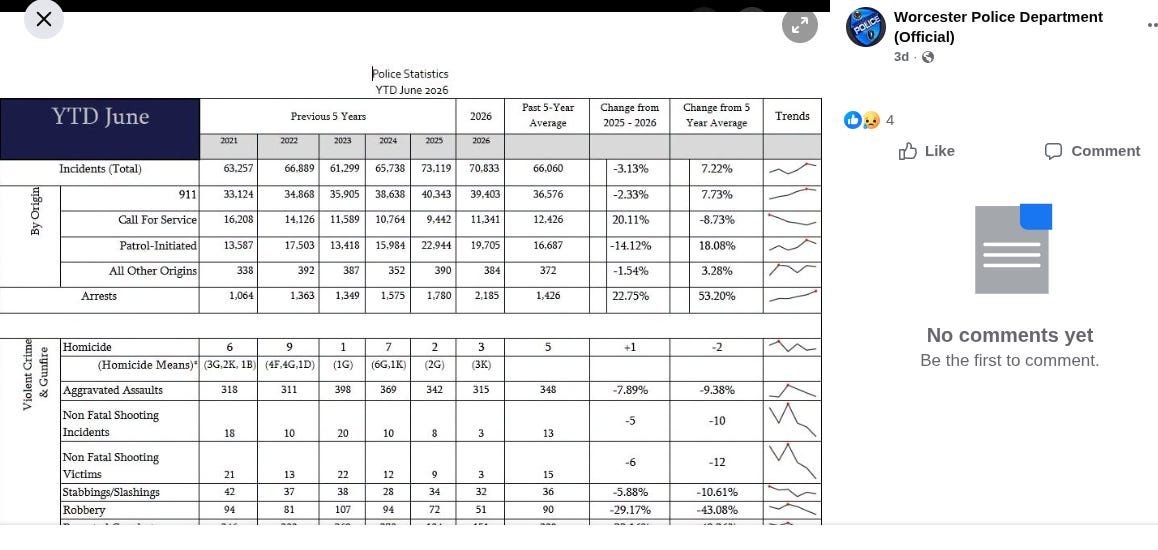
—The police released, sorta, some data on crime over the past six months, compared to the same time sample going back five years. The upshot: arrests are up, crime is down. Cue the “Home Improvement” confusion noise. Euuuurgh?!
Listen I’m no Einstein but arrests are for crime in a categorical sense. More arrests equals more crime not less crime. So let’s challenge that assumption by digging into this new cache of WPD data.
Curiously, the report wasn’t released at all, but rather teased out, I guess, on the department’s Facebook page. I couldn’t believe it... I dug through PrimeGov for a few minutes, finding nothing, then went back and reread the Telegram story linked above and yup... “according to (the department’s) Facebook page...” and it’s a post with a screenshot of an infographic, no text, and about 4 or 5 likes over three days, truly a lost post given the engagement on WPD posts about literally anything else.
I’d say this was an attempt to reclaim the narrative, but you’d think if that were the case they’d have tried just a little bit.
The data itself is indicative of a few things. It provides a snapshot of January to June going back five years, listing incidents by how they were initiated, and then violent crime and gunfire reports.
In the incidents section, we see a massive spike in both arrests and “patrol-initiated” incidents, meaning no one called in any public safety threat, the officer just took it upon themselves. 911 calls, the only tried and true way of gauging whether a civilian perceives there to have been a crime committed, are down over the five-year average, in line with the violent crime statistics reported in the second block of the infographic.
Per the dictates of Shotspotter’s “crime forecasting” AI tool, called Resource Router and other names rolled out by the company to make it harder to research and report on, officers are to make routine “community engagements” in the areas that the large language model synthesizing past crime data dictates they go on a given date and time. These “community engagements” are sometimes reported out over the scanner and, anecdotally, they tend to be ‘telling an unhoused person to get lost.’ When I hear “community engagement” on the scanner it’s accompanied, as a rule, by some “quality of life” the officer observed. Outdoor Cats co-host Chris Robarge has the scanner on more than I do, and he’s noticed it, too.
More often than not, an officer is going to “run names” on such an “engagement,” and if it pings back in the system that the person has a warrant out—most likely for missing a court date or a meeting with a parole officer or falling behind on court payments—then the officer racks up an easy arrest. Otherwise, disturbing the peace, disorderly conduct and trespassing are all right there on any given encounter with an unhoused person. Arresting them for these minor offenses all but guarantees a “failure to appear” warrant automatically issued by the district court clerk some time in the future. And so you have basically a perfect system for keeping the same small group of people cycling through the court system, bleeding them of whatever money, autonomy, or sobriety they can muster in the in-between.
It occurs to me at the moment that the vampire-thrall dynamic is a useful analogy here, but I’ll hold onto that one for another time.
The AI’s mandate to do street harassment under the guise of the pleasant-sounding “community engagement” policy, plus the newfound ability of anyone in the city with a smartphone to log a complaint about seeing a homeless person somewhere they’d personally rather not, anonymously, via the 311 app... something that happens on a near daily basis.... produces a situation where arrests can shoot up 50 percent while violent crime—i.e. the only real public safety threat under police purview—is down across the board.
I’m reminded of a new episode of Doom Scroll I listened to earlier this week with #1 GOAT marxist geographer David Harvey (”Right To The City” is my bible), wherein he says that throughout history technological advancements have all served in some way to discipline and diminish the power of labor.
The way 311 and SoundThinking’s surveillance products have exacerbated the homelessness crisis in subtle and plausibly deniable ways feels to me an extremely good piece of evidence to support Harvey’s claim. But who’s to say...
Worcester’s dip in violent crime is in keeping with the trend nationwide. This is a societal phenomenon. The behavior, good or bad, of the WPD has little bearing on it. But the “visible homelessness” problem in Worcester is something the police can very much take credit for. Left with little else to do, they have exacerbated the problem in their attempts to fix it by enforcing a defacto banishment ordinance.
That’s how the police department can produce this absurd dataset: crime is down, arrests are up.
The city council, when inevitably given the chance (likely within a month or two), will credit them for both. The lack of crime will be due to the brave men and women of the WPD “who are out there every day...” they’ll say, along with the other five or six phrases they cycle through, all of them safely meaningless. The arrests will be proof positive of their get-to-it-iveness. The unsheltered homelessness crisis unfolding before our eyes will be the failure of someone else, certainly not the police and the courts and the county jail. More than likely, they’ll blame “the towns.” Or, more accurately, that’s what they’ll say out loud. But in their heads and their hearts they’ll be sure of the real culprit and what should be done to them.
The next council meeting is set for August 18. Definitely mark your calendars as that’ll be another one worth showing up for and tuning into.
Also: the day before, on Monday, August 17, the municipal operations subcommittee is holding a hearing on charter review. That’ll be interesting.
Cursory search of the calendar shows nothing for the public safety subcommittee. Makes sense, given there are no notable public safety issues at the moment.
Odds and Ends
Thanks for reading! Pretty pleased with this one. Took a lot of work. Please consider chipping in so I and the rest of the team can keep this outlet running!
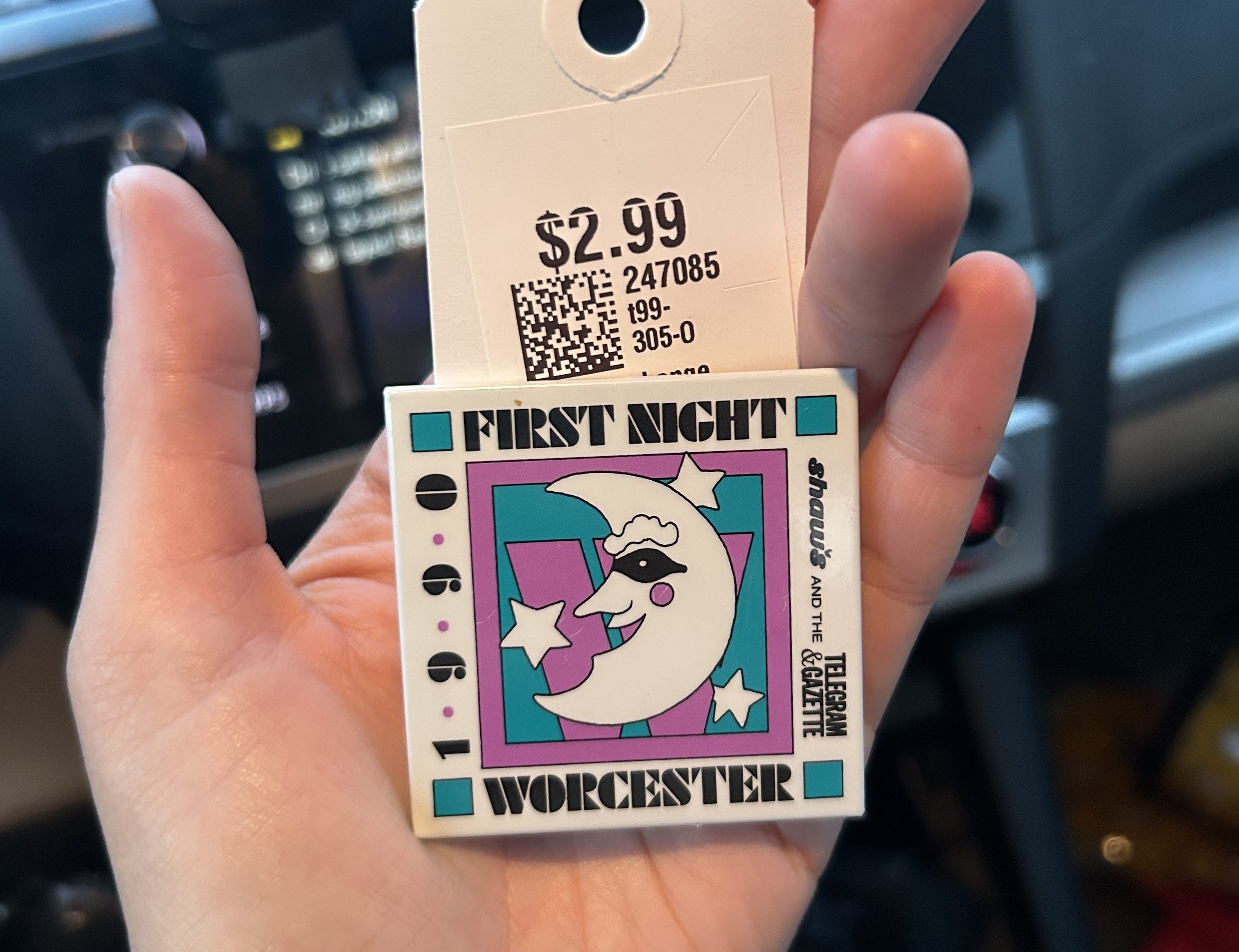
Look at this simply incredible find my friend Nessa pulled from the whatnots depths of the Lincoln Street Savers.
Excited to see The Shoestring and friend of the newsletter Andrew Quemere teaming up on a series called “The Brady Bunch,” about officers on the Northwest District Attorney’s “Brady list” — i.e. officers whose conduct has been such that their testimony is not allowed in court. The first edition is about a Granby cop who paid subordinates to do his homework. Lmao.
Records allege Granby cop sexually harassed women, paid subordinates to do his schoolwork
An outside investigation found that the former lieutenant, Gary Poehler, boosted his pay by obtaining two degrees after having police department employees write papers and take exams for him, records say.
In light of the investigation’s findings, the police department sustained an allegation of “conduct unbecoming” for “cheating in pursuit of academic degrees and receiving compensation for those degrees,” according to the Massachusetts Peace Officer Standards and Training Commission’s online disciplinary database. The department also sustained an allegation of a “non-minor policy violation,” finding that Poehler “abused his position as a lieutenant” by asking the employees to complete his schoolwork, the database says.
Once we get the Worcester DA’s Brady list—something they continue to deny even exists—we’ll have to do our own Brady bunch. That list remains the holy grail of Worcester reporting.
Funny one from Andrew Quemere. State police officer stealing a bobcat from a tree service he hired at his house in the exact town where this would happen, Palmer, MA.
Meanwhile in New York mamdani is going after bad landlords…
I pick up Worcester events coming up...
You love to see it!!
Good story in Playboy the other day: “What We Didn’t Learn from Vietnam” by Tom Bissell.
Good track:
Ok! That’s it. Talk soon!
Ratcheting up the rage, Bill! I've been encouraging folks to watch the YouTube clips of the speakers at the last council meeting. I agree that video has a place in your reporting.
As you mentioned on your recent podcast, the speakers at the council meeting were articulate and on point. Most squeezed in their prepared comments within the two minutes allotted.
Jermoh Kamara's comments were inspired. "Shame on all of you!" And we get Moe Bergman.
Worcester repulses.
Excellent piece. Thanks for. Digging into the arrests vs crime rate aspect.