

Bill here with a quick editor’s note: Proud to present this, the third edition of “Worcester Speaks” under the new and very capable ownership of Dani Killay! This interview, like all good interviews, operates on two levels: it spotlights the perspective of people with something to say, and it also probes at the big contextual questions in the background, in this case around what it means to be an artist in a community of artists, and the nature of that community’s relationship with the city it calls home. Great stuff! It’s all thanks to the paid subscribers that I’m able to keep building this outlet out, bringing more great writers “into the fold” to produce vital work about this city. If you’re a paid subscriber, thank you, and let the following piece from Dani serve as proof positive of money well invested! If you’re not, no better time than now.
The place is in a three-floor walk-up on Webster Street, and you find it by navigating a building that feels like it’s mapped for a video game, all industrial corridors and the smell of old machinery, until you reach a door that could open onto a “school of magic” (so says a sign taped to the wall) or nothing at all. Inside, there is a man who calls himself Hunchback for reasons that have to do with his spine and a keen sense for marketing, and a woman who goes by the Whiskey Witch because she used to sling whiskey and comes from a line of fortune tellers and belly dancers. There is art made from discarded paper and plastic and meat trays sterilized for block printing, a series called “Friendly Floats” that a thirteen-year-old fell in love with, and an upcoming exhibition by an octogenarian stroke survivor who painted himself back from the dead. There is a pride flag at the door, and a “no assholes” policy that functions as both ethos and business model. They stock zines in a punk shop on the east coast of Ireland and a market on the Lower East Side, because when Jess or Travis travel, they take their things and say, ‘hey, we’re doing this,’ and other places seem to want a window into whatever this is.
This is Worcester, Massachusetts, the second-largest city in New England, and people here can have a chip on their shoulder, myself included, about our place in the world because, as Travis says, you don’t walk through Providence or Hartford and question whether it’s a city. You do here. There was a television show about a woman trapped in this liminal space of a place, and they didn’t shoot a single frame of it in the actual city, but that didn’t matter because the idea of Worcester—the miserable Worcester, the Casey-Affleck-with-a-Dunkin’s-cup-full-of-regrets Worcester—had already solidified into myth. The other Worcester, the one where a group of artists got laid off and needed to make rent so they began a series of one-off markets called Punkcake and let it mutate through venues and pandemics and incarnations until it landed here, in this room where people discover the art in their city and in themselves—that Worcester is harder to find if you’re not looking, and easier to dismiss even if you are.
The people who run this place are transplants, a Worcester cardinal sin. Travis came from Connecticut with his reservations intact and bought a house here because he could afford more in Worcester than in Natick. Jess grew up fifty yards from the Worcester line, in Holden, which is close enough to claim adjacency but not quite membership. They talk about the city the way people talk about difficult mothers: we can say what we want about her, but if anyone else does, they’re dead. There is a crab-in-the-bucket mentality, they explain, the warring tribes of Scotland, the impulse to tear down anyone who starts to rise. Paradoxically, it’s the friction of resisting this death roll that creates the spark to move the work forward. Because when no one is doing something in Worcester, when there is a vacuum where a thing should be, it becomes your job to do it. You don’t wait for permission. You start in a parking lot.
I asked them about art in times that feel heavy, because this is the kind of question you ask now, in 2026, when everything carries the weight of everything else. Jess got weepy, which she does with a beautiful ease, and said that creating is a radical act of claiming yourself back, that when we don’t value creation we get into trouble, that looking at history, you notice who they arrest first–the artists, the people telling their truth. Travis said that if you don’t get the feelings out, what you think becomes what you are, and if you think you’re doomed, you’re doomed. He said you only need permission from yourself, which is a nice mantra, but the truth is that some people need more than permission. Some people need a room with a pride flag on the door and art made from trash and a college kid making zines next to an elder-queer’s show of Lewdy Nudies. Some people need to be told that the thing they made—the sketch, the comic strip, the collage—means they are an artist, too. Some people need a place where the stories they tell themselves about who they are can shift, just slightly, into something more than just merely survivable.
We tell ourselves stories in order to live, Joan Didion wrote, and these days it feels something like a warning. Perhaps the danger is in the stories we stop questioning, the myths we accept because they’re easier than the alternative. The myth of the miserable Worcester, the myth that artists should pay for shelf space and be grateful, the myth that this city is only ever almost something else. In the room on Webster Street, they are building a longer table instead of higher fences, and if you ask them why, they will tell you about noblesse oblige—those who can, should—and about a young trans kid who saved up and bought art for the first time, and about a bicycle repair tech who came in not knowing what to create but who left having made something, and how they keep coming back to collect and to make art. They will tell you that the point is to get the thing out there, to capture the culture before it disappears, to remind you that you are living in the good old days right now, even when it doesn’t feel that way. Even when it feels, specifically, like the opposite. This is Punkcake Alterno Art and the Hunchback Gallery where the collective built a home. This is Jess Curtin and Travis Duda and how their radical love for the art of being alive is punk as fuck and contagious as hell, and maybe couldn’t have happened in just this way any where but right here.
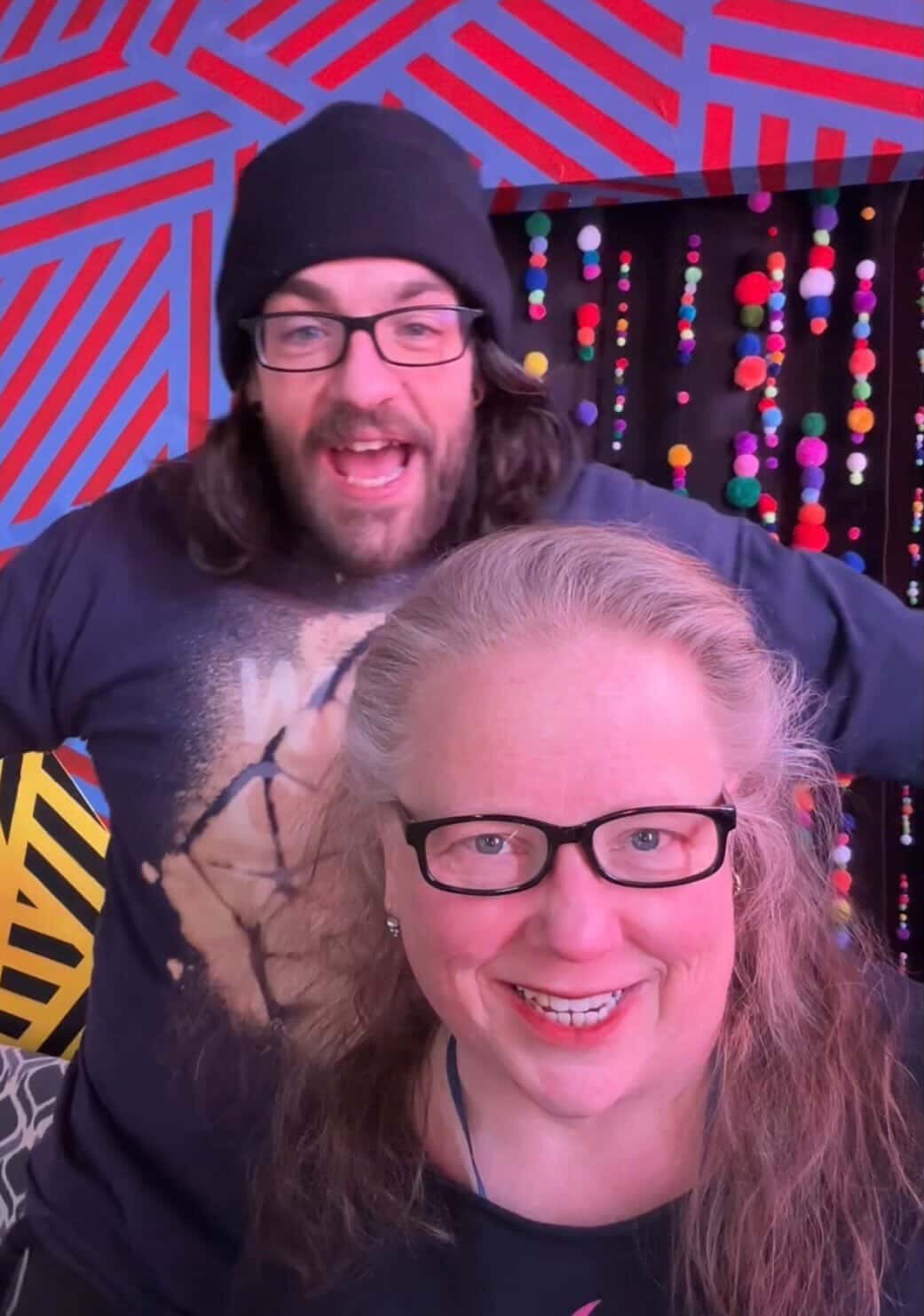
Dani: I live in Worcester now, but I am not by Worcester’s definition of Worcester. I’ve only been here for three years. I’m coming at this pretty fresh. I know both of you only from social media, so I’m here to learn everything I can in about an hour of your time. If you wouldn’t mind just tell me a little bit about yourself, your background?
Travis: So I, too, am not a lifer. I, too, am a transplant, and I’ll never be of Worcester. You are of Worcester.
Travis motions to Jess with a nod
Jess: Worcester adjacent. I’m of Holden, but, like, 50 yards from the Worcester line. Our house was the last house before you crossed over into Worcester.
Travis: So chronologically, I think this story starts with Jess.
Jess: Back in 1971. I’m from the town next door and I grew up in Holden, went to Wachusett [High School], basic 70s nerdy kid, had the Dorothy Hamill haircut and the whole nine yards.
Have you always been an artist?
Jess: I’ve always been creative. I come from a long line of, like, creatives and fortune tellers, belly dancers, burlesque on mom’s side. Dad’s side, very Swedish, hard workers. So there was sort of a mix there. But we had piano lessons growing up and we were always doodling. My mom just encouraged us to vignette everything. We’d go to the beach and it was, I think she just didn’t want us to annoy her, so she’d be like, okay, draw a box in the sand, this is your house, decorate it. I’m gonna come back in an hour and we’ll talk about what you’ve put in your house type thing, which is hilarious. We just sort of grew up having arts around us. My folks didn’t have a whole lot of money, but my mom was tied into every free event ever. Then I went to college for teaching. I’m a special ed teacher by trade.
Is that something that you still do now?
Jess: Now I teach teachers. The company in the clinic that I work for was bought out by a corporate education entity, which is kind of wild, but I still get to teach teachers and now Travis and I in the guise of Punkcake want to get art to people and make sure everybody has access to it… I can’t remember when we started, but Darcy Schwartz, who ran ArtReach in Worcester, had brought me on knowing that I was a special ed teacher, she had students with some rather specific needs. So I started teaching for her. Zines came up. We pulled in Travis, and Travis and I started working with a group of young individuals and just teaching them how to take the ideas that are so complex, so colorful in their heads and get it on paper. I was the writing person. Travis did a lot of the digital end and the art, the layout. Last week, we just spent a day at Worcester Academy, we ran two sessions of zines. So, yeah, art’s always been somewhere in my life. I think, you know, we took it for granted growing up, it was just something to be celebrated. It’s supposed to be there. I drive by people’s houses or I go into people’s houses where they don’t have art on the walls and I’m like, what happened here? Did someone steal your art? Why are there so many blank walls?
Travis: Not even posters.
Jess: I taught in Connecticut. I moved overseas for a number of years and then came back. Infiltrating a community as an adult is so hard so I started slinging whiskey. Who wants to talk to a special ed teacher who’s roaming around a building? But if you’re giving away free whiskey...So I have the moniker the Whiskey Witch, is what I go by sometimes with Madame Punkcake on the Punkcake side.
Travis: The Whiskey Witch turned into the Punkcake parking lot. She was hosting some of the original markets over at Ralph’s [Rock Diner], collecting a whole bunch of weird vendors, and then also pairing it with local punk bands, so you had live music with all these local makers.
That’s how Punkcake got started?
Jess: Essentially. Actually, the very first Punkcake had started because there was a lot of our artist friends working for a company that bought a machine and laid off a bunch of the artists, so they needed to make rent. And at the same time, my husband is a musician, and his bands were only playing in Boston, and there’s no fucking parking in Boston. So I was like, why can’t you just play out in Worcester? And he’s like, well, no one books us. So at that point in time Beatniks was down on Park Ave. I went in and said look I’m tired of driving to Boston, can I book a show here? And then a bunch of the artists that got laid off, I said okay we have the show and you guys can set up some tables so why don’t we do it? and we said what are we gonna call it? We’re gonna sell cupcakes and have punk music. The old George Carlin routine stuck in my head, like when you’re cleaning out your fridge you find a lump could be meat could be cake it’s meatcake and so we kind of riffed on that. We got some punk. We got some cupcakes. We got Punkcake. And that’s how it started. It was supposed to be a one-and-done to just to kind of help everybody, and 13 years down the road, here we are. It’s been a number of different iterations. We got too big for Beatniks, moved over to Fiddler’s Green, the Hibernian Center, which was great. We had a ton of people. But we had to charge a fee that made vending not accessible to everybody who needed to vend. Ralph’s let us take over their flea markets one Sunday a month. Then we were able to be like, all right, throw us 10 bucks so we can give the bands gas money. And our friends with bands were really great. And they’re like, yeah, yeah, we see what you’re trying to do. Just cover our gas and maybe get us a beer. We did that for a long time. We did that until the pandemic. And then the pandemic, we shifted a little bit. We tried to do a couple of things online. Travis and I, at that point, were teaching for ArtReach, and we slowly started to move more into the realm of education and art. And also at that point, other markets started to pop up, which is awesome.
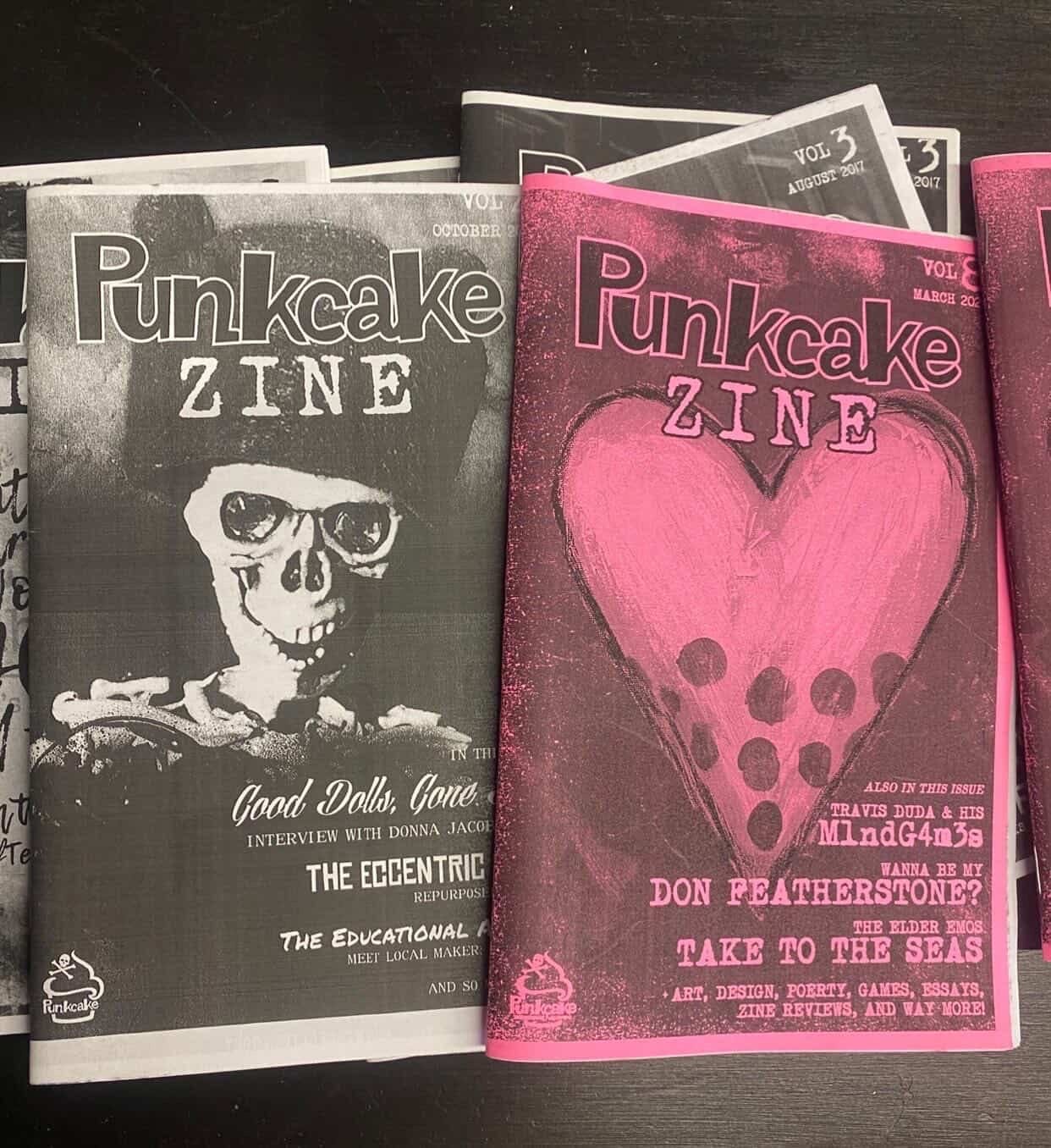
Travis: I’m a transplant, and I found my way to Worcester kind of inadvertently. I had my reservations about the city, which I’m on record. I got cars broken into when I was visiting here from Connecticut when I was younger. So I never thought Worcester was going to be my place. And at the time, I was getting married and my ex-wife and I bought a house here because we could afford more in Worcester than we could anywhere else. So, I found my way to Worcester. I’ve kind of been entrepreneurial my whole life. I knew I didn’t want to have a normal life. I was working for a civil engineering company as a graphic designer supporting a staff. That was killing me, because during my nights I was designing stuff for bands. I come from a music background. I used to play in bands. I used to print t-shirts. I just, I loved that mentality. I got really into comic books and I started deciding that I was gonna write comic books and then my business partner and I did Boston Comic-Con 2014, maybe 2015, and up walked this lovely lady and her husband attracted to one of our things at our booth. We just start shooting the shit. We instantly connect. It becomes oh my god. You’re in Worcester? I’m in Worcester! We should hang out. I went to Punkcake and realized this is that community I’m looking for. It’s a lot full of weirdos. I feel at home. And then because I had that comic book background and digital layout background and just had a growing interest in zines, we were like, we could make a Punkcake zine. So back then we did a few issues kind of cataloging everybody that’s around us, who’s doing cool stuff, no real plan, just seeing what came together. And then, when lockdown happened, we’re like, we have all this energy. Jess, you positioned it very cool. Kids in the future are going to need actual references. And so we need to catalog our experience because at some point, someone is going to need to research this and your first-hand experience is going to be valuable to that person doing that research.
Jess: So it’s a group of middle school individuals. We were seeing them online and basically asking them to keep quarantine diaries and it could be comics, it could be just drawings, it could be pulling stuff off the internet so it could be remembered. We told them you might be somebody’s primary source.
We never think of ourselves as the sources of history, but I’m sure Samuel Pepys didn’t either and we’re reading his diary three centuries later.
Travis: And that was an inspiring moment for them. So we put together a couple of quarantines and that was a way to stay unified through that awful time. And then even then that proved to be real arduous for what we were trying to do. Jess and I would talk about trying to do different things, but nothing seemed to sit right. Fast forward a couple more years, you’ve got the Merch Witch stuff going, I’ve been focusing on the design company that I run, and then I’ve had this growing interest in a gallery. I’ve had this growing interest of providing a space for local creatives to show their wares, sell their wares. Long story short, put more money in artists’ pockets that avoid some of the other players in the city like to take the money from the artists. Like they’re making money off the artists so that the artists can make scraps. And that to me is fine for those people, but not necessarily the way I want to live my life, nor is it the only way money can be made.
An anti-capitalist art gallery?
Travis: I think that’s what balances the space out. I have a good sense of the community we’re serving. We don’t want it to be too serious because some of those folks with those anxieties won’t come in if it’s too organized or whatever. So the point is to just stay open and welcome, and that’s to me what Punkcake is. And so when this space became available, I realized it was more than the design company could handle. Jess and I had been talking about what’s next for a while, and this kind of presented itself as an obvious what’s next.
And Hunchback Gallery is born?
Travis: Two years ago this month.
It’s a beautiful space.
Travis: I got a lot of help.
Jess: There was definitely a community thing. But you really are the driving force of this, but when people walk in, there’s a gasp, like there’s an audible (Jess mimes the breathless awe you feel coming through the door), and it’s not so much shock as, it’s almost like a piece of themselves that they didn’t even know was missing.
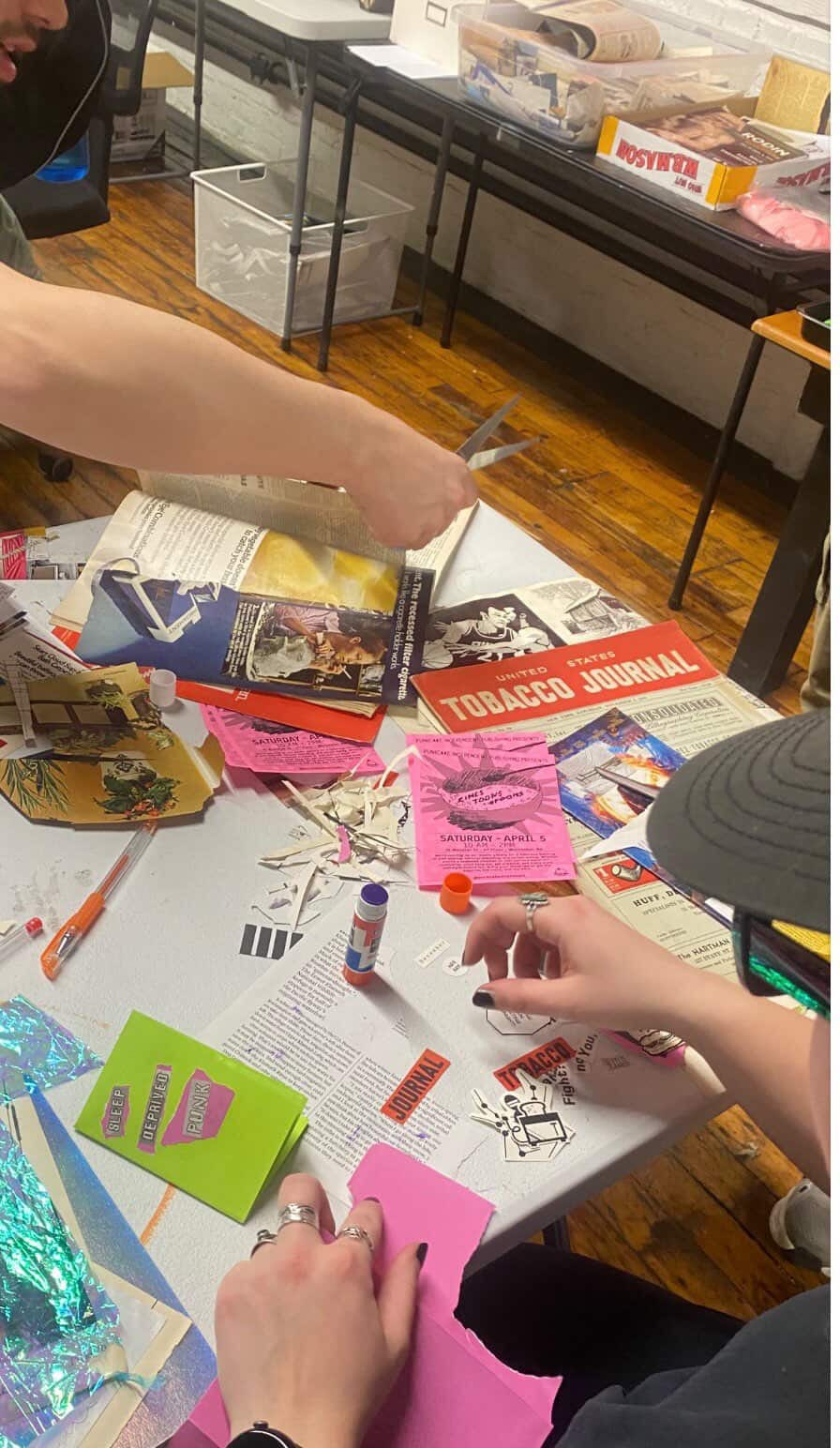
Travis: So to activate the space and to provide more community opportunities, the zine program kind of made sense to come back. Once a month we are putting out tables and just inviting folks to come down and work out your feelings. Come just hang, bring your own project. Just opportunities to provide community as a place. We have a cool clubhouse, let’s fucking use it. And not charge people because the idea of a second space is becoming so hard to find. And a place where you can go and not have to pay to exist is just not very prevalent these days. There’s lots of different ways to make money in the world and it’s never been my intention to make my millions off my friends. Money can’t buy happiness. We all see how pissed off Elon Musk is.
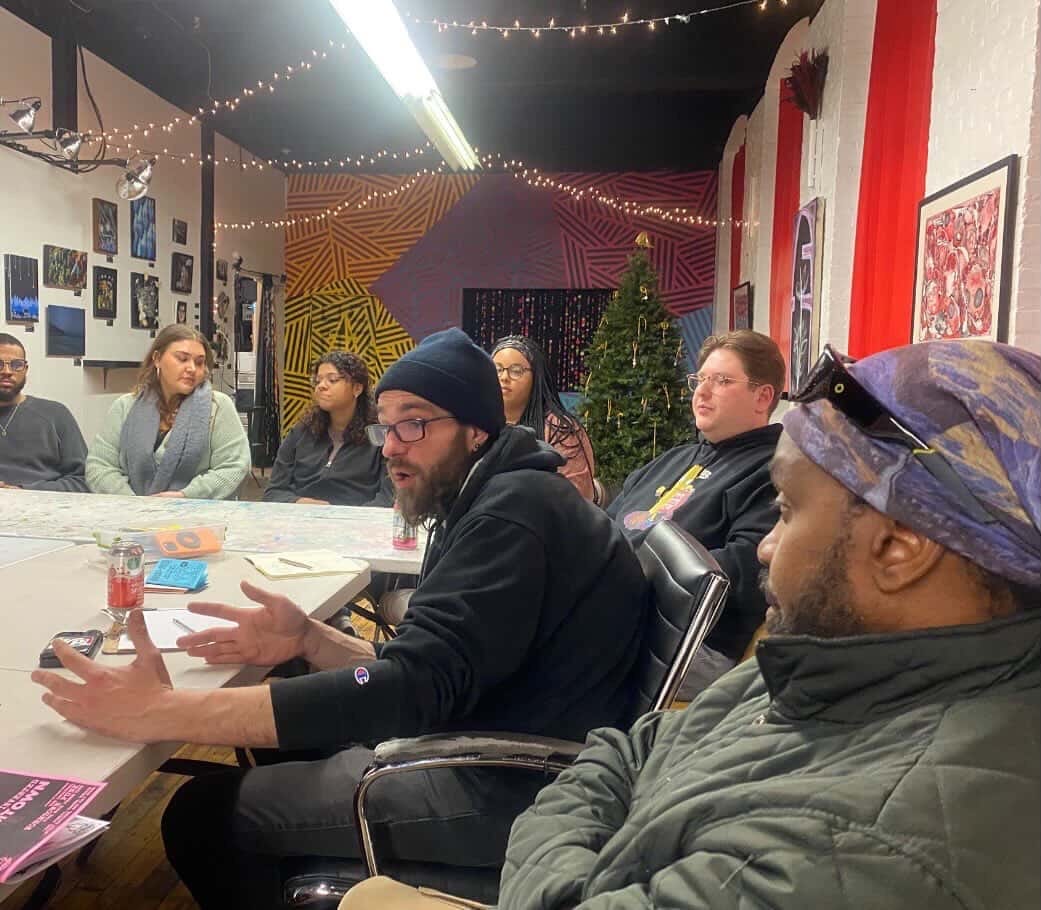
So there are things that you can show value as long as everybody gets their piece of the pie. And that to me is essentially what this is, right? I’ve worked my tail off to get myself and my organization to a point where I can offer something. I could have built bigger fences. What the fuck is the point of that? I built the longer table because with more people here to share the load, now that’s more people buying into the greater mission. That’s more people seeing themselves in this organization, whatever variation it is. And that’s how we’re all going to get farther.
And then to me, I have a background in Worcester now and some community art organizations and the local mural festival I was a part of, those to me were all tapping at what that sense of community is. But my opinion of Worcester really is like, we are the second largest city in New England, right? People love to fucking tout that. We don’t walk through Providence or Hartford and question whether or not it’s a city. You do here. So we have this chip on our shoulder where we think we’re something better and we try to steal ideas from other people. Truly we are our own fucking sense of weird. So just to kind of trail back to what we were talking about when you walked into here. One of the greatest compliments that I can hear, and I hear it every now and again, is “oh, this is like old Worcester”. Yeah, and I’m like, oh fuck, I wasn’t here for that.
It almost feels to me like there are two split Worcesters. Because the Worcester that I see other people seeing–the nothing on the way to Boston or the Berkshires– I’m like, I don’t see that. I came to Worcester. I found punk rock. I found community. I found people coming together, building things. The stereotype of Worcester is the miserable lifer, huffing butts and ain’t everything just a piss. There was a whole television show about a gal being trapped in this miserable city of Worcester. That is not the Worcester that I know. But it is the idea of Worcester that a lot of people here cling to in spite of themselves. And it befuddles me that we have a deep, amazing punk root in this city that The Establishment of it doesn’t want to embrace, because when cities do embrace that, they bloom and grow. Good things come to them. Thriving communities of artists and thinkers and entrepreneurs come to them. So like what do you think it is about Worcester that keeps that thinking in play. What is holding us back?
Travis: We are big enough where you can go outside and not know all your neighbors, but we’re small enough that you can see the impact of your work. So if you have something in mind that you want to do, all you really need is permission from yourself, and you can go fucking do it. Start on the streets, start in a parking lot. So like, Punkcake started and grew. I think that’s one of the powers of this place.
Jess: Yeah, I think the media is so fond of saying, we’re almost like Boston. We’re almost like this. And I can remember, Travis, it was like two summers ago, somebody did a big article on traveling from Boston, like the group that travels from Boston or Manhattan out to Tanglewood, and we need to give them better reasons to stop in Worcester. And our whole group was like, fuck you. We’re not Boston. We’re not Tanglewood. And we have so many varied communities inside Worcester, but there are some communities in Worcester that want to be a Boston. They want to be the culture stop between Manhattan and Tanglewood. Okay, well, I mean, you can’t shape all of Worcester. We’re freaking huge, and we’re weird, and we’re glorious, but in ways that make us our own, and Worcester has never wanted to embrace its own grittiness in a celebratory way. It’s always been all “oh, Worcester sucks, Worcester blows, I’m trapped here.” And that’s a story that outsiders tell and then people inside believe it and get mad instead of really just throwing up your middles.
Travis: It’s like your mom, right? You can say shit about your own mom, she’s your mom, but if anybody else talks shit about your mom, they’re fucking dead.
Jess: We were somewhere in Boston and Sean Connelly was opening one of Lenny Lashley’s shows, maybe. And he said something like, oh yeah, I’m from Worcester. I know. And people were like, boo. And I’m in the back like, fuck you. But that’s people, as soon as they hear Worcester vs Boston.
Travis: All of that shit together, I think that makes us who we are, and that’s that chip on the shoulder I was describing. You once described Worcester as the warring tribes of Scotland, and I think that is extremely true.
Jess: Everybody, it’s like the tribes in Scotland, everybody wanted freedom, but the clans wouldn’t work together to achieve it. And everybody in Worcester wants to elevate Worcester.
But then we hold ourselves back. Like why can’t we get our shit together?
Travis: You get a crab in a bucket mentality where as soon as you start rising, people that didn’t get what you got. (Travis reaches upward and brings back down a potentially successful imaginary crab) That’s one of the secret sauces of this place, is that I’m trying to be a unifier. Punkcake to me is a unifier. We have hip-hop kids in the city. We have smart tech kids in the city. We have punks. Like you said, there’s two Worcesters and I think that’s true. I think there’s actually way more than that. I used to feel extremely similarly to you, where I had my rose colored glasses on and everything was beautiful. And now I’ve been here 15 ish years and like, I still love this city. I’ve never felt connected to a place like I feel with Worcester, Massachusetts, but now I’ve earned my “Worcester Sucks” in a lot of ways.
She’s let you down as much as she’s lifted you up?
Travis: But in some regard that’s an earned feeling. I feel that way because I care about it so much and because I see the potential and I see that community that is here.
Jess: You’ve also done the work. There’s that too. And I think there’s a lot of folks who don’t necessarily do the work. They stay with one view of Worcester or one line about Worcester. Whereas, I feel like our crew, we’re so good at hopping in and out of different communities. We have folks who are jumping in and out of different communities, and then there are folks in Worcester who stay in their one lane. It’s a terrible analogy, but It’s very New England all around though.
Travis: But it’s also in that New England sensibility where, like if you pop your tire out west, people will stop and they’ll feel so sorry for you, but you’re changing your tire by yourself. Out here, they’re going to stop–
They’ll change your tire while they call you a cunt for getting a flat tire?
Travis: They’re going to berate you. They’re going to call you an idiot but your changing your tire together. I think that, to me, is the truest sensibility, where we’re all real rough. We have to survive this winter shit, and we have to do it with some regard of a smile on our face. So to kind of tie into what we’re doing now, we brought back the zine, and then it stalled again. We were doing our zine nights, and that felt good, but it needed more structure, it needed more purpose. So all of this shit is now kind of coalescing…Punkcake Zine can provide an opportunity to be that independent, creative magazine, that rag that Worcester Magazine used to be and Pulse never really was, but there’s just nobody covering the culture.
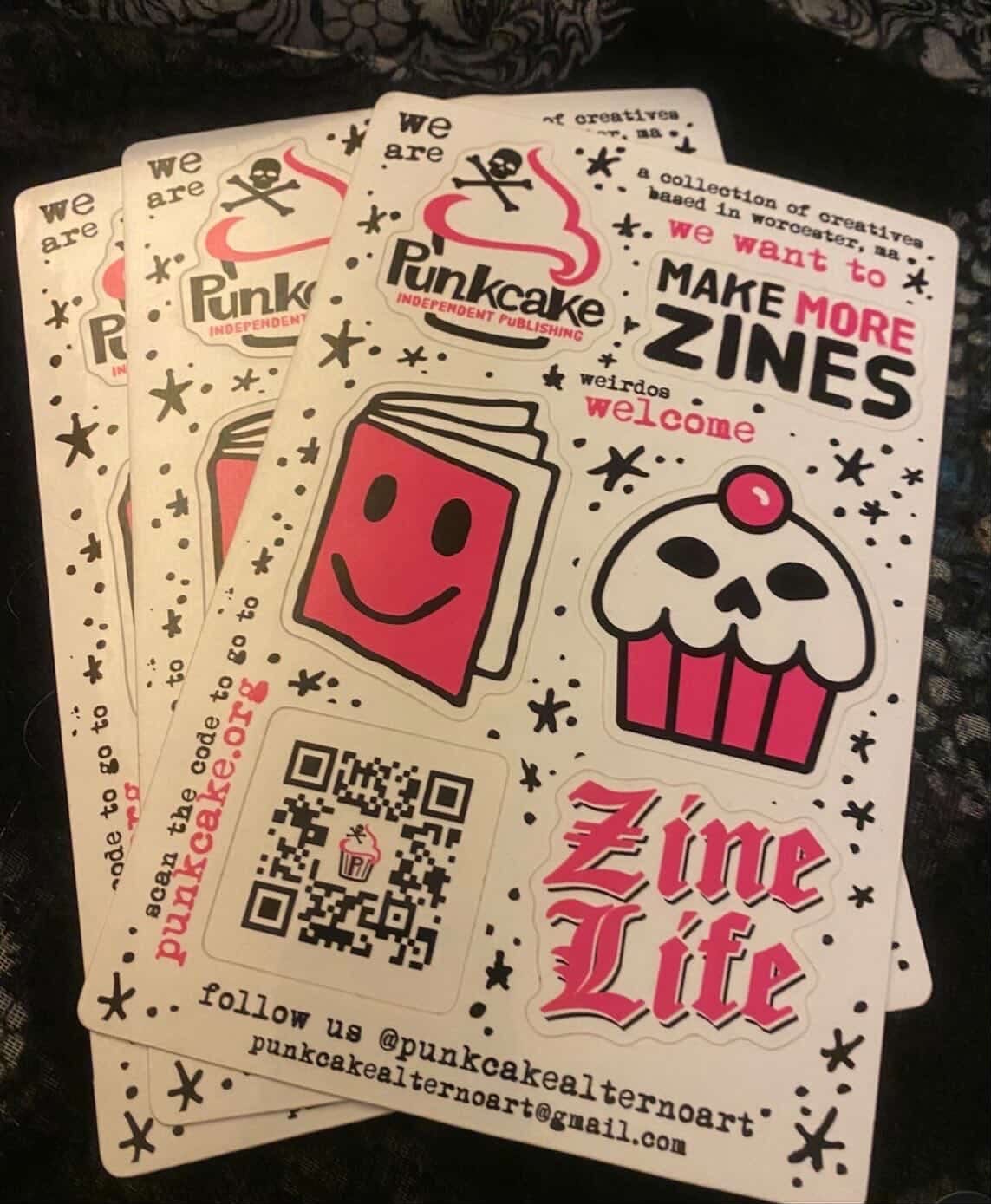
The papers that you’d pick up outside the club, the big square papers, like LA Weekly, Phoenix? That all seems to be disappearing…
Travis: We have, so we have Happiness Pony, but I don’t know how frequently they’re producing. No, there aren’t a ton of independent people releasing stuff. We have folks like Dirty Gerund [Poetry Show at Ralph’s Rock Diner] that are starting to do their own zine, which is rad. Like, I would love to see more of that.
Jess: Things are disappearing. We have our zines in a market in the Lower East Side [of Manhattan]. And they’re really popular there because they are into the hype. And yeah, because no one is showcasing anybody. And you can open it and see that it’s not the same music. Getting coverage. It’s not the same old artists who are getting, you know, another article. I’m excited to be bringing it back. And it’s funny, you and I always talk about education. You know, we have recently started doing a class here on how do you make with stuff you have around the house. That’s been the other drive of Punkcake, to make art accessible, to make sharing your art accessible. Punkcake’s never had a brick and mortar. This is the first time we’ve ever had a home outside of my basement. So it was always like, we’re going to go here and do a thing, and make that space accessible. But Travis is, when you looked at this, and it was like, look at all the space. We can make so much accessible. Sometimes that gets me into trouble, because I’m like, we’re going to do this, and we’re going to do this, and we’re going to do this, on top of full-time jobs and families.
Travis: So, I got divorced a couple years ago and after that I had a little bit of money from selling a house. So I did a little bit of traveling that I never had the opportunity to do. And I came into contact with these places out in the West Coast, out in San Jose and San Francisco. There’s places in New York City. There’s a place in New Orleans. Like there are similar style setups. The one I was most inspired by is this place called Art Boutique out in San Jose that’s unfortunately closed now. But that guy managed to merge art, comics, merchandise, and he has a whole back room that he throws punk shows, and we can’t do that here quite yet, but It’s the ultimate goal. Some of my good friends around here are stand-up comedians, so I want to be able to lift those guys up. I used to do a podcast. I used to do all this other shit. I’m an entertainer at heart, so I want to do some more of that shit, there’s just only so many hours in the day and so much money in the pocket. But I see Hunchback Gallery as an opportunity to provide artists a space that they can sell their art, and I don’t charge them space. I’ve done some other things in the city where I had to pay for shelf space to show my work, and then I wasn’t making money, so it would cost money to show my stuff, which is fine. They’re a business. They’ve got to make money. But as an artist, it becomes a barrier.
It kind of feels like an MLM, like you can be your own business. And here, you pay me, and now you’re your own business.
Travis: In a way, it kind of is. You pay them, and they get a cut of every sale. I just want to be nice. I’ve had a lot of negative experiences. There’s a lot of people I will not work with. There’s a lot of people that are out here vulture fucking eating artists alive. I can run through the list, right, but it doesn’t serve. What it does is it recognizes all the things I don’t want to fucking do, all the ways that I can help my fellow artist and my fellow human the best I can and really just provide I don’t want to be the only game in town. I want six of us around. I want like, because now with six different art groups doing different shows, you are now showing fucking big ass beacon in the sky, Worcester is an artist city, and allowing artists to do cool things. We all plan on the same weekend, Paul and Emily are fucking great at that. They’re amazing. Instead of recognizing that we’re competing, which in some ways we are, but some ways we’re not, those guys put together to show all the stuff that was happening. It was like them recognizing, hey, there’s all these things going on. So instead of just advertising our own, let’s advertise all of them. And the opportunity or the likelihood that somebody coming in will want to go to more than one art market is pretty goddamn high.
Jess: They’re rewarding people for making it out and about, which is just awesome. I love it.
The scrappy energy is what I really love about it here, is that people will not wait for permission. They’ll see something that needs to happen and be like, well, I got some stuff in the garage.
Travis: I love it. It underlines the potential here. And it’s how do we lift up the the odd that we are? Right like compared to the normies. We are the weirdest. That’s fine. How do we galvanize the weirdo and arm the weirdo to fucking face life? Provide them opportunities, provide them spaces, provide them just potential. And sometimes it’s the know-how.
Jess: I’m thinking of Max. So our very first zine night, we had showed people how to take a piece of paper, fold it up, and make a zine. And now typically we also have bowls of zine shells. You can come in and just grab one and go. And they created two pictures. That was it. Now they come in, fold up a zine. They’ve made coloring books for their partner, and they’ll walk out having made a few zines in an evening.
Travis: Yeah, they feel so connected that they’ve hit me up individually to come work in the space because they needed a space to go work. They’re that rad.
Jess: It’s just so very cool to be able to provide the support that also moves artists along. And they now consider themselves an artist. They didn’t at first. And then they came in with their partner and their partner bought their first piece of art from one of Travis’s shows. And now Max considers himself an artist. He’s giving art as gifts to people. And, it wasn’t just Zine Night, but it was being exposed to all the various styles and levels of art. It’s that you can come into any given event, just folks of all ages kind of milling around seeing art that a lot of places in the city won’t show or wouldn’t have thought to put together a show with that theme. Love Worcester Art Museum. It’s amazing and we need all levels of art. Kids need to go in and see antiquities and find art. But it is a very different experience.
It’s very different, if you’re looking at that as a child, if you’re looking at like a John Singer Sargent, it’s kind of hard to imagine yourself making that. Whereas when you come into a more eclectic gallery and you see all the different ways that things can be art, it’s very different.
Jess: And that’s what I wish Worcester would embrace. Like they’re so proud of the museum and they should be. Worcester should be as proud of places and touting places like this right alongside, because...
What’s the difference between fine art and folk art except for access and esteem?
Jess: And esteem is something that you can give! You can raise anything. We’ve had kids come in. Like this girl, thirteen or fourteen years old, and she’s walking through, and she sees Travis’s Floaty Friends series, and falls in love with them. Then we get to introduce her to Travis and he presented her with a print for her to take home. And then that day, while all the older folks are chit-chatting, she’s working away on these little tiny canvases and making things. But she got to meet the artist and gallery owner, and it wasn’t in a big museum. This is like, oh, that’s a dude in a sweatshirt and a beanie. And he created something really cool, and now I’m going to sit and create in the same space.
Travis: I wanna be clear, we’re standing on the shoulders of other folks that tried to do this. Nine Dot Gallery is a direct inspiration, what they were able to do over there was spectacular. And Sprinkler Factory. Sprinkler Factory to me…Birgit and Louie, I adore them immensely. So, when somebody says this is like Sprinkler Factory, that to me is another one of those big compliments, because we lost one of our biggest places where you could do this type of work. It provided that eclectic opportunity.
So, I gotta ask. I’ve been so curious? Why Hunchback? Where’d the name come from?
Without missing a beat, Travis bends over to accentuate the pronounced outward curvature of his upper spine.
Travis: What was it? Turn your pain into purpose. I used to do t-shirts for bands and I was always hunched over my computer like the hunchbacks I was working. Quasimodo kind of was a character I enjoyed growing up because people didn’t know how amazing he was and they wrote him off for something and that to me is kind of like my story in a lot of ways and then I kind of I don’t mind acting the fool or letting people make their own judgments because they can make their own decisions all they want. I’m going to keep doing what I’m doing anyway. And eventually they’re either going to catch up or fuck off and I don’t care either way. At a certain point, you have to wave your own flag, because everybody else is going to wave it for you if you don’t. And that’s why I’m so weird about making sure everybody else gets credit, because Hunchback, yeah, it’s because of my spine and my jankiness. But what has become is this beautiful mishmash of weird people, odd people, that have a similar passion, that just want to do cool things with their life. They want to just be a part of something. A lot of times I felt like an outsider in my life, where I had friends, feel like I had to convince those friends to like me. And even still, they were only doing it as a gesture of kindness, not necessarily because I was interesting. It’s my own fucking shit, right? Recognizing that.
Imposter syndrome?
Travis: 110% to this day. But I thought, if I make a clubhouse that’s so cool that everybody wants to come hang out with me, I won’t have to feel that way. And I can’t have a clubhouse that doesn’t let some people in, that doesn’t feel like the kind of clubhouse I want to be a part of. Though, I will say that there’s now a little bit of a change in that. There are some people not welcome here, and they know they’re not welcome here because they don’t want to be here in the first place. We have very differing views. The fact that we have a pride flag on our front door probably is enough to signal them. My line is assholes. My design company has a very specific no asshole policy. We fired clients for being assholes because it’s not worth my energy. I started this networking group because I wanted to find other people that weren’t assholes. So I started No Jerks at Redemption Rock [Brewing Company] All of that built to this. I would love to bring that shit back. I want to find more opportunities. I want to build that community, not to be the guy that fucking builds it, just because that’s cool.
Jess: We had a couple of meetings where it’s like we got to be real. There’s so many things as creatives that we could do , that we want to do. We had to really think through and understand what really matters to us. Which is kind of why we’re doing the change in Punkcake now. We did two years of education, of showing people what zines are.
Travis: Now that there’s a little bit more people that know the lingo, we’re going to bring back our zine. We’re going to try to find different beats, people to cover different beats of the city to capture that culture. But we also don’t want to control what that narrative is too strongly, because the narrative of the city or narrative of the culture is going to lead the progress of the book. We also just want to see who fucking shows up. What weirdos are gonna come in that night and want to come hang with us and what are y’all interested in? Maybe there’s stuff that we don’t even know? There’s all this shit happening where no one person is going to know everything. So how can we capture what we can? I also have this kind of reoccurring mentality of how do you know you’re living in the good old days while you’re in them? And every fucking day that you live is the good old days. There’s going to come a time when we look back at this specific time with such affinity. And I’ll be honest, this shit is stressful. Like a lot of this stuff’s coming out of my pocket. I am not as financially well off as some people might think or the outside perception might be, like, this shit hurts. But as painful as it is, I wouldn’t want any other challenge. Like, I know for a fact from other points in my life when I was poor and doing the thing that I really wanted to do, this is me living my dream. But to me, that’s what our zine is going to be. It’s going to be an opportunity to capture more of those stories and provide them.
Jess: And there’ll be other zines. Travis has put out other zines. And Punkcake will shift, as part of that whole DIY community. And that kind of goes with not having to follow any rules, because Punkcake can be whatever it wants to be for a little while. I feel like Hunchback is sort of our steadying partner. A rudder for a larger community. And that allows other people to come in who can do things for a short period of time. If we want to bust out and help other folks make another zine, we’ll absolutely do that, and the zine will be called something else. But I think our showcase one, where we’re showing off the cool shit in Worcester, will probably stay Punkcake.
Travis: We’re calling ourselves [Punkcake] Independent Publishing now, too. So we want to encourage folks to release their own zines. Some of the Dirty Jarend folks came here early on, and we encouraged them to do one. We had nothing to do with their production of their zine. It just showed up here one day. And I tell you, the sense of pride when I saw them walk in with their zine, I’m like, you guys fucking did it. You guys did it. That’s the kind of stuff we want to encourage. But to Jess’s point, this is going to be that mishmash that we have cake, we have punk, we have weird kids in the city. Punkcake, here you go.
Jess: And it is interesting how many folks in other places love this little window. Like I mentioned, we’re in a market in New York City. We are in this little punk shop on the east coast of Ireland. It’s like a punk thrift shop. Because whenever we travel, I take our stuff and like, hey, we’re doing this. And other places are doing it. Other places, I think, are, and it’s nothing against them, are striving to make themselves look polished. They’re striving to make it like, oh, we’re going to make enough money and we’re going to bind it. And we’re just like, no, our time is spent finding cool shit and trying to raise up our folks and just do something neat.
Yeah, because at the end of the day, it’s also like ephemera. The culture that the zine represents is only going to exist for a brief amount of time, and then onward we go.
Travis: And realistically, like, the reason we changed up the way we’re doing this scene is because these are also excruciating to put out. It’s mostly Jess and I hounding people for it. So as an opportunity to be like, can we do this better? We switched up the zine night to try to provide that opportunity for folks to come in to recognize what it means to be a part of it. So like our goal right now, I don’t know if you want to tell people, but I don’t mind saying like our goal is to put out once a quarter, right? So every three months we release an issue. So every zine night now has purpose. The first one is the start where we’re giving like releasing stories and getting people assignments. The second one is what we’re finding and actually potentially putting together a layout. And then the third one is actually production and stapling and figuring out how we’re going to distro this shit. And like, so now we have a team of all, we’re all volunteers where nobody’s making money off this shit. If anybody’s making money to buy more toner for our printer, so we can make more copies. That’s the point. The point is to get this shit out there.
Is there a regular zine night? When is it?
Travis: We have switched it to Tuesdays. So, look for it on a Tuesday.
Jess: As soon as we put out the reel saying we switched it to a Tuesday, I would say, five different people contacted us and said, thank God, now I can come. So, and what’s exciting is, and I was gonna let you know, I’ve had two other artists since that, since we’ve changed the structure, and structure puts some people off and structure will draw some people in, but zine night was fun, people came, we had snacks, you had access to all sorts of materials, we had one local creator who never made a zine, but every time she came in she would make a piece of art, but people are excited to be part of the team, because that’s a different feeling Like you can come in and make something and it’s fun. And if you don’t have access to all of that stuff at home, hell yeah, come here and do it. That’s one of the reasons that we want to have some open, you know, open times. But this, the work smarter, not harder, like how do we help other people help us help other people that, you know, that’s kind of got away from me there.
I also love the symmetry of something community made for community benefit.
Jess: And people are excited to come. And be a part of that. We used to have to chase people down and say, your art is so fucking good, can we, could I just come and take a damn picture of it and put it in the zine? And it was like, oh yeah, maybe, maybe. Now people are like, the zine’s starting back up? Oh, okay, I’m gonna submit, I’m going to give it to you. I’m like, excellent, I’m so fucking tired of chasing people. But as an educator too, I’ve been chasing like, you know, students and teachers for like 28 years, so.
So to close things out, the other question I knew I was going to ask…and in the world that we’re in, I think it’s an appropriate one: In times where everything feels heavy and serious and maybe people might think that using their time or their resources to make art is frivolous, what would you say to people about the place of art in the revolution? The place of art in the time of struggle?
Jess: Fuck, art is revolution. This is where I get weepy, partially menopausal. I’ve been a crier from way back when. Do I cry every Saturday when I come in?
Travis: It depends on how deep we get.
Jess: I think art is so essential to us as humans, and we’ve lost, a number of folks have lost that. Art is, creating it is like this radical act of claiming that part back. Communication, art, sound, just living with it. We need it. We need it as humans. And when folks don’t have it, we get into trouble. When we don’t value creation, when we don’t value art, that’s helped push us down the path to where we are. Looking back at history. Who do they arrest first? Like, that’s the expression of what is inside of us is so essential to us as humans. We need it. And that’s whether you are cutting stuff out of a magazine and making a Valentine on a record. We need it, and I think it’s art and creation that are going to remind us of what is worth fighting for. Which is ultimately ourselves, our souls. I know I’m getting super deep after being so freaky all morning.
No, go for it. Dive in.
Travis: But it’s huge. And I think, like, it’s these times that inspire some of the most expression, right? Political songs, or just how creative folks get with political signs. I think it’s always going to be there, because it’s an outlet for us as humans to get these raw feelings out. There’s value to that. There’s multiple values. There’s a value of sanity, where if you don’t store all this shit in your brain, you’re able to actually think of other things. So yeah, it may feel like you’ve spent an hour doodling on a page. But if you can breathe again, now you can go do some real work. Or you can just do some of the harder work, or however you want to look at it. I’m a fucking guy that gets paid to doodle. I’m a professional doodler. I’m a professional pixel pusher, right? I very strategically did this. There’s a lot of really heavy thinking that has to go into my job, strategic shit about being a good designer and communicator and all this shit. But at its core, I make pictures for a living. And it’s because I didn’t want to give back any other way. And I think that there’s so much power now. It feels like we’re not being seen or not being heard or feels we don’t have a future. You got to fucking get those feelings out of your body because what you think becomes what you are. Like if you think you’re fucking doomed, you’re doomed. But if you can get that heavy shit out and then hopefully find the light…well, we’re not doomed if I can do this. That’s how we get to progress And a place like this, folks will come in, and then they don’t necessarily talk, but they do create.
Jess: And every so often somebody says something, and then everybody in the room comes over and looks. And that act of creating together is akin to eating together, like sharing a meal because food is so essential. And when you eat with somebody, you’re sharing that experience of feeding your body, feeding your soul. It is so necessary, maybe even more so in times like this, because everybody feels so And, you know, my crew, including myself, we’re all a little neuro-spicy, and so we all have our quirks, and we have become this sort of welcoming place where folks who are usually, they create alone, whether it’s because they don’t actually like to have people around them, or they don’t like noise, or places smell funny, or it’s just a comfort thing to come together and just be in a room, your own thing has become important to them. Yeah, now, more so than ever, if money were not an object, I think this place would be open every day and there’d be a...
Travis: Because I would want to pay somebody! That’s the goal.
Jess: It would be open for people to come in, see art, access art, and there would always be a place to make it. Enjoy it and make it. It was a hard decision, to take zine night and change it, because we would put the zine library over there and people could come in and read and there was food and then you could sit and create whatever, just come and be part of that community. With the new structure to zine night, I think that we’re going to be able to take our community out to a larger community and there’ll still be people creating, but we’ll figure out a way to do that as well. It’s essential. Any type of creation is so essential, especially during these absolutely shit-tastic times.
Travis: We ran some very specific days where we put out the supplies, like on the blackout day we stayed open and provided that opportunity, where it wasn’t to sell anything. It’s just like, y’all, if you want to find community, it’s here. You need to create. You need to get some feelings out. Come do it here. That to me is essentially what this serves, where you need the permission from yourself to let those feelings out and I feel like that’s some of the opportunity we can provide here. How important is that? Fucking detrimental to who we are as humans. I know me personally if I don’t create something every day I don’t feel human and I know that there’s other folks like me out there and it’s just to encourage those people to do that. You only need permission from yourself.
Jess: I know we tend to roller coaster. Very flippant, but also heavy. I mean, art is heavy. Art is everything. Like, art runs the gambit. I mean, isn’t that life though?
It’s a joke that’ll kill you?
Travis: Nobody makes it out alive.
Lots of interesting stuff, folks. Caring about art and creativity remains vital. Trying to define Worcester will always be bad poetry.