


Welcome to the October issue of WPS in Brief. This month covers realignment, digital bathroom passes, graduation requirements, staff absences, and more from two School Committee meetings and four subcommittee meetings. There’s a lot here, so if you only have time for one thing, please read the realignment section. These decisions will affect students and families across the city for years, and now is the time to pay attention and give feedback.
Let’s dive in:
Realignment.
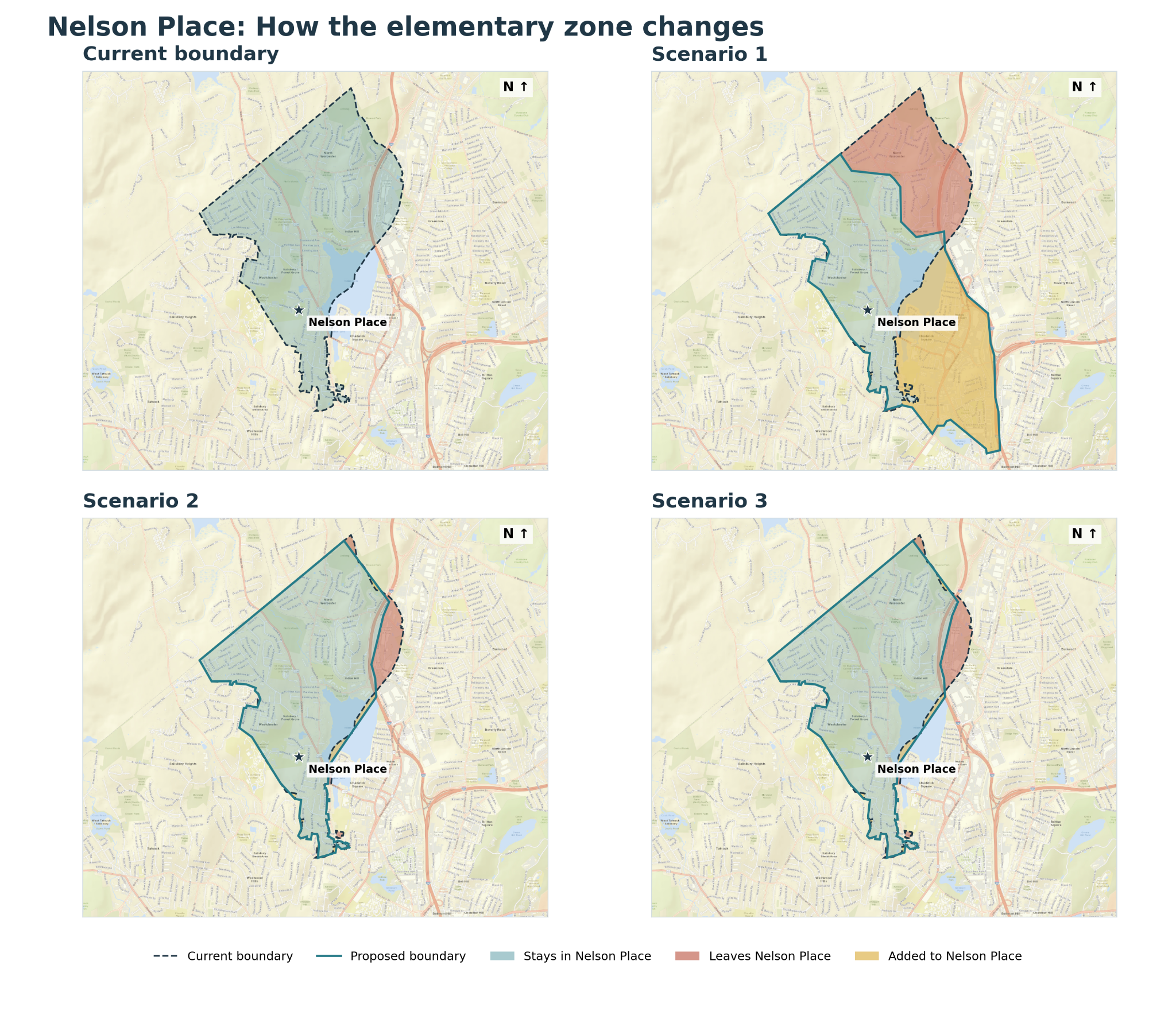
Realignment is the most important School Committee issue to pay attention to right now. The decisions being considered will shape where students attend school, their pathways through middle and high school, and access to programs across Worcester for years to come. I’ve put together a realignment reference guide to help families understand the proposals and what they could mean for their schools. Please take a look and give feedback: email alignment@worcesterschools.net or attend one of the public forums. Tell the district what works, what concerns you, and what questions still need answers before the committee votes.
Securly Hall Passes.
The October 8 School Committee discussion about digital hall passes being piloted at Worcester Tech (and perhaps Burncoat and South, although there was some confusion about that) left me wondering what problem we’re trying to solve, at what cost, and whether the benefits justify handing over more information about our students. The vendor, Securly Pass, gives principals a dashboard showing who is out of class, their destination, and how long they’ve been gone. Reports identify patterns, including which students are out at the same time. Superintendent Brian Allen said he did not see the system as “Big Brother,” describing it as supporting administrators and climate and culture staff. The discussion included using patterns, like a student going to the bathroom every period, to understand what is happening with a child.
The phrase “high flyers” came up, and all I kept thinking about was a student on a heavy day of her period who needs the bathroom more frequently. Is she going to show up as a “high flyer”? What about a student with a health issue who would prefer not to explain it to every adult with access to their bathroom history? The stated purpose of a program is one thing; how it’s implemented is just as important. I understand why staff should know who is out of class, but what happens between identifying a pattern and deciding what it means? Will staff approach a student’s bathroom data with curiosity, concern, or suspicion?
Bathroom records could reveal personal information about a student’s health or gender identity. Does the system identify the specific bathroom? Who can access those records, and how long are they kept? What information is shared with the vendor? Are photos? Have students and families been told?
Securly is owned by Golden Gate Capital, a private equity firm based in San Francisco. Its student privacy policy permits aggregated or de-identified student data to be used and shared with third parties for research and analysis. How does information collected from our children help build a private company’s products and business? What limits has WPS placed on that data mining in its contract?
Member Maureen Binienda (at-large) described using student IDs to monitor students in the hallway at South High a decade ago. What platform did it use, and could WPS meet this need internally without another subscription and another third party holding student information? Binienda also mentioned students stealing paper passes and forging signatures. But students will find workarounds for digital passes, too. (They already have.)
It also raises the question of how it fits with our staffing investments. The current year’s budget includes 46 climate and culture assistants and 11 deans of students across middle and high schools, alongside principals and assistant principals. The climate and culture assistants alone are budgeted at $1.92 million in salaries. Eight were added for 2025–26 specifically to take duties like bathroom and lunch coverage off teachers’ plates and allow more common planning time. Do we not have enough people to manage the halls? What gap remains, and why does filling it require another subscription and another company collecting student information?
Member Jermaine Johnson (district F) also expressed frustration that his earlier request for a vaping-detection pilot lacked funding. I’ve covered that discussion before. His budgetary questions could not be answered at the meeting. But it raises questions about how the district decides which technologies are worth trying. (These small meeting moments also show budget priorities taking shape: a bathroom-pass subscription here, a discussion about flag football there. By formal budget debate time, most commitments are already determined and those conversations are happening now.)
I’d like to hear from the students, and what they think about their trips to the bathroom becoming data tied to them individually. Students have asked the School Committee for better bathroom facilities over and over. There’s something ironic about paying to track how long students spend in bathrooms when students have had to ask to have bathrooms that work.
Gender support for students.
The gender support plan petition returned to the full School Committee on October 8, with more public comment following the September discussion I covered last month. Students had described being outed without permission, repeatedly having to explain their names and pronouns, and feeling unsafe at school.
Deputy Superintendent Marie Morse said WPS uses the DESE gender support form as a resource and works individually with each student. She said the district meets state requirements and apologized for the experience the students described. The discussion also referenced Safe Schools training at all high schools.
Member Sue Mailman (at-large) asked about consistency across high schools and how the district evaluates whether its approach is working. Morse pointed to training across all high schools and feedback from students. Member Molly McCullough (district A) also moved to bring the requested report on which parts of DESE’s approach WPS has implemented back to the full committee, rather than provide it through a Friday Letter (which is essentially an email from the Superintendent and a way in which school committee members can request information back from administration without having it come to another school committee meeting).
An individualized approach and a consistent process should be able to coexist. Each student may need something different, but they should all know who can help, how their privacy will be protected, and how their wishes will be communicated safely to staff. Students have already provided feedback about where those systems failed them.
Graduation requirements.
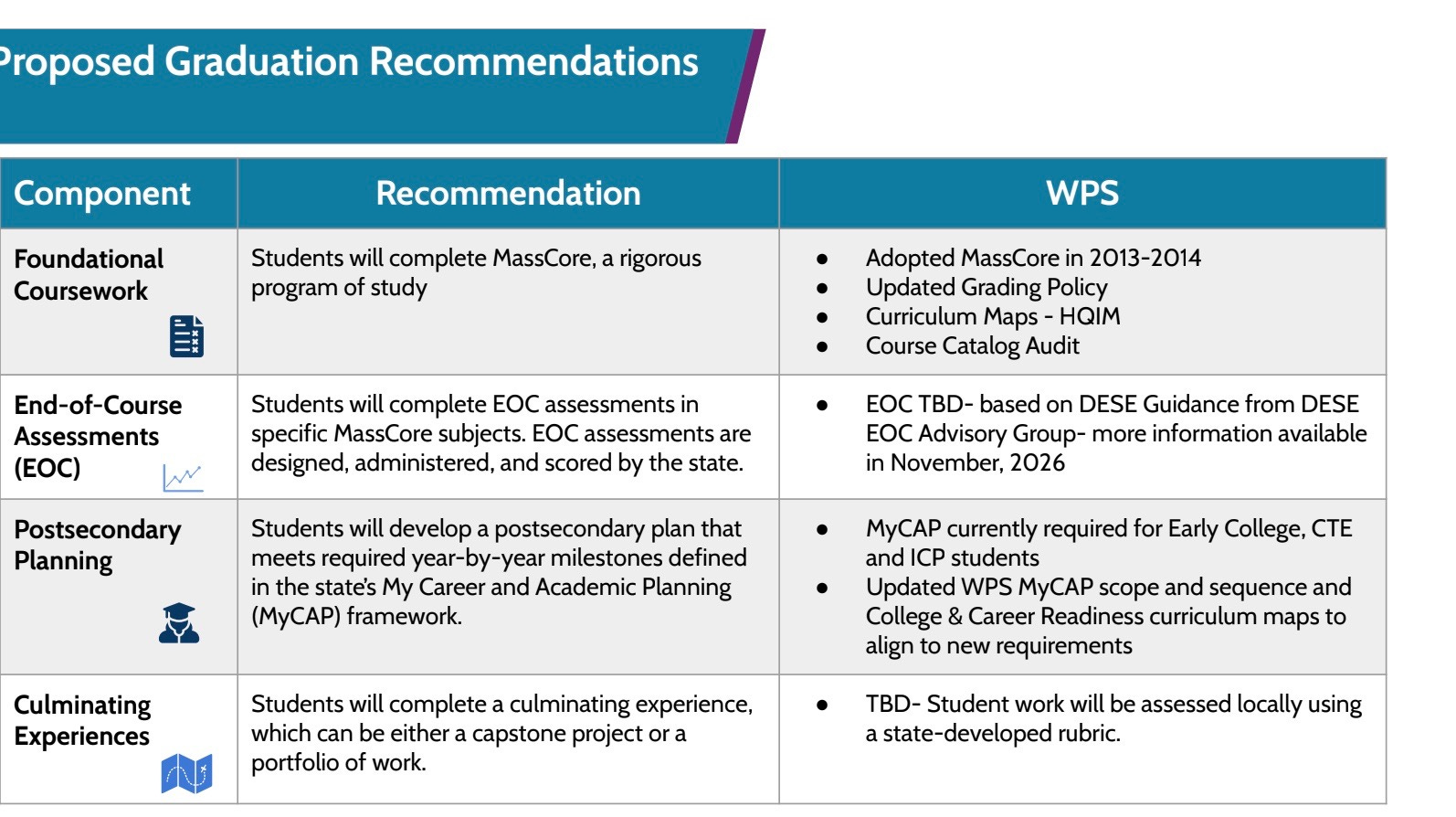
The October 8 Report of the Superintendent touched on the Massachusetts graduation requirements, which was scheduled with the expectation that the state’s new requirements, following the removal of the MCAS graduation requirement, would be clearer by now. But they’re still being developed. The proposed framework includes MassCore coursework, which WPS already requires; state-designed, administered, and scored end-of-course assessments in specific subjects; a postsecondary plan through My Career and Academic Planning (MyCAP); and a culminating capstone project or portfolio. Under the proposed timeline discussed at the meeting, MassCore would become a statewide requirement beginning with students entering ninth grade in 2027–28—current eighth graders. The remaining requirements, including a MyCAP plan, would begin with students entering ninth grade in 2028–29—current seventh graders. WPS is waiting for more guidance, including details about those assessments.
Member Alex Guardiola (district D) asked what measures WPS will use to determine whether graduates demonstrate college and career readiness, and whether the committee could review clear metrics annually. Accountability is an important role of the committee, but college and career readiness are not the entire purpose of public education. Schools also prepare students to participate in democracy, understand the world, build relationships, and contribute to their communities. WPS’s own Vision of a Learner reflects that broader purpose: students should become problem solvers, curious learners, empowered individuals, effective communicators, and engaged community members. How will the School Committee ensure that the graduation requirements reflect that vision?
Staff Absenteeism.
At the October 22 school committee meeting the committee received another staff sick-day report, requested by Guardiola. The percentage of instructional staff using 15 or more sick/family medical days declined from 14% to 11.4%, while cafeteria and custodial staff had substantially higher rates, at 26.4% and 24.9%. The report also explains that employees using more than 15 days may still be within their accumulated sick leave allowance.
Guardiola’s questions about substitute coverage, differences between schools, and the impact on other teachers sounded familiar: I asked them in my July 2025 brief. Perhaps he’s a reader. I’m glad he raised the questions, but he left them as questions. He didn’t request a report or ask the administration to come back with answers.
When Superintendent Brian Allen acknowledged that some schools struggle to find day-to-day substitutes, there was an opening: What has WPS done to try to recruit more? What are the barriers? Is it pay, working conditions, or something else? I’m a licensed teacher who occasionally works as a day-to-day substitute in WPS (I started last month). At $18.33 an hour, I’m not willing to do it regularly. Is compensation one of the barriers the district has examined? The district could also consider having central-office administrators cover classrooms, as El Paso ISD is doing, to reduce substitute costs and reconnect administrators with classroom life. That’s a perspective you don’t get from a walkthrough.
School Committee members could have requested a report on substitute recruitment, barriers to coverage, and options they could fund or address through policy. I agree with Guardiola that staffing gaps have serious consequences for students and staff. But when does the committee move from monitoring to action?
MCAS.
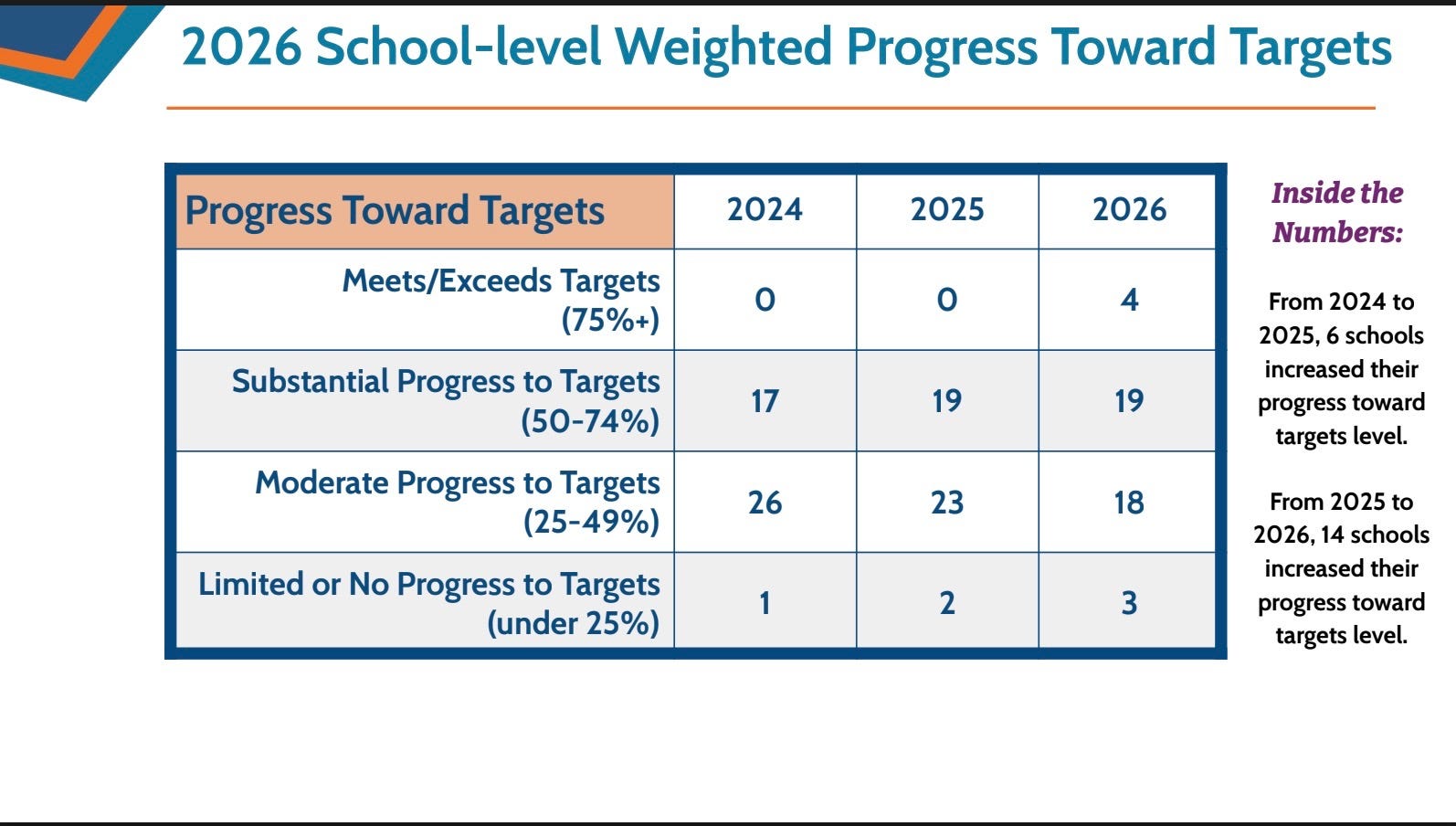
The October 22 report on MCAS and state accountability showed a mixed picture. High school achievement declined in English, math, and science for the second consecutive year. But elementary and middle school students showed improved growth in English and math, and English learners in grades 1–8 exceeded the state’s target for progress toward English proficiency. Four schools—Columbus Park, McGrath, Midland Street, and Worcester Arts Magnet—were named Schools of Recognition.
What caught my attention was Member Maureen Binienda’s emphasis on students meeting standards rather than focusing on scores. I agree. But that emphasis stood out given her opposition to removing MCAS as a graduation requirement in 2024, when she argued that education had improved after MCAS was introduced and questioned how standards would be assessed without the requirement. Bill Shaner covered that discussion here. I’d like to hear more about how she distinguishes the two now. What evidence of student learning should the school committee prioritize beyond test scores, and will they apply that same perspective consistently when evaluating our schools?
Bits and bobs.
Career Technical Education program admission. The Operations and Governance subcommittee approved updates to the CTE admissions policy on October 13, which went to the full committee’s October 22 agenda. The changes
remove sibling preference under the state’s admissions rules.
eliminate the extra lottery entry tied to a recommendation letter.
count Worcester Dual Language Magnet eighth graders toward the Worcester Tech seat allocation for the middle school associated with their home address.
remove language preventing students from enrolling unless they passed their previous year’s English and math courses, following updated DESE guidance.
Communicating to families when assessments are happening. Member Jermaine Johnson asked that parents be informed when their children will take assessments. Deputy Superintendent Marie Morse said schools typically provide that information. This is especially important for fifth and sixth graders taking Star assessments, because those scores determine admission to Goddard Scholars and Hanover Insurance Academy of the Arts. As I’ve explained before, these tests have consequences beyond measuring classroom progress. Families should know when they’re happening and how many times their children can take them to qualify for those programs.
Less federal funding. The October 21 Finance subcommittee’s first-quarter budget report shows WPS receiving about $423,500 less in Title I funding and $193,600 less in Title II funding than budgeted—roughly $617,000 combined. The district says the Title I reduction will directly affect its ability to provide summer and after-school programming, while the Title II reduction affects professional development. These are cuts to services and support, even if they don’t appear as cuts in the district’s general operating budget.
Also.
One more reminder to make time for the upcoming realignment meetings: Monday, October 26 at 6 p.m. at Forest Grove Middle School, and Saturday, November 7 at noon at Goddard Elementary School. An additional Operations and Governance meeting has been added for Monday, November 16, with the time and location still to be announced. The October 26 meeting will be devoted to public feedback, with no presentation. If you’re trying to make sense of the proposals, read my realignment reference guide. You don’t have to understand every detail to share what matters to your family. Come with questions, concerns, and ideas. If you can’t attend, email alignment@worcesterschools.net, and check the realignment website for updated meeting details.
Thanks for reading! These briefs take many hours of watching meetings, reading reports, and tracking down answers. If they help you stay informed, please share them, consider a paid subscription, or buy me a coffee. And as always, I appreciate questions, corrections, and tips about what’s happening in your schools. See you next month!