


A previous version of this Brief incorrectly called the amount the city is required by law to pay each year as net school spending. It is called the “required local contribution.”
Welcome to the February edition of WPS in Brief. This month covers key topics from two school committee meetings and three subcommittee meetings. I know February is the shortest month, but Jesus Murphy it has been looooooong. Please consider subscribing to support our work.
Let’s get to it:
Preliminary Budget.
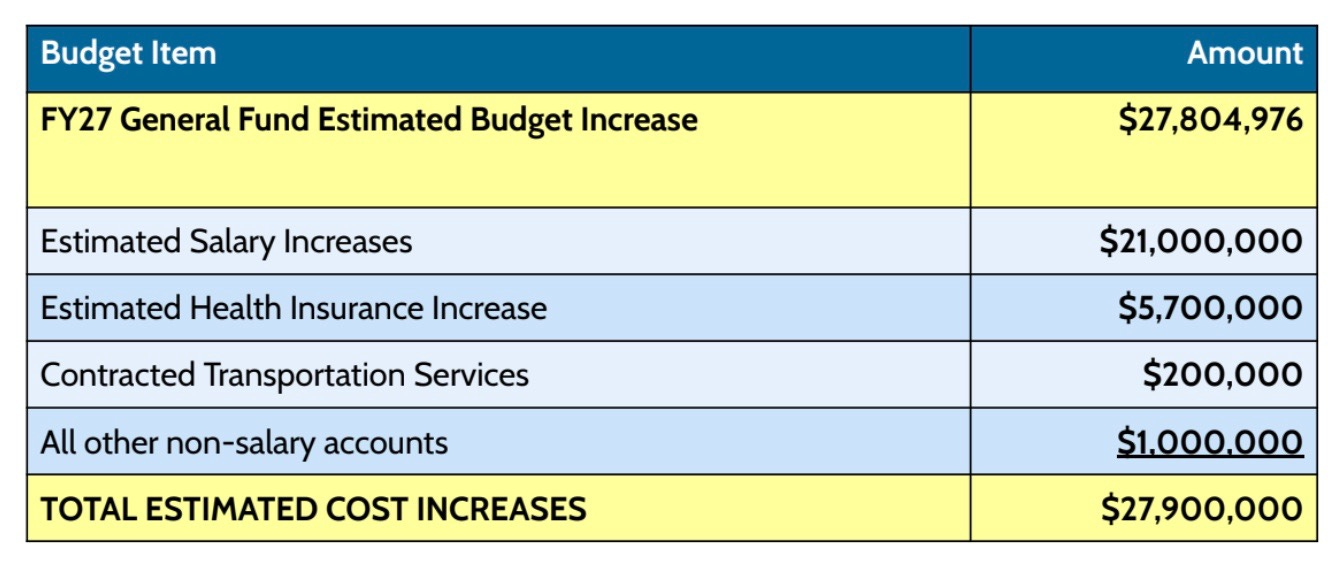
It’s budget season, which is the most important time to be paying attention to WPS governance. CFO Sara Consalvo gave a presentation at the February 5 school committee meeting, sharing the preliminary estimates for the FY27 budget (covers from July 2026-June 2027). Consalvo outlined that the general fund baseline budget will increase by $27.8 million, but the cost increase to maintain the same level of services is $27.9 million. That means the district is basically breaking even.
It can be hard to follow if you’re new to all this lingo (and even if you aren’t) so here’s a breakdown on how the school department budget works. Stay with me, because understanding the budget is one of the best ways to know what is happening in Worcester Public Schools.
Worcester gets over half of its funding from the state. These funds are called “Chapter 70” and make up a good chunk of what is called the “foundation budget,” or what the state sees as the minimum foundation of what is needed to adequately educate our students. The funding formula used by the state to decide how much aid a district gets is determined by:
1. Student enrollment on Oct. 1, 20251
2. An inflation factor
The state decides what the City of Worcester must contribute (called “ required local contribution”) based on local income/property tax wealth, which is about 29 percent of the foundation budget. The estimate for next year is the city will contribute $161 million to schools2, $4 million more than this year, and the state then makes up the difference.
The Student Opportunity Act (SOA), passed in 2019, updated Massachusetts’ school funding formula over a six-year phase-in to better reflect the real costs of educating low-income students, English learners, and students with disabilities, as well as rising health insurance expenses. Because of Worcester’s student population, the city has seen foundation budget increases during this phase-in. But this year marks the final year of those increases. Without that buffer, and with enrollment likely to continue declining due to lower birth rates and reduced immigration, Worcester may face more difficult budget years ahead.
Decreased enrollment and decrease in low income students and English learners.
This year WPS student enrollment decreased by 101 students (0.41%), and it’s the first year of enrollment decrease after an increase over the last three years. For context, the total public school enrollment in the state decreased by 15,442 students (about 1.7%). For Worcester, high school enrollment increased by 22 students, middle school enrollment increased by 45 students, and elementary school enrollment decreased by 171 students.
Even more impactful to the budget than the slight enrollment decrease, is the significant decrease in low-income students (-595) and in English learners (-243). Superintendent Brian Allen addressed this at the meeting, saying “We knew there was going to be a state-wide low income drop because Covid era benefits expired last year, but we didn’t know the extent.” The district does not know what criteria students are qualifying for to be considered low income (i.e. SNAP, MassHealth) so could not estimate the decrease. In terms of the decrease of English learners, Allen said it’s “a combination of newcomers not coming and also the testing of our students.” Based on ACCESS testing from last year the district knew that English learners were testing out, which Allen said “is a good thing, but means a corresponding revenue decrease.” All these enrollment changes equate to a decrease of $4 million.
Federal Funding. The foundation budget is the meat and potatoes of how WPS is funded, but WPS gets funding from other sources too, most notably the federal government which completely funds student nutrition, head start, and entitlement grants to the tune of about $53 million each year. That money currently supports about 600 jobs.
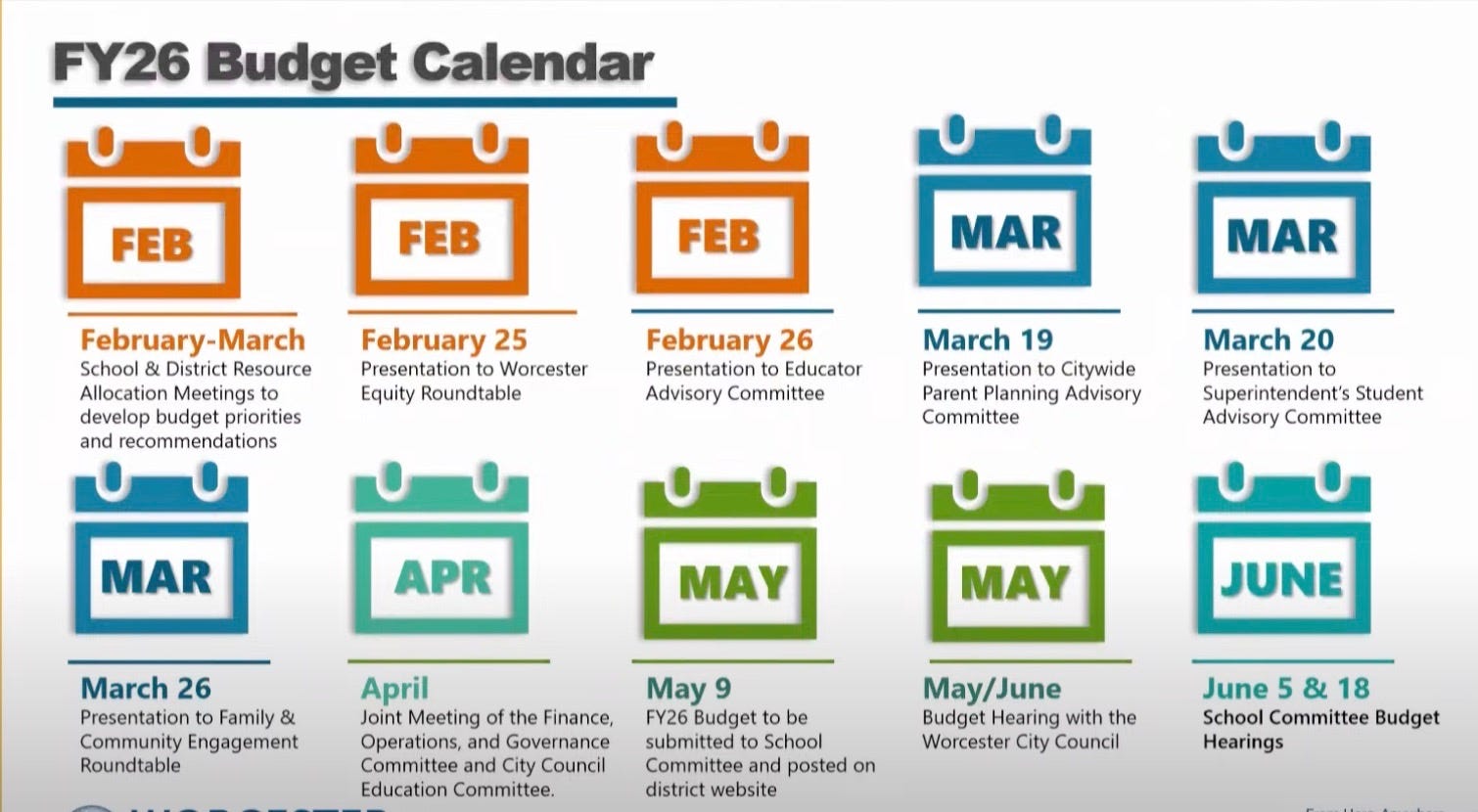
If you want to give input, see above for the times and places you can do that. The official public hearing on the budget takes place on May 28.
Culturally Responsive Pedagogy.

The February 26 meeting report of the superintendent covered “culturally responsive pedagogy” (CRP), a strength-based, student-centered approach to teaching that recognizes and leverages the knowledge students bring from their experiences. The initiative is directly connected to the district’s strategic plan and positioned as a research-grounded “lever of change” that affirms students’ identities, cultures, and lived experiences while advancing academic achievement, cultural awareness, and critical consciousness.
Underway at South High and Sullivan Middle, it is framed not as an add-on but as a core method for building a culture of belonging and upholding high standards of academic excellence. The work aligns the curriculum with teaching methods and focuses on building capacity through sustained educator learning, strengthened instructional coaching, and expanded leadership capacity at the school level. Next steps include continuing professional development, identifying three to five “non-negotiable” specific, observable actions and behaviors in a classroom, embedding culturally responsive practices into existing systems, prioritizing coaching cycles, and using walkthrough data to monitor implementation.
In comments after the presentation Maureen Binienda (at-large) claimed that culturally responsive practices were already underway at WPS during her tenure a decade ago, and that the walkthrough tool was also in place at that time. Dianna Biancheria, Sue Mailman and Vanessa Alvarez made comments in support of the CRP work.
Meeting Moment.
At both school committee meetings this month, as well as at the infamous TLSS standing committee meeting, members discussed Chromebook use, screen time, and student data privacy. In the above clip, the district responds to questions about whether biometric data is collected (yes — photos, videos, and voice recordings, though not for authentication purposes) and whether student data is used to train AI (yes — but only after it has been de-identified). The district will be having discussions within the technology advisory committee about an opt-out option for the collection of biometric data and then will bring a recommendation forward to the school committee. There was also some excellent public comment around these issues from elementary parents at the TLSS meeting, see clip below.
The district also shared updated screen time guidance. If you have an elementary student, it’s worth reviewing. The guidance provides clearer expectations around 1:1 device use, screen time, and instructional time than we’ve seen in recent years.
Improving Public Participation with Clear Meeting Start Times.
Sue Mailman (at-large) proposed a rule change that school committee meetings should begin no later than 15 minutes after the posted start time. Because executive session happens first, it’s often unclear when public comment will actually begin. When start times vary widely, meaningful public participation becomes extremely difficult, especially for families with school-aged children who are arranging childcare, work schedules, extra-curricular pick ups, and dinner. A few years ago, when I attended to speak on behalf of a school site council, the executive session ran an hour and twenty-two minutes past the posted start time. Needless to say, I wasn’t able to stay to speak.
The strong reaction to Mailman’s proposal was surprising to me, with members inferring that the implication was that they intentionally don’t respect the public’s time and taking personal offense, while also suggesting that meetings rarely run late due to executive session. I ran the numbers, and from 2022 to 2025, 44 meetings included executive sessions. Of those, 41 percent began 30 minutes or more later, and 11 percent began an hour or more later. Just 23 percent of the meetings started within ten minutes of listed start time. The average delay was 24 minutes.
Mailman’s item highlights that even with the best intentions of the committee, executive sessions are unpredictable because there are often important, complicated discussions. As Mailman noted, there are workable alternatives: recess executive session to begin the public meeting on time and then go back to it after the meeting, hold public comment first, or move executive session to the end. It’s all a question of what the committee’s priority is to make meetings accessible to the public.
But instead of exploring how executive session has unintended consequences for the ability of the public to participate, the committee voted against the item 7-2 (with Alvarez and Mailman for it), thus filing it without sending it to committee for broader discussion. It’s an interesting choice at a time when the district has invested significant resources through the Family and Community Engagement office to make district meetings more accessible, including providing food, childcare, and translation. Ensuring that school committee meetings begin at a predictable time feels like a modest, reasonable step to accommodate the public. (Anyone interested in filing a public petition?)
Indoor Track at Burncoat High School.
At the February 26 meeting the committee voted to grant District C Member Dianna Biancheria’s request for reconsideration of a vote taken at the February 5 meeting (7-2, with Mailman–who wrote the original item–and Alvarez voting no). The committee then took two separate votes: one on supporting state legislation to create a commission to study the Massachusetts School Building Authority (MSBA), and another on supporting plans for an indoor track to be built at the new Burncoat High School. The proposed state commission, filed by Senator Robyn Kennedy, would study the MSBA building process, a system that reporting by the New Bedford Light, along with analyses from the Worcester Regional Research Bureau and MassINC, has found disproportionately benefits suburban districts. One potential outcome of such a review could be changes to what projects are eligible for MSBA funding, including indoor tracks, which are currently prohibited.
That means if Worcester wants to build a regulation indoor track at Burncoat, the city would have to fund it entirely on its own. Based on a comparable project at Lexington High School last fall, the estimated cost of a MIAA-regulation indoor track is roughly $55 million. Members Biancheria, Binienda, and Roy voted against supporting the commission to study the MSBA, but did vote in support of building an indoor track. Look forward to hearing where they think that $55 million will come from.
Bits and Bobs.
The quarter two finance report listed a deficit of (-$792,747) in the teacher salary line due to an unanticipated doubling of teacher degree changes, which increases their salaries.
Superintendent Allen reported that due to 15 new electric buses, paid for by a grant, the district may be able to lower the walking cutoff to a mile and a half for the third tier (later start) middle schools for next school year. In terms of the high schools, the last time the district looked at it in December 2023, it was reported that to decrease the cutoff to 1 mile it would take 49 more buses. To decrease it to 1.5 would take 34 more buses. Each big bus costs around $150,000 and then obviously bus driver pay and bus maintenance costs.
Recommended Reads.
Snowbanks, no sidewalks make it tough to walk to this Worcester elementary school: If you have children in WPS, I caution you before you watch the video from the meeting. Seeing why they voted down installing sidewalks (that the city was willing to pay for) adjacent to an elementary school will infuriate you!
Chicopee 1st to install cameras on school bus stop signs to prevent violations. Just yesterday morning two cars drove through the stop sign of my kids’ elementary bus. It’s been over a year since the city council and school committee approved cameras on school bus stop signs, and still no update on when it will happen.
Also.
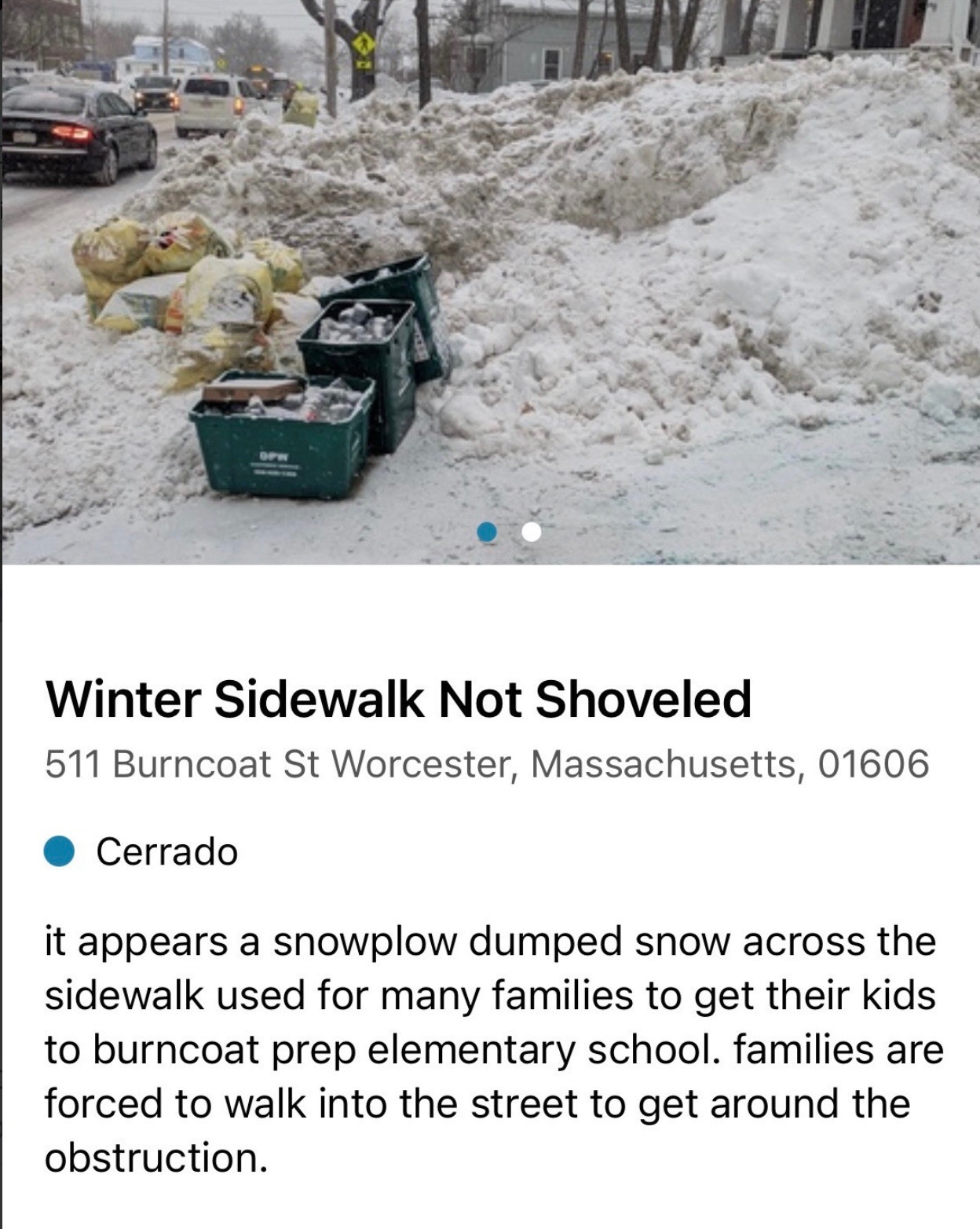
It has been a struggle to be a pedestrian in this city after all this snow, and I don’t know what the solution is, but I’m about to do a gofundme to buy some snow dragons and create a fleet of volunteers to clear the paths to school. Let me know if you want in!
Upcoming Dates.
All school committee meetings have virtual options with Spanish translation. See the school committee site for more information.
School Committee Meetings are March 5 and 19, 5:30pm at City Hall
Budget and Transportation presentations to the Citywide Parent Planning Advisory Council, March 11, 6pm-7:30pm at Doherty High
Operations & Governance (OG), March 9, 5pm at Durkin Administration Building
Teaching, Learning and Student Success (TLSS), March 26, 5pm at Durkin Administration Building
See you next month!
Back in September Superintendent Allen highlighted how that October 1 date is truly just a snapshot in time in our district, explaining: “I want to give an example of how Worcester’s enrollment changes each day using last year’s school data. Between the first day of school last year and October 1 [2024], the district enrolled an average of 125 new students each day, while we also unenrolled 46 students each day during that same period. From October 1 [2024] to the end of the school year last year we enrolled an average of 12 students every day, while we unenrolled an average of 8 students every day. So while we were 24,778 students enrolled in this district last October 1, that was the only day we actually had 24,778 students enrolled in the district.”
Of that $161 million, $45 million will be distributed to charter schools, which, remember, do not have elected school committees.
Again, excellent. Thank you. Yay for the electric buses and Yay for possibly reducing the walking-radius. I'm wondering if there's a relationship between the walking radius and the drop-off/pick-up traffic problems at Roosevelt & Doherty.
And just WTF turning down installing sidewalks near an elementary school??? If we're talking about West Tatnuck, that was brought up at the hearing re: the Pleasant St. re-design. Really, people, really.
And yes, the irresponsible pile-up of snow at T-intersections and corners . . . the contractors responsible should be fined/docked pay. It's been a difficult winter to be a pedestrian here.