

There’s a school committee meeting on Thursday, which we’ll get to in a moment. But before walking through that agenda, I want to highlight a really important meeting happening next Monday that could have broader implications for the district. We start first with the meeting, and then get to the agenda preview.
Leer en español
Dearest reader, I know we’re all busy and I don’t say this lightly. But if I were going to tell you to attend one Worcester Public Schools meeting during the 13 years your child is in the district, this would be the one.
On Monday, March 23 from 6:00–7:30 p.m., WPS is holding a community forum on the School Boundary and Quadrant Realignment Project at South High Community School. The district is asking parents, caregivers, and community members to share priorities as it begins a process that could reshape which schools Worcester students attend starting in the 2027–2028 school year.1
If you have kids, or plan to, please consider coming. There will be childcare and translation available (but no dinner). The important thing is that the district is at the very beginning of this process, which means now is the moment to weigh in.
So what exactly is this “realignment”? Worcester is beginning to rethink the lines that determine which students attend which schools. Most people call this redistricting, though district staff prefer the term “realignment.” Right now WPS generally uses a neighborhood elementary model (K–6) that feeds into middle schools (7–8) and then high schools (9–12). The current boundaries can be explored using the Worcester Regional Research Bureau’s interactive map, though official assignments are determined by the district’s street list, which assigns every address to an elementary, middle, and high school.
Below is a quick overview of what the district is considering, why it’s happening now, and what this could mean for Worcester’s students.
This conversation has been brewing for a while. Back in September, 2023, Worcester had one of the lowest enrollments it had seen in a long time, but the district still reported that there were only about 1,000 open seats across the entire system. Some schools were already over capacity. Lincoln Street and Chandler Street were leasing additional space to alleviate overcrowding, and Belmont Street was already full.2 At a School Committee meeting that month, then-superintendent Rachel Monárrez said the district would likely have to look at changing school boundaries at some point. As she put it, it’s something “no one likes to do,” but it was probably unavoidable. A formal agenda item to begin that process appeared in November, 2024.
A lot has changed since then. Immigration into Worcester has slowed significantly due to federal enforcement actions. As one staff member at the Parent Information Center recently told me, referring to new student enrollments, “It’s like a tap was shut off.” At the same time, birthrates in Worcester have been declining for more than a decade. Taken together, those trends suggest that elementary enrollment will likely continue to decline over time.
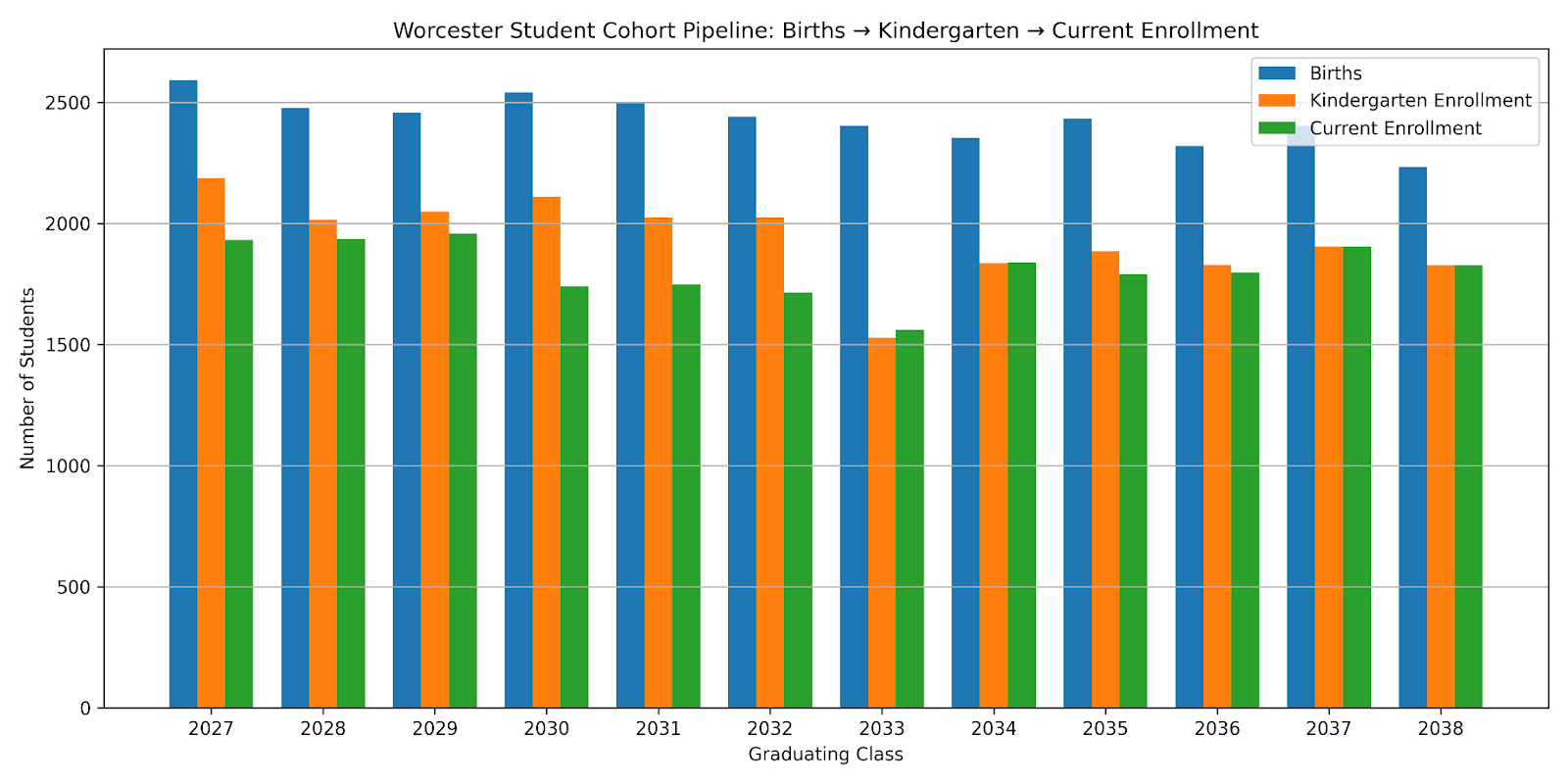
Across Massachusetts, that dynamic has already led to school consolidations and closures. Worcester went through something similar in the early 2000s, closing seven schools over a four-year period.3 The district says it does not anticipate school closures as part of this process, but enrollment pressure remains uneven. Some schools are overcrowded while others have space, and the district has also struggled to expand preschool opportunities because elementary classrooms were already full.
The redistricting project is meant to address some of those issues. According to the district, the focus will primarily be on elementary schools, with the goal of reducing enrollment in schools that are over 90 percent capacity and increasing enrollment in schools that are under that threshold. In previous meetings the district has publicly identified Belmont Street, Chandler Elementary, and Rice Square as schools experiencing overcrowding, with Rice Square sixth grade moving to Worcester East Middle to create space. The district has also said that Forest Grove and Sullivan are “exceeding capacity,” which means too many kids are feeding into those schools. There’s also weird boundaries that have emerged over the decades. As an example, a friend of mine can see McGrath Elementary from her front steps, but her address is assigned to Nelson Place, more than a mile away.
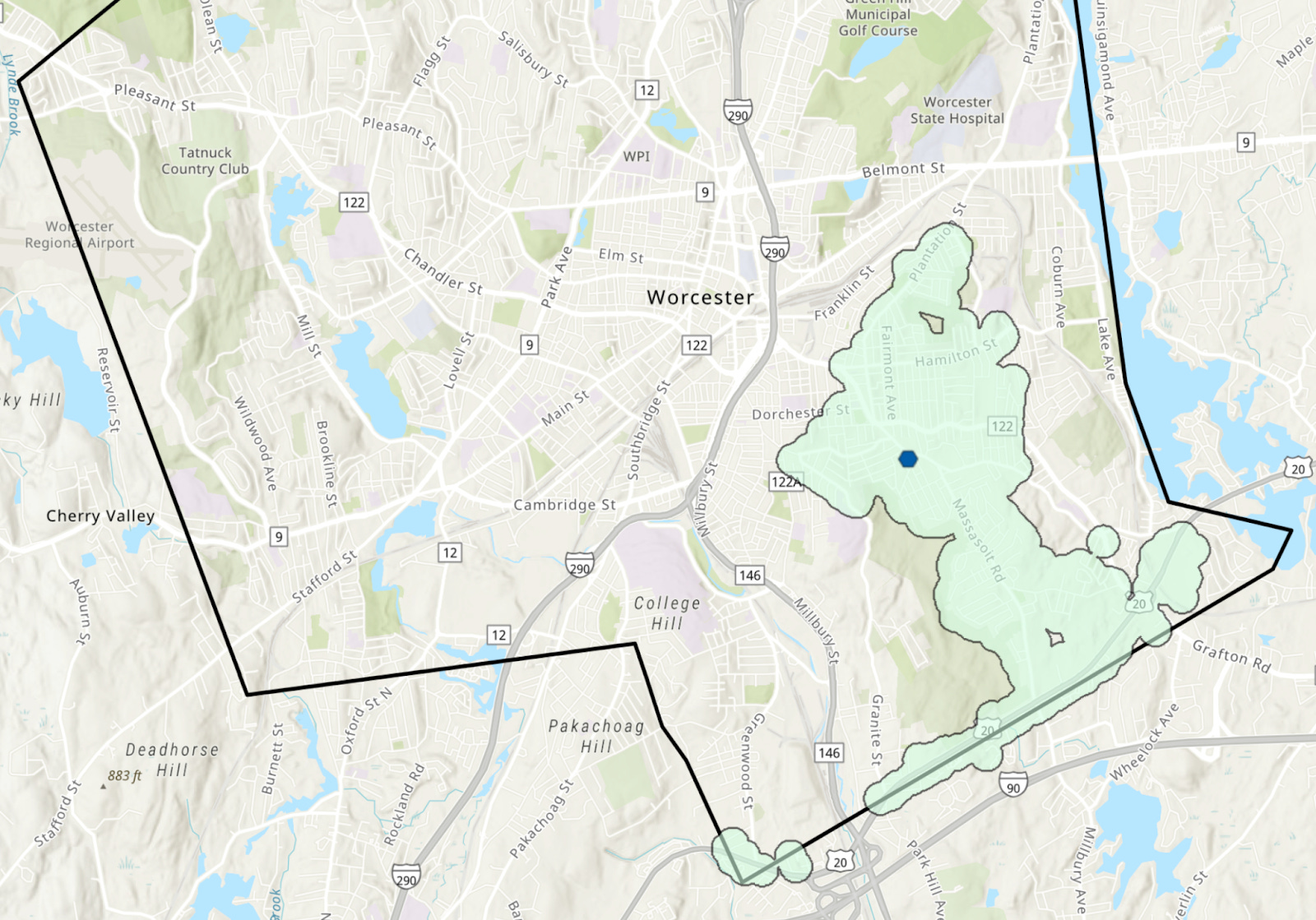
Designing boundaries for 33 elementary schools across a city is not simple. The district has to consider how many school-aged children live in each neighborhood, transportation and safe routes to school, balancing enrollment by grade, and what the ideal size of each school should be. To help model potential scenarios, Worcester hired Dillinger Research and Applied Data. But before those scenarios are developed, the district wants community input, which is the purpose of next Monday’s forum.
Another issue the district is looking at is what it calls “illogical” feeder patterns. Worcester is divided into four quadrants tied to the city’s comprehensive high schools, but the pathways students take through the system don’t always line up neatly. Chandler Elementary, for example, feeds into three different middle schools, while several others — including City View, Belmont, May Street, Norrback, Quinsigamond, and Vernon Hill — feed into two.
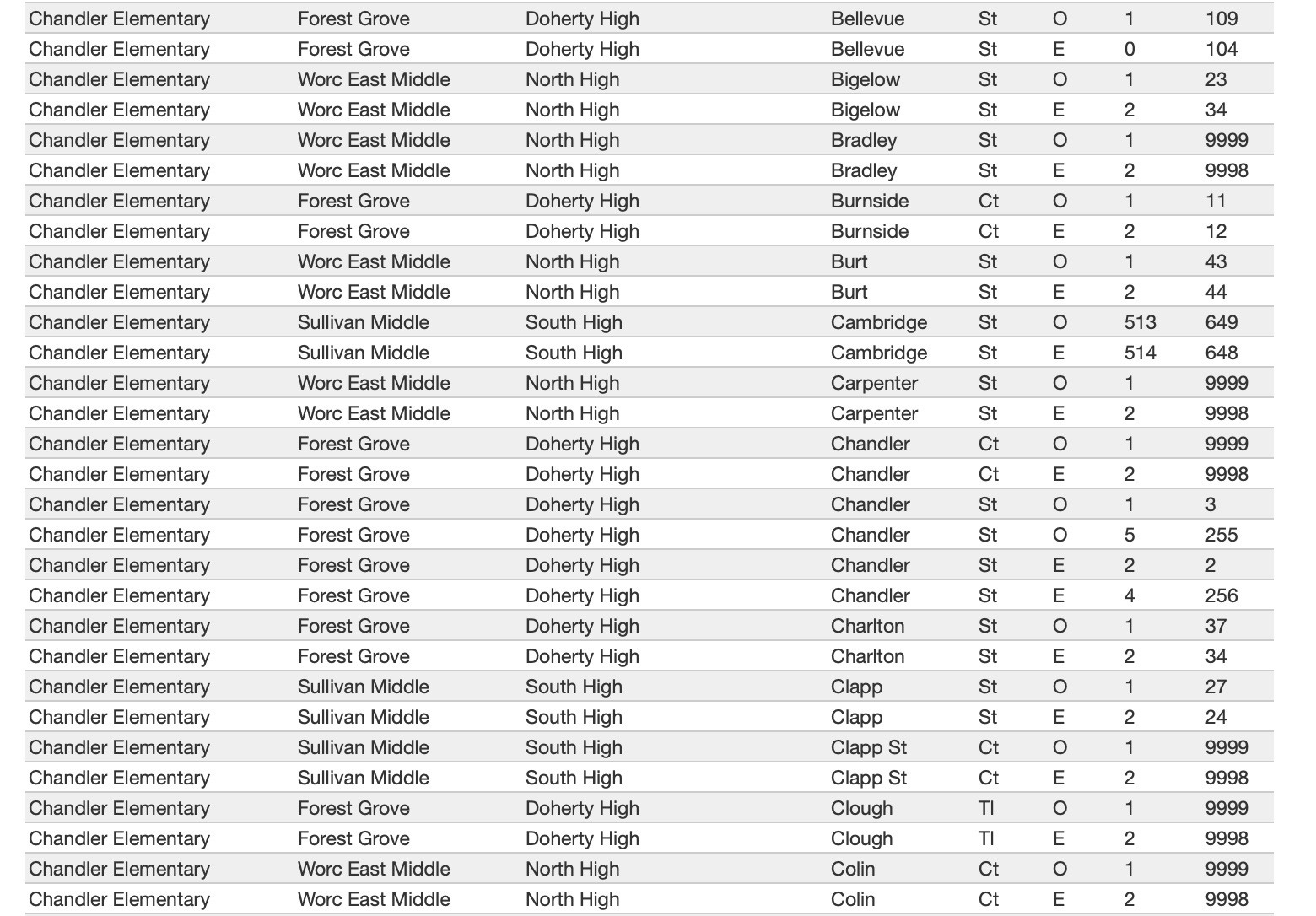
Even when students attend the same middle school, they may split again later. Students from McGrath and Nelson Place all attend Forest Grove Middle School, but some continue on to Burncoat High School while others go to Doherty. (And oddly enough, students who live on Nipmuck Road attend May Street and Forest Grove, but are assigned to South High.)
The dual language program is another example of how complicated the system has become. Elementary programs are located in the South and Doherty quadrants, but the program continues at Burncoat Middle and Burncoat High, meaning it is currently overseen by three different executive directors.
At a recent meeting (video above), Superintendent Brian Allen also discussed the possibility of “grandfathering” students into their current schools if boundaries change — meaning students already enrolled could stay where they are. The trade-off is that it could take six or seven years for overcrowding issues to fully resolve.
I understand the instinct to avoid disrupting students, but as a parent whose child was forced to transition to a new school building in first grade, elementary-aged kids are pretty adaptable, especially if the result is more balanced class sizes across the district. And transitions already happen in Worcester. When families move within the city, students are typically required to change schools unless parents can provide transportation. For families experiencing increased housing costs and housing instability, school transitions are, unfortunately, already a regular occurrence.4
There’s another piece of this conversation that doesn’t get talked about enough, and that’s the socioeconomic segregation across Worcester’s elementary schools. Because Worcester relies heavily on neighborhood schools, the distribution of financial, social, and political capital varies significantly from school to school. That shows up clearly when you look at PTO fundraising.
Based on demographic data for the 2025–2026 school year, Flagg Street (26.3 percent low income) raises about $60 per student through its PTO. West Tatnuck (36.4 percent) raises about $58 per student, and Worcester Arts Magnet (43.4 percent) raises about $54 per student. Meanwhile, Worcester Dual Language Magnet (53 percent low income) raises about $29 per student, Gates Lane (73.3 percent) raises about $9 per student, Woodland (85 percent) raises about $3 per student, and Belmont Street (89.6 percent) raises nothing at all. This is not a matter of which parents work harder or which communities care more. It’s about who has access to resources.
Neighborhood schools are deeply embedded in Worcester’s identity, and I don’t expect that model to change anytime soon. But it also reinforces socioeconomic segregation. Right now, 43 percent of Worcester elementary schools enroll 81 percent or more low-income students, with a median of about 85 percent, while 30 percent of schools have 60 percent or fewer low-income students, with a median of 49 percent. For comparison, about 41 percent of students statewide are low income. Realignment alone won’t undo decades of housing and policy decisions, but adjusting the quadrant model could create better balance. Currently, Doherty Memorial High School is 58 percent low income, while North High School is 78 percent.
School boundaries shape how students move through the district, which schools they attend, and what resources they have access to. And once those lines are drawn, they tend to stay in place for decades. So if you want a voice in that conversation, next Monday night is the time to weigh in. I hope to see you there!
Agenda Preview: March 19, 2026 School Committee
The next school committee meeting is scheduled for Thursday, March 19. Executive session starts at 5 p.m. and the regular meeting is scheduled to start at 6 p.m. The actual start time depends on how long the executive session takes. See the agenda here. You can watch it via zoom or Youtube Live. Spanish translation is available on zoom.
Here’s what’s on the agenda:
Approval of a New Elementary Math Curriculum.
The district is requesting authorization for a six-year contract, not to exceed $3.2 million, to purchase the Reveal Math curriculum (published by McGraw Hill) for grades K–6. According to the district, the program is “better aligned with the district’s standards for High Quality Instructional Materials and capable of meeting the complex needs of all students in our Pre-K–6 setting.”
Elementary teachers have not piloted the curriculum. The district already uses Reveal Math from 7th grade through Algebra 2 and reports “very positive feedback” from secondary teachers, arguing that adopting it in elementary grades would “enhance vertical alignment.” The report also states that “adaptations of the existing resources and instructional approaches have led to inconsistencies in student outcomes,” implying that a new curriculum would address those issues.
Unlike the English Language Arts curriculum adopted three years ago, the report does not indicate whether other curricula were considered. I also wasn’t able to find examples of specific lessons online.
Most surprising, though, is that the recommendation is to approve and file the contract without first sending it to the Teaching, Learning, and Student Supports (TLSS) subcommittee for a deeper discussion. When the district discussed adoption of its new ELA curriculum in April 2023, TLSS Chair Molly McCullough noted that “procedurally, it needs to go to TLSS.” Committee member Tracy O’Connell Novick added:
“I’m thinking of some second grade teacher who is wondering what the heck she’s going to be teaching next year, and that doesn’t feel fair. And the reason we even have any say in curriculum at all in Massachusetts is for the public process piece, and it feels like we’re skimping on that… I trust your judgment… I’m just worried about us as a body not doing the part of the job that really is ours — which is actually less about our judgment and more about the fact that we do it publicly.”
Again, it is a six year contract that is up for approval.
Public Petition.
WPS parent and former school committee candidate Nelly Medina has a public petition requesting “a comprehensive, published K-12 calendar of all district-wide and state assessments..and request that parents and caretakers be notified of specific subjects and testing dates at least one week before the start of any assessment to allow us to prepare our students mentally and academically.” Interestingly, I recently attended a school site council meeting where this request came up from parents, who also expressed the desire to help their children prepare.
Report of the Superintendent.
This meeting’s report of the superintendent will be on Family and Community Engagement.
Other Items:
There’s a report about the lack of an organized fire prevention education programs in WPS, and the plans to implement one for fifth grade.
Molly McCullough (district A) has a request to look into creating guidance as part of the Quadrant teams.
Two requests from Alex Guardiola (district D): one for a report on special education transportation and another for a report of Head Start enrollment.
For context, that’s when toddlers born in 2022 go into kindergarten, when current fifth graders are going into seventh grade, and current seventh graders are going into ninth grade.
Worcester’s “official” enrollment that is used by the state to determine how much money the district gets is counted on October 1. For a city like Worcester, the October 1 number is the only day that it actually had that many students. As Superintendent Brian Allen said at a September 2025 school committee meeting, “From October 1 [2024] to the end of the school year last year we enrolled an average of 12 students every day, while we unenrolled an average of 8 students every day.”
In 2003 the three elementary schools the school committee voted to close were Adams Street (now the Schoolhouse Lofts condos), Granite Street (now the Gerald Creamer Center) and Greendale (now Head Start); In 2006 they closed four other elementary schools: Harlow (now Challenge and Reach), New Ludlow School (now the New Citizens Center), Mill Swan (now Head Start) and Dartmouth Street (now Nuha Lofts).
In 2024 North High’s churn rate was 21%, and Chandler, Grafton, Canterbury and Rice Square all had churn rates of 30%.