

Welcome to the May issue of WPS in Brief. This month covers key topics from the FY27 budget (yes, I read all 398 pages so you don’t have to), two school committee meetings and three standing committee meetings. The format is a little different because the big focus this month is on the budget. This time of the year is a grind, but hang in there it’s almost summer!
Before we get to the budget it’s important to have a basic understanding of how funding for Worcester Public Schools works and why we don’t have a deficit (or a big increase) this year. If you haven’t read my quick budget primer I’d recommend it as a starting point before moving on.
TL;DR: Despite budget cuts facing dozens of districts this year (even the rich ones), Worcester is okay budget-wise. But buckle-up because starting in 2027-2028 we’re looking at some serious deficits, and the exhausting cycles of budget cuts will continue for a few years.
Ok, let’s dive in:
The Proposed 2026-2027 Budget.
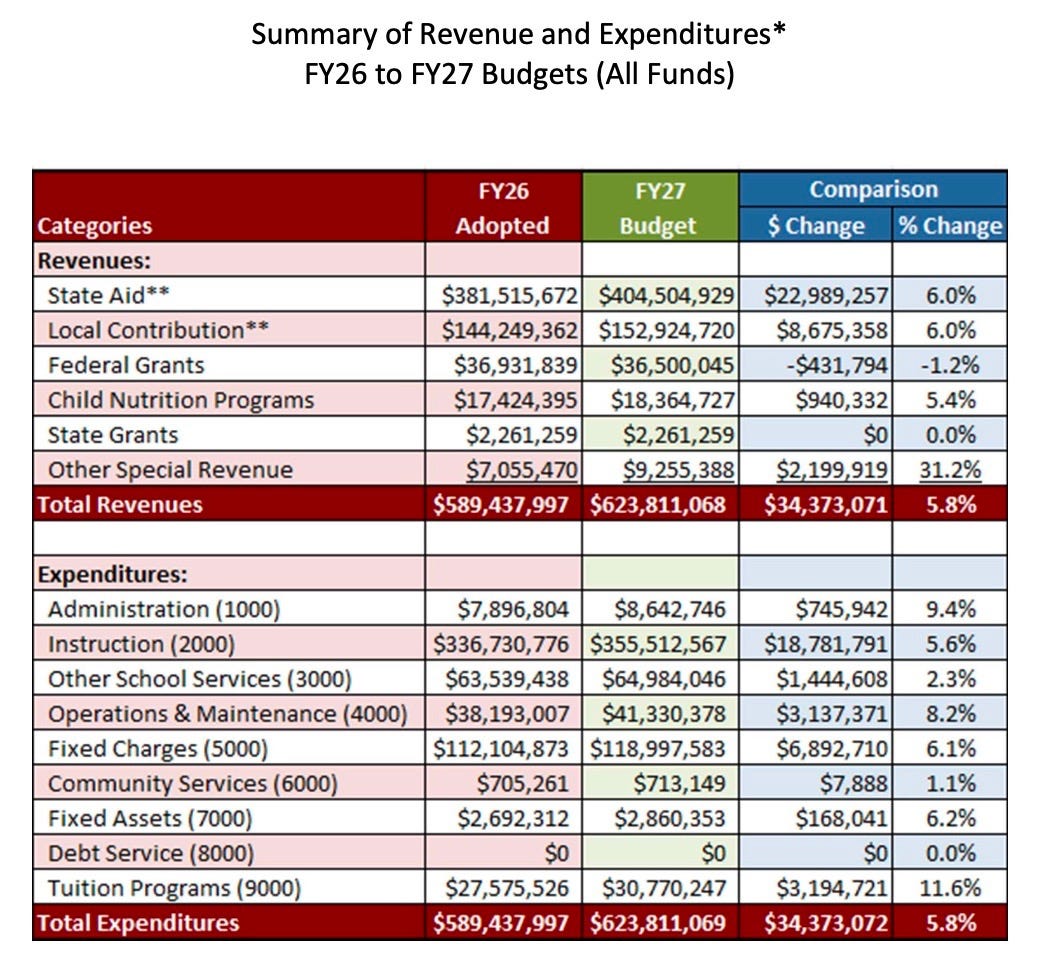
The WPS budget office released the proposed FY27 budget book, and as usual they do an excellent job laying out where the money comes from, where it is going, and how that connects to the district’s strategic plan. What I write about here is proposed, meaning this is what the district administration is suggesting. The School Committee will now deliberate on the proposal before taking a final vote (hopefully) by June 30.
Unlike the City Council, the School Committee has the power to move money between accounts. In past budget meetings the committee has typically discussed each account line one by one, often asking clarifying questions of the administration. In some cases members must recuse themselves from the discussion on certain accounts due to conflict of interest laws. After the committee goes through each account (which usually takes hours over two meetings) members can make motions on moving money between accounts. Now is your chance to voice your thoughts and priorities by emailing school committee members or attending the Public Budget Hearing, where you can speak for two minutes to the committee. It’s on Thursday, May 28 at 6 p.m. at the Durkin Administration Building.
Here’s a broad overview of key aspects of the budget, as well as some interesting tidbits:
This year’s budget feels very different from last year’s. Last year the conversation centered around restoring positions after a tough $22 million cut in 2024-2025. This year the biggest story is that the district is openly projecting double digit deficits over the next three fiscal years (FY28, FY29, and FY30). That looming financial picture hangs over almost every section of the budget book.
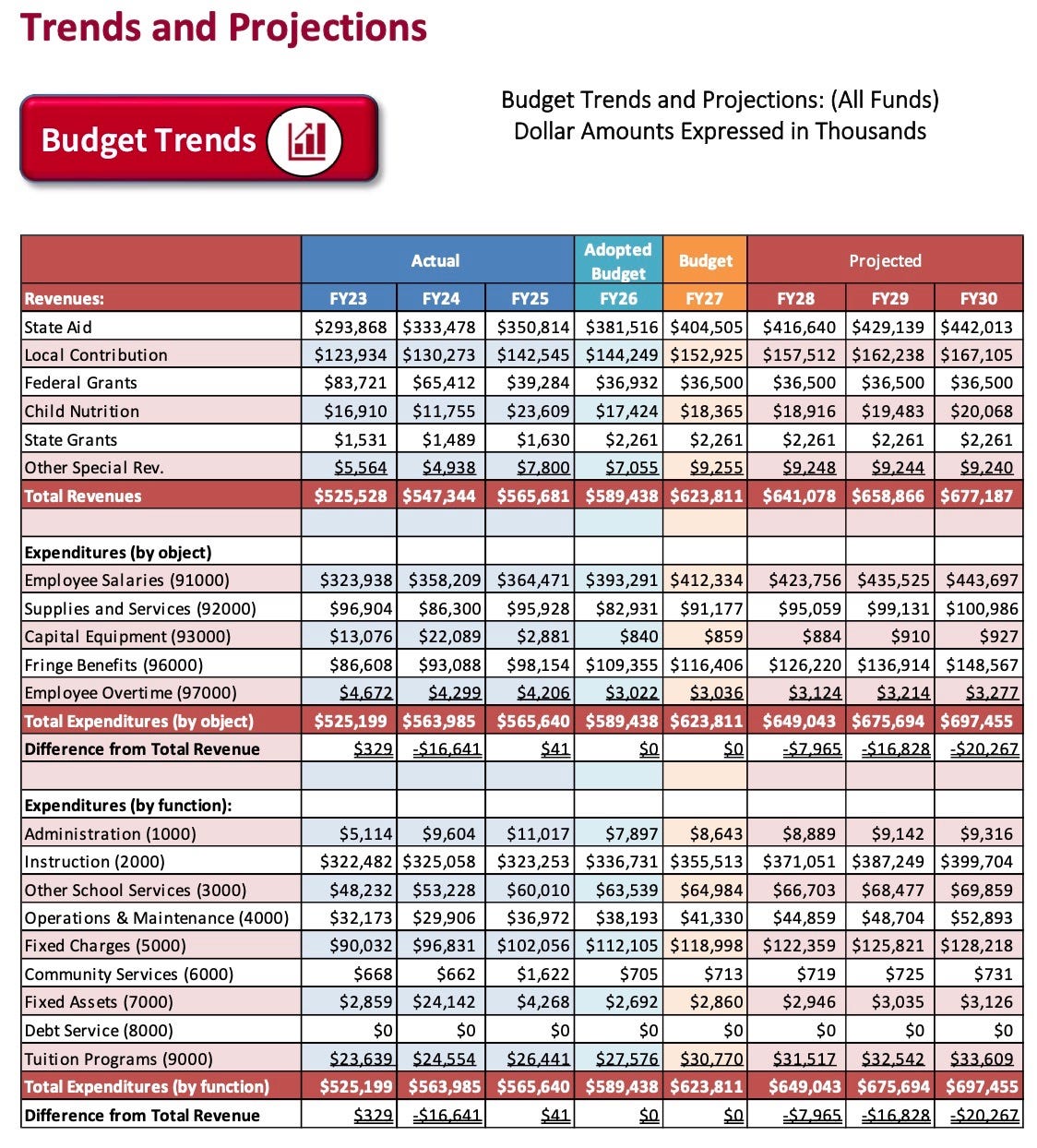
The FY27 budget is $31.6 million higher than last year’s adopted budget. But according to the district, $29.1 million of that increase is needed simply to maintain existing services due to inflationary costs and contractual obligations. That leaves only $2.5 million in actual new spending capacity.
A major reason for this is that many costs continue to rise faster than revenue. There is also a broader structural issue here: the district has relatively little flexibility in where cuts can even be made. Sixty-six percent of the budget goes to salaries, health insurance costs are increasing by 10 percent, and retired employee health insurance costs the district $17.4 million annually. These are not areas where the district has much flexibility to cut. (I also wish more local leaders were paying attention to what it means for Worcester’s economy that its two largest employers–UMass Memorial and WPS–are in sectors facing significant strain.)
These necessary cost increases create one of the most confusing realities in the budget: even though the budget is increasing overall, the district is still reducing positions.
Staffing.
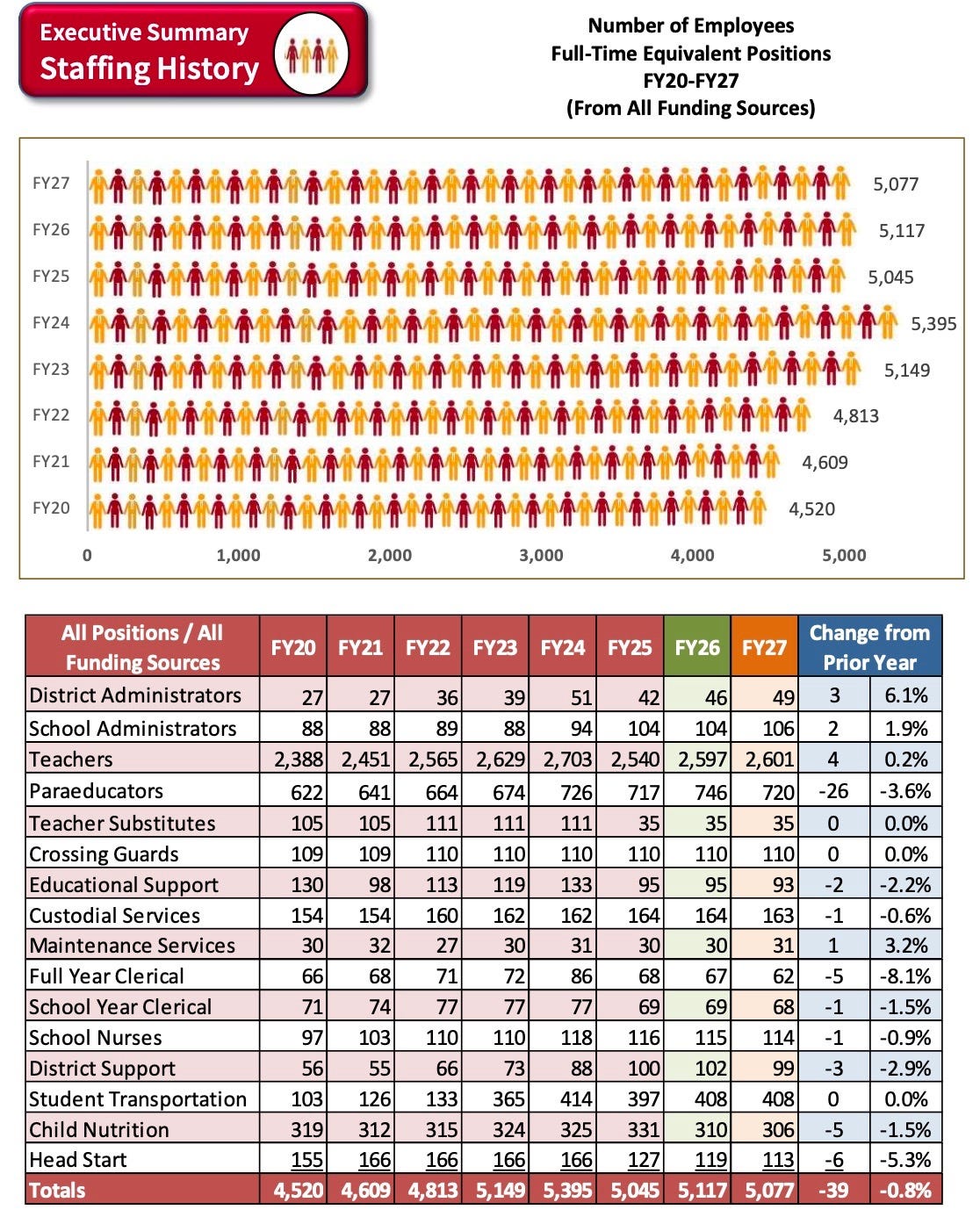
One of the clearest tensions in the budget is that the district says it is using available new funding to increase teacher and instructional support positions, while at the same time the overall number of positions declines by 40. Both statements are technically true, which is part of what makes the budget complicated to follow.
At the elementary level, the district is adding 19 teacher positions, with seven of those being classroom teachers. At the secondary level, the total number of teacher positions remains flat at 877, though enrollment shifts mean the district is adding some positions while reducing others. New positions include Chapter 74 vocational teachers, an innovation pathways coordinator, and some English, math, social studies, and art positions, while nine “core content positions” are being reduced.
There are also reductions in several support areas: special education teacher positions are decreasing by 14, student support service positions are decreasing by three, and paraeducator positions are decreasing by 26. Multilingual learner teacher positions, meanwhile, are increasing by two.
The district is also continuing to expand its use of building substitutes, adding five new positions for a total of 24 building substitutes alongside 50 day-to-day substitutes.
The district appears to be strategically preserving certain priorities, like elementary classroom staffing, multilingual learner services, vocational programming, and building substitutes, while quietly reducing staffing in other areas. That balancing act becomes especially visible in the reductions to paraeducators and special education positions.
Administration and reorganization.
One of the most confusing parts of the budget this year is trying to follow the district’s new organizational chart. I felt like I was solving a Murdle puzzle.
The Positive Youth Development Office has been renamed the Student Support and Engagement Office, to be headed by Thomas Toney. That office, which previously had four employees, will now oversee the Family and Community Engagement (FACE) office and Nursing. FACE was previously under the Personnel, Engagement and Equity division, while Nursing had previously operated as its own department.
At the same time, principals have been moved out of schools into newly created district-level positions, including “Principal on Assignment” and “Manager of Student Support and Engagement.” Yet Woodland Academy, a school where 95.7% of its students are high needs, will spend another year without a principal. The Claremont Academy principal will oversee both schools again next year.
The Director of Equity & Cultivation position has been downgraded to an assistant director role. Translation services are being moved from the FACE office into the communications division. Student Placement & Enrollment, the staff who work at the Parent Information Center, has also been moved from the Personnel, Engagement and Equity Division to School Compliance & Improvement. Have I lost you yet?
Some of these changes may ultimately make sense operationally. But from the outside, it is not always clear what problems the reorganizations are intended to solve, whether they are connected to cost-saving measures, or how families are supposed to navigate systems that keep moving around administratively. The lack of principal at Woodland Academy especially stands out because it reflects a broader pattern of temporary arrangements quietly becoming longer-term realities. What was initially framed as a short-term leadership solution is now extending into another school year.
At the same time, the district continues to emphasize that administration spending remains below the School Committee’s self-imposed cap of 1.5 percent of the general fund budget. That creates an interesting tension in the public conversation, because debates around administration are often less about total spending and more about transparency, organizational clarity, and favoritism.
Technology.
One of the largest percentage increases in the budget is instructional technology, which increases by 65 percent, from $2.6 million to $4.0 million. CFO Sara Consalvo said at the most recent school committee meeting that $1.1 million of that increase is leases for replacement devices.
In 2022, using the Emergency Connectivity Fund, the district purchased 23,000 chromebooks. Those Chromebooks are reaching their end of life, as are staff Macbooks. The district has a transition plan toward leasing student devices because it cannot afford another large one-time purchase. The district is already leasing approximately 6,000 Chromebooks used at the middle school level at $582,000 a year. The budget includes adding 1,000 more Macbooks and 6,000 more Chromebooks through an additional five-year lease. The Macbooks will be $300,000 a year, and the Chromebooks will be $730,000 a year. The Chromebook lease has increased 23% from last year, due to tariffs. The price per Chromebook went up from $97 to $122, a total increase of $750,000 over five years.
By 2030, the district is projected to spend approximately $5.2 million annually on technology leases for Chromebooks, MacBook Airs, and iPads. At the May 21 school committee meeting, Sue Mailman (at-large) requested a report on cost savings for eliminating one to one devices at the pre-K through second grades, which many districts are doing recently (see LA, Cambridge, Pennsylvania).
At the same time, instructional materials funding appears to be decreasing. Traditionally this line has funded things principals buy directly for schools and classrooms, like paper, furniture, art supplies, recess equipment, and similar materials. The district says it is maintaining $75 per pupil for instructional materials, but because schools received $100 per pupil last year, this effectively represents a reduction. The instructional materials line item itself decreases by 9 percent.
Transportation and operations.
The district continues to budget for a new electronic bus pass system that would allow families to track when students get on and off buses, and an updated bus tracker that actually works. This is now the third consecutive year the system has appeared in the budget, but it still has not been implemented. According to the administration, the contract continues to be tied up in negotiations between the city law department and the vendor. Perhaps this is why the budget includes new funding for a designated assistant solicitor from the city law department assigned specifically to the schools.
The budget also notes that the district is reorganizing building maintenance into a quadrant-based support model, though there is not much detail yet publicly available on how that will work.
Other budget odds and ends.
Library Services: The district is supporting library services at the elementary level for the first time in decades through a new circulation management system for seven elementary schools.
Expanding Dual Language: The district is expanding two-way dual language in Spanish/English by adding 7th and 8th grade to Worcester Dual Language Magnet School. As you might remember from my road map to improving literacy, longitudinal research over decades has shown that dual language programs have an “astounding effectiveness” for ALL students, especially students with disabilities and monolingual students of low socioeconomic status, not just English learners.
Community: There is $35,000 allocated to the Worcester Education Development Foundation for “public relations and alumni services” and another $105,000 is budgeted for adult education services provided by the Latino Education Institute. (It confuses me that these services don’t have to go out to bid?)
Athletics: The district is adding unified basketball and unified track, as well as freshman volleyball and additional indoor and outdoor track teams.
That’s the broad overview of the proposed FY27 budget. More questions will likely emerge as the School Committee begins deliberations over the next several weeks. But the clearest takeaway from this year’s budget is that even as the district continues trying to preserve and improve services, the projected deficits looming over the next three years are going to shape nearly every financial decision moving forward.
Bits and Bobs.
What happened at the May School Committee Meetings and Standing Committee Meetings:
Public Comment.
There was about an hour of public comment at the May 21 meeting, with frustration expressed about the closing of Worcester’s alternative schools as well as parents and students requesting more accountability around the district’s bullying prevention and intervention plan.
2026-2027 Student Handbook.
Many policies in the district are changed through the student handbook updates, and the handbook for next year has some changes approved by the school committee at the May 7 meeting. Some quick highlights:
The voluntary transfer policy (the way students living in Worcester request to attend a school outside their boundary zone) was updated to remove a part that allows students who change residences in, or the summer leading up to, 6, 8 or 12 grade to remain in their current school with principal’s permission.
The student dress code policy changed to a more generic policy, removing many of the specific descriptions such as undergarments must be covered, no backless shirts, no hats or bandanas, while also removing explicitly allowed items such as durags and religious and cultural headwear.
There is a new item added to the network unacceptable use policy: “Creating, altering, or distributing digitally manipulated content, including images, audio, or video (including content generated through artificial intelligence or other technologies), that impersonates, misrepresents, humiliates, intimidates, or harms another student, staff member, or member of the school community.”
A change in language for exemption from the sexual health curriculum requires that caregivers exempt their child from all the lessons of the curriculum, rather than particular portions.
Grades for academic eligibility for athletics will now be official on the next school day following the date on which the faculty are required to have submitted grades into the Student Information System. Previously it was when report cards were issued.
Turf Fields.
The School Committee revisited the ongoing discussion around the use of turf athletic fields in Worcester Public Schools, a conversation that carries added significance as the district looks ahead to the eventual replacement of Foley Stadium and the construction of a new Burncoat High School. Sue Mailman (at-large), who requested the original report, made three motions requesting all environmental reports used by the Turf Field Committee, the installation of thermometers on playing fields, and a report on field temperatures. The Committee voted 5-3 to hold the item along with Mailman’s motions for further review, with Biancheria, Roy and Guardiola voting no, and Mayor Petty absent from the vote (he’s been absent for a lot of meetings lately…). The discussion reflected continued concern from some members about student safety, environmental impacts, and long-term planning for athletic facilities across the district. As Worcester prepares for major future capital projects, questions around the type, cost, and safety of playing surfaces are likely to remain part of the broader facilities conversation.
Multilingual Learners.
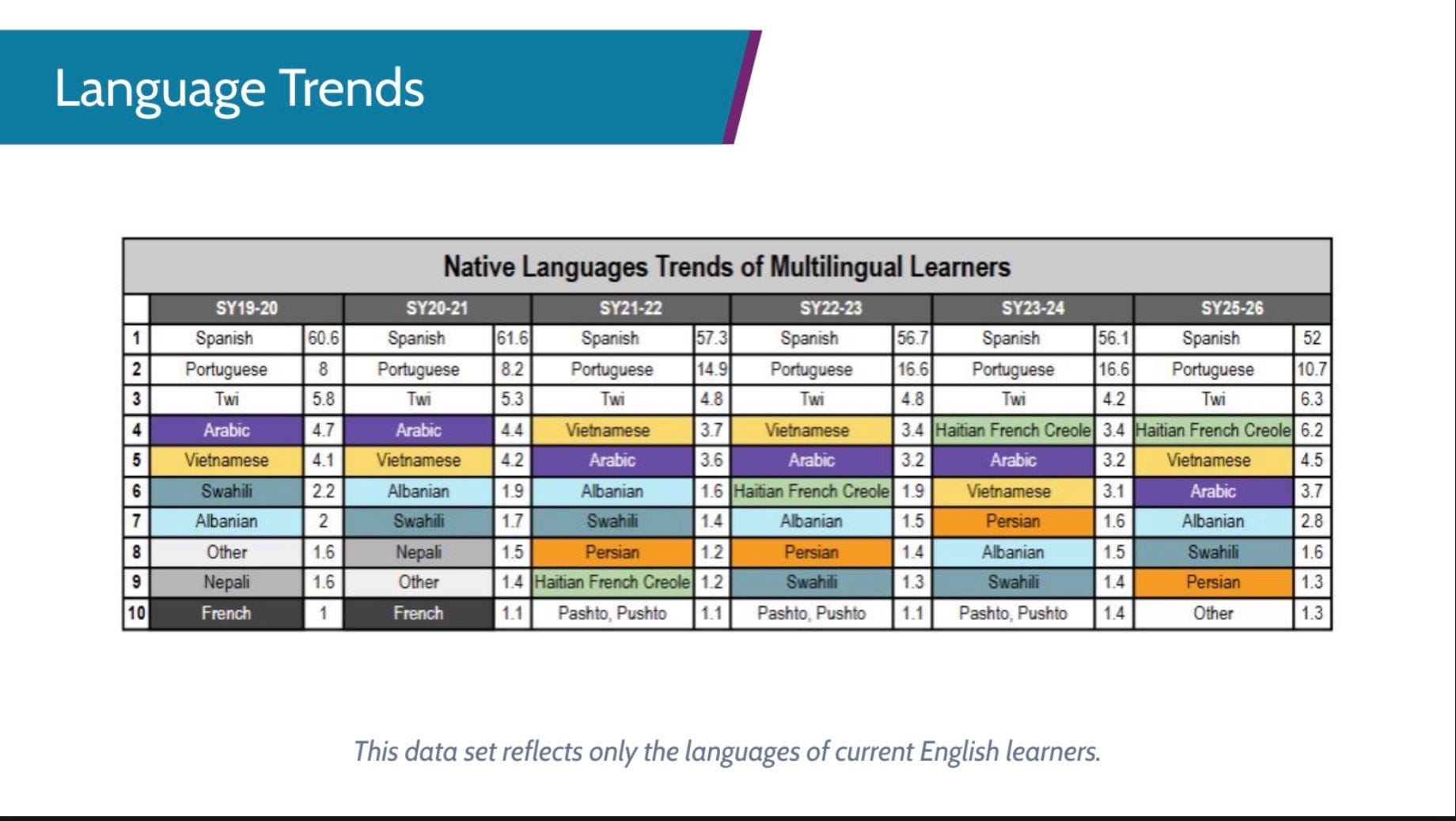
At the May 21 meeting, the Multilingual Education department shared encouraging data showing that English learners are exiting language support programs at higher rates than they were five years ago. This year, 966 of 7,266 tested English learner students exited the program — a 13.3% exit rate compared to 9.3% in 2019. Worcester currently has about 7,740 English learner students, representing roughly 31% of the district, but the district also monitors about 2,000 recently exited students, meaning around 41% of students are being served by the office in some capacity. Students in Worcester speak more than 70 languages, with Spanish being the most common.
Director of Multilingual Education Jessica Mandes said the progress comes from a focus on rigorous instruction, educator support, and recruitment and retention efforts. The office has embedded multilingual learner strategies into curriculum maps across grade levels, strengthened collaboration with special education to better support dually identified students, and expanded partnerships and training opportunities for educators. Looking ahead, the office plans to strengthen the dual language program at the high school level, continue professional development around the new ESL curriculum, and support newcomer programs as the New Citizen Center closes at the end of this school year.
College and Career Highlights.
Dr. Emily Lehman, Administrative Director of College and Career Readiness, and Dan St. Louis, Director of Early College, presented a report on College and Career opportunities in Worcester Public Schools, highlighting growth in both Early College and Advanced Placement (AP) programs. The report outlined six Early College pathways available to students and noted that 1,362 participants have earned a combined 7,696 college credits, with 160 students earning more than 12 credits each. Over seven AP subject areas, WPS students completed 2,820 AP exams in 2025, with 51% earning qualifying scores, a percentage that has steadily increased since 2022.
The presentation also highlighted the continued expansion of Worcester Night Life, which now offers more than 80 in-person workforce development classes annually, and the Worcester Adult Learning Center, which provides no-cost education opportunities including high school equivalency, CNA certification, and English language learning courses, with priority enrollment for WPS parents.
Upcoming Dates.
All school committee meetings have virtual options with Spanish translation. See the school committee site for more information.
Public Budget Hearing is May 28, 5:00 p.m. at DAB
Teaching, Learning and Student Supports is May 28, 5:00 p.m.
School Committee Meetings to discuss the budget are June 4 and June 17, 4:00 p.m.
Operations and Governance is June 8, 5:00 p.m.
Teaching, Learning and Student Supports is June 11, 5:00 p.m.
That’s it. Have a great end to the school year! And please consider a paid subscription to Worcester Sucks and a tip to support my work.
Thank you for reading the entire budget and explaining it so well!
Yes, thank you! Yay about the libraries (did they look into TinyCat as collection management system?) and dual language programs! But that is REALLY CONCERNING about still having 1 principal oversee both Woodland and Claremont: one of them is going to get short-changed by the split attention. And your point about it following the worrying Worcester pattern of temporary things becoming permanent is spot-on.