

Worcester Public Schools released its second districtwide redistricting scenario last week and consultants from Dillinger Research and Applied Data presented it at the September 16 Operations and Governance meeting. You can review the presentation, demographic data, and interactive map. This is still a draft. Another scenario is expected in October, implementation details have not been decided, and the School Committee is not expected to vote on final recommendations until December. If you are new to what’s going on with redistricting, read my initial redistricting overview from March and my overview of scenario 1.
Scenario 2 tells us a lot about what the district heard after the first proposal, and which tradeoffs it is now willing to make.
Let’s dive in.
What changed?
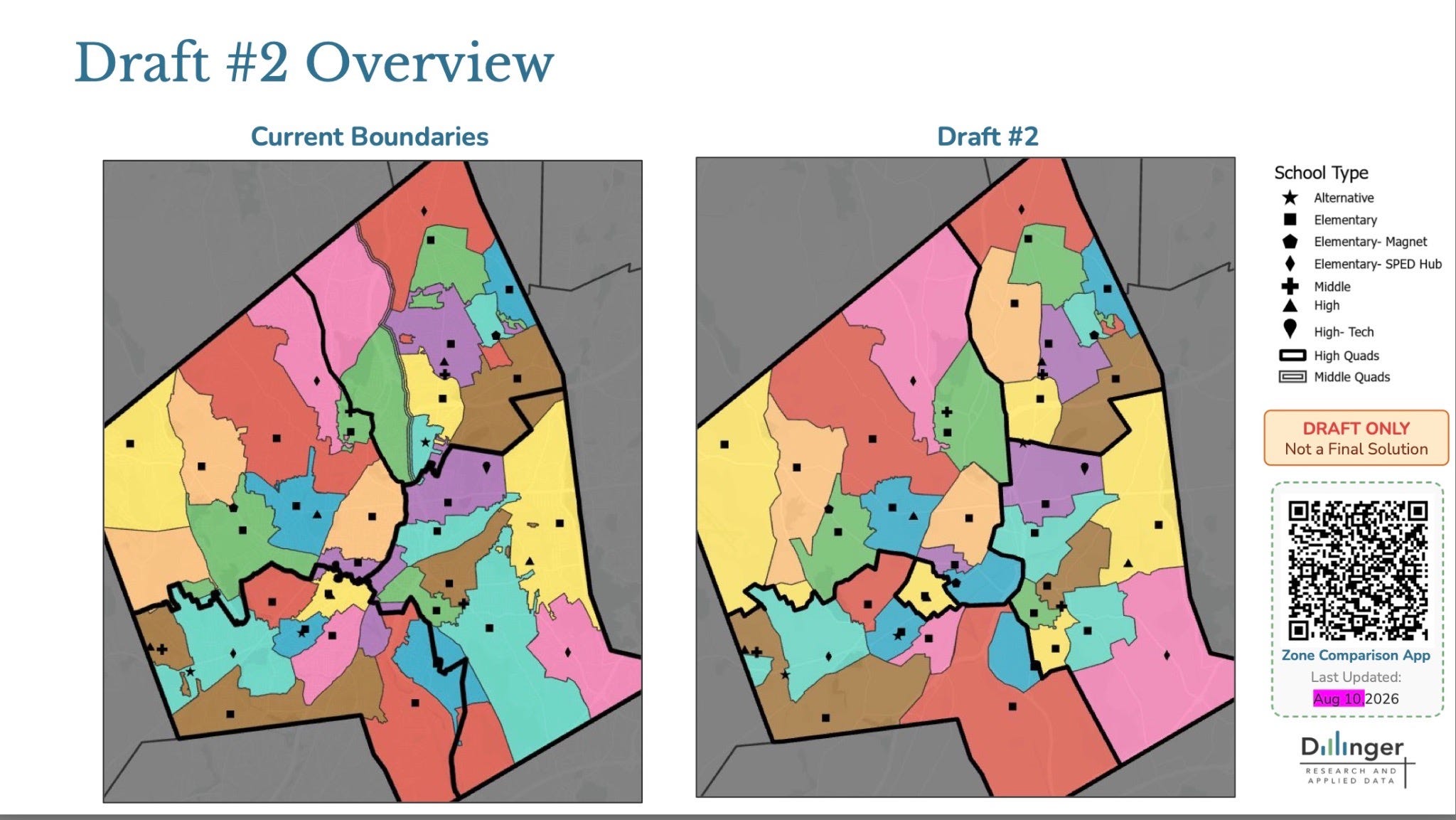
The biggest change is that the new scenario backs away from several of Scenario 1’s most controversial proposals.
Worcester Arts Magnet will remain in its current building.
Francis McGrath will continue as a neighborhood elementary school.
The area where a parent spoke about how that they had purchased a home specifically for access to Nelson Place and Forest Grove was moved back to Nelson Place. The revised boundary also returns School Committee member Molly McCullough’s neighborhood to Nelson Place after she advocated for an alternative boundary to keep it from being moved to Norrback.
Belmont Street will remain in the North Quadrant instead of moving to Burncoat.
Columbus Park will remain in the South Quadrant instead of moving to Doherty.
Jacob Hiatt will still become a neighborhood school, but it will remain in the Doherty Quadrant rather than moving to South.
Instead of converting the current WAMS building into a neighborhood school, Scenario 2 proposes opening a new PreK–6 school in the Greendale Head Start building, largely by dividing the current Thorndyke school community—although the new zone would also draw from several surrounding schools. Head Start could then move to the University Park Campus School building, while WPS explores some kind of merger or co-location between UPCS and Claremont. None of that has been decided.
City View sixth graders would go to Worcester East Middle, joining Rice Square and Grafton Street sixth graders. (Can we make every Worcester middle school grades 6-8? The grades 7-8 model feels increasingly outdated.)
The proposed school-day order has changed, too. High schools would still begin first at the brutal start time of 7:15 a.m., but elementary schools would move to the 8:15 a.m. tier and middle schools would start at 9 a.m. Those times are still under consideration.
What stayed the same?
The central structure of the proposal remains. Every neighborhood elementary school would feed into one middle school and one high school and the district’s nine split pathways would be eliminated. Granite Street would reopen as a PreK–6 neighborhood school in the current Gerald Creamer Center building, and GCC would move to the Fanning Building. The district would work toward having a preschool classroom in every elementary school. Voluntary transfers still have to be addressed, because boundaries cannot balance enrollment if large numbers of students continue attending schools outside their assigned zones.
The proposal does a much better job of matching students to available elementary space. Today, elementary utilization ranges from roughly 57% to 113%. Scenario 2 narrows that range to approximately 73% to 90%, with no elementary school modeled over capacity. But I have questions about the low end of that range.
Nelson Place—the newest elementary school in the district—would be the least utilized at approximately 73%, while Lincoln Street would be the highest at 90%. Lincoln Street is in a part of the city where the consultants anticipate enrollment growth, which is one reason they originally proposed converting the WAMS building into a neighborhood school and moving the arts program elsewhere. To me, it does not make sense to leave the newest school in the district (which has AC! And is ADA compliant! etc.) so underutilized. Seventy-three percent leaves a lot of empty space.
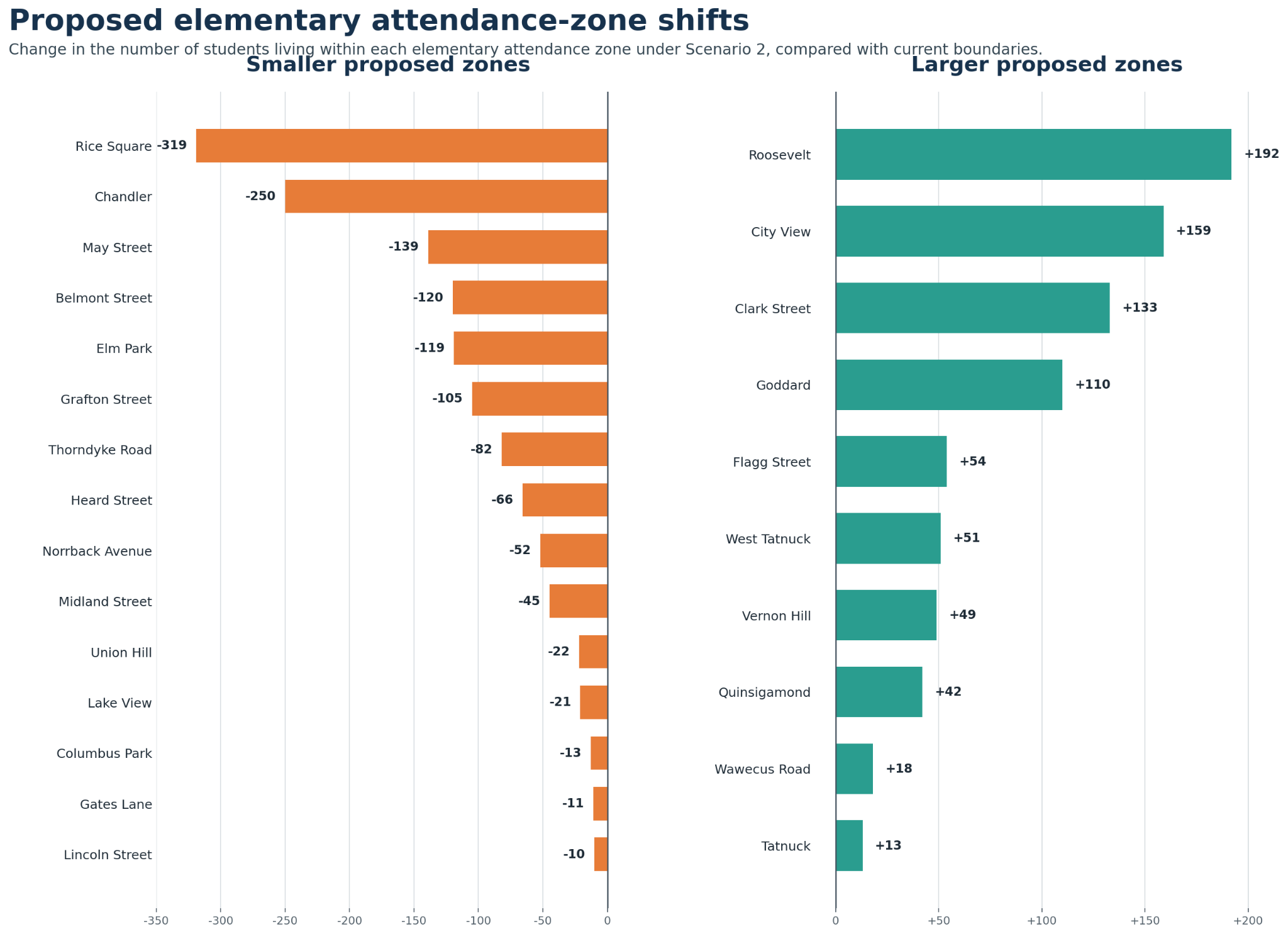
In terms of individual attendance zones, the largest reductions would be at Rice Square and Chandler. May Street, Belmont Street, Elm Park, Grafton Street and Thorndyke Road would also have substantially smaller zones. On the other side, Roosevelt, City View, Clark Street and Goddard would receive substantially larger zones. Flagg Street, West Tatnuck, Vernon Hill and Quinsigamond would also serve larger areas.
The chart below shows the net change in the number of students living within each elementary attendance zone, not the change in current school enrollment. It excludes the new Jacob Hiatt, Greendale and Granite Street zones because they do not have current attendance zones to use as a baseline. In other words, the chart shows how many students would be added to or removed from each school’s geographic zone, not necessarily how many students would enter or leave the school.
Less disruption, but less integration.
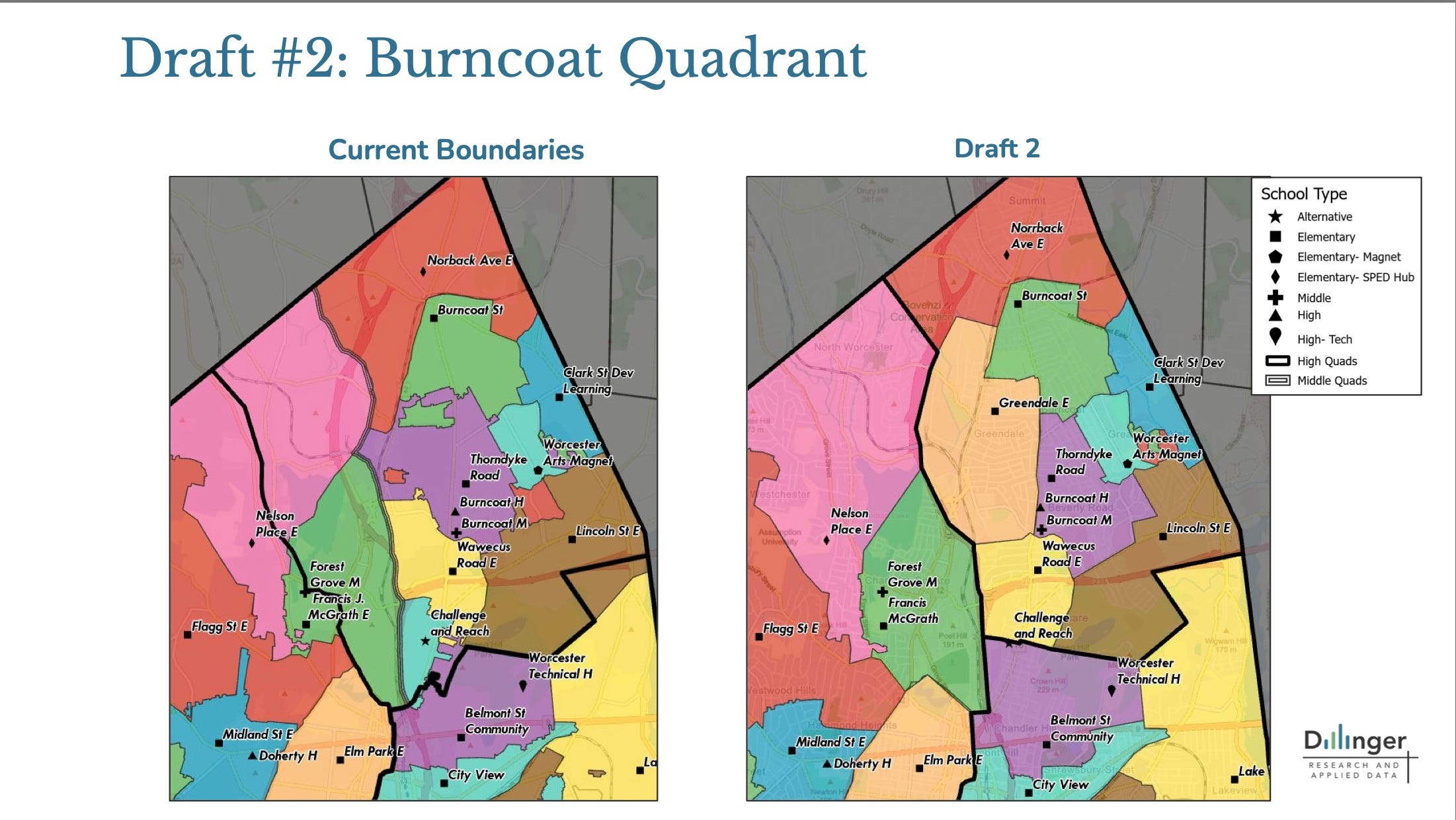
Scenario 2 preserves more existing schools and neighborhood assignments. That makes it less disruptive, but it does not necessarily make it more equitable. Nelson Place, McGrath and Norrback are the clearest examples. Scenario 1 would have ended McGrath’s neighborhood program and incorporated much of its zone into Nelson Place. It also would have created a much more economically diverse Norrback zone. Under that proposal, Nelson Place would have been approximately 48% low income and 24% multilingual learners, while Norrback would have been 46% low income and 21% multilingual learners.
Scenario 2 keeps McGrath separate and largely restores the existing demographic divisions. Nelson Place would be only 31% low income and 13% multilingual learners. McGrath would be 69% low income and 38% multilingual learners. Norrback would also be 69% low income and 26% multilingual learners—almost identical to the demographics of its current geographic zone.
The racial differences are also significant. Nelson Place would be 53% white and 18% Hispanic. McGrath would be 31% white and 43% Hispanic, while Norrback would be 26% white and 39% Hispanic. The underlying group of children is not dramatically different, but Scenario 1 would have educated more of them together. Scenario 2 preserves three distinctly different school communities: a comparatively affluent Nelson Place and much higher-needs populations at McGrath and Norrback.
Something similar happens around Thorndyke Road. The new Greendale school, created so WAMS can remain in its current building, is formed largely by dividing the current Thorndyke community, although it also draws pieces from several surrounding zones. Greendale is projected to be 57% low income and 23% multilingual learners. The remaining Thorndyke zone would be 67% low income and 28% multilingual learners. Among students currently living in the Thorndyke zone, approximately 58% are low income and 22% are multilingual learners. Scenario 2 would therefore increase those shares by roughly nine and six percentage points, respectively.
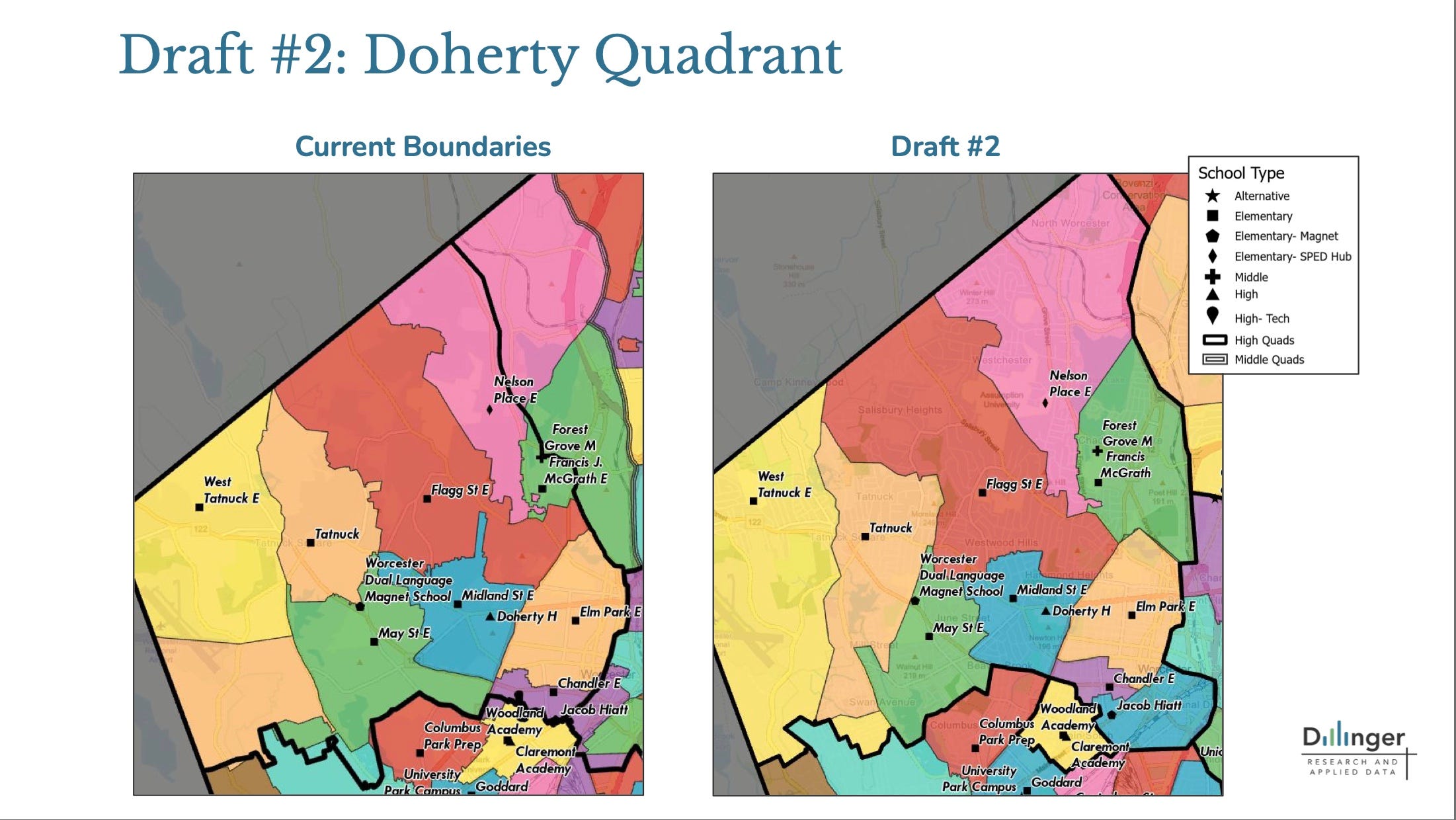
West Tatnuck and (East) Tatnuck provide another example. Under Scenario 1, the two schools would have been very similar economically: West Tatnuck would have been approximately 48% low income and Tatnuck 51% low income. Scenario 2 moves them in opposite directions. West Tatnuck falls to 37% low income, while Tatnuck rises to 59%. In other words, a three-point difference between the two schools in Scenario 1 becomes a 22-point difference in Scenario 2. The racial changes are more mixed, and the multilingual-learner percentages remain relatively close, but the economic separation between two neighboring school communities becomes much larger.
Districtwide, Scenario 2 does not produce dramatically worse demographic numbers than Scenario 1. But districtwide averages can obscure that the revised map abandons some of Scenario 1’s limited opportunities for integration.
The quadrant lottery model.
At the middle- and high-school levels, boundaries alone cannot balance enrollment. Worcester’s buildings do not line up neatly: North and South have more students than their high schools can accommodate, while Doherty and the new Burncoat High have available space. Scenario 2 proposes addressing this through quadrant-based proportional lotteries for specialized programs, including career technical programs, Goddard Scholars, the Hanover Insurance Academy for the Arts and the Burncoat Arts Magnet pathway. I think this is one of the most important proposals in this second draft.
As an example, the current Burncoat Arts Magnet High School program enrolls 345 students. Of those, 211—61%—come from the Burncoat Quadrant. Only 12 students, or 3.5%, come from the South Quadrant. Burncoat Quadrant students are dramatically overrepresented in a program that is supposed to serve the entire city. If a program is intended for students throughout Worcester, its enrollment should reflect students throughout Worcester. Worcester Technical High School already uses proportional representation to ensure students from different schools have access. WPS should apply that same principle more broadly.
Goddard Scholars, for example, already selects students based on Star scores. If the program expands, seats could be allocated proportionally among elementary schools and offered to the highest-scoring eligible students within each school. That would preserve the existing academic criterion while ensuring that high-achieving students are identified throughout Worcester, not primarily in schools or neighborhoods that are already overrepresented.
As the parent of children attending a true citywide magnet school, I believe that if WPS says a program is available to all students, it needs to be genuinely accessible to all students. That requires transparent admissions, proportional access and public reporting on who actually gets the seats.
And where is dual language?
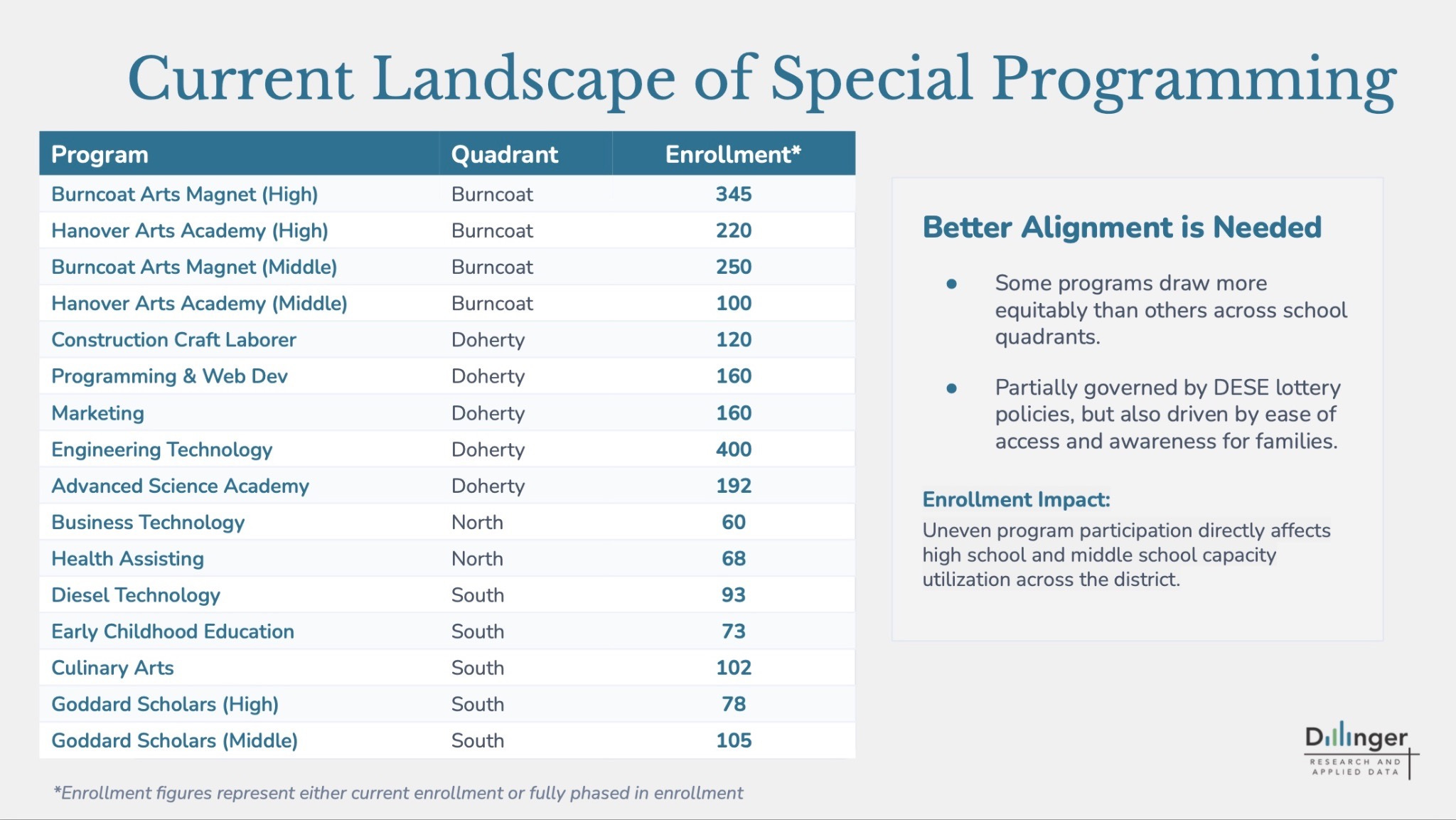
The presentation included a list of specialized middle- and high-school programs being considered in the lottery and capacity discussion. Dual language was not on it. When School Committee member Molly McCullough asked whether the high-school dual-language program would remain at Burncoat, the answer was essentially. ‘the district is still figuring it out.’
As a dual-language graduate and now a dual-language parent, I find that infuriating. Worcester has spent years building Spanish–English dual-language pathways at Worcester Dual Language Magnet School and Woodland Academy. In November 2025, the School Committee approved a district dual-language plan with goals for developing a strong pathway through high school. Less than a year later, WPS is redesigning feeder patterns and specialized programs across the city, yet dual language did not even appear in the presentation. Families still do not know what will happen after eighth grade. It is deeply discouraging, and speaks volumes about the district’s priorities, or, in this case, its lack of priority for dual language.
If you’ve been a longtime reader, you know I will shout this from the rooftops: research shows that dual language is one of the strongest educational models we can offer for ALL students, regardless of background. Worcester is uniquely positioned to provide robust dual-language programming. We have thousands of multilingual students, experienced multilingual educators, two established programs and a School Committee-approved plan. Bilingualism and biliteracy are academic assets, workforce skills and central parts of who Worcester’s students are. A strong districtwide plan should include a clear PreK–12 pathway, equitable access for students from both programs, transportation that makes participation realistic and opportunities that expand rather than narrow as students get older.
Our students’ multilingualism is an enormous strength. Why does WPS keep shelving dual language instead of developing it to its fullest potential?
What happens next?
Right now, the district is asking for feedback, and this is where your input can be especially helpful. Families can see their current and proposed assignments and submit feedback through the district’s Community Input Mapping Tool or email alignment@worcesterschools.net. Of course, look at what the proposal means for your own family. But also look at the bigger picture: Does it use our buildings more fairly? Keep neighborhoods together? Create clearer pathways for students? Expand access to programs and opportunities?
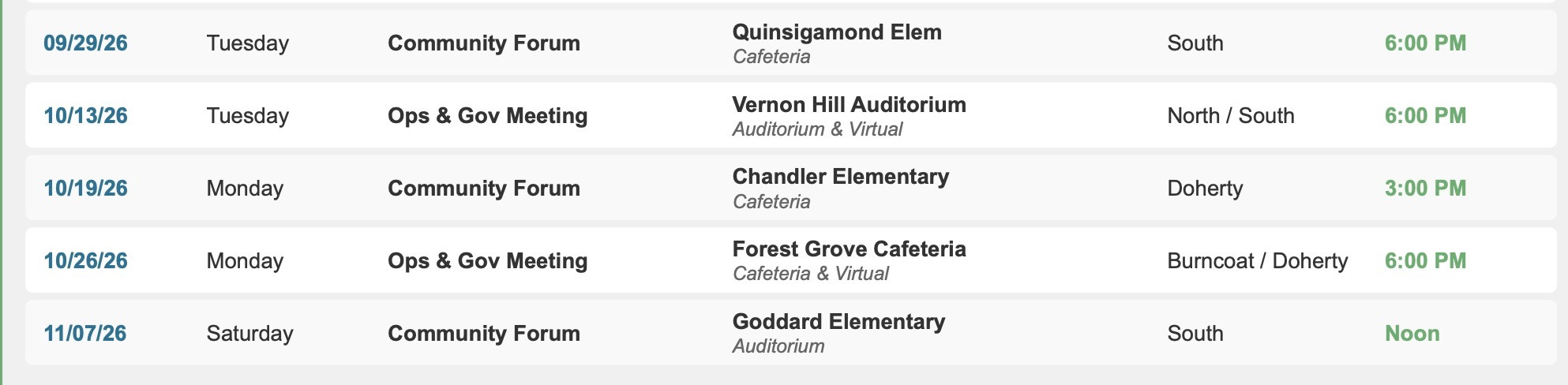
Final scenarios are expected to go to the School Committee in December, following public meetings and community forums throughout September, October and November (see below).
If you found this explainer helpful, please share it with others to help keep our community informed. And if you appreciate this work and want to support more independent coverage of Worcester Public Schools, please consider becoming a paid subscriber.