


The next school committee meeting is scheduled for March 5 with executive session at 5 p.m. and the regular meeting starting at 5:30 p.m., depending on how long executive session takes. See the full agenda here. You can watch it via zoom or Youtube Live. Spanish translation is available on zoom.
Since there was a meeting last Thursday, the agenda is slim.
Here’s what’s on it:
Executive Session.
Executive session includes review of executive session minutes, a grievance, and three open meeting law violation complaints. Two of those open meeting law complaints are from me; one is around a request for executive session minutes and the other is regarding the committee following its own rules when it comes to policy approval.
Report of the Superintendent.

This meeting’s report is on the Vision of a Leader, an effort that comes out of the strategic plan and aligns with the district’s Vision of a Learner.
School Accountability and MCAS.
The district has a report back in response to two items from Jermaine Johnson (district F) and Alex Guardiola (district D) around district accountability and MCAS. The report outlines three key indicators in the state’s accountability report: MCAS scores, chronic absenteeism, and graduation rates. This report is specifically for Hispanic students, English learners, and students with disabilities. The report also outlines ways schools are trying to motivate students to take the MCAS seriously, including “friendly competitions.”
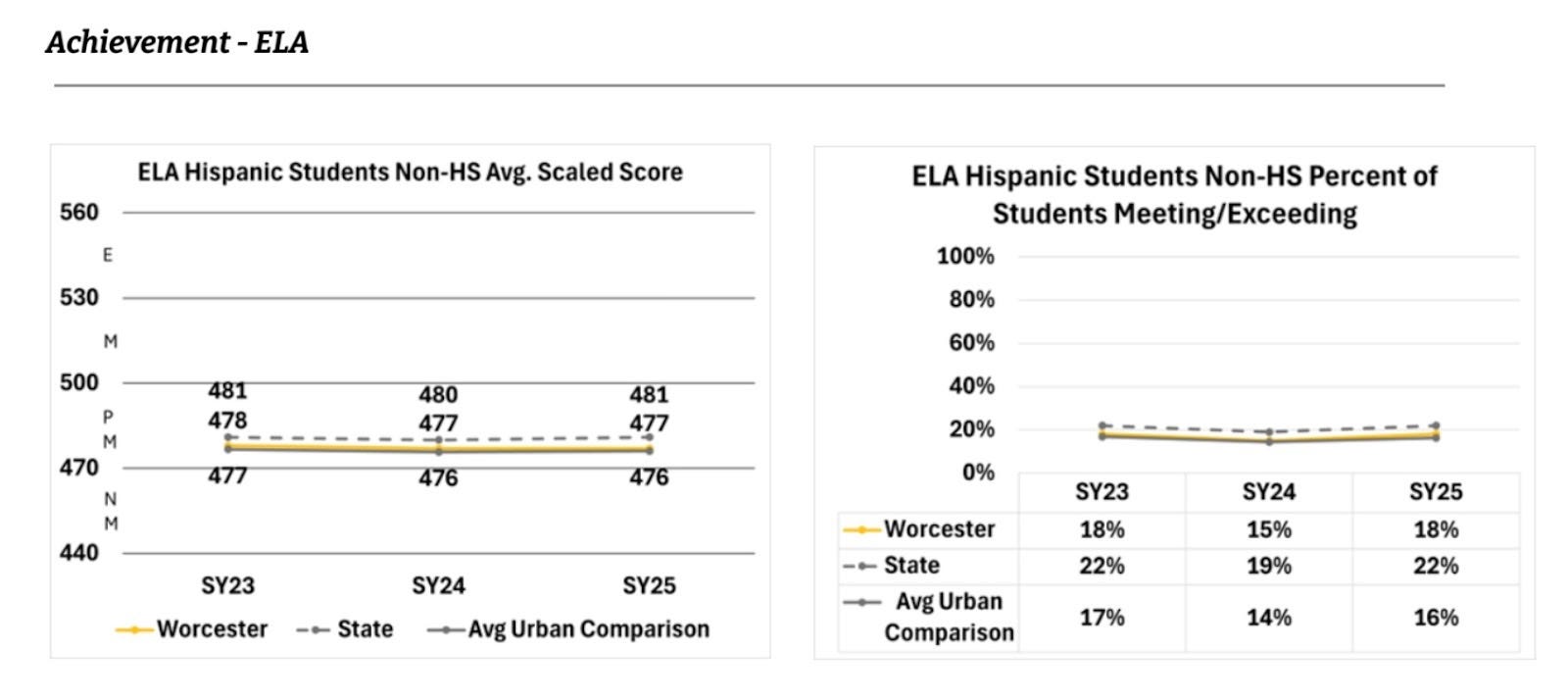
As you see in the chart above, the pattern from previous years continues, with scores fluctuating the same way as the state. This fluctuation continues to raise questions of the validity of the MCAS as an assessment. In terms of the breakdown between the different student demographics in the report, one thing worth noting is the high degree of intersectionality for the Hispanic and English learner groups–last year about 45 percent of English learners also identified as Hispanic. This overlap means that when looking at testing data, nearly half of the Hispanic subgroup’s test scores are heavily influenced by language proficiency. It’s also worth noting that 2025 was the first year some students could take math, science and civics MCAS in Spanish. At the end of the report is an extensive description of the district action plan to improve these metrics, as well as a section on roles and responsibilities.
If you read me frequently, you know that when standardized tests come up I will continue to emphasize that:
Out-of-school factors have the biggest impact on MCAS, like language spoken at home, family income, and parent’s education.
Research shows that children who are bilingual and biliterate outperform their monolingual peers on standardized tests, something that is true in Worcester, where former ELs in elementary school have the highest percentage meeting or exceeding expectations on the MCAS of any demographic group.
One third of Worcester’s student body is a year younger than every other district in Massachusetts, so developmentally it is not an equal comparison.
And repeat after me: MCAS scores ≠ literacy rates!
That’s it. Have a good week! If you have feedback you can always get in touch: aislinn.doyle@me.com