

Hey Bill here real quick. Very excited to share this piece! It’s a new look for WPS In Brief and I think you’re going to like what you see. Just a reminder that everything on Worcester Sucks is free to read but not free to produce. Aislinn and I and everyone else who contributes work hard to provide the local news and analysis the city otherwise lacks and badly needs. Please consider supporting our work! Via a paid subscription ideally, or a contribution to the tip jar or a merch order or Venmo Aislinn directly. Ok! Now to the work.

Imagine you have an eight-year-old and a five-year-old, and you need to bring them to a 5:00 p.m. school subcommittee meeting.
You pick them up, race through the McDonald’s drive-thru, and park outside the Durkin Administration Building so they can shove chicken nuggets into their mouths and wash them down with Hi-C. With five minutes to spare, you coax them out of the car. Since they’ve had indoor recess again for what feels like the thousandth time this winter, you decide to take the four flights of stairs instead of the elevator, hoping to burn off a little energy before asking them to sit still.
As you climb, you give the speech.
“Remember, this is an important adult meeting. The expectation is that you’ll be quiet and considerate. These are the people in charge of all the schools in Worcester. We need to show respect.”
The eight-year-old asks, “Will there be pizza?”
“No,” you say. “It’s not that kind of meeting.”
You try the spiel again. “Do you both understand what I’m saying?”
You’re answered with two deeply annoyed YES-es
The meeting room is small, about the size of a college seminar classroom. You all sit down in the seats available for the public, and your kids start drawing on the whiteboard on the wall. As you wait for the meeting to start, a school committee member asks other people in the room if they saw the email complaint about snowy sidewalks leading up to Goddard elementary school. The other people say no.
Oh that parent is a pleasure, the school committee member says.
The tone was sharply sarcastic.
You look around the room and think: Is no one going to say anything? Is it just normal for them to talk about parents this way?
The school committee member continues their dismissive diatribe with an I’ll tell you what, it’s not about the snow. It’s because her kid is at that program.
Your jaw drops. The casual disdain is stunning.
Did they really just say that about a parent? About a child? In public?
You sit there with your kids, who you just finished lecturing about respect, and wonder what, exactly, they’re learning right now.
You go home and tell your spouse what happened. They’re appalled too. You sit with it all weekend, replaying the moment and how inappropriate it felt. You weigh the pros and cons of saying something. You ask people you trust for advice. Finally, you decide to email the chair of the school committee and the chair of the subcommittee where it occurred.
You write:
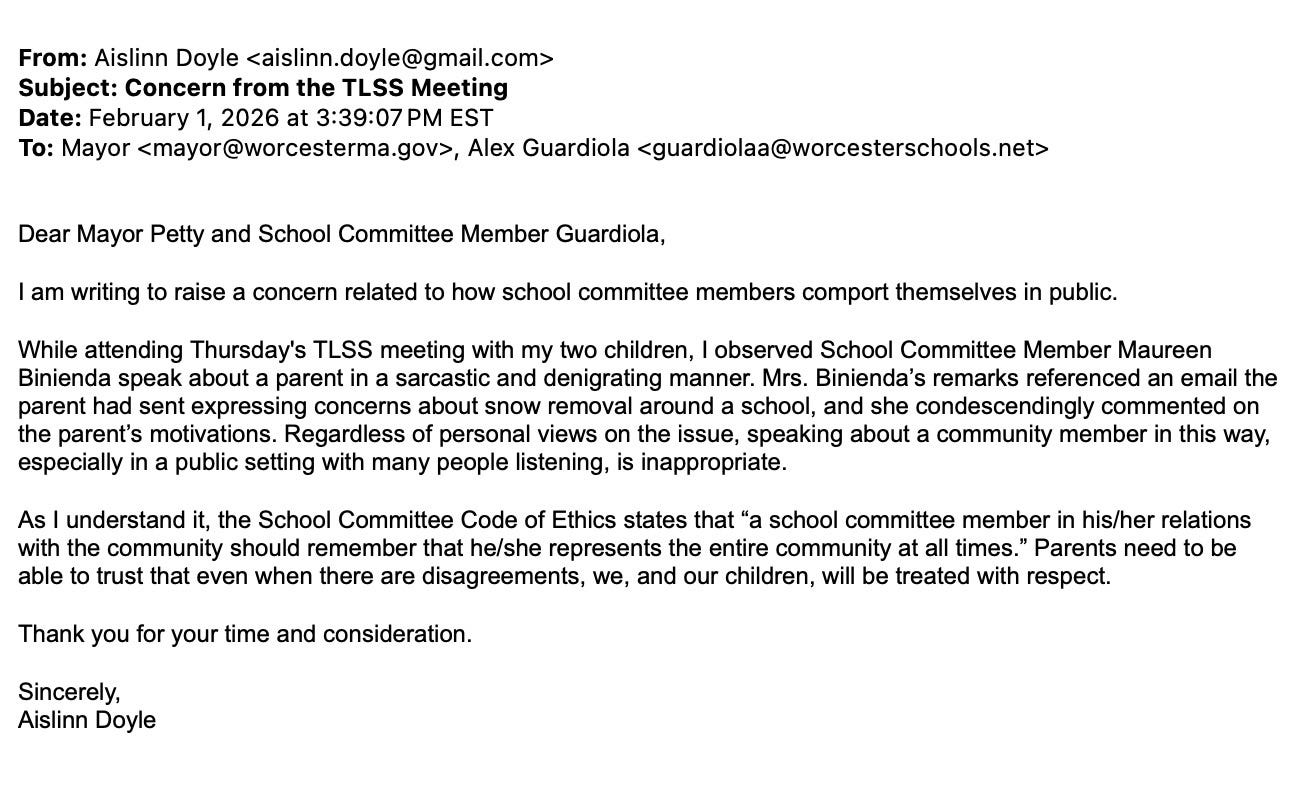
You describe what you witnessed. You don’t speculate about intent. You don’t demand punishment. You simply say that speaking about a parent in what felt like a sarcastic and denigrating way, in public, crosses a line, and that parents need to trust that disagreement will be handled with respect.
The Mayor’s Chief of Staff responds to you two days later:
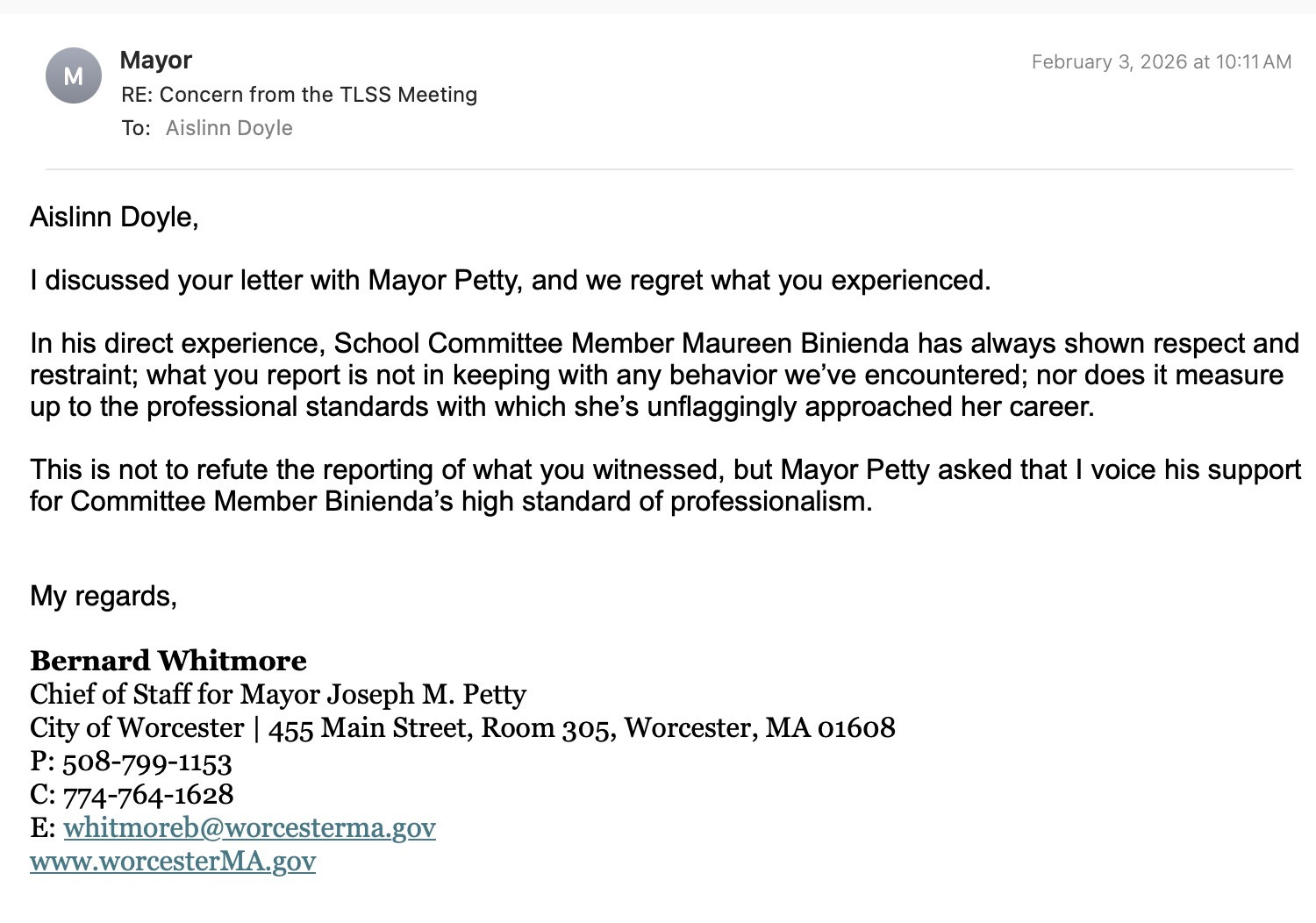
It’s an astonishing reply that centers reputation over accountability and closes ranks. From the office of a mayor who claims to listen, include, work across differences, and bring people together. (Just not people like you, apparently.)
Meanwhile, the aforementioned parent had sent the same email about the snow issue to city councilors. One of them placed an order on the city council agenda about ensuring streets and sidewalks around schools are thoroughly cleared after snowstorms, specifically citing Goddard School of Science and Technology.
Speaking on the item, City Councilor Gary Rosen says:
“I brought up Goddard School because I got a long and very good email from a parent who has a student at the school, I guess in a special program there, and remarkably she notices all that’s going on and she noticed how many students were walking in the street and how dangerous it is.”
How can two elected officials have such different responses to the same email?
Why is a parent’s complaint treated as petty, suspect, and self-interested by one, and as legitimate, civic-minded, and worthy of public discussion by another?
This wasn’t an isolated moment.
We’ve seen this pattern before, most recently at the February 3 teaching, learning, and student success standing committee meeting, where parent concerns about an AI company’s data harvesting practices were consistently reframed through inaccurate assumptions and familiar red herrings. Questions about process became questions about motive. Instead of engaging with what was actually being said, the response appeared to be shaped by what some members already believed parents were trying to do.
That’s confirmation bias, not governance. Those who ask questions are not seen as constituents, but as potential disruptions and variables to be managed. Concerns are filtered not through their merit, but through how inconvenient they are. Inventing narratives about the public to make their advocacy easier to disregard is not okay. When concerns are filtered this way, parents are sorted into “pleasant” and “problematic.” And when the dynamic shows up repeatedly, it stops feeling accidental.
To be clear, this is not true of every school committee member. In the past week alone, I’ve also seen genuine, good-faith efforts to engage on these topics by Vanessa Alvarez, Jermaine Johnson, and Sue Mailman. That looks like doing the research. Asking questions with real curiosity and listening to the answers. It looks like humility and acknowledging what you don’t know, and showing a willingness to step outside familiar bubbles to learn more. It’s about not letting political “loyalties” get in the way of doing the right thing. That’s how trust is built. Even when a vote doesn’t go the way we might hope it will, those good-faith efforts make a difference. They tell us that someone listened, did the work, and was transparent about how they arrived at their decision.
And the contrast between those good-faith efforts and shutting down constituents shows that the problem isn’t disagreement on policy, it’s how power is exercised.
As we climbed those four flights of stairs the other night, I had told my kids that these were the people in charge of all the schools in Worcester. That they deserved respect. What I didn’t have words for was how, sometimes, respect didn’t seem to flow both ways.
If we believe that the main purpose of public schools is to teach kids how to participate in a democracy (which I do), then district governance isn’t a side issue, it’s the curriculum. When constituents are treated as adversaries rather than partners, we’re teaching a very specific lesson about power: who gets to speak, who gets believed, and who gets talked about when they’re not in the room. This is why district governance matters more than we’re often willing to admit. Because kids are always watching, even when we think they’re just quietly drawing on the whiteboard in the back of the room.
So the question becomes, what is the lesson we intend to teach them?
"It’s an astonishing reply that centers reputation over accountability and closes ranks." Regrettably, Ms. Doyle, this reader is hardly astonished. And the response from the Mayor's Chief of Staff is right out of the City Hall Playbook. Demeaning garbage.
As most are aware, when MB was not reappointed as Superintendent by the School Committee, she promptly sought a position on that very School Committee. Hardly showing "respect and restraint", Mayor Petty.
Totally agree that local government is very important as an example (preferably positive) to its citizens. It is disheartening to read what you not only experienced, but the response from the Mayor’s Office which was so evasive and inappropriate. Please do not give up trying to make things better for all students in the WPS. That is what your children will ultimately remember and be inspired by.