

At a time when the global policeman is erratically lashing out, so too is the local policeman. And, locally and nationally, we’re left with a sense of helplessness, nervously watching the frothing mouth and beady amphetamine eyes, knowing they have their straw in our proverbial milkshake and we have no way of taking it out. That the ability to drink our own milkshake is, at minimum, a generational project.
Hey at least it’s fuckin’ uhhh nice out! Aw heck wait…

Today’s post is split duty between myself and Gillian Ganesan, who comes to us this week with the first edition of what’ll be a monthly history column called How Did We Get Here and it has its own section. The first piece is about the Woman’s Progressive Club, a community organization in the city’s Black community that came together to take care of their elderly neighbors.
It’s really great, and the last day of Black History Month is a fitting one to run it. And at a time when senior homelessness is on the rise with only a… new day center sometime next year? to redress a thoroughly Dickensian problem… seems worth a consideration.
Before we get to either, some upcoming events. It’s gunna be a busy month!
—Doing a cool talk about sarcasm in the news at the WPL on Saturday (event page and the library is requesting people pre-register)
“Journalism, Activism, Satire ... What’s the Difference?” Date: 2 p.m. Saturday, March 7 Moderator: Edgar B. Herwick III (host, “The Curiosity Desk,” co-host, “The Culture Show,” GBH) Panel Members: Matt Shearer (Journalist, WBZ News) Brad Petrishan (reporter, Telegram & Gazette) Giselle Rivera-Flores (podcaster, journalist, publicist) Bill Shaner (editor, Worcester Sucks [and I Love It])
—Next Sunday, the second annual Purim Spectacular. “Sloppy and E-Wasted: An Anti-AI Purim Production” I may or may not be making a cameo. In either case, tickets here.
— On the 21st, the Roast of Worcester
I’ll be heading straight from that to…
—Care Giver’s record release show at Ralph’s
Sheesh!
Also, there’s an emergency demonstration in an hour or so at City Hall.

Please consider supporting this outlet also. The money you invest in here goes toward my work, as well as a growing roster of contributors. Aislinn’s February WPS In Brief is up as of this morning. Gillian’s unveiling a new column today as I already mentioned. Shaun dutifully administers his Bad Advice every week, I have a great interview from Dani Killay’s Worcester Speaks awaiting some edits. I have a Worcester history piece I’ve been nursing for years like a little baby finally placed in a major outlet, barring some contract tweaks. It will be hilariously cool for Worcester. Can’t say anymore but just you wait. Not to mention the freakin podcast. What I mean to say with all this is we work hard over here!! And it’s all due to the time and energy for good local journalism afforded by the people who pay for a subscription to this outlet.
Since we’re on the subject of our great contributors, let’s start with Gillian’s piece, then a piece from me synthesizing a week or so of WPD news after that.
Gillian’s column will live from here on out in its own section of the website, and come to your email from that section! The piece you’re about to read is already there in its standalone version. (You can manage the sections you receive and don’t receive in your account settings.)
How Did We Get Here #1: The Woman’s Progressive Club
By Gillian Ganesan
During this time of backsliding and derangement led by a political machine that is explicitly attempting to shrink and inhibit the public consciousness, hiding our nation’s history as it disappears the people who make up our future, I felt that it was a good time to debut a monthly history column: How Did We Get Here? It’s the question I can’t stop asking myself, so I thought together we might try to find some answers. I will write to you about where we live, who our predecessors were, and what they did. I am very excited. And, as it is Black History Month, I thought it would be the perfect time to start this new project.
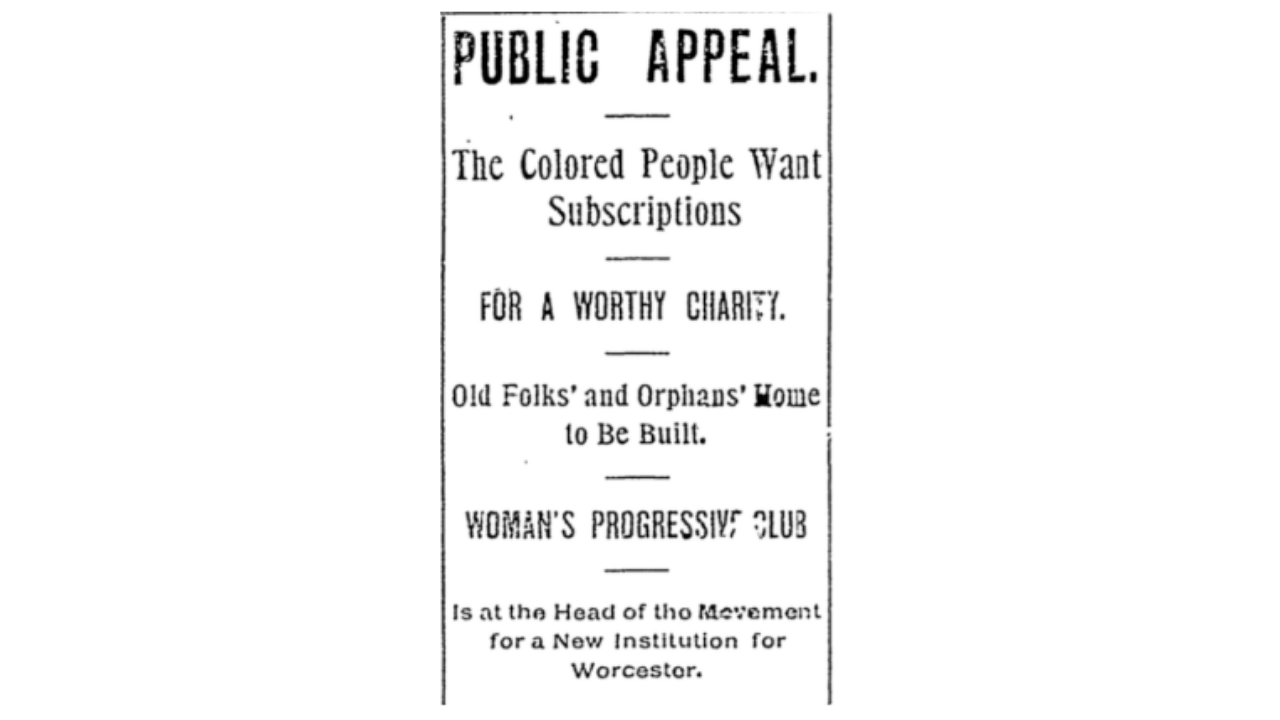
In 1898, a group of women parishioners at the Belmont Street A.M.E. Zion Church gathered together to found an organization dedicated to directly assisting elderly people within their community. They called themselves the Woman’s Progressive Club.1
The turn of the century was the heyday of a national Black women’s club movement, which developed, predictably, as a response to the segregation of mainstream women’s clubs.2 While the Woman’s Progressive Club was a part of this movement, it was different from many women’s groups at the time. Other clubs sought to promote women’s issues, or advance the standing of their members as women—this wave of political self-organization was the origin of the fight for women’s suffrage and first-wave feminism. On the other hand, the WPC acted primarily as a mutual aid organization, run by a group of women who felt empowered enough to meet the needs of others. It says something about the standing of these women in their own community when many felt that they had very little agency; political, social, or otherwise.
Most of the research for this column comes from the Museum of Worcester’s archive. If you’ve never had a reason to visit the research library there, I highly recommend finding one and making an appointment. The head librarian, Wendy Essery, is extremely knowledgeable and helpful, and the library itself is the perfect place to get lost in old documents, which is my version of heaven. I was there for hours just looking through boxes. There’s something incredibly humbling about handling a handwritten record from 1898; it feels like the author just walked out of the room, and she might come back for it at any moment. These records, donated to the museum by the late Stanley Holmes Gutridge, are where I began with this piece.
In the beginning, the Woman’s Progressive Club set out to raise money from within the Black community. This made them distinct: other women’s groups in the city solicited their funding from white patrons, including another Black women’s group, the Lucy Stone Club.3 Their fundraising strategy was an intentional choice by the members of the original Woman’s Progressive Club—self determination and autonomy was a grounding ideal for the organization. One member of the WPC expressed pride in her club’s ability to provide for her community “without appealing to the sympathies of white people.” They sought to sustain themselves mostly from the investment of the community in which they served, which, in their eyes, allowed them to operate with a level of uncompromising principle and agency. Politically, they were several decades ahead of their time.
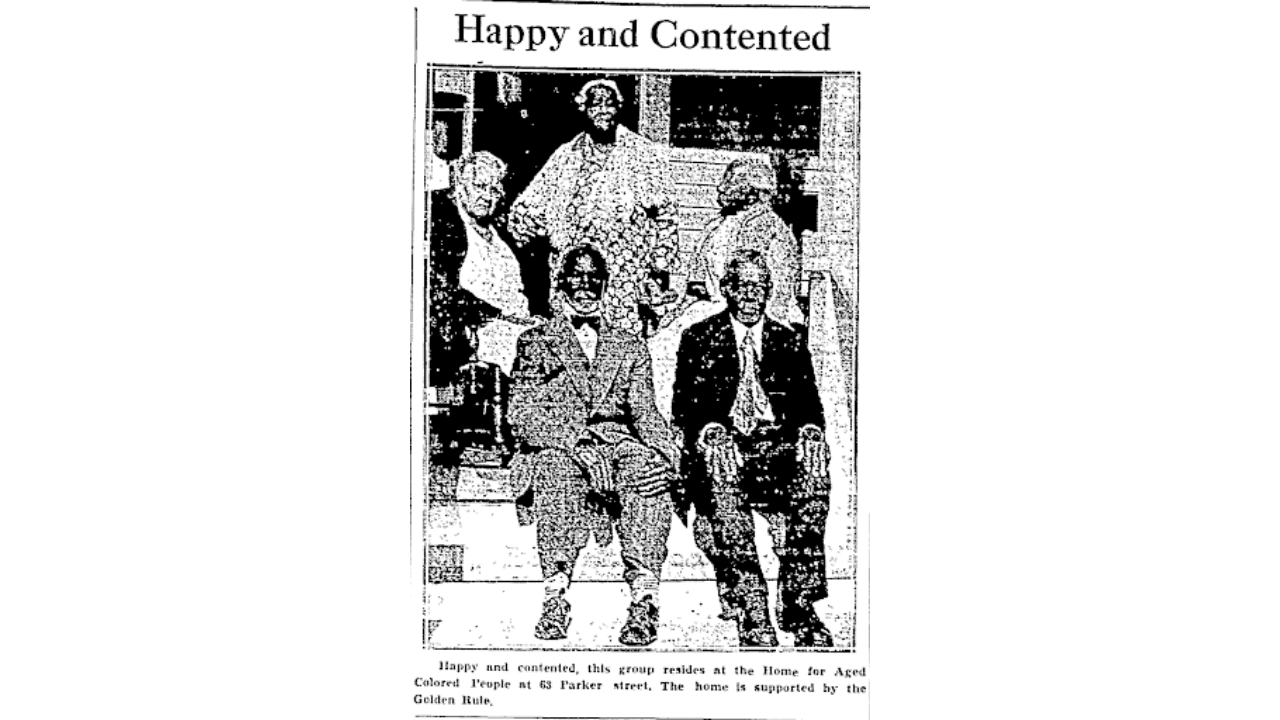
Their strategy paid off: in 1902, despite the small size of Worcester’s Black community, the Woman’s Progressive Club had secured the funding to purchase a home on Liberty Street where they began running a care facility for the elderly, providing food and housing to those who needed it. During this time, publicly-run assisted living facilities in Worcester did not accept elderly people of color, and there was a dire need for services that did not solely cater to whites. Because of this, the WPC soon expanded their program, purchasing another home on Parker Street. As they transitioned into their new space they chose to change their organization’s name to the Home Association for Aged Colored People, though the original women’s club remained active as a Women’s Auxiliary within the Home Association. Finally, in 1952 they opened another property on Pleasant Street, dubbed Sunnyview Manor. At that point, the organization began employing several staff, including a nurse, a cook, a housekeeper, and an on-call doctor.
During their heyday, between 1910 and 1965, the Home Association was active in the community beyond their elder care services. There was public programming held at the Pleasant Street facility—english classes, cooking classes, job preparedness, and others. They also engaged with the growing movement for Civil Rights in the early 60’s. When D’Army Bailey was expelled from Southern University in 1962 for civil rights organizing activity, the Home Association helped fund a scholarship for him to attend Clark University. Bailey went on to lead a great deal of Worcester’s activism during this time, becoming the director of the Worcester Student Movement. Under his leadership, the WSM successfully organized to change Denholm’s policies against hiring Black clerks, among other things. Bailey was the first to receive scholarship money from the Home Association, but he would not be the last.
As the ‘60s marched on, the organization’s purpose had to shift. When anti-discrimination legislation passed nationwide and facilities were no longer segregated, the need for the Home Association waned. That, coupled with stricter federal rules that broadly standardized elder care, meant change was coming. By the 70’s, there were no more people being cared for in the Sunnyview facility. In order to keep it from standing vacant, two of the long-time caretakers, both members of the Women’s Auxiliary, moved in. Eventually, they sold the property, and the Home Association went in a new direction, becoming primarily a scholarship organization for the rest of its existence. In 1972, the organization changed its name to the Association of Colored Peoples, which it kept until its closing in 1995, just three years shy of its 100th birthday.
The Association did not remain a mutual aid organization; I would argue that its turn to a scholarship organization separated it from the direct needs of the community it was formed to serve. But during its heyday, the first 65 years of its existence, it was a group run by women for all those in their community who needed it. Without compromising their autonomy they were able to purchase and maintain multiple properties, pay for several skilled staff members, and fund events, classes, and services that extended beyond the original scope of their mission.
They were far ahead of their time—when the Woman’s Progressive Club first incorporated, Kwame Ture’s mother wasn’t even a twinkle in his grandmother’s eye, and yet the club operated on principles that harkened to the future philosophies of the Black Panthers. The program they led was autonomous, led by Black women, for Black people, and was similar in flavor to the BPP’s free breakfast programs. In 1966, when Ture introduced Black Power to the nation, describing it as a “call for Black people to define their own goals, to lead their own organizations,” he was just catching up to their work and their politics.
Note: All my thanks and appreciation to the Museum of Worcester’s archive for providing access to their collections for this piece, and to the late Stanley H. Gutridge. His care in maintaining these records, and subsequent work documenting the Association of Colored Peoples, has allowed me to share this piece of Worcester’s Black history with a new audience.
Gillian Ganesan (@gillianganesan) is a Worcester-based organizer, writer, and concerned citizen.
1 The names of the founders of the Woman’s Progressive Club are as follows: President Jane B. Collins, Anna N. Bryant, Emma E.P. Brogden, Sylvia A. Kennard, Ella E. Edwards, Gertrude Brogden, Jane Everett, Nary A. Folson, Addie P. Jones, Lizzie Walker, Jennie Johnston, and Narcissa Tossit.
2 Interestingly, the Worcester Woman’s Club, the large and well-known white women’s group associated with Tuckerman Hall, was explicitly anti-segregation within the larger women’s club movement—there was an incident at a national convention where the president of the General Federation of Women’s Clubs rescinded the credentials of a delegate upon learning that she was Black. The WWC denounced the action and later voted to withdraw its membership from the national federation. However, the group was not necessarily a strident ally to women of color. It was consistently an all-white organization, and the club never sought to foster relationships with the other Black women’s clubs in the city, namely the Woman’s Progressive Club, the Lucy Stone Club, the Standard Social Club, and the YWCA’s Negro Women’s Club.
3 The Lucy Stone Club was formed by a disgruntled member of the Woman’s Progressive Club (after the club presidential election didn’t go her way), and their feud was enthusiastically covered by local outlets. Fundraising strategy was the main difference between the two clubs, and a point of contention. Otherwise, Lucy Stone tried to compete with the WPC in almost every area, even going so far as to purchase a home themselves just a little further down Liberty Street. A member of the Progressive Club referred to Lucy Stone as a “secessionist movement” which is one of the shadiest reads I have ever heard. Janette Thomas Greenwood covers the drama in Chapter 5 of her book First Fruits of Freedom: The Migration of Former Slaves and Their Search for Equality in Worcester, Massachusetts, 1862-1900.
Ok back to me (Bill) now. Sound off if you want more history stuff like Gillian’s piece! Personally? Loved it.
Now to the stuff I do not love and also suck….
Like the fiddle string in “Waking Ned Devine”
Big week for WPD news and agitprop. The latest: TWIW has another big scoop, this time about Local 911 President Thomas Duffy meeting with the special prosecutor brought in to try Ashley Spring and Etel Haxhiaj multiple times, also helping to draft the apology letter Gagne tried to get them both to sign onto in return for dropped charges.
“ADA: Worcester Police Union Leader Influenced Plea Offer in Haxhiaj Case”
Northwestern Assistant District Attorney Stephen Gagne and New England Police Benevolent Association (NEPBA) Local 911 President Thomas Duffy II met multiple times leading up to the trial of former Worcester City Councilor Etel Haxhiaj, according to an Assistant District Attorney within the Northwestern District Attorney’s Office.
Prior to Haxhiaj’s trial, Gagne made a plea offer to both Haxhiaj and Ashley Spring to end the criminal cases they faced in connection with the arrest of a woman by federal agents on Eureka Street on May 8. The offer included the unusual requirement that Haxhiaj and Spring sign a joint press release alongside Gagne.
According to the same Assistant District Attorney within the Northwestern District Attorney’s Office, Duffy had a significant influence over the text of the joint press release Gagne required both women to sign alongside him as part of the plea offer. The ADA also says Gagne and Duffy met on multiple occasions.
So much for the “impartial” outside prosecutor. As the article notes, and as I personally saw at both the trial and during a few of the pre-trial conferences, this cozy relationship is ummmm at odds with the way Gagne spoke about it. (When Duffy walked out with the state’s six witnesses to be introduced to prospective jurors, Gagne asked him his name, as if he didn’t know him, in that situation where Duffy very much should not have been where he was. This was well after I’d seen the pair engaging in conversations on multiple occasions.)
The story broke late Thursday, two days after one of the city council’s most nauseating annual rituals: the review of the annual crime statistics report. It’s a kissing of the ring, it’s a bending of the knee, it’s a grovel fest. One thing it certainly isn’t: a “review.”
This year’s episode, on Tuesday night, was particularly gross. Moreso than the content it was the context that made the 2026 show so insufferable. Just days prior, police union boss Thomas Duffy put out a statement apropos nothing but his own comedown in which he demanded Khrystian King (and to a lesser extent Rob Bilotta) recuse himself from all police matters coming before the council for. The injury requiring such redress, Duffy said, was King’s having been vocally supportive of Etel Haxhiaj during a trial which may as well have been orchestrated by and presided over by Duffy himself. More on that a little later. Mentioning it quickly up top because, like the high string of the fiddle at the end of “Waking Ned Devine,” everyone’s waiting for this dude to pop.
And the tenor of the rhetoric is bleeding from Duffy at the top all the way on down to the bottom of the local law enforcement community—where Kate Toomey sits, gratefully and proudly, as chairwoman of the do-nothing-on-purpose Standing Committee on Public Safety. As Exhibit A I present you this statement she made Tuesday night in full:
Councilor Rosen made a comment that the police officer was getting hit by snowballs and maybe there’s nothing they can do. But yeah, there is. And I hope they do something. I hope they use whatever video they can get and identify those people who are assaulting them. Because that’s assault and battery on a police officer. A snowball hitting a police officer is assault and battery. No different than assaulting a police officer with a hand or anything else. So I just want to make that very clear. That that is something that, that’s not something that’s acceptable. It’s not something that we certainly would support. And I want to make sure that our offices know that we have their back on that regard.
Toomey also said the supposed 58 officer deficit in the department’s “complement” is a “real crisis,” an overly dramatic, credulous line that, in spite of or maybe because of it being dramatic and credulous, made its way to a MassLive headline: “Worcester police dept. is down nearly 60 officers: ‘This is a real crisis.’”
The lede:
Though Worcester experienced a 40-year-low in homicides and a five-year low in violent and property crimes in 2025, th city’s police department is currently down 58 officers, according to Police Chief Paul Saucier.
As I wrote on BlueSky, this lede is a good example of the torqued discourse around cops and crime in local news. The “though” at the beginning of this creates an implicit causality (need more cops for less crime), but the evidence presented suggests the exact opposite
In a recent post to his newsletter, Alec Karasantis of Copaganda Fame put this general dynamic first on a list of three pervasive myths in the public discourse on police.
Preserving (and even expanding) existing police, prosecutors, and prison bureaucracies is a good/effective way to promote safety. The benefits to safety of more punishment, surveillance, and centralized government control are seen as so obvious that they are taken for granted as the opening premise. In the imagined “common sense” world of elite opinion avatars, this often goes something like: If you care about people being safe, of course you must oppose reducing the size and power of the punishment bureaucracy.
At some point in the future (but not, it seems, the next scheduled meeting on March 10), Toomey will do all that and more all over again, calling in the chief to her Standing Committee on Public Safety for another, smaller, session of lathering on praise and asking not what the police can do for the city but what the city can do for the police.
While Toomey can be most relied upon to lack self awareness as it relates her bootlicking, we saw during this roughly hour-long affair she’s not the only one. They went around the horn as it were, almost all of the 11 councilors taking time to “ask questions.” Only a small handful asked a question other than “do you need more money?” Let’s take a look at some of those “questions.”
Satya Mitra:
My question was that, is there any shortfall that you face? Is there anything that you need from us more, manpower-wise, or the law and order officer-wise, or equipment-wise, anything in that, so that you can bring it further down? That was my question. If you can find that out and let us know, maybe we can see what we can do to fund you more or give you the opportunity to really make this city more safer.
Tony Economou:
Congratulations, congratulations to the men and women of the department. Certainly proud to be a Worcester resident, thank you.
John Fresolo:
And when you have the tools that you need and you deserve, you get the job done. I was in the legislature, Mr. Chairman, and in my 14 years there, I was able to secure an earmark. I only bring this up to show the true belief that I have in the department, that through four chiefs, 14 years of getting an earmark of $100,000 for community policing, the neighborhoods of Union Hill, Green Island, and Long Grafton Hill and Vernon Hill, and it was night and day with the police when you gave them, again, the tools and the funds that you need to do your job. So in using that as an example, I’d like to ask you through the chair, what could you give us as some numbers that we could in turn speak to the manager and suggest and advise him to that, you know, I know for one, myself, what I’d like to see added to the traffic division.
To which Police Chief Paul Saucier replied “I would love to see that as well.” Of course he would! Fresolo’s last remark: “I look forward to advocating on your behalf in this upcoming budget.
Gary Rosen:
Budget is coming up, when we ask a question, one of my colleagues asked a question, do you need a little more money?
Joe Petty:
So I just want to thank the minimum police department. It’s not an easy job, but you’re out in the community all the time. It shows. I do love the ... lights on the cruisers. It does make a difference. You know why? Because people say they never see a cop. I see a cop all the time now, because the lights are lit up. So it does make a difference in the community.
With no one pushing very hard for real police accountability, Moe Bergman found himself at a loss:
I noticed that we have absent today some of those that I would have expected to say statistics don’t really matter, but they do. And that’s the best way to gauge where we’re at.
Bergman closed his remarks by advocating for buying the police a new station. It’s time, he said, the city “tapped our toes into the water of what are we going to do about an aging police station.”
And we really should revisit that this year because although great things come out of that building, it’s an aged building, and we’ve done a great job in addressing aged infrastructure in the city, but we’ve kind of ignored the elephant in the room. It’s not going to be cheap, but I think given the conversation we’re having tonight and the understanding we all have as to how important public safety is, I think it’s a project we need to start addressing and start looking at ways to tackle.
Bergman is a good way to illustrate the profound difference between the way these people talk to the police department (as eager employees and/or vassals) and other departments (as lecturing, cost-cutting bosses). I’m old enough to remember about two months ago, when Bergman put up a stink about paying more for snow plow operators (while also complaining the snow does not get adequately plowed). Back on Sept. 30, on the issue of giving snow plow operators a small raise—just enough to make the pay competitive and thus retain some snow plow operators for the coming winter—Bergman said he’d prefer the raise be an “incentive” for good performance. “I’d like the taxpayers of the city to see something improve before they are saddled with an increase in costs.” Can you even imagine him saying such a thing about police officers?
Left unasked and unanswered was the question of whether anyone at all has the power, in the realpolitik sense, to tell Thomas Duffy to take a deep breath. The “prominent union boss” to use a little journalese and “archetypical flailing son of father with long shadow” to add a little character building has been ‘back at it again,’ turning to Khrystian King. Apparently Duffy’s left unsatisfied by having put Etel Haxhiaj through a nine month legal ordeal. Now, he wants King (and, to a lesser extent, Rob Bilotta) to recuse himself from all police matters that come before the council. Talk about licking the bag!
In a recent statement, he called on King to Councilor King to “recuse himself from matters directly involving the Worcester Police Department.” The statement goes on:

Public confidence in municipal group governance requires decision-makers who can approach police-related issues with objectivity and without demonstrated bias. When actions and public statements create the appearance of prejudice against law enforcement, recusal is the responsible course.
And blah blah blah yada yada. Until we get to my favorite line:
These activists and their supporters constantly whine that they are being bullied and silenced. Such could not be further from the truth, as they weaponize social media to attack our officers. While at the same time suppress all opposing views. Accountability through due process is not silencing, it is the rule of law.
Wait wait wait who’s whining? Sounds like you’re the one whining, big dog. Looks like you’re the one weaponizing social media. Looks like you’re the one trying to suppress all opposing views. That is definitionally what you’re asking for in King recusing himself! Stupid, stupid, stupid.
(Bilotta, I’m sorry to say, seems to have bowed to pressure. A post he put up in support of Haxhiaj on Instagram has since been deleted.)
Glib references to a certain seeking behavior on Duffy’s part make for a reductive analysis of the politics at work here. It seems he’s found himself in a position—maybe due to some internal pressure, like, just spitballing here, a challenge to his union presidency? Hmm? —he needs to keep someone in the hot seat. Perhaps, after doing a massive victory lap on what was, at the end of the day, a split verdict... one issued by a jury who never got an answer to the question of “why are we here exactly?”... the judge and prosecutor tripping over themselves to block that line of inquiry at every turn... and one for which there was a light sentence, all things considered... some community service and six months probation... Big whoop.... And, remember, in order to get even that split verdict, he had to put his own guys up on the stand... who almost all appeared visibly embarrassed to be there and gave embarrassing testimony, which you can watch almost all of right here by the way... McGuirk... my god... Her strategy was evidently ‘do the lies, but mumble them.’ Like a toddler would... And after Haxhiaj got out of court and loudly condemned the trial and the bullying behind it, maintained her innocence, and is now is on the way to an appeal...
Maybe after all that Duffy made the calculation he needed a new guy on the hot seat. The scape wasn’t goating like it used to. So, brain genius that he is, he picked the most politically prominent black man in the city, accusing him of the crime of... supporting a colleague. Big whoop! This shit is embarrassing. It is weak. It is wack. I’m tired of it.
Enough of this “police are under attack from woke” self-victimization routine. Be a real police union boss, Tommy. Be like Dana Pullman over on the state police side. Do a long bid after your embezzlement scheme goes sideways. Do some work for The Lobbying Firm.
Odds and Ends
Please support this outlet! I’m spiritually and mentally exhausted and getting this out felt a bit like fighting the tide. Not withstanding the current burnout I am extremely proud of what we do here and believe it’s well worth $5 — our goal is and always has been providing the sort of local journalism that binds a community, speaks to a shared sense of morality, a shared civic pride, a shared identity. We need real community before we can achieve anything else. And real community has been under a long, quiet siege here in the good ol U S of A.
The Conan Denis Leary podcast conversation about Worcester has some funny moments...
Some stray links...
—5 Tenet Healthcare hospitals in FL sue group rating patient safety
—Worcester councilor pushes for city investigation of Saint Vincent Hospital
—MA Housing Secretary Edward Augustus to become UniBank CEO
—Telegram & Gazette transitioning to postal delivery
—Worcester’s Municipal Election: 2025 Results - Worcester Regional Research Bureau
—Judge: Worcester hospital broke federal labor law 14 times
—State filing alleges Worcester pastor used fraud to finance vacations
—Rev. Jonathan Slavinskas of Worcester delivers prayer on floor of U.S. House
— Images of Worcester Galleria Mall in the 1980s

And for the customary music portion of the program may I point you to the first in what I hope will be a series of videos of live performances on the modular synth spaceship I’ve been building—my descent into mania taking the form of bleeps and bloops.
Ok gotta run! Talk soon.
Love the post, and Gillian’s part is great! Looking forward to more.
Gillian's piece was really interesting. Can't wait for the next one. Also need to check out the historical museum.
Meanwhile, in current day Worcester we're talking about inflating the WPD budget even more AND building a new station while we have an emergency winter shelter that is being run entirely by volunteers??? (Due to close this weekend I believe.) And still a major shortage of shelter beds during a brutal winter. And forget about making any meaningful changes to actually affect homelessness. Its fuckin maddening!
Lastly, thank you for the much needed pallette cleansing gift of the Conan podcast. Grew up in an Irish catholic family in Mass...so many hilariously relatable moments. I'm probably related to both of them.