

Past two weeks I’ve been trying to paint a masterpiece which in this attention economy? Big mistake. I cannot however stop myself from believing in the piece, so rather than put it out half finished to slake the insatiable thirst I’m putting it on the shelf for now. You gotta Always Be Posting that’s the thing. And I’m past the arbitrary but also very real one week limit between slakings. So the following is just a quick update on recent Worcester news to buy my masterpiece some time. Please don’t unsubscribe you’re so sexy aha1
On the proverbial docket: The rally in front of city hall last night to say fuck ICE and its mother (who happens to be Democrat Joe Lieberman, everyone!), Joe Petty’s council committee assignments, and the agenda of the first meeting of this new council next Tuesday.
Before all that a few quick things for your radar:
—WEJA is having an event tomorrow to discuss what school safety actually means, something that in #Worcpoli is unfortunately an open question. It’s from 1-3 p.m. at the Carpenter’s Union Hall on Endicott St.

—Friend of the newsletter Andrew Quemere won a big judgement against the Northwest District Attorney’s Office for the release of names of cops charged with crimes. In The Mass Dump: “VICTORY: Northwestern DA must release names of cops charged with crimes, judge rules”
Northwestern District Attorney David Sullivan’s office cannot block the public from seeing the names and case numbers of police officers who have been charged with crimes like possession of child pornography, assault and battery, and driving under the influence, a judge ruled on December 30.
This becomes relevant to Worcester when you consider it’s Northwest District Attorney David Sullivan sending his ADA Steven Gagne to Worcester to prosecute Etel Haxhiaj and Ashley Spring for bad faith retaliatory and deeply political charges filed by the Worcester Police Department... and that Steven Gagne and Thomas Duffy, a police union president personally responsible for Haxhiaj’s charges, had private conversations in the courtroom before and after a pretrial conference a few months ago. Thin Blue Line in action.
Support Tom Marino and Worcester Press Freedom!
Tom Marino has a GoFundMe for his upcoming legal battle against Crybaby Tommy (aka Thomas B. Duffy), the police union official suing him for $10,000,000 in a laughable defamation lawsuit. The Telegram finally wrote about it the other day! You can find that here and my coverage from last week here. But if you’re going to click one link make it the one to Tom’s GoFundMe. I put in $100 and maybe you can too? The point of this lawsuit is to put someone who can’t afford a legal battle through a legal battle. A guy that gets paid by the city should not be doing this but I think we’ve established by now that the city manager is not functionally the boss of the police, and especially has no power over a police union official.
Bright side of that lack of oversight is Duffy is going to Wile E. Coyote himself into the brick wall of the first amendment and when his face smashes against the realistic painting of Tom Marino concealing said wall—when he’s going doyoyoyoyoyoy like a spring door stop—the coveted “Do Not Call” and/or “Brady” list of unreliable Worcester cops kept by the DA’s Office is going to fall out of his pocket as he bounces off the pavement, where it gets swept up by a stiff breeze then lands, after an extended Rube Goldberg Machine animation of dips and dives and dipseedoos, straight into the typesetter of the next day’s front page as it goes off to print. At which point Tom Marino will be looking down at Duffy like...

While we’re talking about Duffy, here’s what Kristi Noem had to say about the mother shot and killed by one of her officers for no reason at all save bloodthirst in Minneapolis.
An officer of ours acted quickly and defensively shot to protect himself and the people around him. My understanding is that she was hit and is deceased. We’re continuing to gather more information, but this goes to show the assaults that our ICE officers and our law enforcement are under every single day. These vehicle ramming are domestic acts of terrorism.(...) We’re working with the Department of Justice to prosecute them as such. We will continue to protect our ICE officers and in cooperation with other law enforcement agencies as well.
Here’s what IBPO President Thomas B. Duffy said about Eureka Street the day after.
...all available Worcester police officers were dispatched to Eureka Street to protect the public and ensure the safety of federal and Worcester police officers on scene. For obvious reasons, officers became concerned for their safety and that of the federal agents based on the actions of the crowd. They tried to deescalate the situation and prevent injury to all present. Despite those efforts, Worcester police officers and federal agents were threatened, abused and even assaulted on scene. Such conduct cannot be tolerated or condoned.
Because some protesters threatened officers’ safety, police had to make additional arrests.
Notice the similarities in tone. The same willingness to willfully distort the basic facts. Where Noem uses “domestic acts of terrorism,” Duffy uses “anti-police activist.” Two terms that carry less of a distinction every day! Here’s how he used the local sub-in for domestic terrorist.
Of particular concern in this case, one of our elected policy makers and someone who has created this difficult task for the police, District 5 City Councilor, Etel Haxhiaj, incited aggression towards the police during the incident. This councilor participated in the conduct of the unruly crowd and eventually assaulted both Worcester police and federal law enforcement officers on scene. Her behavior also emboldened others to act in this manner. The conduct of this anti-police activist councilor is deplorable and unacceptable. Regardless of political opinions or views, city officials should never condone the assault of an officer and flat-out disregard to the point of violent opposition, the authority of police to maintain safety and public order.
And here’s Duffy’s analog in Minneapolis issuing a statement that reads 1:1 with Duffy’s.
The Minnesota Fraternal Order of Police stands with the men and women of Law Enforcement across the country. Over the past month, while Federal law enforcement has been doing their job in Minnesota, political and community leaders have condemned and vilified them.
The hateful and anti-law enforcement rhetoric by Mayor Frey and other politicians have made their jobs and those of local and state law enforcement more difficult and dangerous. The job of law enforcement is difficult and dangerous enough without the agitation by leaders in our state and communities.
Like thousands of ‘law enforcement officials’ across the country, you can imagine Duffy is watching with interest to see whether ICE agent Jonathan Ross gets away with murder, a safe bet at this point. Those thousands of reactionary white men, all participating in the grand project of defining the boundaries of the American “homeland,” will be taking notes, updating their own playbooks, learning new terms, new modes of absolution. The promise of Trump to the anointed is the promise of open criminality. That they too can bend reality to their will as they escape accountability and bloody the nose of their perceived enemies. The logic of “because I can.”
Already, ICE agents in Portland have opened fire and I just two seconds ago saw another taunting a protestor with a gun, whipping out his side arm in shit talking fashion while holding the customary paintball gun in the other.
After Jonathan Ross murdered Renée Good, his accomplices didn’t let a doctor on scene near her. He begged to be allowed to the SUV where she was either dead or dying—we’ll never know which because no one who could check did check. They blocked the street so the ambulance couldn’t get through. They said they had their own medics. It was a lie. Also a new line, by the way, and I’m sure the Duffys of the world have made note of it. How long before local police are talking about “their own medics”? A year? As of my writing this on Friday night “no evidence has emerged” of any DHS medics on scene per The Guardian (the real one not the Worcester one).
They stood with their guns and left Good in her car to bleed out. Eventually local EMS pulled her limp body away from her car by hand, no stretcher, because they had to run from the ambulance parked at the end of the block, on the other side of the ICE blockade, and decided the stretcher would slow them down. They walked her to the corner, where the ambulance was parked, “like a sack of potatoes,” and the ICE agents stood with their guns except for the murderer who was promptly whisked out of the jurisdiction if the State of Minnesota. The Duffys of the world made note of all of that, by the way. It’s not just the shooting itself that establishes new patterns and practices it’s all the extra stuff. “We have our own medics.” Like the doctor offering to help and the local EMS were some sort of foreign adversaries, which, functionally they very much were.
We’ve eaten the whole world there’s nothing left to eat but ourselves. Rendering the home to yield the homeland. Meat falls off bone.
It’s hard to look straight at the footage coming out of Minneapolis. There’s only a few dice rolls between what happened there and what happened at Eureka Street. It leaves a sickly feeling in my stomach.
At the rally outside City Hall Thursday several hundred people shouted and cheered and one guy holding a sign about America being the evil empire played the shit out of a big bongo. As I arrived a speaker from Party for Socialism and Liberation, Henry Broadstone, connected Eureka Street to Minneapolis.
This reminds me of the illegal kidnapping that we witnessed in our own community back in May, the abduction of Rosane Ferreira de Oliveira. Of the compliance and collaboration between Worcester PD and ICE, the escalation done by our own law enforcement. And I want to make it clear that that is absolutely unacceptable.
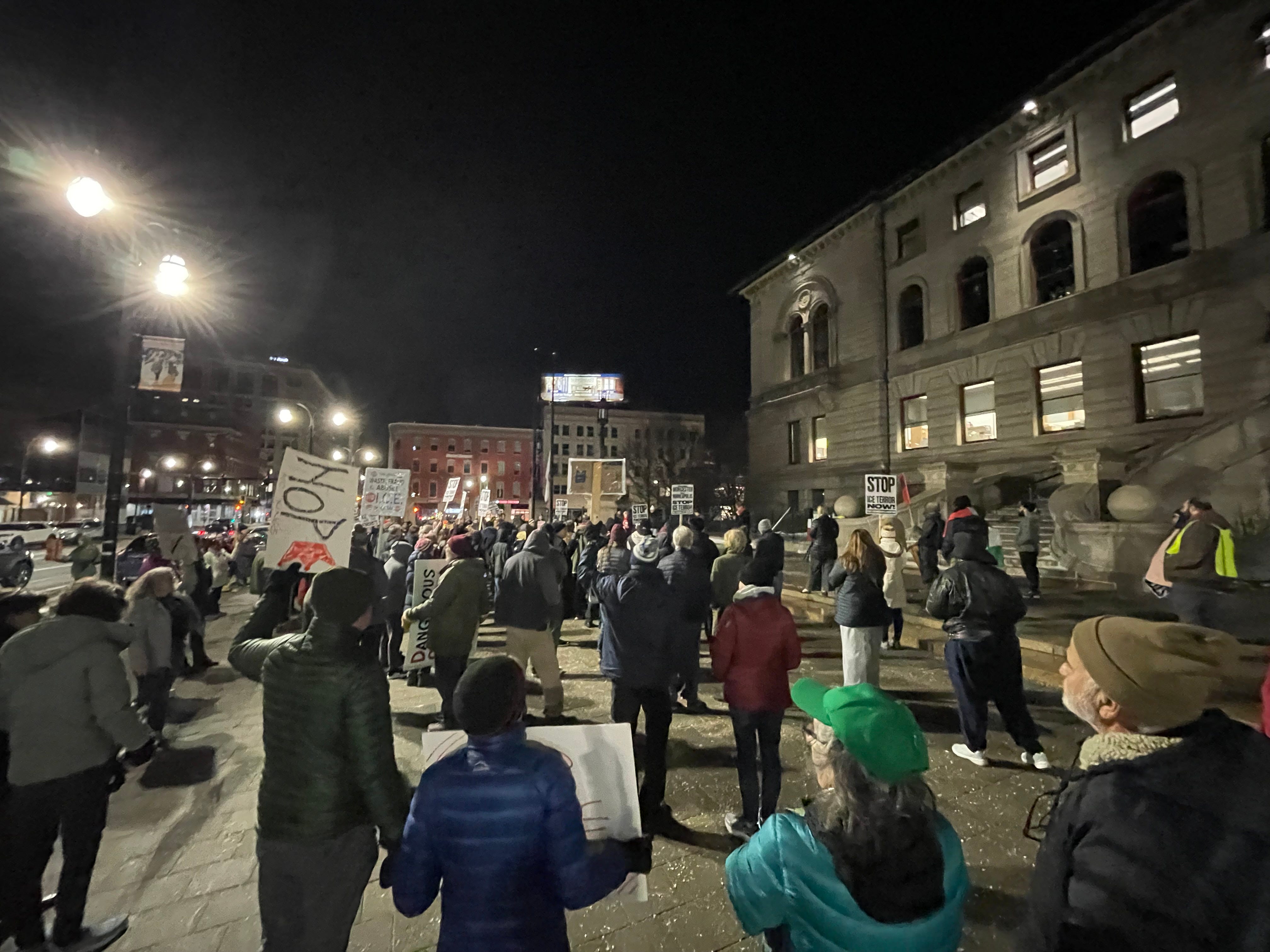
Martha Assefa, speaking about halfway into the demonstration, also made the parallels clear.
I’m a sixth generation Minnesota, and I am enraged to be here. But my anger is deep because Wooster has nailed us. Yes! That’s right! And so has done up and said what was needed to be said and kicked ICE out.
And Worcester police doubled down and manufactured charges on our own people.
Assefa asked people to call the mayor and the city manager to get the police to drop their charges against Etel and Ashley. And that’s a great thing to do but as discussed I think what you’re really accomplishing is reminding them they are not actually in charge of their police department. There’s a better question to put in their heads. I’ll ask it here: Are you sure they’d protect you? You know, if and when... Are you 10o percent sure?
I’m sure you are aware of the boundary line for staying in their good graces. But—and this is the second question—can’t they just move the line? Do you have a game plan for that? What happens when giving them everything you can ceases to be enough? Eric? Joe? Anyone? What then?
But ahhhh I came to talk to you about committee assignments and council agendas. In both we’ll see a city hall that’s reverted fully to its default mode. Insular, reactionary, fully subservient to the police and local caste of developers, content otherwise to litigate small and obnoxious dramas... while also underfunding the schools and making the roads hostile to non-drivers.
Ladies and gentlemen… the new council
There’s a new Brazilian meat market at the bottom of my hill. West Boylston Street drivers may have noticed the wild wacky inflatable arm flailing tube man outside. I was on my way back from hand dropping a merch order in my neighborhood and stopped in. (If your zip code is 01606 there’s a good chance I’m your personal postman for all the fine offerings over at the Worcester Sucks Big Cartel.) The store is well laid out, with five or six tight stacks of dry goods and one deli counter full of fresh meats, marinades and prepped meals. I needed bread for a stew we had on. Come to find, the person behind the counter was bagging up fresh Portuguese rolls. So fresh they were steaming up the bags a little. Best damn bread I’ve had in a long time.
A few weeks ago I had the vague thought that a good model for a municipal grocery store operation (RIP Jenny Pacillo’s best council order in my opinion) would be to rent out small otherwise vacant storefronts and stock them as much like grocery stores as the space allows, selling product without the “convenience fee” slapped on stuff at your average corner store. Market Basket prices on healthy foods at a place in your neighborhood you can walk to. Call ‘em MuniMarts. Many people, I think, would quickly take the city up on this offer. No one loves driving to the grocery store. They do so because they have to. It would promote walkability, neighborhood connectivity, and serve as a positive point of contact between residents and city hall, where services, programs and initiatives could be advertised to an already receptive audience. A city that wants to get its residents more involved in civic life would do well to consider it.
Here in Worcester we’ll have to sit on the idea a while... The only way we’re getting a good idea through the current city council is by convincing the leaders of the police unions to lobby for it. And they are all, to a person, psychos. So. Better luck to us in 2027. A perfect time to move to the new committee assignments...
Committee assignments
Joe Petty, who has unilateral authority to make these and need not explain himself at all, has basically put up a brick wall against oversight or reform of “the way we do things around here.” I’ve highlighted the three that are truly sicko mode.
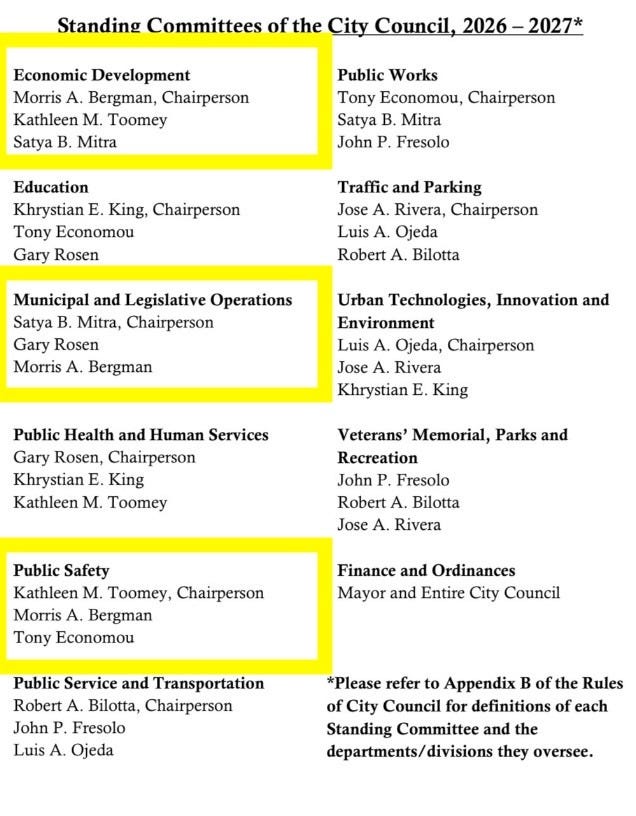
Public safety: Toomey, Bergman, Economou. The latter said the DOJ report was just “words on paper” to the applause of a room full of voters. This body votes 3-0 against advancing a civilian review board proposal 10 out of 10 times. Dead in the water don’t even bother drafting it.
Economic development: Basically has put Tim Murray in control of our housing policy.
Municipal operations: Giving a first-term councilor the chairmanship of the committee that decides council rules is crazy. When you consider it’s a councilor (Mitra) who takes marching orders from Tim Murray, it’s just another abrogation of the institution itself. Par for the course. The Worcester City Council is fake we can all just say it now. Tim Murray and Anthony Petrone in a trench coat.
On to the agenda for Tuesday.... Here’s the link. (The city still does not host these documents meaning I have to go and make some sort of Drive link every time I want to share one of these. Very annoying. The municipal calendar is also still a complete mess.)
Poetically fitting: The council’s first significant act (item 11.4) is to hand over $613,000 to a developer who plans to renovate a building on Main Street. Here’s the report. The developer, Menkiti Group, is going after an HDIP subsidy from the state. That means, necessarily, that the development will have no affordable units. Because our state government has a special deal for developers who want to build unaffordable housing. Insane. And it’s only available in “gateway cities” i.e. the state’s poorest cities, which need affordable housing the most. Insane! I hope those of you who didn’t start skimming this paragraph at “HDIP” like I probably would take a minute to absorb how insane that is. There’s a 2022 Massachusetts Law Reform Institute report on HDIP I thought was pretty good.
The program provides incentives only for higher priced developments, not mixed income, and makes credits available to all 26 cities without targeting weak market or distressed areas. HDIP does not require economic inclusion, direct benefits for low-income residents, or protection against rent hikes and displacement. In some cities, millions in HDIP credits have created islands of segregated, high priced housing for small households with disposable income and no children. Meanwhile, several developers appear to be reaping substantial profits.
Batista tells the council in his summary of the report that we have to do this. Or else the housing production plan falls apart. Which seems an awful lot more like a threat than a plan.
The orders section (13, starting on page 15)—where councilors submit their own proposals and ideas and more often than not ambient gripes and grievances—reads like a full on assault on our city’s meager road safety infrastructure. Moneybags Mitra is ‘starting to ask questions’ about the 25 mph speed limit (13p). Bergman and Rosen (13t and 13f respectively) are doing the same for ‘complete street’ style road redesigns, despite the fact they hate each other. (Gary, this is Bergman’s turf. You’re better than this. Just ignore the Pleasant Street people. They’ll survive.) Rob Bilotta is, naturally, the only one bucking the trend, asking for more road safety on Lake Ave and Lincoln Street, two roads that desperately need it! Lest we forget, King is sort of a crank when it comes to road infrastructure. Bilotta, the only person on the council who knows anything at all about this stuff, from his long career as an accessibility activist, is outnumbered 1-10 or 2-9 depending on Luis Ojeda’s ability to remain normal in this new political environment. If this council wants to mount an assault on Eric Batista’s best and only (?) genuine initiative (Vision Zero), there’s only one vote in the way. Hang in there, Rob. This is going to be brutal.
Tony Economou wants an ombudsman for small businesses (13n) and not to get all Tracy Novick about it but I don’t think he’s using the word right. Even better, he specifically uses the term “ombudsperson.” There, that fixes it. He goes on to describe a customer service representative and/or navigator type role. Way I see it, who cares. Use words however you want it’s 2026 and we kidnap heads of state now. No one show him this paragraph though I want to hear his ombudsman pitch delivered on Tuesday without reservation. There’s at least four different ways I can imagine him pronouncing it also. It’s gunna be good.
I think for 2026 my newsletter-oriented resolution is to give the city council no more than three paragraphs a piece and approach all of it a la Guy Debord: what happens in that chamber on Tuesday nights? That’s a frickin’ spectacle right there.
Odds and ends
Nothing much to add today. Please subscribe! Every dollar counts.
And you’ll hear from me soon with a banger of a piece I think on our worsening homelessness strategy. And I’m also due for a state of the newsletter report so look out for that soon as well. Also a podcast on the way! Just because I;m admittedly grillpilled about the city council doesn’t mean we’re letting up in any way. We have an institution to build!
Good post in The Verge: People are fighting for the truth in Minneapolis
I’m selling a kindle scribe if anyone wants one of those I got you for a good deal. Hit me up billshaner@substack.com
This song came on the radio the other day and I was like oh yeahhhhh this still holds up. So, lastly, bang yr head.
Before you yell at me this is a riff on a onetime popular now obscure internet bit
I'd rather set aside my very limited GoFundMe bucks to help Tom with the $10,000,000 payout.
Fortunately, Joe Petty doesn't have to explain his choice of committee assignments. Just to think of what that would sound like, breh.
It does appear Petty and Murray decided to tell the Worcester Regional Research Bureau what they can do with their Civilian Review Board pipedream. Suck it, folks. As mentioned in the post, Economou publicly stated the DOJ report was, "just words on paper". That was part of his campaign! Kate Toomey publicly requested Chief Saucier's affirmation that that the DOJ report was, "prepared by students", at a Public Safety Committee meeting I attended last September. How much lower can Moe go than that? Perhaps name Thomas B. Duffy as an alternate on the committee?
Also, how does an at-large candidate, squeaking onto the council at the very bottom, after a recount, get appointed Chairperson of the Economic Development Committee of the 2nd largest city in New England? (Ok, maybe that would be fun for Petty to explain.)
Worcester is governed and controlled from the inside. And that's why folks on the outside are so angry with the state of affairs. Worcester Obfuscates.
Regarding item 11.4: the concern you raised here about whether HDIP should be reformed to better target affordability is well taken and worth continued scrutiny. Thank you!
That said, a few clarifying details might be helpful. While HDIP itself is a state income tax credit (not a city subsidy) tied to a roughly $27 million private investment in Worcester, the project materials (agenda attachment) indicate that the development WOULD include five affordable units (out of 48) at 60% of Area Median Income, deed-restricted for at least 30 years. In addition, the project includes four fully accessible units, exceeding baseline code requirements.
At the municipal level, the City’s involvement is limited to a Tax Increment Exemption (TIE): a 10-year agreement capped at 35% of the incremental assessed value, not a full tax abatement. Over time, the project expands the tax base that funds all our municipal services such as streets, parks, and public safety.
None of this resolves the broader policy question you appropriately raised about whether HDIP, as a tool, should do more to directly support affordability. It should! But in this specific case, the project combines limited affordability, accessibility, and long-term tax base growth rather than representing a pure subsidy for “unaffordable housing.”