

Hello hello! Almost June can you even freakin believe it?
June is a special month for Worcester Sucks. Six years ago on June 18-19 I launched this thing. Six years. Eternally grateful I’ve gotten six years now out of what was initially a desperation move. I was so sick of working under the slash-and-burn edict of Gannet I was about to quit. And now look at me, running an outlet that gets better and better all the time, entirely funded by the people who read it. We’ve been able to ride it this far, been able to weather what storms have come, been able to build what is, if you account for resources spent, hands down the best newsroom in the city. And it’s not even a newsroom yet—not until I can afford to take on at least one more full timer, and we’re a ways off from that still. But hey, you gotta keep trying, and that’s exactly what we do here all day every day.
For instance, Aislinn Doyle just had a great op-ed run in Commonwealth Beacon: “Dual language immersion programs are a huge asset to our schools. The state should stop treating them as an afterthought.”
Every Spring, Massachusetts celebrates bilingualism, at least in theory. In May each year, the state proudly awards thousands of graduating high school students the Seal of Biliteracy, recognizing proficiency in two or more languages.
But look closely at who earns those seals. In many cases, it isn’t because schools taught students a second language particularly well — or at all. More often, it is because families did.
Across Massachusetts, many of the students receiving the seal speak another language at home and learned it from their parents or grandparents. The state celebrates the outcome while failing to build the dual language programs that would make bilingualism truly accessible to far more students.
Research is clear: High-quality dual-language immersion is not only the most effective educational model for English learners, it is one of the best models for all students. Two-way dual-language programs are “additive,” developing two languages simultaneously. Students in dual-language programs outperform peers in English-only programs on literacy and long-term academic achievement, while also showing benefits in problem-solving, attention, and memory.
So to celebrate, me and the gang are putting on a little thing on Saturday June 20th at our favorite place to put on little things, Steel and Wire. Real pita heads of Worcester will know! George’s syrian bread is simply the best pita you can buy. My dad requests it often, as he can’t get it out his way. And if you’re about to come at me with “Syrian bread and pita are dif—” Shhhhhh. It’s okay. Everything’s fine.

Incredible new piece of Worcester Sucks ephemera right there, courtesy the lovely and talented Katie Nowicki, who used the assignment the other night to level up in photoshop. Anything she can’t do?! Let me know when you find out.
I think I’ll order some shirts of this... maybe tote bags? What do you think?
Anyway, to business. Today we’re talking about housing—what else? A new Worcester Regional Research Bureau report about the state of the problem, a glimpse at City Hall’s inability to do much about it via some choice moments from the Finance Committee, the most fake and useless iteration of the City Council save perhaps the Standing Committee on Public Safety.
It’s industry briefs all the way down
The report, titled “Raising Housing: Understanding the Affordable Housing Crisis in Worcester” was released earlier this week. It is a capable summary of the available data diagnosing the problem. It leans on the work of MassInc and its Gateway Cities Housing Monitor report and the National Low Income Coalition’s Out of Reach report—both great resources I’ve cited in past editions.
The WRRB report takes appropriate time to break down the failures baked into the term “affordability” to truly capture the state of affairs. I appreciated that, as it’s confusing and little understood. The AMI, or Area Median Income, as the WRRB explains, is based on an area that is not Worcester, but Worcester and the wealthier communities around it, in a “metropolitan area” defined by the Office of Housing and Urban Development, that changes seemingly at random and is difficult to find good information about. But the point is that the area median income is the metric used to set thresholds of “affordability”—80 percent, 60 percent, 50 percent, 30 percent, etc.
For a place like Worcester, this muddies the conversation before it even gets going.
The WRRB explains:
A central challenge in understanding Worcester’s housing crisis is the disconnect between how “affordability” is defined in policy and how residents experience the housing market. Much of this stems from the way Area Median Income (AMI) is calculated: AMI reflects the median income of a broad HUD-defined region that includes many higher-income suburban communities, not Worcester alone. As a result, the official AMI for Worcester—$117,300 for a family of four in 2024—is significantly higher than what many Worcester households actually earn. According to the Census Bureau’s 2024 estimate, the median household income for a family of four in the city was $96,366. This represents a gap of $20,934, meaning the typical Worcester family earns nearly 18 percent less than the income level that underpins the region’s definition of “affordable” housing.
Any math wiz reading this will be able to suss out from the above passage that Worcester’s AMI is organically 82 percent of the AMI used to set affordability! What the WRRB could have made a lot clearer is that many of the city’s affordability efforts, most importantly its inclusionary zoning policy, are tied to the 80 percent AMI threshold. And that for Worcester purposes, that’s entirely fake: 80 percent of the AMI is actually just two percent lower than the city’s AMI. The city is counting units tethered to a figure two percent less than the median income as affordable. How many of the affordable units the city is supposedly producing are tied to 80 percent, as opposed to 60 percent (still expensive) or what we actually need, housing in the 30-50 percent AMI area?
The WRRB provides half an answer here:
This imperfect definition of affordability compounds Worcester’s severe shortage of deeply affordable housing: the HPP identifies a deficit of more than 8,500 units for households earning below 30% of AMI, leaving thousands of families paying far more than they can afford, doubling up, or facing displacement.
But, bewilderingly, this analysis is included in support of an “all housing matters” argument. To say, this is why we need more high end housing, actually. The report goes, indeed with the very next line, to say...
At the same time, Worcester lacks enough moderate- and higher-income units, meaning middleand upper-income households compete for older “middle” housing stock that would otherwise be attainable for working families. This “filtering up” dynamic—shortages at both the bottom and the top of the market—helps explain why affordability pressures now touch nearly every income group, and why even AMI -based programs often fall short for the residents who need help most.
And the WRRB supports this claim with a graph I found stunningly misleading.
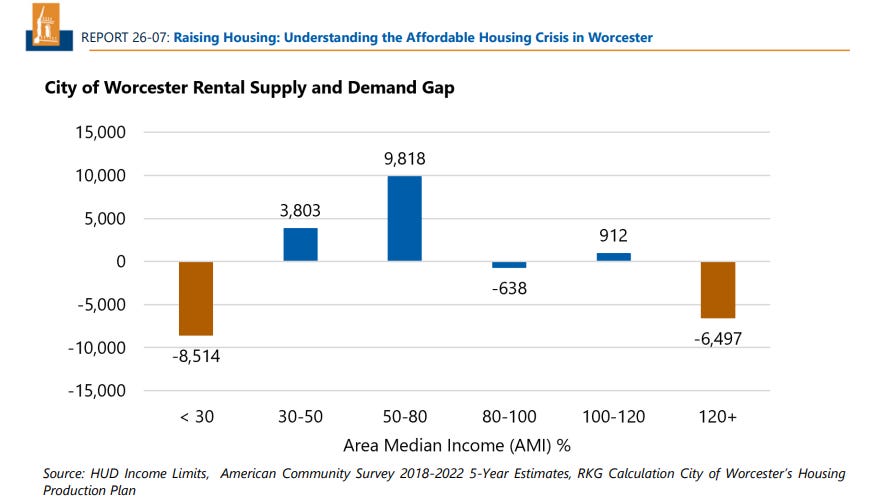
It appears in the report to demonstrate the legitimacy of the argument that both high end and low end housing are needed. But while the low end is obvious—and obviously the issue, as families risk displacement, thus creating homelessness and labor shortages and shredded community support systems—the high end “need” is hard to swallow. Who are these residents making 20 percent more than the area median income who are having trouble finding an apartment, and are they really “squeezed”? Or are they exercising their consumer choice to not move into the many still-vacant units in our newly constructed luxury boxes? Or are those newly constructed luxury boxes manufacturing scarcity by keeping a certain number of units empty, as alleged in a price fixing suit filed by the DOJ that implicates several of the local developers city hall tells us we need to incentivize further?
Questions that of course go un-posed in this report. And again, this supposed “need” at 120 percent AMI is a figure generated by RKG Associates, the real estate industry consultancy firm that wrote the city’s Housing Production Plan. How they arrived on this assessment of demand is not made all that clear in the Housing Production Plan itself. May I direct you to three bullet points on page 97 of the 197 page report, where the methodology is discussed.
▪The Household Model starts with forward-looking population projections obtained from the UMass Donahue Institute. It also uses the 2017 to 2022 persons per household and tenure distribution change rates from the American Community Survey (ACS) 5-Year Estimates and extrapolates change through 2033.
Ok nothing too worrying there. On to point 2...
▪ In addition to the Donahue Institute population projections, the Household Model also considers changes in employment in the city and the percentage of future employees who may choose to live in Worcester and need housing. RKG factored in future employment changes using Lightcast employment data and their own proprietary employment projections.
Ohhhh the real estate industry consultant is using Lightcast, a tech company generating labor market data for large corporate employers and those tasked with “economic development,” and how they arrive on their projections is “proprietary” and thus a secret. Shhhhh. While their fiduciary responsibility, not a secret, is happy customers. Surely we’ll turn it around in point 3.
▪ Lastly, RKG projected induced population growth from residential construction activity over the next five years from CoStar’s development pipeline. The Household Model uses these inputs together to project the number of renter and owner households per year between 2023 and 2033 that serve as the basis for the Housing Demand Model.
CoStar? The company that was just this week hit with three anti-trust lawsuits claiming it’s an unaccountable monopoly?
This is the entire basis of the Housing Production Plan’s assessment of need, which leads necessarily to the conclusion that high end construction is just as important as low end. The whole thing is obscured in the proprietary business practices of Lightcast and CoStar, tech companies that service the large development corporations that ultimately decide what gets built where, and when, and who have no reason to care, particularly, about the individual communities in which they secure the land to do their business.
I think you can excuse me, then, for calling this Reaganist supply side argument what it is: a crock of shit.
That crock of shit is where the WRRB eventually arrives, in its conclusion, reverting to an endorsement of the trickle-down theory baked into the HPP,. While it argues in favor of zoning reform to foster density (something we’d have done yesterday if the city really wanted this problem solved), it doesn’t push for much more than that. Convenient for the powers at be! Almost like there was some coordination on the finer points... not that I’d suggest such a thing. Rent control, for instance, is nowhere to be found.
Like the rest of the vague apparatus of power around City Hall, the WRRB takes for a fact that the Housing Production Plan is what it sounds like, rather than exploring what it really is.
As we’ve been over before, HPPs as they’re called are dry compliance documents invented for the benefit of towns that demanded a way to wiggle out of state requirements for affordable housing construction. It is a bureaucratic expression of saying you’re trying when you’re not really trying. The HPP, by design, lends cover to the towns that, like Marblehead—as made famous by that awesome guy at Town Meeting—are “just being dicks,” siting their “available land” for affordable housing on golf courses, in their case, and in nearby Holden, on family farms and shuttered quarries. Intentionally putting together “plans” around thoughtfully useless hypothetical. Worcester’s plan is the genesis of the line often repeated that we need 12,000 or so more units by 2030, a line that is almost always invoked to say why we can’t afford to regulate the real estate market, can’t impose too stringent protections on affordability, in the case of our vaunted mayor Joe Petty to say how rent control will be a disaster for the city’s budget. Petty’s assessment and the HPP’s conclusion, it turns out, are sourced to the same intellectual spring: Real estate industry consultants wrote the “housing demand forecast” part of the HPP and also basically wrote Joe Petty’s messaging. (If you’ll remember, he, or whoever wrote the op-ed under his name, literally copy-pasted from anti-rent control campaign literature in a letter to the Telegram.)
All of this together makes a news item like $3,700 two bedroom apartments in Main South a feature rather than a bug. This is the outcome city hall wants. Whatever lip service they pay to struggling renters or displaced communities they are handmaidens to the machine that creates those things. And they like it that way.
Before we turn to the council, a quick plug...
Please support this outlet if you can!
Please support this outlet! The weeks ahead of the anniversary and a glut of annual subscription renewals (insh’allah, please don’t unsubscribe ha ha) are always very very slow far as income is concerned. Ya boy is pinching pennies.
There are three great ways to keep Worcester Sucks going.
Subscribe / Tips / Merch Store
Just a random thought about writing while I’ve the lens turned inward.
Much too much psychology involved in a self-ascribed deadline. Editor mad at me (?) is a clean psychological force getting the writing from “the fun part” to “filed.” Editor will yell at me is a similar motivator for making it good. When you, the writer, is also the editor, you can’t be mad at you or yell at you like a good old fashion “other person who is your boss.” And since you set the deadline, you also know how arbitrary it is. This is bad for you, the writer, and worse for you, the editor. For all of the grand history of journalism up until like five years ago writers and editors performed this delicate dance of the deadline, including such advanced moves as the writer sussing out through clever conversational tactics just how arbitrary a deadline is. Is it really and truly necessary this piece be filed by noon? A question you can’t ask directly, blocked from doing so by Editor will scold me. You can only dance around the subject, sending cryptic missives. Just stuck on this one part ha aha. Will get it over ASAP. in most cases you, the writer, never gets to know how arbitrary the deadline really is. Unless the writer is also the editor, and you thusly holds the secret knowledge that the only thing that isn’t arbitrary about the deadline is the power it holds over the writer—to actually get their shit done, to not move on to something more interesting after “the fun part” has concluded, leaving nothing serviceable to show for it. When the editor and the writer are the same person this bit of theater, crucial to the process of “getting it out there,” loses its magic. The vague pressures of a content schedule are a sorry substitute for the human being enforcing said schedule, who can’t be argued with about the shape and pace of said schedule, who has little patience for probing questions about why the schedule is the way it is, who can make the writer feel like a pestering little kid for going there. Not so when this all happens in your mind, waking up on a quiet sunny Sunday morning with the dull dread of “it’s not done,” manifesting in your pacing around the apartment going “all right all right all right.” Doing Karate moves to psych yourself up to sit down at that desk. The delicate dance of the publication process done now in the dark recesses of the subconscious.
In conclusion we need to Bring Back This Guy.

Mea Coopa
Picking up where we left off there were two moments from the FinCom earlier this week that highlight the city’s willful-or-incompetence-based failure to address the housing crisis.
First moment is Councilor Kate Toomey’s inquiry into the state of accessory dwelling units.
First off, the way she says “Mea Coopa on that,” meaning, I think, mea culpa, is chef’s kiss. (2:17 in the above video)
But that’s not why I pulled it.
Toomey opens by saying accessory dwelling units are something that “of course you know I’ve advocated for for a long time here.”
Toomey in December 2023 voted for an incredibly restrictive version of an ADU policy, put forward by George Russell, which failed 5-6. Then voted again for a slightly less restrictive version, put forward as a classic “compromise position” by then-councilor Sean Rose. . The two dissenting votes were then-Councilors Etel Haxhiaj and Thu Nguyen, who both argued for the full, by-right policy, with no owner occupancy restriction. That was, at the time, too “progressive,” so councilors like Toomey, having no political imagination of their own and operating most of the time on a reflexive opposition to anything activisty, opposed it. Sean Rose, as one of his last acts as a councilor, put forward the compromise policy Toomey et al voted in, likely to spare the mayor from having to take a clear position.
As I wrote at the time...
Then the council voted against a more restrictive version proposed by George Russell. His version would have required owner occupancy and a special permit process to approve ADU construction in single-family zoned areas (read: the “nice neighborhoods”). The council rejected that version by a 5-6 vote. Rose, Nguyen, Haxhiaj, and King were joined by Mayor Joe Petty and Councilor Sarai Rivera in opposition.
This is the part that really bugs me. That 5-6 vote against Russell’s extra-restrictive ordinance could have easily been a 6-5 vote to pass the restriction-free version! The one endorsed by the city administration and the planning board and the standing committee on economic development! The one in line with best practices around the state and entirely innocuous.
Then the state overrode that “compromise” policy in 2024, with a statewide ADU policy that eliminated many of the regulations, chief among them the owner occupancy restriction. Awful rich to hear her now, at saying stuff like this (4:30 mark)...
“One of the things that they’re saying’s been difficult in other communities are the regulations, which, clearly, I think we’ve gone beyond that and probably are far... [nods head]... much further ahead, with that.”
Lady, the state got rid of the regulations you voted for. The ones that make it harder in other communities and in this one, as evidenced by the fact there have only been several dozen ADU projects in the three years since they were allowed. She quotes from an article she read showing that Worcester is very much middle of the pack, asks Peter Dunn about why there are conflicting numbers, because she confused ADA compliance upgrades with ADU construction, then tries to ask Dunn a leading question about how much better Worcester is doing ADUs than other communities. Brain dead politics right there. Later in the meeting, she would repeat the claim that Worcester is “taking in” all the homeless people from “the towns,” an assessment based similarly on vibes, and similarly inaccurate, as her position that Worcester has a better regulatory framework for ADU construction than other communities. Brain dead.
Moment #2 shows new district 4 Councilor Jose Rivera operating on the same low frequency psychic wavelength as Toomey.
“Not to bring up a sore subject,” he begins, using the classic Bergmanian device of beginning remarks by saying you’re not doing exactly what you’re doing, he asks Dunn about whether affordable housing is getting built now that the specialized stretch code got eliminated. Dunn spends about three minutes saying “no” in the most confusing way he can.
Turns out the specialized stretch code was not the inhibitor to development activity that Tim Murray et al said it was in order to get it repealed.
Just some scenes from “The Brain Death Of The City Council.”
A few other ones I don’t have time to set up and contextualize:
Odds and Ends
One more pitch for the road. What they don’t tell you in Substack school is what you actually need is a steady stream of new subscribers to really keep making money.
Subscribe / Tips / Merch Store
Few more odds and ends…
This story out of Rutland has it all in terms of the law enforcement community being a bunch of petulant babies. “Group seeks probe into Rutland July 4th cancellation”
Councilor Kate Toomey put out a statement on the common stabbing promising an increased law enforcement presence. Everyone, she said, deserves to feel safe. But as far as I know, no one has put out a statement about this: “Teen hit by pickup truck in Worcester.” Crazy the way violence is tolerated when it’s a car that’s the weapon.
Nice story about a nice person: Worcester teacher honored as she inspires students while battling ALS
From WGBH: Interesting story about Worcester on Worcester UK soccer matches of the past.
Porter said, during the war, Arthur Carlton — the then-mayor of Worcester, England — promoted the idea of towns and cities in England adopting communities in the United States in what later became known as “twinning.” Carlton hoped that, as U.S. troops passed through England on their way to the war’s frontlines, the soldiers would stop in the English cities that had relationships with their American hometowns.ed to watch
And the academic paper that prompted it can be found here.
Here’s a nice fitting Cesaire quote to go out on.
We must resign ourselves to the inevitable and say to ourselves, once and for all, that the bourgeoisie is condemned to become every day more snarling, more openly ferocious, more shameless, more summarily barbarous; that it is an implacable law that every decadent class finds itself turned into a receptacle into which there flow all the dirty waters of history; that it is a universal law that, before it disappears, every class must first disgrace itself completely, on all fronts, and that it is with their heads buried in the dunghill that dying societies utter their swan songs.
From Discourse on Colonialism, a 1955 essay that may never stop making sense.
For the music this week, here’s a truly cursed song about the smiley face someone dropped in the chat! God I love the smiley and the mundane spectacle of its evil.
Thanks for your reporting on the housing situation, Bill. Grim. 30% - 50% AMI housing cannot be built in the current economic climate without deep subsidies and the work of dedicated housing advocacy non-profits. We get it.
A more realistic approach would be for the city council to focus on something within reach, such as "Rent Control" for those in the 30% - 50% group already housed. Security, stability and peace of mind have become a luxury for this large, but somehow, marginalized group. Unfortunately, the voting majority of the city council doesn't care about this group. That's why they got elected. We get it.
On a related note, petition 20b. on the City Council's agenda for Tuesday, 06/02, is an interesting development. The council will likely, as noted in the agenda, refer this item to the Planning Board. This item is significant. It requests the Zoning Ordinance be amended, essentially changing the off-street parking requirement from 2 spaces / DU to 1 space / DU. The petitioner is Mark A. Borenstein, a local attorney specializing in real estate and regulatory law. It's no secret Mr. Borenstein is associated with pro-development, Chamber of Commerce type initiatives in Worcester.
What makes this petition interesting is the petitioner is Mark A. Borenstein, 80 Barry Road, Worcester, MA. I can't believe that resident Borenstein is concerned with off-street parking on Barry Road. Rather, it's likely the petition is on behalf of the above-mentioned, pro-development interests. If this item reaches the City Council, the votes for approval have been in place since the morning of November 5, 2025.
There's much to consider and discuss about this petition. Worcester residents and neighborhoods will be impacted differently. Developers will do what they always do. The greater concern is that pro-development interests such as the Chamber of Commerce are aggressively pursuing an agenda of policy reforms favoring the real estate industry and business community.
Freezing the Specialized Stretch Code failed, not because the votes in favor were not there, but because none of proponents did their due diligence.
Worcester Equivocates.
I love the "Fearless Local Journalism" slogan.
I think Toomey confusing ADU with ADA is the real "chef's kiss" moment.