

Happy Juneteenth! Here’s a good set of slides on the history of the holiday from The Village and the Black Heritage Juneteenth Festival, “Things We Don’t Usually Say On Juneteenth,” and a good speech Khrystian King gave at a flag raising ceremony this morning outside the YWCA, connecting the then to the now.
We’re in front of YWCA, led by their CEO, a Black woman, Black leader, Debbie Hall. And we’re not across the way at City Hall. And that resonates with me for a couple of reasons.
Juneteenth is about education and civic engagement. You think about it, the message had to get out. It was an executive order, but it had to be enforced by military action. And it was to educate. It was to be civically engaged over the last two, three years over here at City Hall. We’ve reduced access. We’ve limited civic engagement. So I encourage everyone here today to get involved, use your voices, show up and show out.
The newsletter turns six years old today. Wow. [Grateful Dead in four-part harmony voice] What a loooooooo—
That the anniversary is on Juneteenth is an accident of timing don’t worry I’m not uhhhh laying any claim, let’s say. Speaking of, never forget...
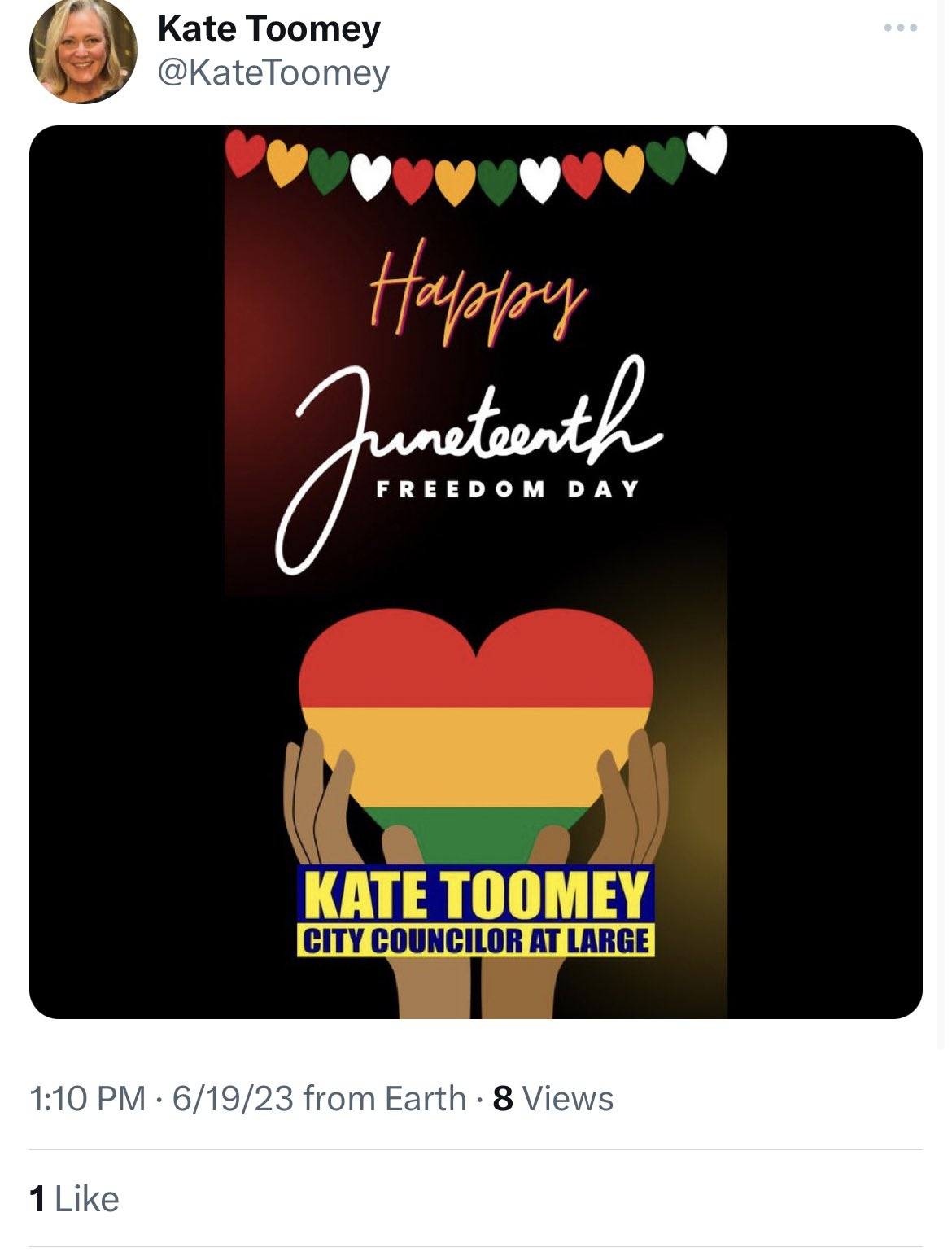
Lol.
On the matter of this newsletter turning six whole years old: On June 19th, 2020, I emailed my resignation to the Telegram‘s then editor-in-chief, who had, in the weekly leading up to that email, unceremoniously and wordlessly censured two of my columns on the matter of police brutality and city government’s covering for it. The events of June 1, 2020, the WPD busting out the riot gear, going full IDF mode on a group of kids, the pop of less lethal weapons and the smell of sickly chemical smoke, the clear plastic riot shields smudged with skin oil, the terrified eyes of a certain few police officers, faces otherwise obscured by kit, the dead eyes of others, ‘move back move back move back.’ Still vivid as a photograph in my mind. That, and the censuring of my ability to describe it to the readership I’d cultivated at Worcester Magazine, by an editor who didn’t hire me, who was forced to take me on by an equity firm that extracts profit from laying off local journalists, who didn’t have any reason at all to care about the editorial independence of the one-time alt weekly I wrote my columns for—at that point only nominally... when I filed those columns then came to find the next morning that they did not appear in the issue, it was the last straw. I was either leaving journalism entirely or pulling one last big move. Chose the latter, obviously, and here we are. From those early ‘fuck it’ days the realization that I could lose this thing—that there is indeed a “thing” that exists and it’s up to me and my choices to keep it that way—has seeped in through so many cracks in the drywall to the point I can now say the ‘fuck it’ era is over and the ‘tightrope walking’ era has begun.
How to keep a subscription-based publication alive in an altogether different time than the halcyon days of 2020, when everyone seemed to have a cozy bit of walking around money. Now everyone is getting juiced, squeezed, juiced again by an America that’s out of ideas save for looting the company store. Subscriptions are dropping off in a way that suggests a budding trend. Scary. I’m doing fine at the moment but you usually want to see ‘line go up’ versus ‘line go down.’
Please subscribe! Running a half off for a year deal until July.
This newsletter, really any homegrown local news outlet, offers something that has no one weird trick, no ground floor to get in on, no promise of salvation from being slotted into the category of excess population and thus further immiserated. By the grace of God, who is perhaps peeking, every once in a while, past the edges of Lurie’s Dome, Worcester Sucks is surviving. It can be hard to keep centered the plain fact that survival is success in the world of local journalism. That I’m able to say the thing turned six years old today is in and of itself a great accomplishment.
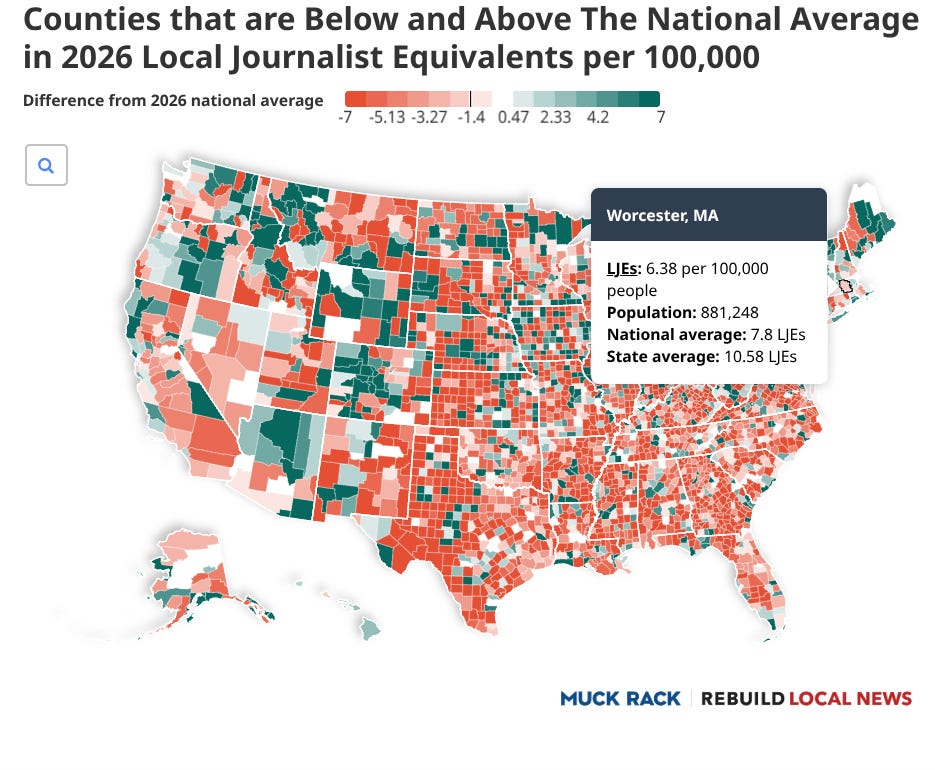
This fact was made stark by a recent report from Muck Rack and Rebuild Local News, updating the Local Journalism Index the two organizations launched last year.
Last year, Muck Rack and Rebuild Local News teamed up to explore a crucial question: How many local journalists are there?
The effort entailed crawling 52,000 outlets in the United States to identify what we called Local Journalist Equivalents, akin to the full-time equivalents (FTEs) you may know from your workplace. This includes many types of journalists – TV, radio, digital only, newspaper, podcasters and Substackers, full-timers and part-timers, as long as they published their work online.The results last year were jarring. They indicated a 75% decline in the number of local journalist equivalents since 2002. And contrary to what many assumed, the shortage was not primarily a rural problem. When measured against population, many suburban and urban counties proved just as stressed as small rural ones. The local reporting capacity crisis was nearly universal.
This year, we enlarged the study, looking both at the number of Local Journalist Equivalents and the content of their work. We reviewed the headlines and available text of 4.2 million articles published from January through March of 2026 to identify the local stories and the topics they covered.
In the below screenshot, we see Worcester County’s 6.38 per 100,000 working local journalists as well below the national average.
I am going to save further discussion of this report for a different post, one that will be going up on Sunday morning, that will be dedicated to a sort of “State of the Newsletter” report. I’ll be sharing particulars about finances, readership, growth, etc, and offering a direction for the future. Today, there’s too much local news I haven’t gotten to yet.
Tomorrow, those who attend the little soirée I’m throwing for Worcester Sucks at Steel and Wire (7 p.m., free and open to the public), will get a live in person version of that report! So make sure you show up! It would be nice to get a good little crowd out, like the one we had for the first Election Squad event last summer. (Feels like two years ago at least doesn’t it?)
Again that’s tomorrow, Saturday June 20, at Steel & Wire, formerly Nick’s, 7 p.m.
If it’s nice we’ll take over the back patio, which is about as lovely a spot to hang out as exists in the whole city.
That’s enough navel gazing for today, you’ll get plenty of that on Sunday. Now let’s turn to those aforementioned barriers between the Worcester we have and the Worcester we want.
More time on bike lanes than the budget
As I predicted, the council voted through the city manager’s budget “proposal” after agonizing months of midnight budget “review” sessions without a single alteration. Not that it was a difficult or risky prediction. This is what happens every year.
Unlike years past, however, there was a significant discussion of the council’s uselessness in the process on Tuesday night, ahead of what was ultimately a unanimous vote of approval with no motions made to alter the $1.01 billion budget in any way. Well, no motions allowed. Freshman councilor Satya Mitra tried to motion for an additional $20 million loan order for road reconstruction projects. Mayor Joe Petty ruled the motion out of order, saying councilors can’t add to the budget, only subtract—wild but true. It’s explicitly written that way in the city charter. The only way a council could add to the budget, per the charter, is by voting down the city manager’s and then writing their own—at least, that’s one creative interpretation of the second paragraph on page 24.
Since the council shares only two or three staffers, versus the city manager’s comparatively vast bureaucracy of spreadsheet people and number crunchers, that scenario is so implausible I’ve never heard anyone ever suggest it. It occurs to me in my writing this that the ‘writing their own budget’ provision of the charter has no rules against copy and pasting. So it’s conceivable they could, to use Mitra’s motion as an example, vote down the manager’s budget, Ctrl+A Ctrl+C Ctrl+V, stick in a line about a 20 million loan order and vote it through. That would take political acumen and willingness to lead, two realities that disqualify the current council pretty much automatically—before even considering how many of them would find the concept of select all-copy-paste bewildering. [George Russell voice: ‘Paste? Like the tamata sauce in the little cans?’]
Mitra’s motion and Petty’s shooting it down prompted a roughly hour-long discussion on what it is the council is there for, as it relates to the budget. While still a decidedly fruitless conversation, it was better than nothing. And we’ll get to the particulars in a bit. First, though, it’s worthwhile to compare how much time they spent Tuesday night on the budget—their first or second most important job, in theory—against how much time they spent on another matter: bike lanes.
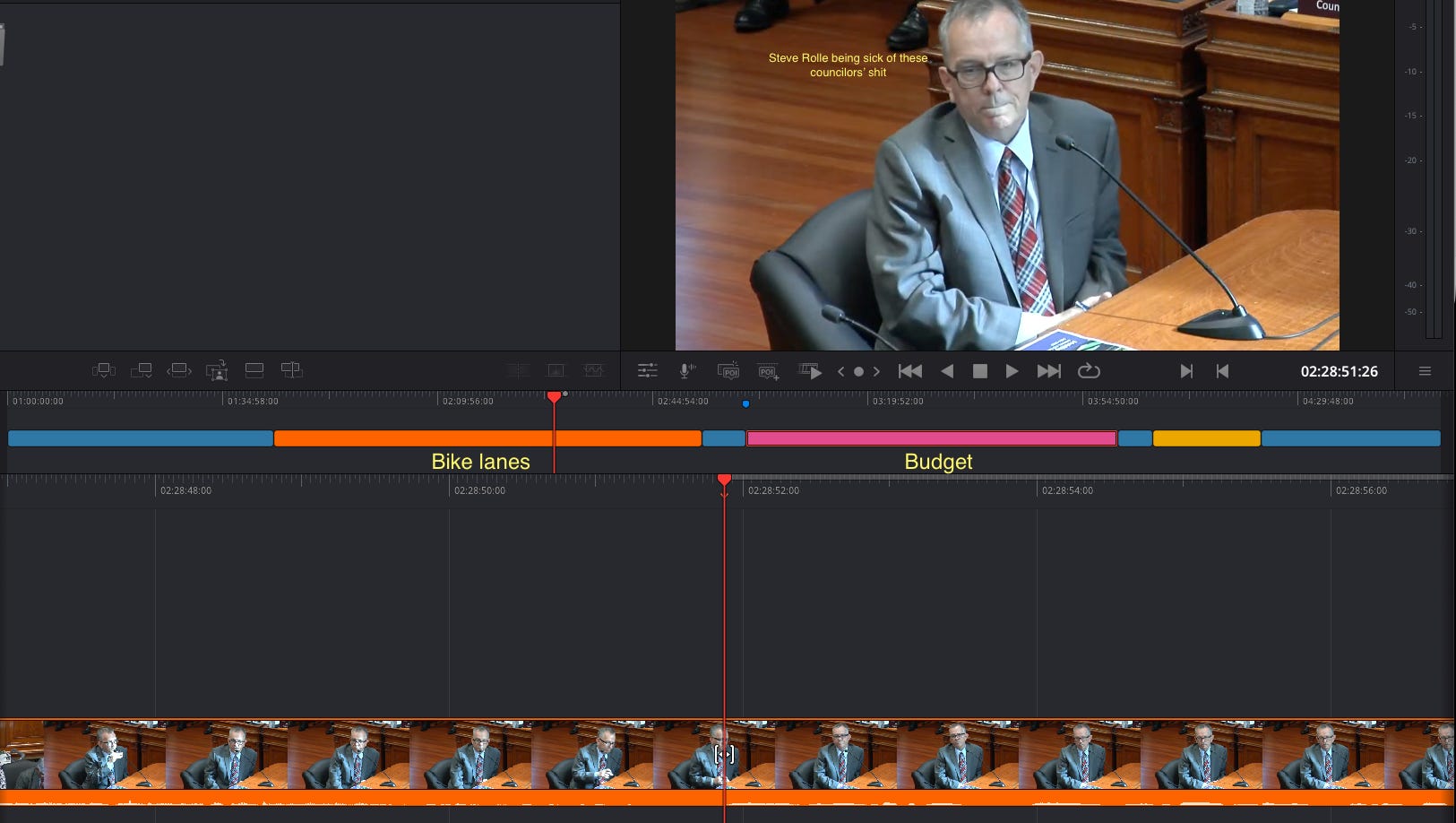
Time spent peppering Department of Transportation and Mobility (DTM) Chairman Steve Rolle and DPW Director John Westerling with inane questions: One hour, 10 minutes.
Time spent discussing the whole ass city budget: One hour, zero minutes.
While the dumbest question award goes to Kate Toomey (’Do electric car users charge their cars for free off city solar panels?’ Paraphrasing but not kidding. Check the reel I made about it for the Worcester Sucks Instagram.), the runner up in the stupid department and the clear winner in the “getting intellectually destroyed” category was Moe Bergman, who tried to pin Rolle down, yet again, on the Mill Street bike lanes.
“Do you really believe, because you said this a minute ago, I wrote that down, that the bicycle lanes are better for everyone,” said Bergman. “Do you really, truly believe that?”
Rolle responded, plainly and quietly, denying Bergman the conceit that the topic’s worth any dramatics.
“So bicycle lanes are shown time and time again when employed in effective manner to help control vehicle speeds, help provide a safe place for bicyclists which gets them out of the travel lane and better segregates the different modes, gets them off the sidewalk. So yeah, it’s an important component of a comprehensive street system.”
Bergman, sifting around for an edge, brought up the one (1) death that has occurred on Mill Street since the 2023 redesign, when, early on, a 90-year-old man rammed his car into a parked car, killing himself in the process. Lying, Bergman said “I hate, and I really am going to use this word literally, hate to go back to the discussion of Mill Street.” If you hate to bring it up, my brother, why bring it up? Apropos nothing? Toward no end? “One person dead, one person paraplegic after the bicycle lanes were installed. So again, do you truly believe that bicycle lanes are better for everyone?”
The dozens of pedestrian that have been killed by drivers in this city since that one elderly gentleman rammed his car into what was by the grace of God an inanimate object and not a pedestrian—killing himself by his own 10-and-2 hands—never seem to come up when Bergman does this to Rolle. (This being the third or fourth time I can remember.) I’ll let you, dear reader, hypothesize on why it is Bergman is hung up on this one death—an incident he can vaguely pin to a road redesign if his audience doesn’t think too critically about the particulars—and doesn’t ever invoke the dozens of dead pedestrians resulting from the fact our entire city’s road infrastructure is designed to facilitate driving as fast as one can through densely populated areas.
Incidentally or intentionally, Bergman is making a blunt expression of who he thinks counts and who doesn’t. It makes my blood boil. In a sane world he’d be run out on a rail for it. But this is freakin’ Worcester Mass, baby... How do you think we let things get this bad in the first place? A million tiny decisions over dozens of years.... all of them expressions of who counts and who doesn’t. The Ford Super Duty establishing itself in the process as the apex predator of city youth.
The conversation continued...
ROLLE: I’m not going to debate the merits of individual crashes that occurred on that corridor. I can tell you that we have seen crashes decrease significantly in the years since that was installed. The post-crash rate is quite a bit lower than the pre-crash rate, and I do think over time we will see that that will continue.
BERGMAN: And how about the businesses that are impacted through the chair by the bicycle lanes? Is it better for that?
ROLLE: Most research shows that bicycle lanes tend to result in improved economic activity.
Luckily Bergman only has the power to piss and moan about it otherwise we’d have seen him do something besides piss and moan by now. He cross examined Rolle to arrive at the same conclusion he always does: he asked the DTM to focus more on cars than pedestrians. All that fire and brimstone to arrive at a petulant suggestion that’s weightless in the real politik sense. Easily ignored. Memory-holed as soon as his speaking time runs out. (Steve if you are reading this please do not quit because Moe Bergman is annoying. Hang in there. We’re 36 votes away from never thinking about him again.)
Rob Bilotta, new District 2 councilor who unseated Bergman’s thought leader Candy Mero-Carlson in the last election, offered a refreshing rejoinder to Moe’s usual bullshit.
Big fan of history. So we’ll do a little history lesson. I-290 blew through the city. Didn’t go west of Park Ave. It didn’t go through Holy Cross. It went through the east side and it went through Polish and Lithuanian and Black communities and wiped out whole neighborhoods because they were deemed disposable, just like many of the big transportation policies in the mid 20th century. And that was done to ... have a highway, going through the middle of District 2, separating a park and a school from a neighborhood. That is very problematic and very challenging. I know this work is going to take some time, but all of these policies that were done over the last 60, 70 years were done to move traffic fast and efficiently at the expense of everyone in the neighborhood. So it’s going to take a lot to do this.
It’s especially refreshing to hear a councilor say he’s a fan of history, as Bergman is often quick to do, and then actually know some history. Not just use “history” as a synonym for “war monuments,” as is the case with Bergman.
But anyway.
Kicking and screaming, kicking and screaming...
By the by, any other outlet would have reported the above in the stylistic fashions of objectivity, necessarily legitimizing the “issue” on which there are at least “two sides.” Bergman and the rest of the cranks benefit tremendously from this journalistic tradition. I can and often do deny legitimacy to obviously illegitimate positions like “bike lanes are bad,” and I can and do explain why I do that. It’s about twice as honest to readers as pretending for the sake of “balance” that bike lane haters need to be heard out. So there’s a reason right there to subscribe to this outlet.
Subscribe / Tips / Merch Store
This is what I meant, as well, when I got in a Facebook fight with Moe Bergman (breaking my own rule about going on Townie Facebook) and told him I don’t call him for comment because I don’t respect him. Haha. Whoops! We discussed this at the beginning of the last podcast episode if you missed it.
Back to the budget, Mitra’s out-of-order motion created an opening for Khrystian King to pursue a line of questioning that I consider the only worthwhile line as it relates to the budget and why we bother to review it.
King asked the manager if the budget review process over the past several months has resulted in any adjustments to the budget. “And if so, what were they?”
As he’s want to do, Batista answered circuitously but after a few minutes of preamble got to the part where he said “no.” The only thing that would cause an alteration, he said, is “a vote or motion in which the entire council body as a whole” makes a specific cut (remember: they can’t add, unless on the advice of the manger.) “Then that’s something that we would immediately have to take into consideration for potential adjustments.” Outside of that, he said, councilors make their individual requests on their pet priorities throughout the year and those requests get factored into future budgets in some way he didn’t really explain.
King made a motion to have the manager’s office put together some information on a special act the Boston City Council passed to give it more discretionary powers in the budget process. “The ability for the council to engage a little bit more, have some more influence on this process Is necessary and appropriate,” King said. That motion was ultimately the one concrete action the council took on its nominal role in crafting the budget. A small step toward maybe one day having a real say in things, as the expression of the public will. Until then, if there’s a then, the budget will remain the polar opposite of participatory.
This line of inquiry dovetailed neatly into Kate Toomey’s extremely goofy order—obviously made in reaction to my recent post about the sheriff’s shenanigans, which spent some time detailing the bizarre fact that Toomey, an employee of the sheriff, has chaired the public safety subcommittee for about a decade straight.
Toomey’s order read...
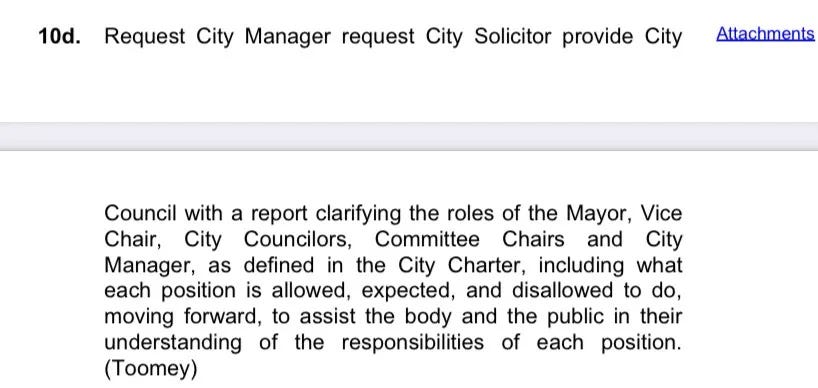
Of course, the code of silence around saying mine or the newsletter’s name in city hall prevented Toomey from articulating a clear reason for the order. So instead she said...
It’s been mentioned before there’s different people, different organizations have different ideas of what we’re all the aforementioned is supposed to do. I think over the years there’s been misinterpretation. And I think it’s time... very timely right now to make sure that we have an updated lexicon, really of, of all of the above.
Gary Rosen, maverick that he is, used Toomey’s vague argument as an opportunity to steer the conversation in a concrete direction: charter change. If we want to discuss the roles of councilors and committee chairs, he said, there’s always the idea of reviewing the charter.
“I don’t think that the city solicitor is going to give us any different definitions of our jobs other than what is listed in the present City charter,” he said. “So I just can’t support this I just don’t think it’s necessary.”
The trouble with asking the city lawyer for definitions of roles is you’re going to get the most undemocratic interpretation possible—the lawyer works for the manager, who benefits from diminishing the oversight capabilities of the council, a natural check on his power, by the design of the charter, but open, always, to creative interpretation.
Opposing the order, King said the prior city solicitor, Mike Traynor, issued a few opinions that sought to significantly curtail the council’s authority. He’s worried, he said, this order could lead to more of that.
That is of course what Kate Toomey wants. She wants someone to tell her she doesn’t have the power to hold the police department accountable because she has no interest in doing that. “I know what my role is,” she said. “I know what I’m supposed to do.” Yeah, Kate, it’s pretty obvious, and it’s obvious who tells you what you’re supposed to do. I for one do not think the police unions should have regulatory capture of the public safety subcommittee without at least paying for it. They have accomplished the remarkable feat of neutering the subcommittee for free, simply by making its longest serving members, Toomey and Bergman, feel like they’re part of the law enforcement family. In the deal they got not just a captured entity but a reliable stream of free advertising. You do not under any circumstances have to hand it to them, but... pretty slick.
The role, as Toomey sees it, is just that: how she sees it. In different hands, the subcommittee could be put to different uses. This is what I mean when I call the standing committee on public safety the closest thing the city has to a police oversight board. It is the committee through which certain public safety proposals must travel for approval. It is the committee the police chief meets with publicly the most regularly. It is a forum for more substantive conversations on surveillance technology, the particulars of “community policing,” the department’s internal discipline mechanisms and their efficacy, the homelessness and mental health response strategies, etc etc.
Kate Toomey does not use her authority as chair to take up any of those issues. She uses it as a propagandist would, inviting the chief in to recite the official line while lavishing praise.
When Khrystian King a few months ago called Toomey’s leadership of the committee “impotent,” that’s also what meant.
I went back and carefully reviewed the charter and found, to my surprise, there’s no language at all about subcommittees. This underscores my point: the role of committees is built culturally rather than structurally. Kate Toomey is asking for a formal definition that doesn’t exist—that she would know doesn’t exist if she just read the charter—because she wants a way to say her hands are tied. It is easier to say, to critics or just out loud, “my hands are tied” than “I like my hands right where they are, doing what they want to be doing.” The city solicitor is compelled, by nature of who she works for (the city manager) and who she doesn’t (the city council), to give Toomey what she wants. I’m sure she’ll find a way.
The vote was a split one, but it broke in Toomey’s favor. With King, Rosen, Bilotta and Ojeda in opposition, it passed 7-4. I imagine the solicitor will find herself able to turn this particular order around rather quickly.
Evaluation Time for Batista
The city manager put on his state of the city address on Wednesday. It was pretty dry. If you like ship and storm metaphors buddy you are in luck. I don’t know that I have much to say about it. Same stuff we always hear. Notable reduction in pomp and circumstance over years past. Everyone kept their comments brief. The black curtain and stage lights of the JMAC subbed for the wood paneling of the Levi Lincoln Room’s little-used podium. Suits in folding chairs applauding at the agreed upon moments. There was no dance number. No protesters, far as I could tell.
More importantly, the manager filed his written self evaluation with the city council this week. Later this month, they will evaluate him publicly. There’s no rubric, metrics, benchmarks, or any structure other than “everyone says something.” This process is almost as fake and useless as the budget review, but considerably less so. The most important thing to watch for is how hard the old guard councilors are willing to “go after him.” And, then, how enthusiastically the mayor “stands by his guy.” There’s a certain point, one that will be subtle and hard to notice, where the mayor recognizes he has to drop his current guy and go searching for a new guy. None of that will occur in the way it’s supposed to, but rather with public winks and nods to what’s always going on just off screen, usually in the conveniently located back rooms of the third floor, where councilors have been seen slipping quietly in groups small and, at times, large, to have their “real” conversations. To the untrained eye these convenings in the mayor’s office directly adjacent the council chambers, or the city council chambers down the hall, are almost impossible to spot. councilors can float in and out of public, on and off camera, to destinations that the viewing public, either in the gallery or at home, would be hard-pressed to discern. The very architecture of the building encourages this movement. Makes it all the more seamless. Almost as if the floor plan was laid out however long ago to serve that one purpose specifically.
Odds and Ends
One more subscriber pitch for the road!
Subscribe / Tips / Merch Store
Take me up on this deal please. It’s a great deal. Some are saying the best.
And reminder: Party tomorrow, state of the newsletter delivered live and in person, then written state of the newsletter on Sunday.
It was my birthday on Tuesday too so you could send me a nice birthday tip if you enjoyed what you read here today!
For the podcast heads out there, might I suggest checking out a new show called HEX LINE, written and recorded by my friend Sam Halen, it takes on matters of the occult in New England and especially Rhode Island (Sorry to say it, but the most occult New England state—Providence is scary in a way Salem could never ever ever.) I did the theme song, which I’m quite proud of, and the mastering work, which sounds half decent! And some other bleeps and bloops found throughout the episodes. It’s on Spotify and Apple currently, will be on others soon. Check it out! Hex Line Podcast.
An academic paper with an impossibly cool title and also premise I found courtesy 404 Media: “If LLMs Have Human-Like Attributes, Then So Does Age of Empires II“
The Dynamy John S. Laws Youth Academy is getting shut down and there’s a Change.Org petition to correct that. From a reader:
This program is getting shut down unexpectedly, and it does amazing work with housing-insecure and immigrant students. If we lose this, along with the NCC closure, our neediest students are going to be left out in the cold.
A recent piece in Propublica reader Brian Keaney sent along on the failures of the low income housing tax credit program explains a lot about the absolutely broken nature of our housing system and how it got that way. A good thing to be versed on as the rent control debate tumbles into the “inscrutable micro dramas” category.
Ok that’s good for now I think! Much much more on Sunday. And see you tomorrow!
It's as if Satya Mitra doesn't know his job.
But Khrystian King does. And Rob Bilotta does.
I have to take an online ethics training from the state (because I'm a part-time ESOL teacher for a municipal school system): Doesn't Toomey have to?