

To anyone here for the first time after reading my work in Playboy, welcome to the jungle. Please consider helping keep the spirit of the alt weekly alive in our little Northeastern outpost of the rust belt, Worcester MA.
And to everyone else, my work appeared in Playboy! I wrote a piece about the smiley face, examining Worcester’s crown jewel as a culchurul expaw’t, in a sort of macro-economic historical context. My approach was to view the symbol as an expression of the initial intent, and to see that intent, in the abstract of the historical record, to be a plain old corporate humiliation ritual.
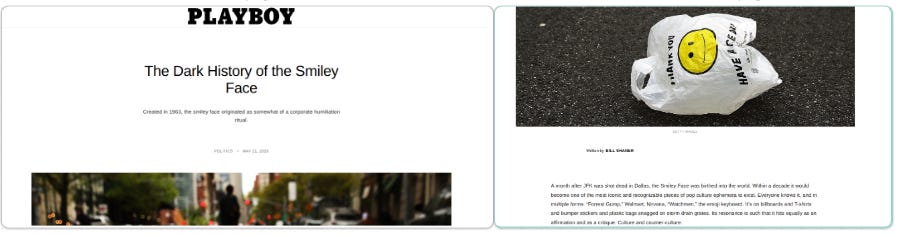
The timing of this ritual and the obvious resonance, manifest in how the smiley spread around the globe organically and memetically as a piece of pop culture ephemera, makes the smiley, and the humiliation ritual laden in its intent, a harbinger and then perhaps the defining avatar of a new world order. One in which a free market fundamentalism that spilled out from a few economics departments, would capture the necessary levers of state power, and from the 1970s to present, it would slowly dismantle the social contract between the state and its people, sharpening the part pries open new markets while selling off the rest for parts. In this way the smiley face is an endlessly fascinating cultural totem, I think. It gets even more interesting when you start to understand how important H. Ladd Plumley was to the advancement of that budding free market fundamentalism, and how the smiley face was a direct product of his innovations in the “consolidation” space. All that and more over on Playboy Dot Com. I suggest you stop right here, click on over to there, and read it before continuing on here (click it two or three times, even, so I look good in their metrics and they’ll let me write for them again. Just kidding... Sorta.)
“The Dark History of the Smiley Face”
A month after JFK was shot dead in Dallas, the Smiley Face was birthed into the world. Within a decade it would become one of the most iconic and recognizable pieces of pop culture ephemera to exist. Everyone knows it, and in multiple forms: “Forrest Gump,” Walmart, Nirvana, “Watchmen,” the emoji keyboard. It’s on billboards and T-shirts and bumper stickers and plastic bags snagged on storm drain grates. Its resonance is such that it hits equally as an affirmation and as a critique. Culture and counter-culture.
The people who invented the smiley face didn’t have such lofty goals for it, of course. The common telling is that the management of the Massachusets-based insurance company, Worcester Mutual Fire Insurance, wanted to bring cheer to their workplace, so they commissioned an artist to draw that happiness into being. But perhaps the reason the smiley face can be taken as both an expression of content and contempt is because its origin was filled with both those things. The smiley face was intended to bring cheer, but if you look at the totality of the record, the goal seems more sinister. In effect, the smiley face became a plain old corporate humiliation ritual.
[watching to see whether you open a new tab]
Great, now that you’re back, here’s a passage that didn’t make the cut on the draft that Playboy ran but a more local audience would find interesting.
The fact it was a humiliation ritual at all has been remarkably obscured, perhaps because the only people invested in articulating this niche origin story have in some way sought to benefit economically. The city of Worcester has used it as marketing material, thrust as they are into the neoliberal model of inter-city competition for outside investment. They found willing partners in Ball and his son, Charles, who started a foundation and attempted to make World Smiley Day happen, to limited success outside city limits.
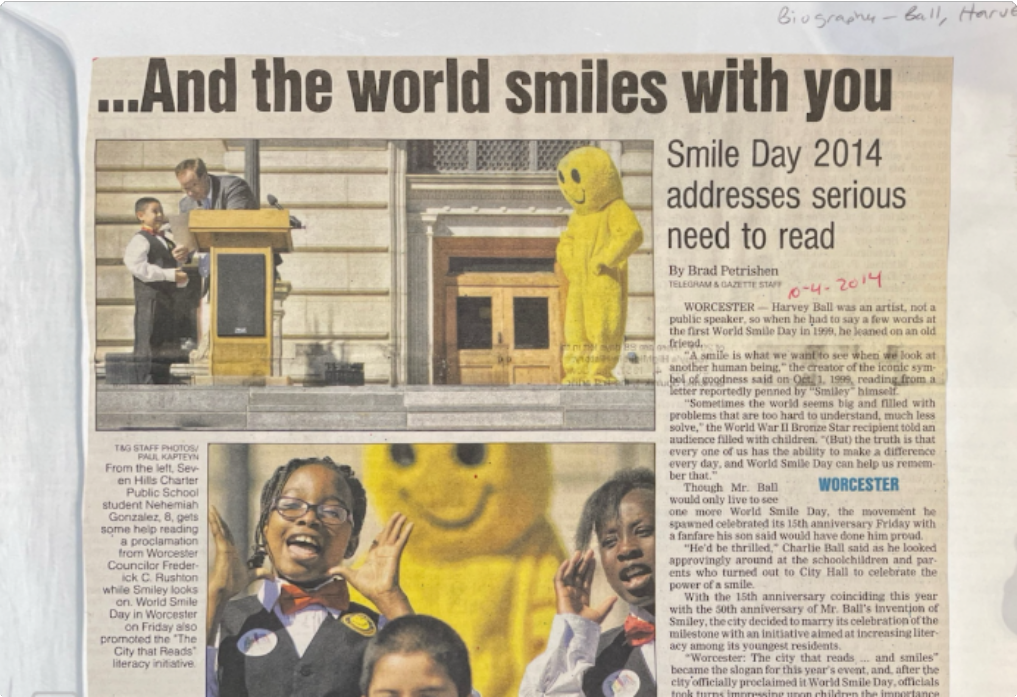
In 2002, the boosters of the smiley tried their biggest stunt yet: a human smiley face, made of hundreds of people dressed in yellow or black, carefully arranged for an aerial camera of some sort. There are two copies of the photo in the public library’s archive. It doesn’t appear to exist anywhere else.A 2014 celebration suggests the enthusiasm had tapered off. On the front page of the next day’s paper, a frumpy Smiley mascot slouches, hands on its hips, as it stares down a boy apparently laughing at it, as an adult struggles behind a podium to coax him into reading his lines.
Now’s a good time to say: the story was edited by Brittney McNamara, one of people behind the project of Making Teen Vogue Cool Again, who, after that outlet was gutted by a Plumley-style consolidation (RIP), followed EIC Phillip Picardi over to Playboy. Brittney, who I’ve worked with in the past on a few stories for Teen Vogue, did a fantastic job pulling out what worked and getting rid of what didn’t in this admittedly weird, sprawling story. Thank you Brittney!
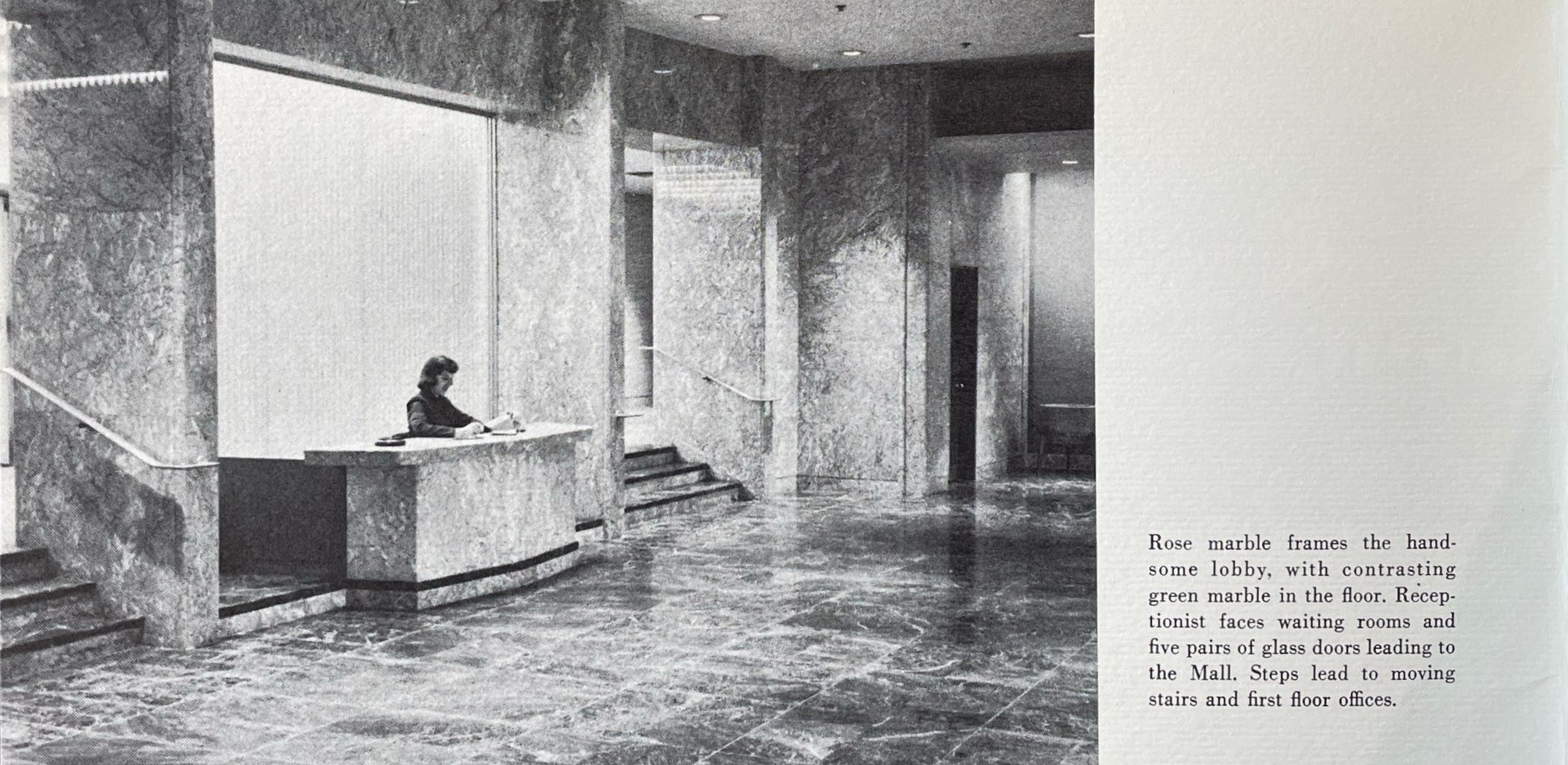
Last note on this: my research folder on this is five gigabytes. There’s so much more to tell and I think I have “a book in me” on this subject. For instance, this is what the secretarial desk looked like, where people would go to get a handful of “those smile buttons,” planting the early seeds of its proto-virality. Lookin’ like Adrian Veidt’s lair!
So if any lit agents or friends of lit agents are reading this… billshaner@substack.com! I am ready and able to “query” the hell out of this thing.
Please think about supporting this little alt weekly that could!
Ok now back to the usual bullshit. But first, my ability to take on freelance work like this is due in large part to the paid subscribers that allow me to pursue the craft of writing about this city full time. I hope you agree with me that in the six years I’ve been running this thing, we’ve honed in the craft quite a bit. Imagine where we’ll be after the next six!
Subscribe / Tip Jar / Merch Store
Spreading the word is also great!
“Doing drugs, having sex, and peeing”
The other morning the weekday host on WICN said, with a heavy Worcester accent, “let’s get the day started with a little culture, and I’m not talking Sauerkraut,” and it was basically my “Cellar Door.” I’d never heard a more perfectly distilled expression of our perverse little regional dialect—at least since the George Russell years, may as well have been a decade ago now. The way she said “culcha” running through my head like a catchy hook all week, up until I finally watched this week’s city council meeting last night and a new turn of phrase replaced it.
“We have also had people parking at the end of the street, doing drugs, having sex, and peeing,” said a woman, calling in by phone, to voice her opinion on a private street conversion that turned out to be the single most important thing the city council did this week—spending some two hours to take a vote on making one of our 80 or so private streets... remain a private street. The most intense, highest stakes debate of the night was over one single, small side street. I don’t even remember which one. Not looking it back up. Who cares.
The city makes residents of a street pay for the conversion cost. In this case it would have apparently tacked on some $40,000 per home to tax bills. With a policy like that it’s no wonder we have, as city solicitor Alexandra Kalkounis told the council, one the highest densities of private streets in the region.
You can see how it happens. The council doesn’t address the obvious fact that the policy of making affected homeowners pay for the public way conversion roadwork directly—where in every other instance it’s a socialized public work, because that’s literally the point of paying taxes, the point of the municipality as an entity—creates a situation where private streets will stay private forever. No one says “let’s instruct the manager to change this policy so we can be done with the private street mess.” Because that would be actually governing.
So if and when a conversion proposal crops up, as was the case Tuesday, you have residents making the obvious decision that dealing with a crappy road is better than taking out $40,000 in debt for a slightly less crappy road, and they show up to the council all pissed off, all how dare you, and the council, reactionary body that it is, sees all that homeowner anger out in the gallery and decides, on those grounds alone, that the issue is Very Important, thus necessitating Lots Of Debate. And the debate becomes confined to the one street in question and weighing the opinions of a handful of people who live on it. In a city of 200,000 our primary executive governing body is taking up matters that affect maybe a dozen people. Nodding along, the concerned & benevolent city patriarchs, as the woman tells them how bad it is that people are in their cars taking drugs or having sex or gasp peeing, due to the legal status of the road. Embarrassing, man. Stupid people governing stupidly.
Meanwhile there’s not a chance in hell the following video, captured at Dan’s Rockin Cafe right next to the courthouse on Monday afternoon, will get due litigation in the hallowed Esther Howland Chambers.
ICE agents hovering around the courthouse, two blocks from City Hall, like vultures, going into small locally owned businesses to whisk someone away for god knows what reason, the point being the performative violence, using city sidewalks, city roads, city data, city pension funds, the police department’s holding cells and the man hours of those who work down there, and who man the computers feeding the fusion centers that then feed local databases up the chain, the culture of cooperation and mutual aid found in the law enforcement community, from ICE to the DA to the police, back scratching and scratching back, the city officials helpless but to lie on their behalf about “no cooperation.” The council happy to deem it anything but a “local issue.” Happy, you’ll remember Eureka Street a year ago, to blame anyone who finds a little courage in their hearts to make a stand. To cast them as threats to “public safety,” knowing full well they’re not talking about safety and they’re not talking about the public.
In Cambridge, the city council just recently voted to terminate its Shotspotter contract. There’s not a chance in hell Worcester will follow suit. In the following, from the Harvard Crimson, longtime readers may observe the similarity in the rhetoric deployed by the police chief in support of the surveillance system. But you’ll also notice that the councilors quoted aren’t reflexively parroting the chief.
Councilor Ayah A. Al-Zubi ’23, the lead sponsor of the policy order, said the city should evaluate surveillance technologies against “measurable standards” — including accuracy, cost, or resident input, before adopting them.
“It’s got a higher false positive rate in our city and cities across the U.S., in which case I believe the benefit does not outweigh the risks of situations where our police department might be misled,” she said.
Acting Police Commissioner Pauline E. Wells urged councilors to keep the system in place, arguing that ShotSpotter gives police a tool to respond to gunfire when residents do not call 911.
“There have been at least 11 times when ShotSpotter detected gunfire in our city, and not a single 911 call came in — not one. That means 11 moments when no one reached for the phone, 11 moments when officers would have no direction, 11 moments when seconds were slipping away, and ShotSpotter was the only reason help was there at all,” Wells said.
Councilor Jivan G. Sobrinho-Wheeler argued the city should prioritize accurate technology, even if it means changing devices to avoid an ineffective system.
“Let’s actually use proven technologies for all of the things, and let’s tell that to our community, rather than doing some security theater and telling them we’re deploying a thing that’s not actually helping,” he said.
Here’s a representative sample of the sort of review Shotspotter is getting in Worcester, from a Standing Committee on Public Safety meeting earlier this month. The subject of the following is “Resource Router,” an AI dispatching tool that portends to forecast crime. It’s the other product Worcester purchases from the Shotspotter company alongside the network of “gun detection” microphones. (Couple old posts that get into it: “What is ResourceRouter?” “A streamlining solution for crime manufacturers”)
TOOMEY: I mean, clearly, numbers tell a story. And I think that what’s interesting to me is that I think that some of the things that we’re using now also help some of the data. What are you calling it now? The program that has people, the officers getting out and what is that?
SAUCIER: Yeah, resource Router.
TOOMEY: Resource router, thank you. I’ll have to put that into the memory bank. Resource router. Is that, does that have any bearing on the numbers?
SAUCIER:Every single shift officers are given a, it’s basically a box of where likely the most activity is going to be. And they spend time in those areas. But again, call load for 911 calls and whatnot. That could be different. These are more, that’s used mostly for deterrence of crime. Which is our ultimate goal. We don’t want people to become victims. So we try to be out there visible so they’re not become one.
TOOMEY: But a lot of that is also based on past historical events and things like that.
SAUCIER: To the chair, it’s based on a lot of different factors. But the most important one is it’s based on people that call into the police, not police initiated activity.
TOOMEY: Right. Okay. Thank you. And again, I think the numbers certainly tell a story.
Just leading questions setting the chief up to repeat the marketing material. No more, no less.
All told our Shotspotter contracts cost the city about a million annually. The budget currently being reviewed has no new positions scheduled for DPW road crews. How many pothole fillers can you get with $1 million going to a shitty tech company?
With Toomey chairing Public Safety, the question is moot.
Odds and ends
One more pitch for some love!
Subscribe / Tip Jar / Merch Store
Pretty busy news week all told. Here are some things I couldn’t get to today…
Brad Petrishen’s write-up on the now-suspended boxing program at the State Police Academy is worth a read. The quote from Brian Williams, SPAM president, says it all.
“We hope this report leads to the additional resources and incentives necessary to support their continued success in training and developing some of the finest troopers in the nation.”
So we killed someone, that means we get more money, right?
Steve Earl coming to Groton Music Center, which I hear is beautiful - Steve Earle - 51 Years of Songs and Stories - Groton Hill Music Center
Mom can we get a morally correct prosecutor? Mom: we have a morally correct prosecutor at home: [Pic of Steven Gagne and Thomas Duffy holding hands]
— Nelson Place School Principal on Leave after Opposition
— Worcester plaintiffs part of Massachusetts school segregation lawsuit
John Keough with a banger of a poem in his “Writing Stuff Down” newsletter. A man of many talents! Towering Figures - by John Edward Keough
the colorful villains always escape
and always kill again
and always kill again
and always kill again
I made my first very rudimentary VCO last night. More on that once I’ve fully built my own synth, lol. But for now, if you want to go down this rabbit hole with me, this guy’s videos kick ass. Heady stuff.
Ok talk soon!
Our country's current zeitgeist provides a ripe opportunity for someone to create the "frownie face". Great job making all the connections in your reporting, Bill. Keep reading that microfilm.
I attended the council meeting that dealt with making Viele Avenue public. I think it's important to note the petitioner, Satya Mitra, on behalf of the owners of one property, made an ass of himself. He clearly didn't take the pulse of the neighborhood. There were maybe two - (2) residents speaking in favor, but "item 19a" was repeatedly slammed by a determined contingent of residents. When Mitra began his defense of the request, he had a current photo of Viele Avenue put on the wide screens and most thought it looked like every street in Worcester. Even Moe.
Mitra failed to do the "due diligence" expected of a city councilor. His decision to support the petition resulted in the time wasted during the council meeting.
Tremendous work, and thanks for the shine on the poem!