

For as long as I’ve been covering Worcester, I’ve known Karin to be one of the most dogged, committed and persistent advocates in the city. Reading about her approach in this edition of Worcester Speaks was a delight. While one of the more infrequent features of this outlet, Worcester Speaks posts are consistently some of my favorite pieces to run. If you agree, consider a paid subscription or a tip! We’re an entirely reader-funded outfit. —Bill
Subscribe / Tips / Merch Store
Karin Valentine Goins and the Grassroots Fight for a Walkable Worcester
By Dani Killay
Karin Valentine Goins does not have a budget. She does not have a board. What she has is fifteen years of showing up and the kind of stubborn clarity that comes from watching a city slowly, fitfully, begin to believe its own plans.
WalkBike Worcester is entirely grassroots. No one clocks in. What exists instead is a constellation of annual rituals—the Week Without Driving each fall, the World Day of Remembrance for Road Traffic Victims each November—and a woman who has refused to stop asking a very simple question: What if we all drove less? The question, it turns out, baffles too many of us. Earlier this month, the city department principally responsible for making roads safer for walking and biking was asked by sitting city councilors why it doesn’t prioritize car travel. So Karin has learned to soften the ask: not a week, just a day. One trip. Part of a trip.
She is an incrementalist in a culture that demands transformation overnight. The city has plans now—a master plan, a mobility action plan, a Vision Zero commitment—and she has watched each one get clawed into existence. The Complete Streets policy of 2017 meant that state funding for roadway work would finally prioritize safety over asphalt tonnage. On Mill Street, paint and bollards arrived first, with a $2 million design grant waiting. Newton Square, that seven-way confusion of stop signs and bus stops, is slated to become a proper roundabout. These are not victories yet, given the years (or decades) it can take to move from concept to implementation . But they are what victory looks like when you are playing the long game.
Karin doesn’t see the benefit in pointing fingers, but admits that our city council is a mixed bag. Some members have been genuine partners. Others have spread misinformation—most persistently, the claim that no one rides a bicycle here. She once stood before them and noted that if elected officials are not seeing cyclists, that fact is itself frightening. The moral architecture of her work refuses to blame individuals for systemic failures. The person complaining about losing a lane of traffic is not a villain but someone who has been told, their whole life, that the car is the only answer. The work is to outlast. To keep offering alternatives. To keep holding open the possibility that a city designed for people rather than machines might also be a city where kids roam again and public life thrives.
She names gentrification as the shadow side of active transportation progress. She does not want to see the people already here displaced. She owns a minivan. She is not asking anyone to give up their car. She is asking for something smaller and possibly more radical: leaving it home sometimes. Trying something else. Paying attention to what the world feels like when it is not mediated by a windshield.
May is Bike Month. A loose affiliation called the Bike Alliance meets on the third Thursday of each month at New Tradition Co. (5 Harris Court). Anyone is welcome. This is how change happens in Worcester. Not through grand pronouncements. Through bike breakfasts and block parties. Through showing up again and again with the patience of someone who understands that infrastructure moves at the speed of funding cycles. Through refusing the reflexive answer—you can’t, nobody does—and substituting another. The city has a long way to go, a reality Goines was recently made to feel acutely. This past mothers day after a walk in the neighborhood, Karin’s husband (John Goins) was struck by a pickup truck whose driver reportedly did not stop for the pair as they were trying to cross June St. from Nevada St. John was hospitalized for three days and is now recovering from injuries to his chest and head. What happened to John happens too often in this city. A man was killed on Hope Ave in early May, and last week, a teenager was seriously injured by a pick up truck driver in Kelley Square. While an especially deadly summer of pedestrian accidents in 2024 prompted the city to take more aggressive action, severe pedestrian crashes remain routine news events. One could be forgiven for thinking the city will never get safer for walking or biking. But cynicism, Karin believes, is a luxury the work cannot afford, and she isn’t about to let the bumps in the road change her path now.
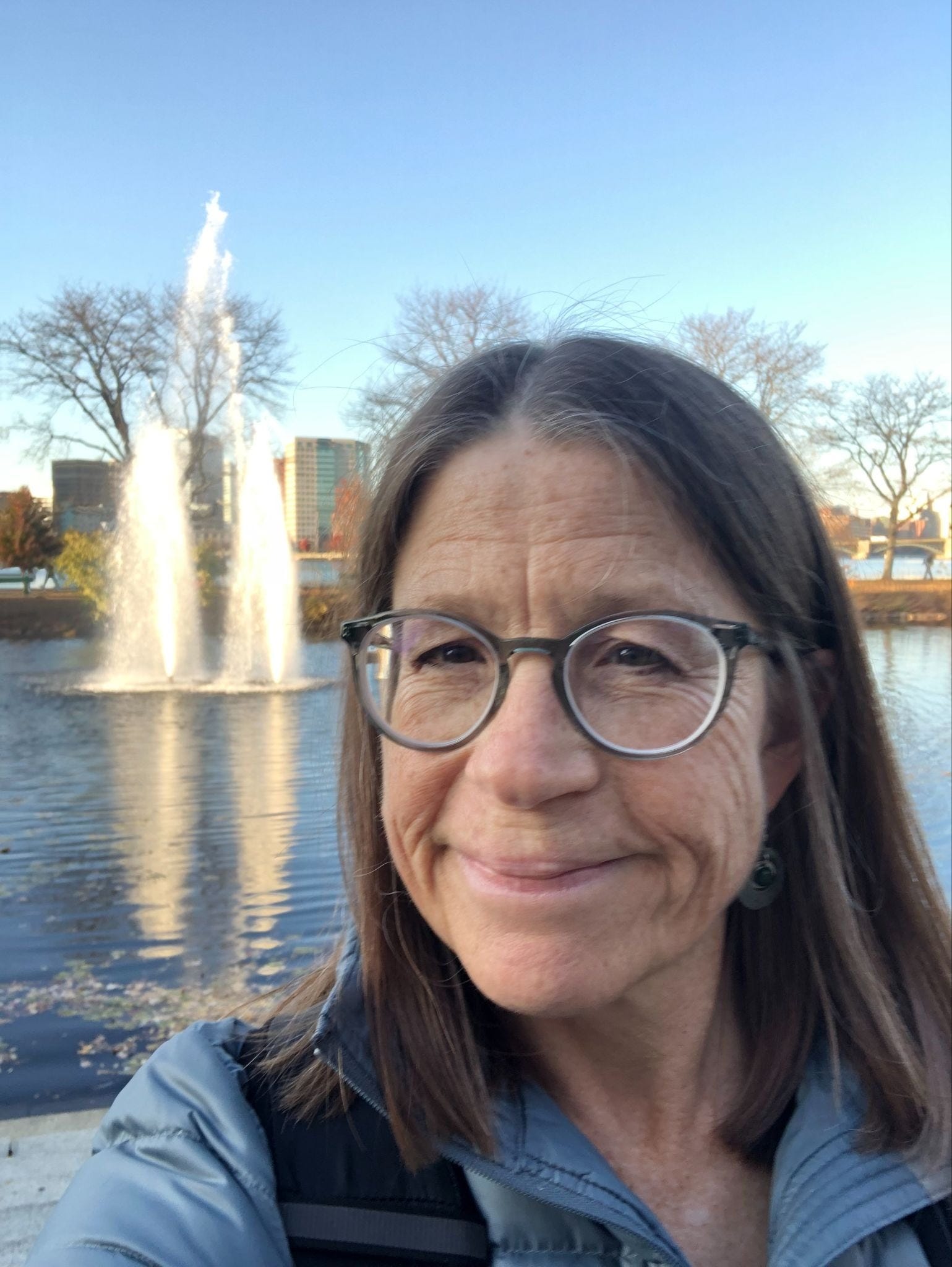
Dani: You are in the organization WalkBike Worcester. How is it organized? Is it a fully volunteer group? Are you in a leadership position? What’s your history there with WalkBike?
Karin: Sure. So WalkBike Worcester has been around awhile. We are an entirely grassroots, no-budget organization. We started in 2011, although my advocacy on these same issues goes back farther than that. And so we have had different eras in our existence. Early work focused more on working with agencies and departments. We had a long period where we were more public facing and had active members who planned community rides and walks. And we had, I think, our biggest community ride, with like 65 people. And then things like the ballpark planning happened in Kelly Square, and then the pandemic, which sort of shifted some of our focus and some of our ways of operating. My co-founder is a fellow named Jerry Powers, who I still miss. He left the area. He was somewhat older. I think he’s in his mid-80s now. But he was my partner in crime for a long time. I would say, post-pandemic, the city itself is in a really different place than when I started doing this work. We have a Department of Transportation and Mobility. We have, in addition, the Worcester Now Next Master Plan, first one in 40 years, which then led to the Mobility Action Plan, which is the city’s first ever long-range transportation plan. And then flowing from that, the Vision Zero plan. And Vision Zero is the concept that humans make mistakes, but nobody should die on the road, that it is possible to prevent deaths and serious injuries on our roadways. So as an organization, I continue to be the lead. I don’t know what to call myself, because we don’t have a formal board or leadership group per se, so our work is in collaboration with others, organizing.
There have been several issues in the last couple of years where we partnered with others to bring people, whether it was contacting councilors, testifying, doing more public facing remarks like that. We also have two signature events each year (Week Without Driving and World Day of Remembrance for Road Traffic Victims). There’s now more bike-focused groups than there ever were in the past and bike month (May) has a number of events.
Tell me more about the staple events you mentioned.
The National Week Without Driving in is the beginning of October. It challenges community members and policy makers to experience the barriers of going carless. And then, our other signature event is the World Day of Remembrance for Road Traffic Victims, and that’s the third Sunday in November. Each year we’ve gotten a little bit bigger with that, to get more people to participate.
So Week Without Driving was started a few years ago. There’s a woman with low vision in Washington state who began that, I think she worked for Disability Rights of Washington. It’s a challenge. And now, there are people in all 50 states and actually internationally that participate. And the idea is challenging yourself to travel differently. Of course, she puts it out as Week Without Driving, which when you say that to people in Worcester, they get very frightened. So what we have said, starting last year, we really emphasized, like can you do one day? Could you do one trip? Could you do part of a trip? Could you just take, you know, the bus for a few blocks and see what it feels like, and it’s traveling in some other way than a personal vehicle, and then share that experience, you know, with your friends and family, but also on social media. What were the challenges? What were the joys? You know, a lot of people are finding even in our challenging conditions we have in the city, that getting on a bicycle is a form of freedom they may not have felt since they were kids.
Could you expound on the challenges that you feel are not necessarily specific to Worcester only, but that Worcester is facing when it comes to reducing dependency on individual cars?
So I think that we can think in terms of two buckets, right? One is infrastructure itself… or maybe three buckets. One is social norms and expectations, which is linked to infrastructure and policy mindset. Vision Zero is a concept that started in, this is taking one thread, pulling one thread, started in a European country. We’ve made progress on this side of the pond with people committing to Vision Zero, but with very rare exceptions hasn’t translated into a lot of change. You know, Americans have been in love with the automobile for over 100 years. And I think the part that people are maybe expressing a little bit more now is that the auto industry was a huge and powerful lobby that did everything from ripping up streetcar rails to convincing people that cars were freedom. Now, 150 years later, we’re learning the problems with that.
So here in Worcester, for a variety of reasons, the roadways we have are enormously wide empty roadways and yet people will tell you there’s no space for protected spaces. This is sort of a global mindset, the idea that we just can’t change that. So I’m an incrementalist. I’m not the sort of someone who comes in and expects everything has to change immediately. I’m happy about the changes that are happening slowly, but we still have resistance to the idea of taking part of our enormous roadways to set aside for people to travel differently. And so it becomes self-fulfilling that I push back against people all the time who say, “well, you can’t.” You can’t walk in Worcester. You can’t bike in Worcester. Well, I do. What does that say about me? I don’t know. It’s this acceptance that how things already are is how things should be. Recently there was pushback at a public meeting about making Newton Square rotary into a roundabout, which is a controlled way of vehicles entering and exiting, and in fact it won’t really affect the number of cars going through; but it will make traffic through the roundabout safer for all.
As someone who uses that rotary literally multiple times a day, I welcome it. There’s a stop sign at that rotary. There’s a lot going on there.
I worry they don’t even know what they were saying. That is a heavily traveled route by school children of all ages. There’s literally a bus stop in the middle of the rotary, but they would say that all their statements were about the convenience of drivers and they wanted to preserve the ability for people to pass in the rotary. So I think there’s a lot about mindset, which is where I’m still interested in the technical changes, but our role is about supporting the good things that are planned in the city and that are done and pushing for elected officials and other people in positions of influence to embrace the changes, to support the changes and building up people’s individual capacity to demand it because we know they want it.
The positive changes. What are some wins, some highlights, some things the city has done that are moving in this direction?
So I think having plans is really important. I mean, I think everybody knows that if you have a plan that just sits on a shelf, it doesn’t change the world. But doing things willy-nilly is not helpful either. It all needs to be flowing from the plans. And the city has done a reasonable job at getting public input on what and where things should be happening, the issues that are most important. In 2017 the city passed a Complete Streets Policy. The impetus for that was that the state has a funding program that, if you go through the process of creating a policy that meets their criteria, helps cities.
Complete Streets allow travel by all users and it usually refers to a process of building from the outside in, leaving just enough room for what’s warranted for the vehicles to travel. So sidewalks accommodating walkers, walkers who use mobility devices, people on bicycles, e-bikes and scooters and other inventive sorts. So when you create the policy, then you create a prioritization plan, which basically puts what it’s in the title, right? It’s the locations that have the highest priority for work to be done because of people’s access to services, because of safety problems and other issues. So then from that, based on that plan, they can apply for funding. But that’s a set amount of money, in a sense. It’s a smaller amount of money. But by creating those rules, then all the work in the city has to be done according to those rules. Every year the state provides each city and town with a certain amount of money on a per capita basis that is specifically for roadway work. And for many, many years, when the DPW was responsible for all infrastructure, we got lots and lots of asphalt. Now all work that’s done, that’s called Chapter 90 is the funding, all work gets the lens of what safety improvements could we make. So for example, Mill Street, the changes on Mill Street received a heavy amount of criticism. Now the city could have done, and they’ve learned from it, they could have done a better job with the upfront communication. But the bottom line is they changed the configuration of space with just paint and bollards and signs. Moving the curb, that’s expensive, that’s changing drainage and everything. And they have a design grant for that now, I think it’s $2 million for just the design of that whole same stretch. And every time they’re gonna do something like that, they’re getting public input. So it’s incremental change, it will map out, they have a a proposed bike network, they’ll continue to add to it to make it more logical to people and not just stop/start.
And not to get you in any trouble here, so we’ll focus on the positive. I will not ask if you feel like you have opponents in city council, but do you feel like you have proponents? Do you feel like you have people in the halls of power, so to speak, that are very open to these changes? Or does it feel like you’re running up against a wall all the time?
So we worked closely with Councilor Etel Haxhiaj when she was a district councilor. She was the first elected official who really worked in the trenches with us, I would say, on these kinds of changes. And that was a real loss that she is no longer there. There are a few councilors that have some principles, I guess I would say, in alignment with what we’re interested in. There are a number who are opposed, have been vocal opponents to the changes that we are demanding and expecting.
Would you feel comfortable naming any of them? I think people know who they are. Or would you rather stay out? I mean, I had a couple come straight to mind.
Exactly. And I guess there are people who have put out misinformation and disinformation, and I think that is very harmful on a lot of levels. And the general vibe of this council to wall off themselves from the public is even more discouraging. And that’s why I think of our most important work being helping people. There’s a lot of what they call latent demand in this city, you expressed it when we started talking. Folks who would probably keep their car, but want to travel less with it. And I think that it’s helping people understand that we can have nicer things and that they deserve to have a voice in that and speak up. So it’s a certain amount of community education and community organizing, which, honestly, is good for the soul. The other thing I want to say is that there’s a lot of, again, misinformation and disinformation. And what I hope is that we can help people navigate that.
What do you feel is something that you are continuously seeing and it irks you that you’re like, that’s misinformation?
This is being put out there: That nobody rides a bike. Okay. That is said over and over and over again. So I stood in front of council and said, if you’re not seeing us, that’s frightening and it’s untrue and it’s frightening. There’s a law in Worcester against riding on the sidewalk. I will never hold it against anyone. That is a call for help. You know, that’s someone who wants to ride and they feel unsafe in the places you have given to them. And so that is an example. People in positions of power exaggerate the demand for cars. So are you familiar with the Worcester Now Next Plan? That’s the master plan?
Only by name. I don’t know a lot of details.
So when they were doing the public outreach for that, a survey, and they kept it up there for a long time. And when, at the end of the day, there were about 1,400 responses, 1,300 people said, we want safe streets, we want choice, safety and choice. 100 people said, no, it should be all cars. But all those people don’t always vote. They’re not always paying attention on the local level.
So with the Worcester Now Next, what is next? What would you want to see in those incremental changes? What is something that you would like to see changed that is very accessible to Worcester to change?
So, there’s different ways to answer that. I mean, are you looking for policy or practice change?
I would say both. I would say where would you like to see the city make changes and where would you like to see the people make changes?
Sure, so the city does street and sidewalk work every year, a certain amount of it. There’s a certain budget. There’s the chapter 90 money, but there are also many other communities around the country that have done a specific bond, like a five-year program for streets and sidewalks. I think that would be a really big step forward too. And it will snowball. When people see more, they’ll do more outside of cars. And so I guess that’s what I would like to see. And I know it’s not going to be next year, but I think that that’s something that this community’s very capable of organizing to push for. On the public side, and I feel we’re starting to see this around the country, is for people to understand that it’s not creating space for other people who are not driving cars. It’s not a zero-sum game. It improves a community, it’s quality of life for everyone. It actually makes it safer for drivers. There is less chance of a crash, less chance drivers or a passengers are going to be injured. And I think people are beginning to talk more about our obvious child and adolescent mental health crisis. The loss of mobility from my generation to my daughter’s generation has been huge. And we’re beginning to see effects that could be ascribed somewhat to that. You know, I raised my kids to walk and bike, not all the time, but a lot, and they still do. They’re careful users of all modes. They also do drive a car. I have nieces and nephews who don’t even drive. But for people to understand that, you know, greater green giving more over to green, whether it’s trees or bushes or small, pocket parks is good for everyone. Another thing that’s talked about nationally, I have a public health background and that’s what I work in now, is... there’s the social connection that’s been lost by people driving around in their metal boxes. Its something we need to rebuild. It has contributed to the political problems and the social problems we have. There is nothing that is not improved by providing opportunity for people to get around without a car.
Getting around without a car in Worcester this winter I feel like was specifically very difficult. As an able-bodied person I found it very difficult. What, if anything, is being done on the advocacy front specific to individuals with mobility assistive devices, wheelchairs, mobility challenges? Are there folks that are specifically voicing those concerns in council about making sure that our city is bare minimum accessible so that people can live their lives and survive?
So there’s a few, you know, positive things recently. Rob Bilotta, councilor for District 2, is an incredible advocate. Having him on the council is such an important lens. The city has its first, what’s called an ADA transition plan, which is about how to make the public spaces accessible for people with disabilities, so that’s an important step. Again, it’s going to have to be incremental. I know that what used to be called the Center for Living and Working is active, Access Advocates, I think, is active, and this is all why I talk a lot about partnering with groups, because I’m not going to speak for someone, but I can help give them an opportunity to tie what they’re focused on to some of the issues that I work on. And, you know, we’ve also partnered with someone like Liz Myska who uses blindfolds to educate students and officials. She’ll have them walk blindfolded or with a white cane and with a guide to see what it feels like to actually do that. Like a kind of walk audit.
Tell me a little bit about a walk audit.
Sure. So audits sound scary and formal and, you know, like something you do for your taxes, but it just means really using a loosely structured process to pick a space and to carefully, for good and bad, make records –whether it’s writing notes, taking pictures, doing videos–of your experience and then sharing the results with the public and with people who have the kind of decision-making power and resources that could make the needed changes.
Walk Audits is that something Worcester does as an organization or is it something that individuals can do in assistance to WalkBike Worcester?
So I mean audits can run the gamut. AARP has tons of forms people can download and they can actually do something entirely on their own. We collaborate a lot with an organization called Walk Massachusetts which is the oldest pedestrian advocacy organization in the country, used to be Walk Boston, now Walk Mass. They’ve done audits that we’ve assisted with out here, five audits or something like that. And it stretches all the way to these really intense research-based ones, where they collect a ton of data, half of which they never use. The team I’m part of, I work at UMass Chan Medical School in the Prevention Research Center, we have a study called Neighborhood Connect. The premise of that is getting people comfortable doing their own audits, whether it’s a walk audit, bike, park and green space, unsafe space, or unused spaces. We provide some simple prompts that people can use and guidance about how to organize it. It does not need to be experts being paid money to lead you on an audit. It’s a simple process.
So in a perfect world where we could continue making incremental changes and end up in a more ideal city, what do you think that would look like? If we were able to eliminate some of the congestion, eliminate obstacles for pedestrians, danger to cyclists, less need for space for vehicles, what do you feel Worcester might look like?
I think it would look a lot more green because we could give over some of that space. I think you’d see more actual people, instead of people traveling in the metal boxes. I think you’d see people out moving. I think you’d see, I want to add something here, because we also need to make sure that as those changes are made that we’re linking it to other issues that are really important. I want to call out housing here, because in most if not all the places you might look around the United States that have made strides in what you can call active transportation infrastructure, you’ve seen gentrification. And that’s something that, if you are making conscious efforts to link what you can call built environment improvements with things like housing affordability, that you’re going to simply displace the people who are there. And I guess that’s what I would say is that yes, we can welcome new people. Of course, we always want to welcome new people. But I do not want to see a replacement of people who are here. I want to see people be able to enjoy the place where they have live. But I think that that’s what I would say. We would, first of all, see less cars. You wouldn’t need as much parking. So you could use that, whether it’s outdoor dining or parks. Or you would see, I’m going to sort of leave aside the question of how kids get to school, for example, because Worcester has a pretty complicated way of assigning people and a fair amount of busing. But you’d see more children. People talk about children as an indicator species. You’d see kids out on their own. That’s another thing I’ll mention is there’s a concept called third spaces. Worcester would have more third spaces, which are places you can go and gather and people watch and do all those fun things without spending money.
I’m a mom. Three of my kids are teenagers. And I think a lot about how different things are now. I was a teenager in the nineties. I was almost never home. I was out, I was about, I was, you know, making gains, making mistakes, learning lessons, becoming an adult that can think critically and figure out situations and navigate the world. And I feel like that experience has been stripped away from the modern teenager. They have to be concerned about physical dangers or they have to be concerned that they’ll draw attention and someone will call the police because there’s no place to be anymore.
Yes, I think that it is kind of a moment in terms of recognizing the harm that we’ve done to young people.
And as you said before, it would get so many more people out. When you have a city and no one’s out in it, you just have a ghost town. There’s no foot traffic for shops, or for public safety.
I think people are, or I hope they are, thinking about… do you know the term weak ties?
No.
So that is the idea that we all have close relationships with some people, and people of a variable number. But what has been lost a lot, particularly in the United States, are these weak ties. So my neighborhood, I think our lots technically wouldn’t be legal now. They’re small. We have a mix of housing. We get to interact. Hello. How you doing? How’s your mom? How’s your kids, you know? Wow, I can’t believe they’re getting married or something And the same with shops, you know, I shop at the small places around the corner from me on June Street. I don’t know them all well, but you pop in and out. You see people. I can’t wait till Cordell’s is open again. [Karin and I both smile and sigh in wistful agreement.] It’s those weak ties, that’s what builds a community.
What are some avenues where folks could make an impact? Whether it’s individual or joining up with a group, what kind of things can they do to make inroads into being part of the positive changes? Part of that community building?
Well of course I’ll put in a pitch for getting on our list so that when we put out information about engagement opportunities. And there is the research study that we are involved in with Neighborhood Connect. That is an opportunity, in multiple areas of the city, for people to be part of. I would say having conversations with your neighbors about conditions in your neighborhood. Go for a walk and see what you like or don’t like. And people have different relationships to different neighborhoods. They might live there, but also maybe it’s a neighborhood your church is in, or your kid goes to school in? There’s all kinds of different ways to care about a neighborhood. I encourage people, I know I’m a nerd, on some of this stuff, but I think it’s a civic responsibility to be familiar with what the plans are in your community. And they are on the city’s website. We have a nascent transportation coalition of groups that are all interested, from different directions,in transportation. Find one that resonates. And I would say just to participate. There’s different ways: you can attend a public meeting. There’s usually an opportunity to provide written input, and then just keep talking to people. Also, be brave. Try something new. There are several groups around. There’s a small but growing number of opportunities to learn to ride safely for folks who have really never ridden on urban streets. And they’re really concerned about that. You don’t have to go it alone. We collaborate with MassBike. Worcester Earn-A-Bike makes it possible to build a bike for yourself. Again, I’m not a purist. I owned a minivan for a lot of years. I raised two children in the city and getting them to enrichment activities would have been tough without a vehicle. So I’m not gonna say don’t own one, just leave it home sometimes and be willing to try to do that more often.
Is there anything I didn’t ask you that you kind of hoped I would, something that you want people to know?
That the city has a long way to go, but don’t be cynical about that and be willing to try things and to share your perceptions and your observations, but please don’t immediately say, people shouldn’t ride, you can’t ride. Let the first answer be, ‘how are we going to do that?’
Very helpful in understanding the big picture of what's happening in Worcester. Lately, I've been encouraged to see more folks waiting at bus stops. Ridership is measurable data in support the fare free program.
I also think it's worth noting that many of the affordable units available in the Lincoln Square Boys Club conversion to housing DO NOT include parking. Linking this model of affordable housing to free bus transit may be a positive development.
For a deeper dive into walkability, I recommend City Nerd on YouTube. Although it's generally about cities much larger than Worcester, Ray Delahanty provides an interesting critique of the built urban infrastructure and environment.
Good piece! 👏