


I spent the first two weeks of August on a glorious vacation in PEI with my family, so, in an attempt to have actually taken that time off, this edition of WPS in Brief looks a little different. I will not be covering the August school committee meeting in my usual play-by-play format. Instead, I am sharing a few reflections from Tuesday night’s redistricting meeting and linking to other local reporting on what happened at the one full school committee meeting this month.
Let’s dive in:
Initial Redistricting Scenario.
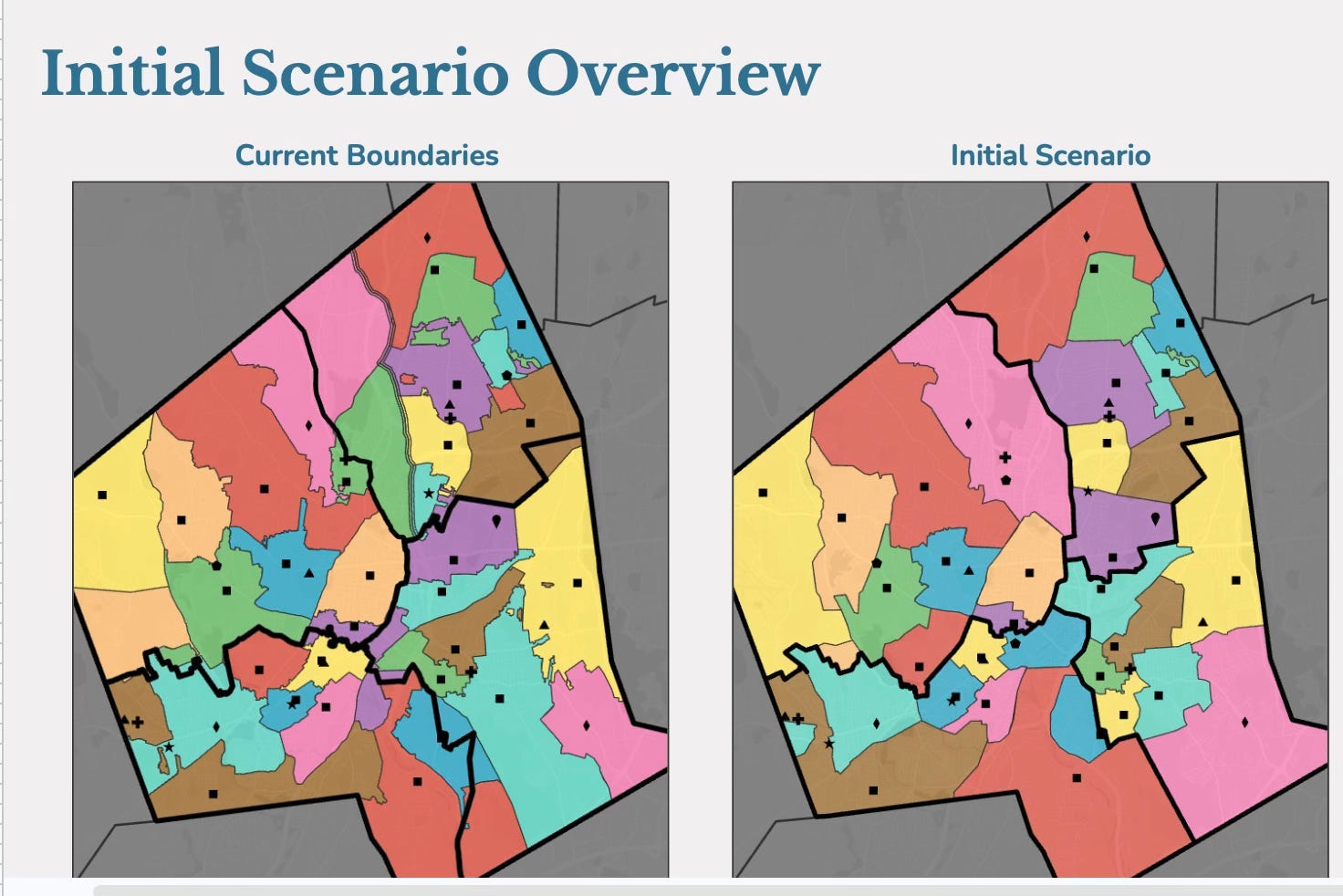
If you missed my post about the initial redistricting scenario—including what would change and why WPS is undertaking this process—you can read it here.
The initial proposal is just that: a proposal. There are three more scenarios coming, with public forums and months of feedback before anything goes to the full school committee for a final vote. There are plenty of boundary lines that could change. But it’s important to keep the larger goals of this important work centered. Redistricting gives us an opportunity to ask not only, “What does this mean for my child?” but also, “How do we make Worcester Public Schools stronger and more equitable for every child?”
Nelson Place/Norrback Divide.
One issue that emerged during Tuesday night’s redistricting discussion probably would not surprise anyone who has followed Worcester’s real estate market or read the recurring “Where should I buy a house in Worcester?” posts on Reddit: Nelson Place is perceived as one of the city’s “better” elementary schools, and families want to remain within its attendance boundary.
That perception is not necessarily a measure of the education children actually receive inside the building. But it is real. Nelson Place is regularly mentioned alongside schools such as Flagg Street and West Tatnuck when people discuss where to purchase a home in Worcester. The $58 million building, opened in 2017, is the newest elementary school in the district and sees some of the highest requests for voluntary transfer from other neighborhoods. Real-estate listings sometimes identify the school as an amenity, and families have said they bought homes specifically so their children can attend the school.
Case in point, on Tuesday, a parent of a rising Nelson Place first grader whose home would be reassigned to Norrback told the School Committee, “I purchased my home with careful consideration of where my children would be receiving their education.” She said recommendations from lifelong Worcester residents whose children attended Nelson Place and Forest Grove influenced the family’s decision. After moving in and speaking with neighbors whose older children attended the schools, she said, “I knew I made the right decision.” The parent, who said she serves as Nelson Place’s PTO treasurer, asked the committee to pursue alternatives that would not “negatively impact my son and his friends’ education at Nelson Place.”
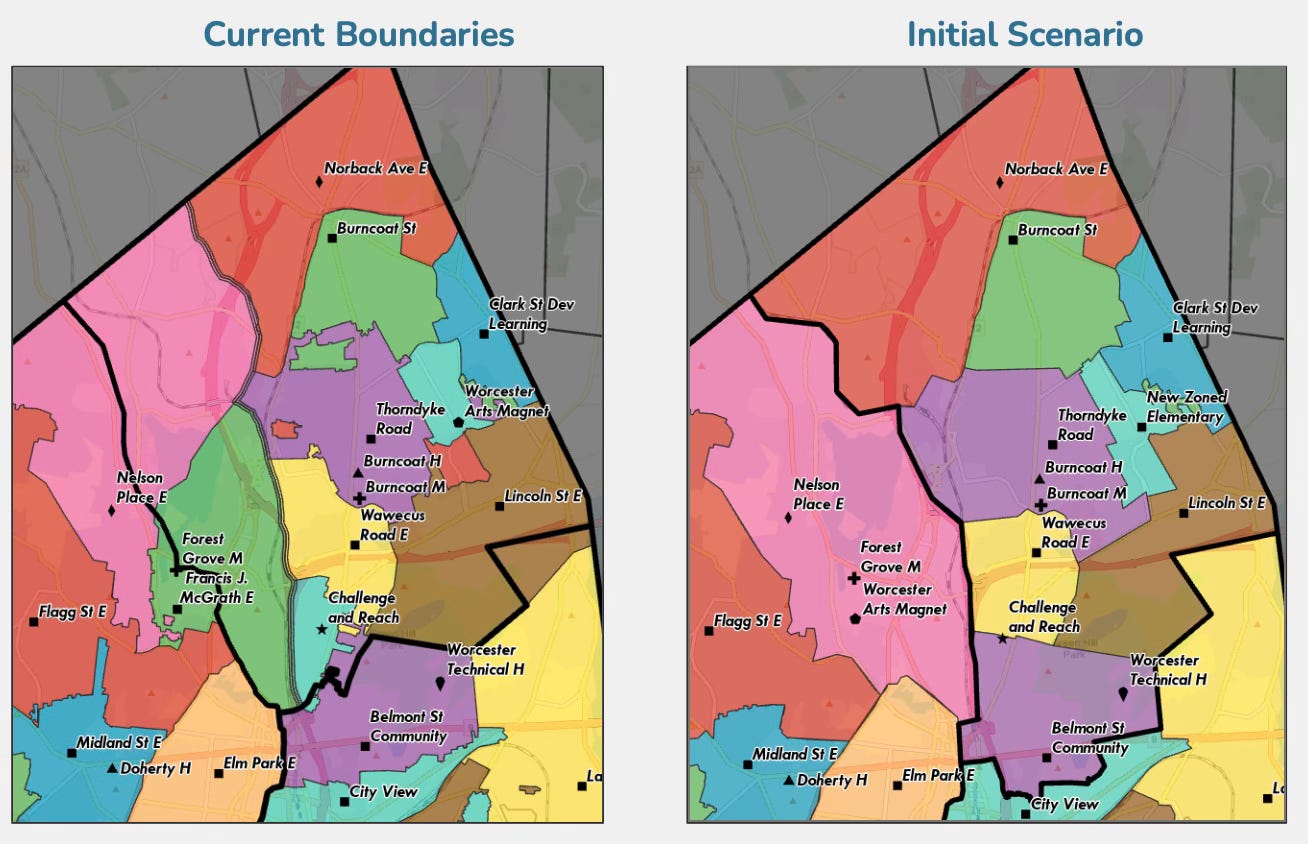
During Tuesday’s discussion, school committee member Molly McCullough (district A) also raised the new proposed boundary between the two schools and discussed alternatives she had previously suggested to the district’s redistricting consultant, including using Ararat Street instead of the railroad tracks as a dividing line. She said that her proposed “solutions” had so far “struck out,” but that she was “still working on it.”
That caught my attention because the alternative boundary McCullough discussed along Ararat Street would directly affect the school assignment zone for her own property, something she did not disclose during the discussion. Her home is currently assigned to Nelson Place, but would move to Norrback under the initial scenario. The alternative boundary she proposed would keep her home within the Nelson Place boundary.
The map below shows the general area McCullough discussed, highlighted in yellow.
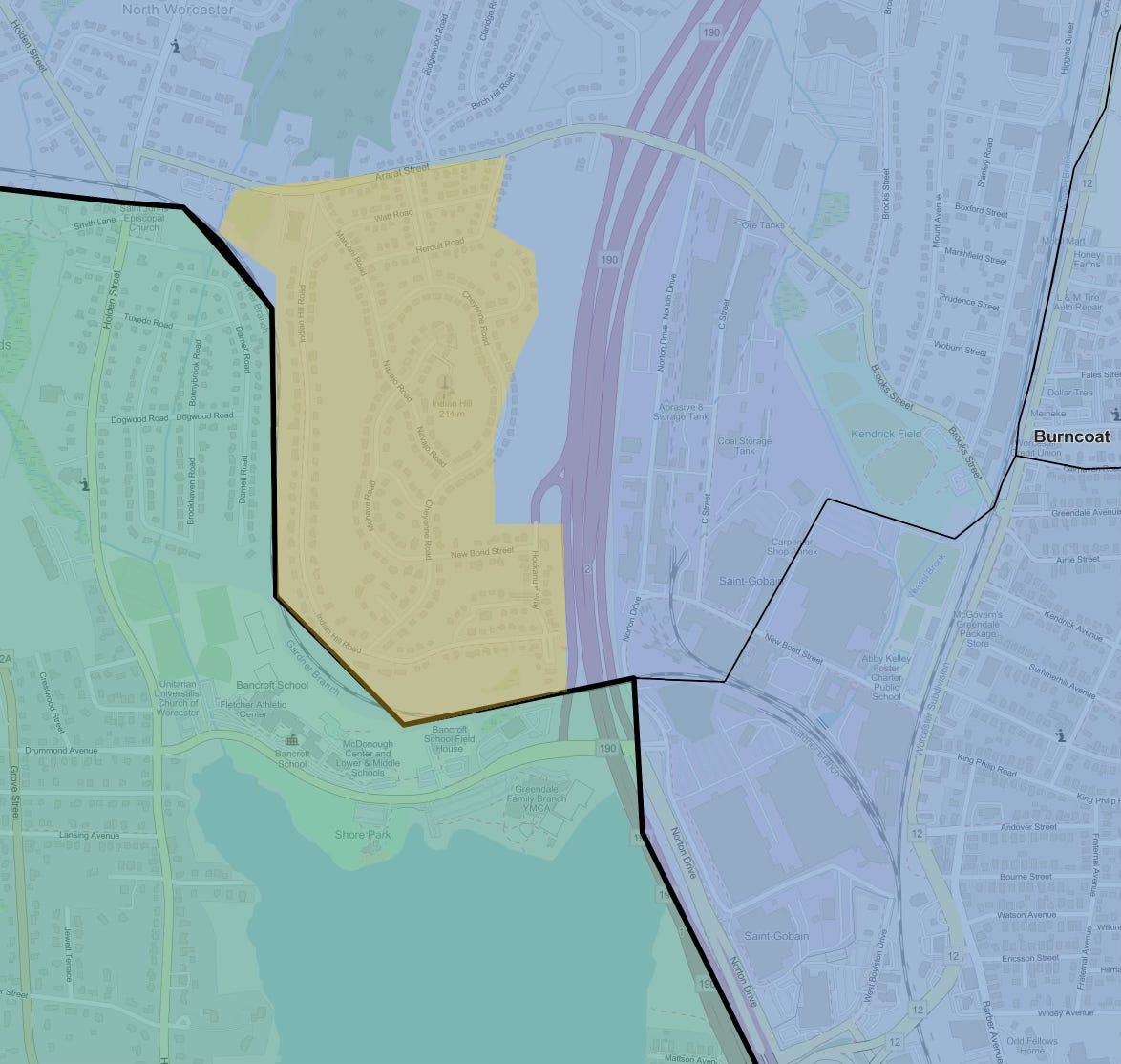
The perception surrounding Nelson Place, that it’s one of the district’s better schools, is what makes McCullough’s advocacy for the boundary change worth flagging. The perception of a school can in turn influence how desirable, and potentially valuable, a home in its assignment zone is perceived to be. I cannot say whether the proposed boundary change would affect the value of McCullough’s property, and I am not making that claim. But Massachusetts conflict-of-interest law prohibits municipal officials, including School Committee members, from participating in a particular matter in which they have a financial interest, including when a matter could alter an official’s property “value, rights, or use.” The term “participating” encompasses more than casting a vote; it can include discussion, recommendations and advice.
There is also a relevant precedent. In 2021, the State Ethics Commission advised a Natick School Committee member that she could not participate in a school-closing decision because of its potential effect on the value of her nearby home. The potential conflict arose not from where her children attended school, but from her ownership of property that could be financially affected by the decision—a principle that applies, for example, when an official’s property would be affected by a zoning change.
The Natick case does not mean every school boundary decision creates a conflict. Massachusetts law exempts some general policy decisions when an official’s financial interest is shared by a substantial portion of the community, and citywide redistricting may qualify. But Tuesday’s discussion moved beyond the broader plan to a specific boundary—and an alternative that would keep a small group of houses, including McCullough’s, assigned to Nelson Place. Only the Commission can determine whether a conflict exists, but the public should not be left to speculate. School committee members should publicly disclose potential conflicts, seek guidance from the State Ethics Commission before participating, and share the Commission’s determination. That transparency is essential to maintain public trust in the redistricting process.
How we talk about other schools.
This redistricting process is going to be long, complicated and, at times, emotional. Families should ask questions, scrutinize the maps and share what they know about their neighborhoods and schools. But as we do that, I hope we can remember that there are real children on every side of every boundary line. And keep that in mind as we have these conversations.
In 1994, when I was in fourth and fifth grade, my hometown of Framingham went through redistricting because schools on the south side were overcrowded. My elementary school had grown from 634 students to 822 in five years. By my fourth-grade year, there was so little space that the sixth graders were being taught in the town administration building.

My school was also more than 50% “minority”—the language used at the time—and the district was required to redraw boundaries to address the racial imbalance. What I remember most is the overwhelming sense that other families did not want their children reassigned to our school. They talked about buying homes specifically so their children would go to different schools. They emphasized how difficult the transition would be for their children. The message I heard was that our school, and, by extension, the children already attending it, were not good enough.
During Tuesday night’s public comment, I heard echoes of that same dynamic. Redistricting means some children may have to change schools or buildings, and families have every right to ask what those transitions will mean. My own child’s school closed suddenly in 2023, forcing them to move to a new school. I understand that transitions are hard and that the district must provide meaningful support to the children affected.
At the same time, there is a difficult line between advocating for our own children and speaking as though another school—or the children who attend it—is somehow less desirable. Children hear these conversations, too. They hear how adults describe another school building. They hear when attending school with children from a different neighborhood is framed as a loss. And they notice which programs and communities adults rally to protect.
None of this means families should stay silent about legitimate concerns. It means holding two questions at once: What does my own child need, and what would make the district stronger and more equitable for every child? The measure of this process should not simply be whether each of us gets the outcome we want, but whether every child in Worcester has access to a school worth fighting for.
What happened at School Committee.
I am not doing my usual play-by-play recap of the August 13 School Committee meeting, but several local outlets covered the major issues.
The School Committee unanimously rated Superintendent Brian Allen “proficient” in his first annual evaluation. The Telegram & Gazette covered the evaluation, while MassLive reported on concerns raised by some parents.
The Worcester Guardian reported on calls from union representatives for School Committee members to become more directly involved in negotiations. The current contract expires August 31.
Questions about enrollment at Nelson Place also came before the committee after parents described difficulties navigating the placement and voluntary-transfer processes. Two petitions seeking de-identified information about placement decisions were referred to the administration. The Guardian later published an explanation of the differences among neighborhood enrollment, voluntary transfers and special education placements.
You can also watch the full August 13 meeting here.
PSA: Download the updated school calendar.
WPS has posted an updated 2026–27 school calendar. Take note that there are four weekdays between October 9 and November 11 when students will not have school:
Friday, October 9 — Professional development day
Monday, October 12 — Indigenous Peoples’ Day
Tuesday, November 3 — Election Day/professional development day
Wednesday, November 11 — Veterans Day
Don’t forget to put those dates in your calendar now, especially if you will need to arrange child care!
Thanks for reading. Good, local journalism is essential to a healthy city. It leads to higher voter turnout and less political polarization. We don’t all have the same priorities, but in order to have productive conversations we need to be working with accurate information. Please support our work here at Worcester Sucks and consider a paid subscription. Happy back to school and see you in September!
Excellent, work as usual. Yes, while the immediate goal of redistricting is to better utilize the space in the schools, the ultimate goal of the school system is to make it so that you don't feel the need to choose where to live based on the perceptions of the quality of the neighborhood school: So that all the schools are all good schools for all our kids. That really is the ultimate goal of supporting and improving our school *system*. And just ditto on the emphasis of perception, and what those perceptions are standing in for.