

Welcome to the 36th issue of WPS in Brief. This month covers two school committee meetings and two subcommittee meetings. I’m also covering some things that didn’t happen in meetings per se, but are important in terms of the governance of our schools.
Let’s get to it:
Student Discipline Data.
The report of the superintendent for the December 18 meeting was on student discipline data. Presenting were Administrative Director of Positive Youth Development Tom Toney, Director of Research and Accountability Marco Andrade, and Deputy Superintendent Marie Morse. The report gave an overview of the newer state law limiting removals and non-exclusionary practices in schools, and then highlighted data collected on disciplinary actions, as well as how Worcester compared to similar communities, like Springfield and Boston.
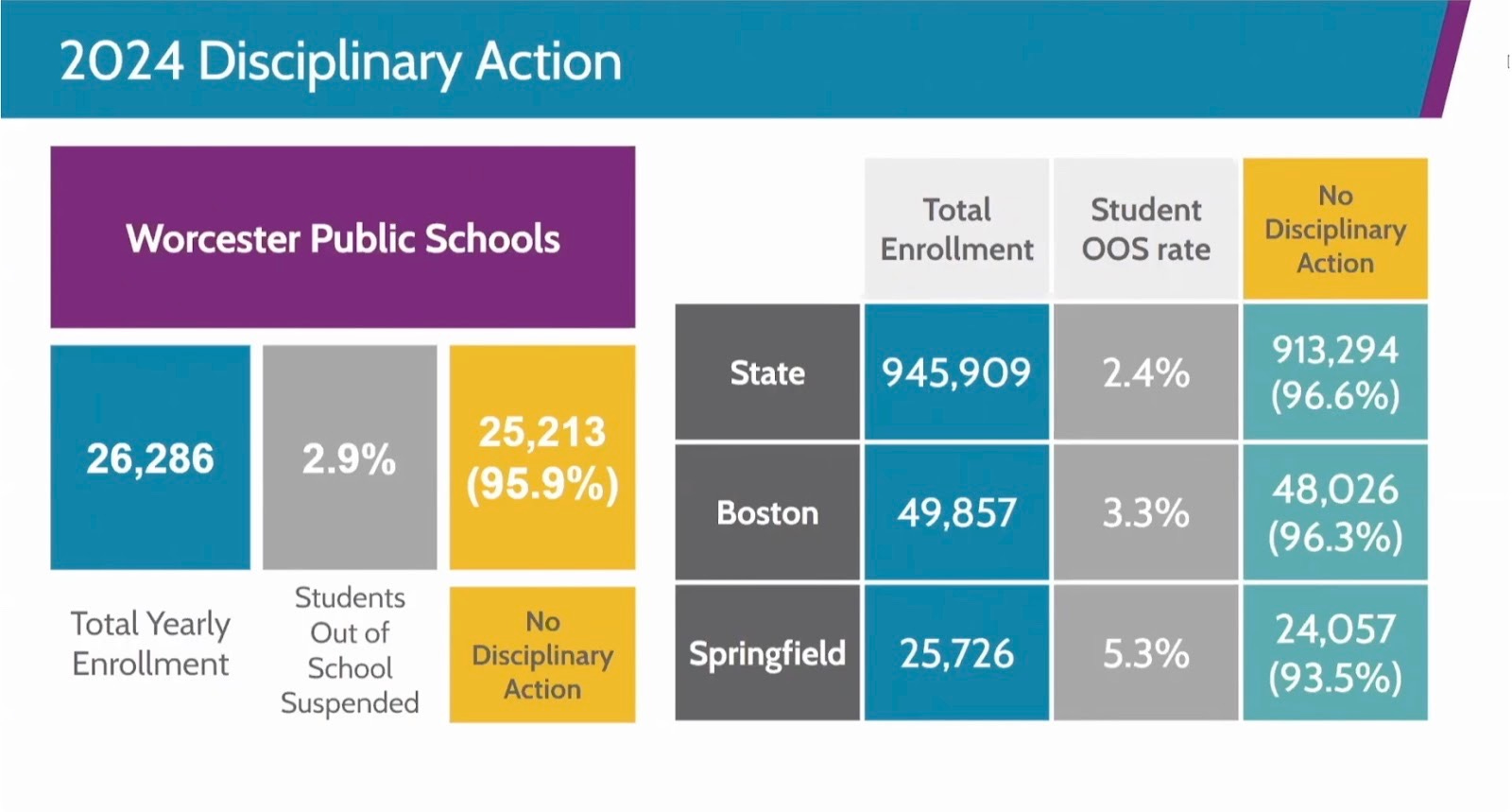
As seen in the above slide from the presentation, a small percentage of students are involved in disciplinary action. If you’d like to see more of a breakdown of the data or see it by school, all of it is publicly available on the Department of Elementary and Secondary Education (DESE) website. Based on that public data, we can see that for the districts that border Worcester, the trend has been an average decrease in students disciplined between the 22-23 school year and the 23-24 school year, and then an average increase in students disciplined between the 23-24 school year and the 24-25 school year.
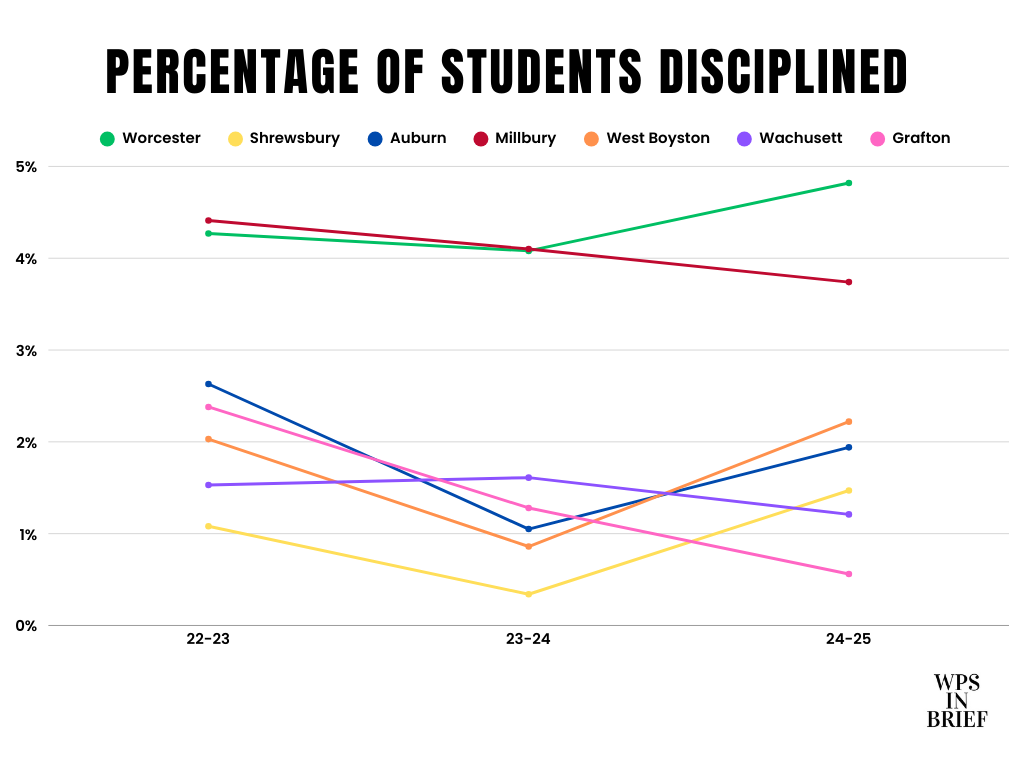
Between 2023-2024 and 2024-2025 Worcester saw student discipline offenses go up from 4.1% of the student body to 4.8%. Putting that in the context of other districts in Central Massachusetts, Worcester is in the middle of the pack.
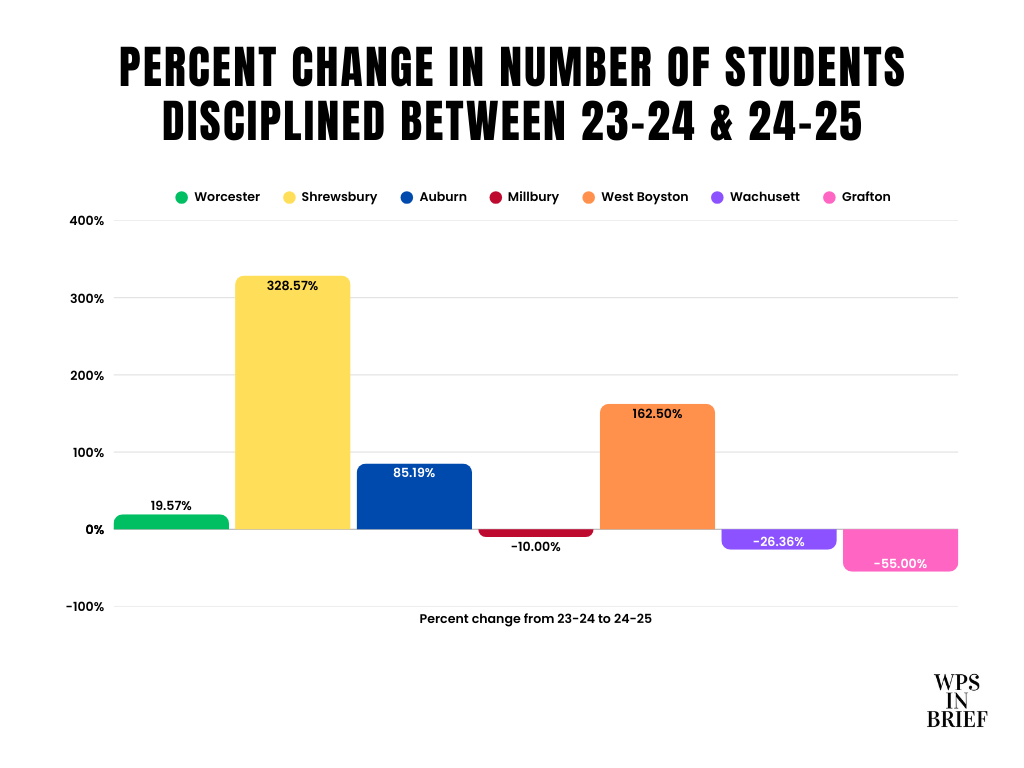
In Shrewsbury (6,000 students) offenses went up from 21 in 2023-2024 (0.34% of the student body) to 90 in 2024-2025 (1.47%). That’s a 329% increase. In Auburn (2,500 students) they went up from 27 offenses in 2023-2024 to 50 in 2024-2025, an 85% increase. And in West Boylston (900 students) it increased 163%, with eight offenses in 2023-2024 and 21 in 2024-2025.
The specific piece that got a lot of attention in Worcester when the data initially came out was the increase in student assaults on staff, which was specifically from students in kindergarten through third grade (this is last year’s data, so it’s LAST year’s K-3 students, not this year’s).
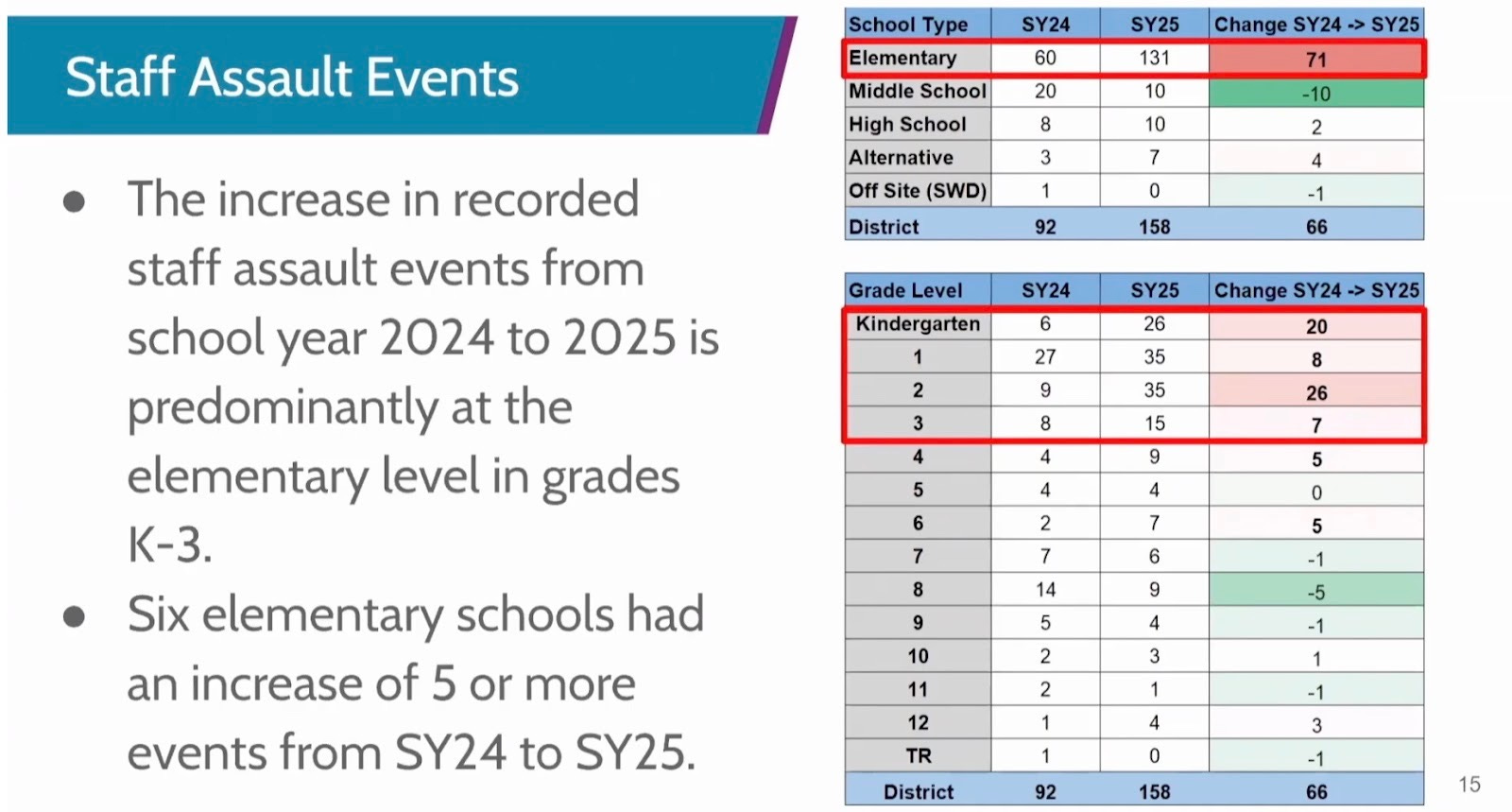
This data validates what superintendents across Massachusetts, and the U.S., are seeing with younger elementary children having increasing outbursts and meltdowns. As a parent of a current third grader, whose toddler and preschool years were impacted by the COVID lockdown and subsequent isolation, it’s not a surprise to me. Those key developmental years were not normal for the kids who weren’t old enough to go elementary school yet, either. As an example, just 7 percent of last year’s Worcester kindergartners (born in 2019) were in center-based preschool more than 20 hours a week, and for 55 percent of them, kindergarten was their first time in any formal school. For comparison, this year’s kindergarten class (born in 2020) has increased to 15% attending center-based preschool more than 20 hours a week, and for 39% of them, kindergarten is their first time in any formal school.
At the end of the presentation, Superintendent Brian Allen emphasized steps the district is taking around climate and culture at the elementary level, including:
Creating a data team to look at coding discipline and making it consistent
Expanding the early childhood task force to support students before they enter Kindergarten
Allocating additional resources for elementary schools in next year’s budget and
Reinstituting an “elementary wellness center” to support student assessment and placement. (During the discussion school committee members referred to it as the “student safety center,” which in 2024 was just for 4-12 grade students. The safety centers were created by previous safety director Rob Pezella in response to school shootings). Allen would like to make that change for the current school year, and hopes to use recent allocations from the city to fund it, but plans to officially bring that to school committee approval in January.
Quadrant Teams.
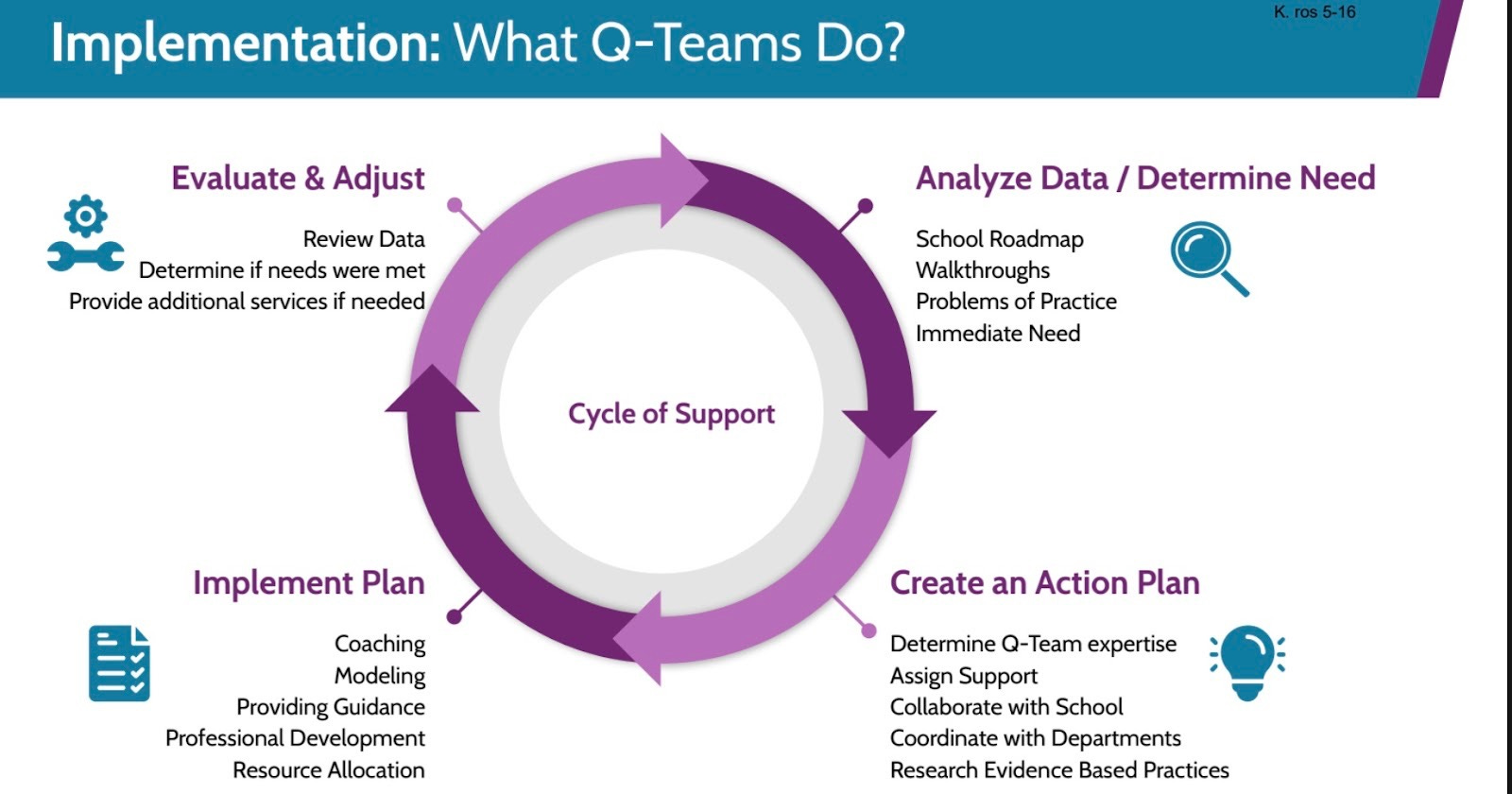
The December 4 Report of the Superintendent was on the Quadrant Teams (referred to as Q-teams). WPS is divided into four district quadrants, named after the comprehensive high school in each quadrant: North, South, Doherty and Burncoat. The teams were first introduced at the start of the 2023-2024 school year, so this is the third school year of implementation. Initially, the majority of people on the Q-teams were already working in the district (which meant minimal fiscal impact on implementing this model), but were separated in individual department silos. Now, Q-teams are a comprehensive group of skilled individuals from multiple departments whose goal is to provide efficient and consistent support to students and schools. The cross-department Q-team members rotate through the schools in their quadrant, and provide coaching, modeling, mentoring and guidance. The presentation ended with the future vision of strengthening data systems, sharing best practices between quadrants, and expanding the impact of climate and culture to support attendance, engagement, and restorative practices.
Change in Standing Committees and in Rules.
The school committee approved changing the two standing committees (sometimes referred to as subcommittees), into three. The three new committees will be Finance; Operations and Governance; and Teaching, Learning and Student Success. The rationale for the change is “to spread responsibility out amongst administrators and committees and to create a format where there are no tie votes” because as it stands right now, there are four people on each subcommittee, which has led to an occasional tie, leaving items stuck in committee. The proposed change is similar to how the standing committees were before 2024. The key difference this time is that Governance and Operations are together, and Finance is on its own. Also, pre-2024, there were six members of the school committee (minus the mayor, who does not serve on subcommittees), which meant everyone served on two committees of three members each. Now there are eight school committee members, which means that everyone will serve on one subcommittee, except for one school committee member who would need to serve on two subcommittees. The mayor chooses who serves on what subcommittee.
The school committee also approved changes to the school committee rules. Here are the previous rules and here were the proposed changes. The changes that got approved are:
An email to the school committee, referred to as the “Friday Letter,” is an official way that items can be referred by the committee (the other three are to a standing committee, to a special committee, or to the administration).
Anything that has been inactive in a standing committee for two years can now be automatically filed, with notice.
School committee members must submit items by using a provided google form by 12 p.m., on the Wednesday a full week before the next meeting.
Public petitions must also be submitted by noon on the Wednesday a full week before the meeting, and petitioners would have up to three minutes to speak instead of two minutes.
If the administration is not ready to respond to a public petition “after 120 days, the Chair of the Committee shall put it on the agenda to get an update from the administration as to where it stands and to the timeline.” (This rule was added due to public comment at the FOG subcommittee meeting and from emails members received.)
Meetings will start at 5:30 p.m. instead of 6 p.m. during the school year, and during June, July and August they would start at 4 p.m.
The vice chair will always be seated at the desk next to the superintendent.
WPS and WPD Operating Agreement.
The district provided a copy of the operating agreement between the schools and the police department for the 2025-2026 school year. Due to staffing restraints, the WPD pulled out of the Student Liaison Officer (SLO) model that had been in use for the previous three years. This also means that the city can no longer use those officers’ salaries (about $700k) as part of their net school spending requirement. The 2025–2026 Agreement is largely based on the 2024–2025 version, keeping many student-protection provisions intact, but it does broaden police access to school security systems in emergencies. Superintendent Allen explained, “We had provided the police access to our camera system upon request. In speaking to the chief...we are [now] actually providing them camera access instantly, so if there were to be a school incident, they automatically have access to our camera system.” Looking at the language in the new agreement, WPS agrees “to provide comprehensive access to live and recorded video, access control, and any communications integrations for purposes of a WPD response to any active assailant situation or criminal investigation at the school” and there will be quarterly tests of that system integration.
Next school committee term.
This month closes the chapter of our current school committee term, although there is no change in the committee composition for next term (the first time since 2011 that’s happened). As we move into the next term I like to remind ourselves, the public, that the school committee has certain functions and responsibilities, including finance/budget, education policy and goals, curriculum, advocacy, and collective bargaining, to name a few. These are the things we need the school committee to focus on and be good at getting done. Specifically, I think the work that will be the most critical over the next two years is:
How to deal with federal funding cuts and stewarding Student Opportunity Act money
Redistricting of school zones, which the district plans to implement in the 2027-2028 school year.
Contract negotiations with teachers, as the current contract expires in 2026.
Implementing the strategic plan, which ends in 2028, and the process of developing a new strategic plan.
Superintendent Allen’s contract, which goes to 2028. Negotiations to extend his contract, or plans to hire a new superintendent, would likely start in early 2027.
Upcoming Dates.
School Committee Swearing in is January 2 p.m. at Doherty High
School Committee Meetings are January 8 and 22, 5:30 p.m. at City Hall
Also.
Attend your January School Site Council meeting! Budget season is here and it’s arguably the most important time to be paying attention to WPS. The updated budget calendar for the 2026-2027 school year budget can be found here. Individual school resource allocation requests must be in by January 26, 2026. This means that at the January school site council meetings all principals should be reading over their school-based budget proposal for site council review. This is a great opportunity to learn what your school is prioritizing and offer input at the school level. All school site council meetings are listed on the WPS website.
Thanks for reading. If you find WPS in Brief valuable, please share it. If you’d like to support my work you can send me a tip. See you in 2026!
I want to thank you, Aislinn, for your comprehensive, fact-based overview. Again! You do real civic work: you clarify what’s actually happening, ground the discussion in evidence, and make it possible for non-specialists to engage meaningfully with K–12 issues that are often reduced to slogans or budgets.
Reading this also made me reflect on a comment I recently shared with a member of the School Committee, and I wonder whether it might be useful as part of the broader School Committee discussion emerging from the current K–3 focus.
Specifically, I wondered whether there is an opportunity for the School Committee to help identify a small, disciplined set of “upstream measures that matter” — factors and metrics at the City level that strongly shape K–12 outcomes but are not visible as civic priorities in Council meetings. Pre-K participation rates, for example, intuitively feel like a powerful indicator, given their relationship to early regulation, screening, and readiness for structured learning.
I appreciate that the City’s fiscal constraints are real, and I’m not suggesting directives or critiques of existing efforts. But it seems that even naming and tracking such upstream measures publicly — perhaps alongside their associated costs — could add real substance, transparency, and accountability to the City’s strategic goal around education. If the School Committee were able to agree on a small set of these indicators and communicate them clearly, it might give the incoming Council and City Manager a shared frame of reference as they consider FY26 priorities.
Put simply: even identifying not “what should be,” but “what is” — the critical upstream signals where early alignment and support are most likely to yield downstream dividends would be valuable, perhaps enabling, for the City. Having those signals prominently visible, perhaps on a City website, could keep the score top of mind not only for policymakers, but for residents too.
I offer this in the same constructive spirit as the K–3 discussion itself: as a way of using the current focus to clarify how the City, working alongside the schools, might best support student success beyond state formulas, facilities, and transportation.