

Welcome to the July issue of WPS in Brief. This month covers key topics from one school committee meeting.
Let’s get to it:
Superintendent’s Goals and Self-Reflection.
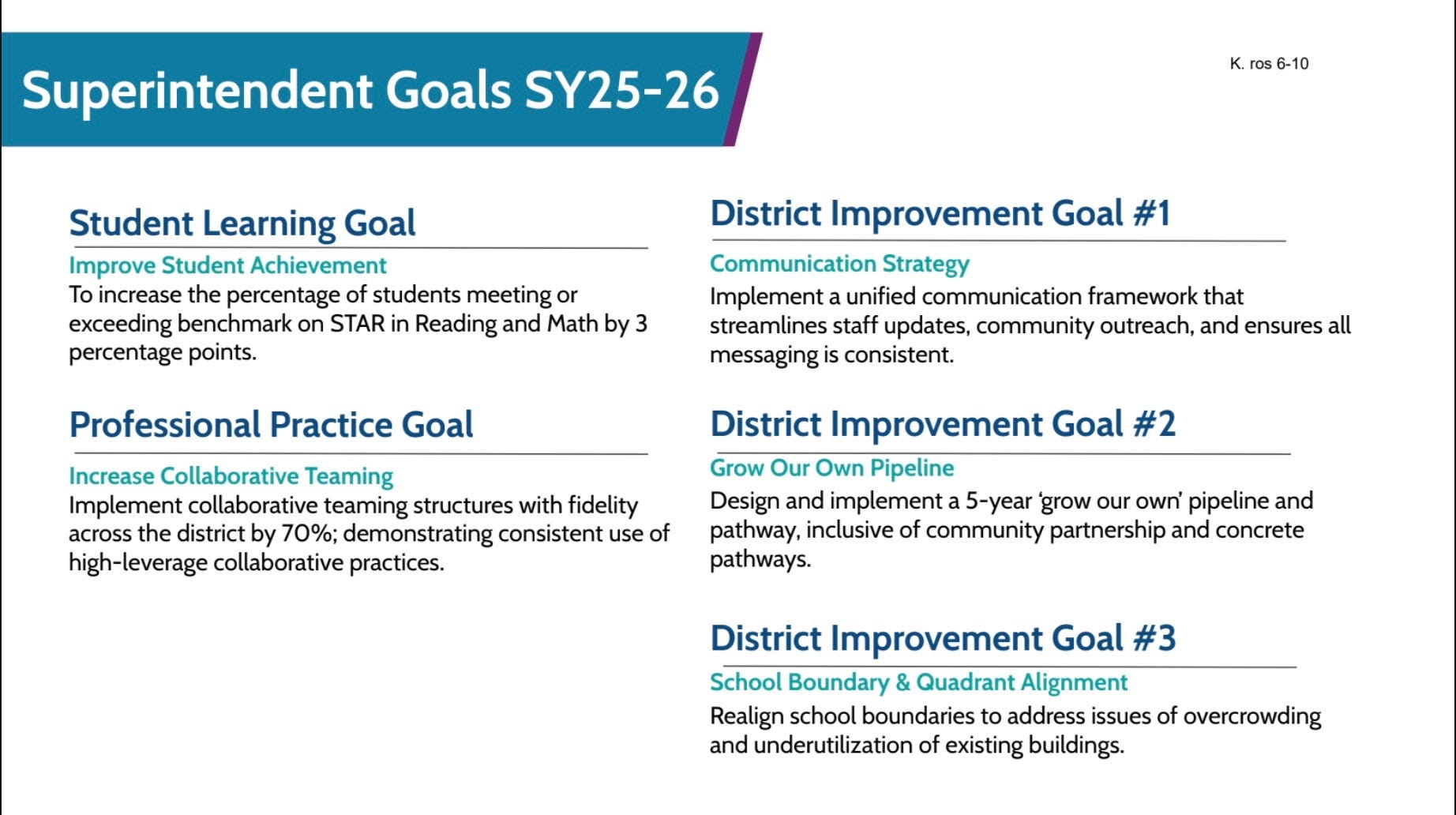
At the beginning of each school year, the superintendent presents annual goals to the School Committee for approval. At the end of the year, he reports back on how those goals were met (or weren’t). It’s an important process because, when done well, these goals serve as both a roadmap for the district and a key accountability tool for the superintendent, the School Committee, and the public.
While Allen’s presentation lasted just twenty minutes, his 44-page self-assessment covered a lot of ground. I could do a deep dive on every goal, but in the interest of keeping this brief, I try to highlight the biggest takeaways.
Because Allen has been in the district so long at such a high level, it allowed him to hit the ground running as a first year superintendent. One thing I want to emphasize is where Allen’s strengths lie: he has an expert’s understanding of operations, systems, and organizational structure (as I reported when he got the job, he’s one of the best in the state, if not the region). His leadership has focused on turning the district’s strategic plan into concrete systems and processes, with nearly every initiative tied back to that plan, which runs through 2028—the same year his current contract expires. As Allen put it, “Running the Worcester Public Schools is equivalent to running a massive, highly regulated enterprise. We are more than a half billion dollar operation navigating complex legal, civil rights, and special education mandates... ultimately our role is shielding schools and classrooms from many of these operational challenges.” Whether you agree with every decision or not, his emphasis on building systems that support schools is a consistent theme throughout his leadership. It’s also what I believe sets him apart from many of his peers.
Student Goal.
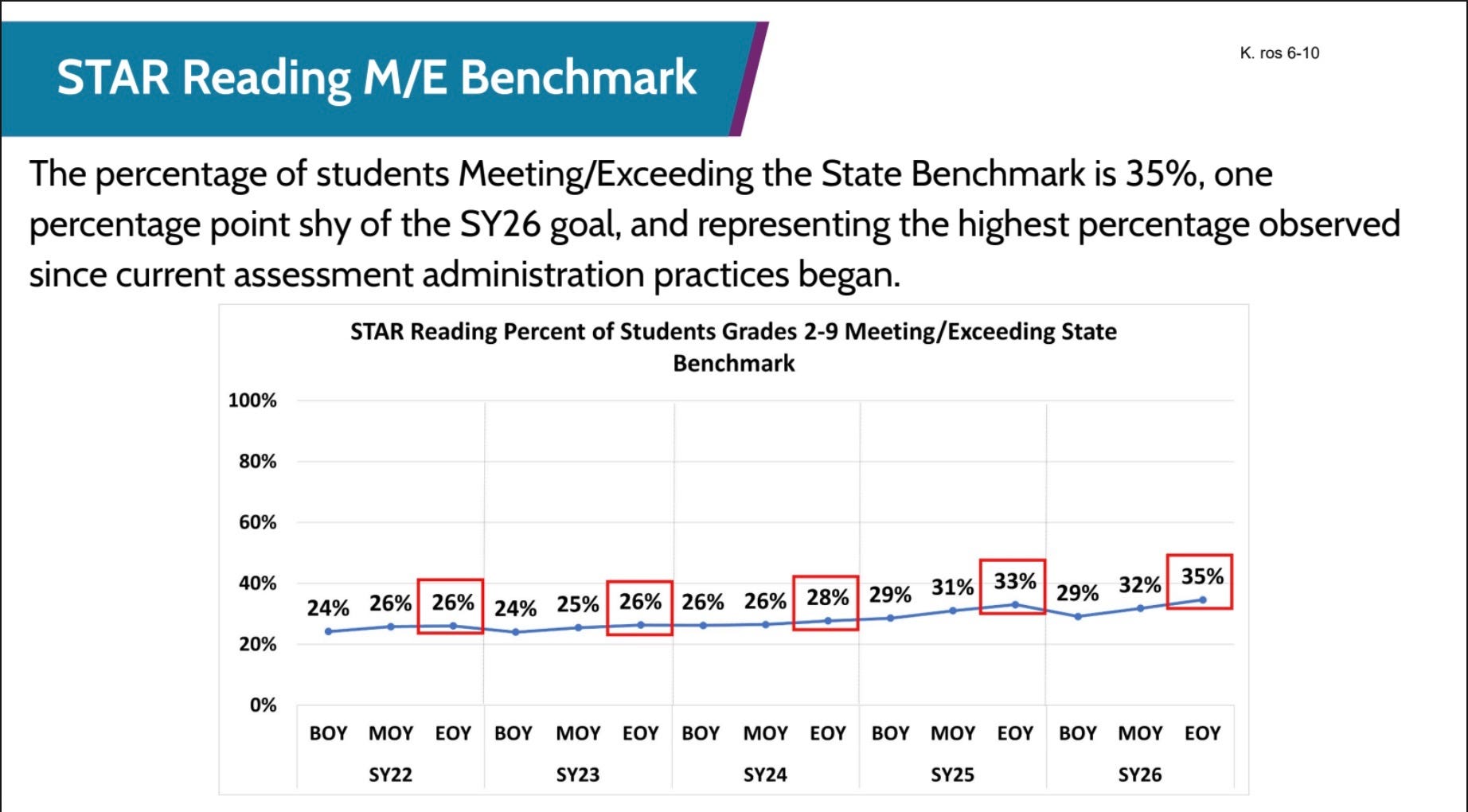
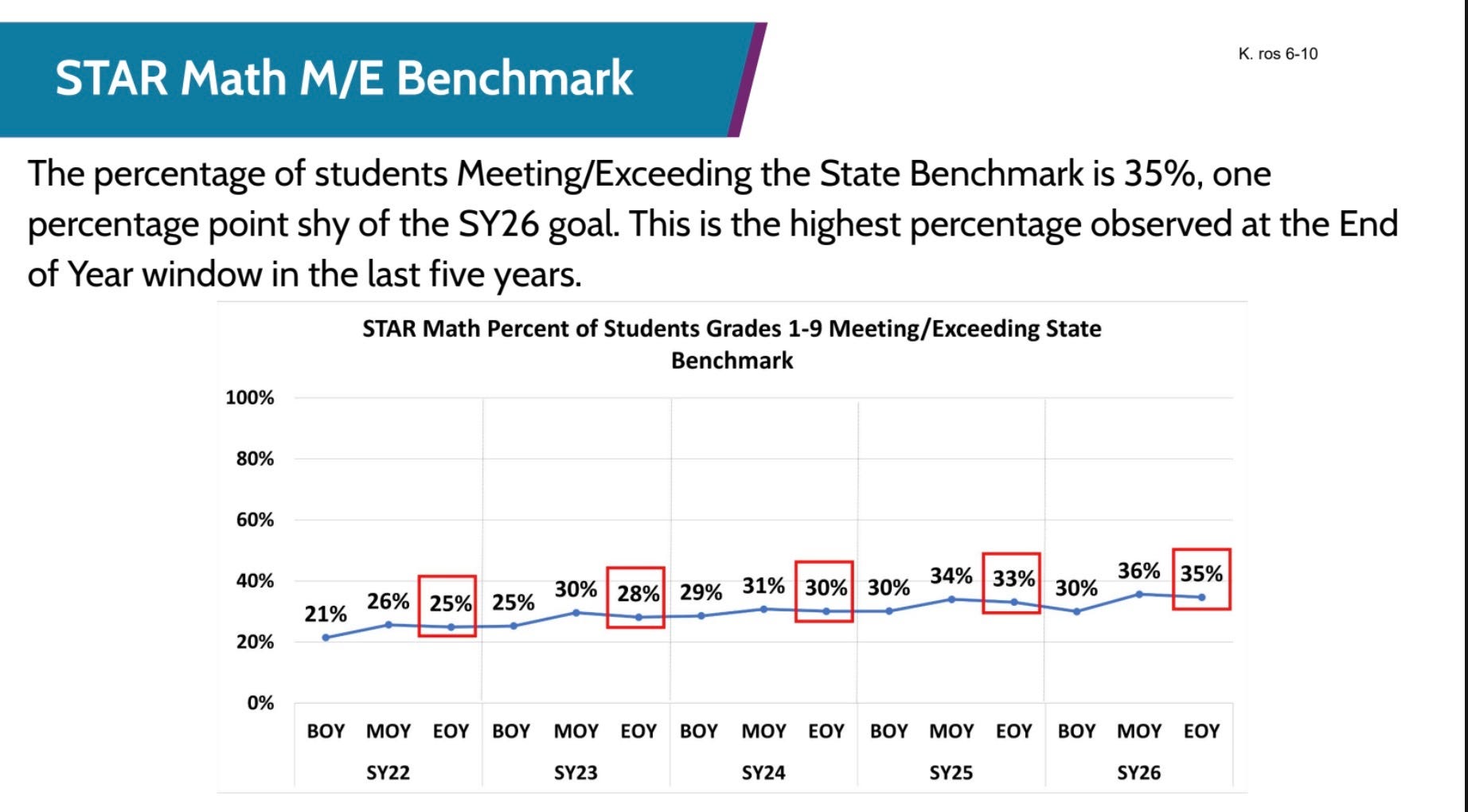
The Superintendent set a goal of increasing the percentage of students meeting or exceeding benchmark on Star Reading (grades 2–9) and Star Math (grades 1–9) from 33% to 36% by the end of the 2025–26 school year. By June, 35% of students met the benchmark in both subjects, representing a 6 percent gain in reading and a 5 point gain in math. According to the district, this is the largest single-year improvement since Star was implemented districtwide in 2021–22. That’s encouraging, though I’d be interested in seeing the data broken down by grade level and student group. Districtwide averages can mask important differences, and some grades have historically shown as much as an 11 percent gain over the course of a single year.
The district also noted that fewer students fell into the lowest benchmark category than at any point since Star was adopted, suggesting growth occurred across the achievement spectrum, not just among students already close to proficiency. As always, though, the bigger question is why scores improved. How much reflects stronger instruction, increased familiarity with the assessment, changes in testing conditions, or other factors? It’s also worth remembering that Star is a universal screener and that student proficiency rates are heavily influenced by factors outside a school district’s control, including family income, home language, and parents’ educational attainment. Worcester’s student population saw decreases in both low-income students and English learners this year, which likely plays some role as well.
There was a deeper conversation around assessments later in the meeting, which I touch on farther down in this brief.
Collaborative Teaming Goal.
The district exceeded its goal of creating more consistent collaborative meeting structures across schools. The target was for 70% of collaborative teams—including Professional Learning Communities (PLCs), grade-level teams, departments, and school leadership teams—to consistently use four core meeting practices by the end of the year. According to Allen, 84% of team meetings included all four practices (using a standard agenda, sharing it in advance, reviewing meeting norms, and documenting action steps), and 38 of the district’s 49 schools met the district’s standard for implementing the collaborative teaming model with fidelity. This is one of those goals that’s hard for the public to see directly, but schools are full of meetings, and having consistent structures can help make those meetings more productive. It’s another example of Allen’s broader focus on building systems and processes that he believes will lead to stronger instruction over time.
Communication Framework Goal.
Allen also reported that the district met its goal of implementing a unified communications framework. The idea is to create a more consistent approach to how Worcester Public Schools communicates with staff, families, and the broader community, while also expanding multilingual outreach and accessibility. The framework is also intended to ensure district messaging aligns with the Vision to Action strategic plan.
The communications strategy document itself is pretty impressive, and I know I sound like a broken record, but communication is night-and-day compared to WPS before 2022. According to the Superintendent, the district will track the framework through communication audits, analytics, and surveys of staff and families, to see whether communication becomes more consistent, transparent, and responsive over time.
Future Teacher Pipeline Goal.
One initiative that seems to be off to a strong start is the district’s new “Grow Your Own” Future Teacher Pipeline. The goal is to recruit Worcester students who are interested in becoming teachers and, ultimately, bring them back to work in Worcester Public Schools. Given that Allen is himself a WPS graduate, this seems like a particularly meaningful initiative for him.
The district far exceeded its first-year goal, enrolling 41 students in the inaugural cohort instead of the 15–20 originally planned. According to the district, 78% of participants are students of color and 56% identify as Hispanic or Latino. Through a partnership with Worcester State University, 13 students completed their first college education course, and 25 graduating seniors took part in the district’s first “Future Educators Signing Day,” committing to pursue careers in education with the hope of returning to teach in Worcester.
Allen has also said he hopes the concept eventually expands beyond teaching. At a recent CPPAC meeting, he noted that WPS is the second-largest employer in the city and said he’d like to see similar pipelines developed for careers in areas like accounting, information technology, and other district professions.
Areas to Improve.
In his self-assessment, the superintendent reflected on several challenges during his first year, emphasizing that continuous improvement requires identifying problems, understanding their root causes, and making systemic changes. He acknowledged that communication was a common issue in several situations, including the principal selection process at Nelson Place, the proposed merger of the Worcester Alternative and ACT programs with the Central Massachusetts Collaborative, proposed administrative reorganization related to equity, and changes to elementary prep periods. In each case, he stated that the district plans to improve transparency, stakeholder engagement, and communication moving forward.
The self-assessment also outlines plans to strengthen the district’s advisory structure by restructuring groups that have seen low participation, while continuing to support established parent organizations such as CPPAC, SEPAC, and ELPAC and maintaining active middle and high school student advisory groups. The superintendent also plans to launch new teacher and community advisory groups, integrate school safety discussions into existing advisory structures, and continue efforts to improve district decision-making through broader stakeholder feedback.
Some other bits and bobs from the self-assessment:
Artificial intelligence remains on pause. Allen reiterated that he has suspended instructional classroom use of AI with students while privacy concerns continue to be evaluated. Both the Future Ready Technology Committee (which includes parent representatives like me) and an internal AI Steering Committee are working on recommendations, with the administration saying any future AI use will be guided by student privacy, educational value, and state law.
Screen time guidance. The school committee approved screentime guidelines that recommend that devices remain classroom-based through grade 3, and students may start bringing Chromebooks home in grade 4. The administration said it plans to revisit those recommendations during the coming school year as new medical guidance and research become available.
A longer elementary school day is still on the table. Allen wrote that “there simply isn’t enough time in the school day” to accomplish everything the district is asking schools to do. He noted that extending the elementary school day remains part of the current collective bargaining process, making this something to watch for the fall.
Seven elementary libraries will open next year. The superintendent said that with seven elementary school libraries operating during the 2026–27 school year, it will be the most Worcester has had since the 1989–90 school year. Future expansion will depend on available space and funding for books, materials, and furniture, but it’s encouraging to see libraries included as part of the district’s long-term vision. (Donate here!)
Planning continues for the Advanced Scholars Academy. The district is continuing to redesign the selection processes for its admission-based programs while a working group develops plans for the proposed Advanced Scholars Academy at Worcester East Middle School and North High School. The stated goal is to make advanced academic opportunities easier for eligible students and families to understand and access.
A new central office leadership position has been created. The district established a Chief of Equity, Access and Opportunity position by reallocating existing administrative funding. The role will oversee equity initiatives, family engagement, and several priorities within the Vision to Action strategic plan.
The Elementary Wellness Support Center is back. Modeled after the district’s former Safety Center, the reopened center is designed to provide students with social-emotional and behavioral supports before situations escalate. The goal is to improve school climate while reducing disciplinary removals from the classroom.
The district continues to standardize teaching and learning. More than 70 new curriculum maps for elective courses will roll out next year, while existing K–12 curriculum maps continue to be refined based on teacher feedback. The district is also implementing five required instructional practices intended to better support multilingual learners across all classrooms.
Higher education partnerships continue to expand. Worcester Public Schools is building new partnerships with Assumption University, Clark University, Worcester State University, and Quinsigamond Community College to expand scholarships, early college opportunities, internships, educator discounts, and its Grow Your Own teacher pipeline. Allen also noted that Holy Cross and UMass Chan have expressed interest in supporting North Quadrant schools.
Allen offered an interesting glimpse into how governance works. In his self-assessment, he wrote that he meets individually with every School Committee member each month, saying those conversations help ensure there are “no surprises” at public meetings. One-on-one meetings between superintendents and committee members are common practice, but it does provide some insight into how much discussion and relationship-building happens before issues ever reach the public agenda.
The committee will formally evaluate the Superintendent at the August meeting, which is a requirement of the Massachusetts Department of Elementary and Secondary Education (DESE).
Common Assessments and Benchmarking.
The school committee approved a three-year contract with Renaissance Learning, which the district uses for Star assessments and district common assessments. During the discussion, Vanessa Alvarez (District B) asked some clarifying questions about how these assessments are used. Dr. Andrew Lampi, of the Research and Accountability Office, explained that Star is administered three times a year for district benchmarking, with additional testing for students receiving interventions. He also cited research showing that assessments can improve learning when teachers review the results with students, help them understand what they got right and wrong, and use that information to guide instruction. He’s right, and it raises an important question: is that happening?
For years, families have asked for access to the results of the online assessments their children take throughout the year, including Star Reading, Star Math, and district common assessments. The issue has been raised repeatedly at CPPAC, where families have been told the district is working on it, but as of today the only way to get your student’s assessments is to request reports from your child’s school or, for Star, to sign up in advance to have them emailed after each assessment, (but this doesn’t give you access to past scores). Even then, the reports can be difficult to interpret. Check out the reports below. On one the reading domain is marked “secure,” but the overall score is only “meeting expectations.” On the other the student is “exceeding expectations” overall in math while multiple domains are still marked “developing.”
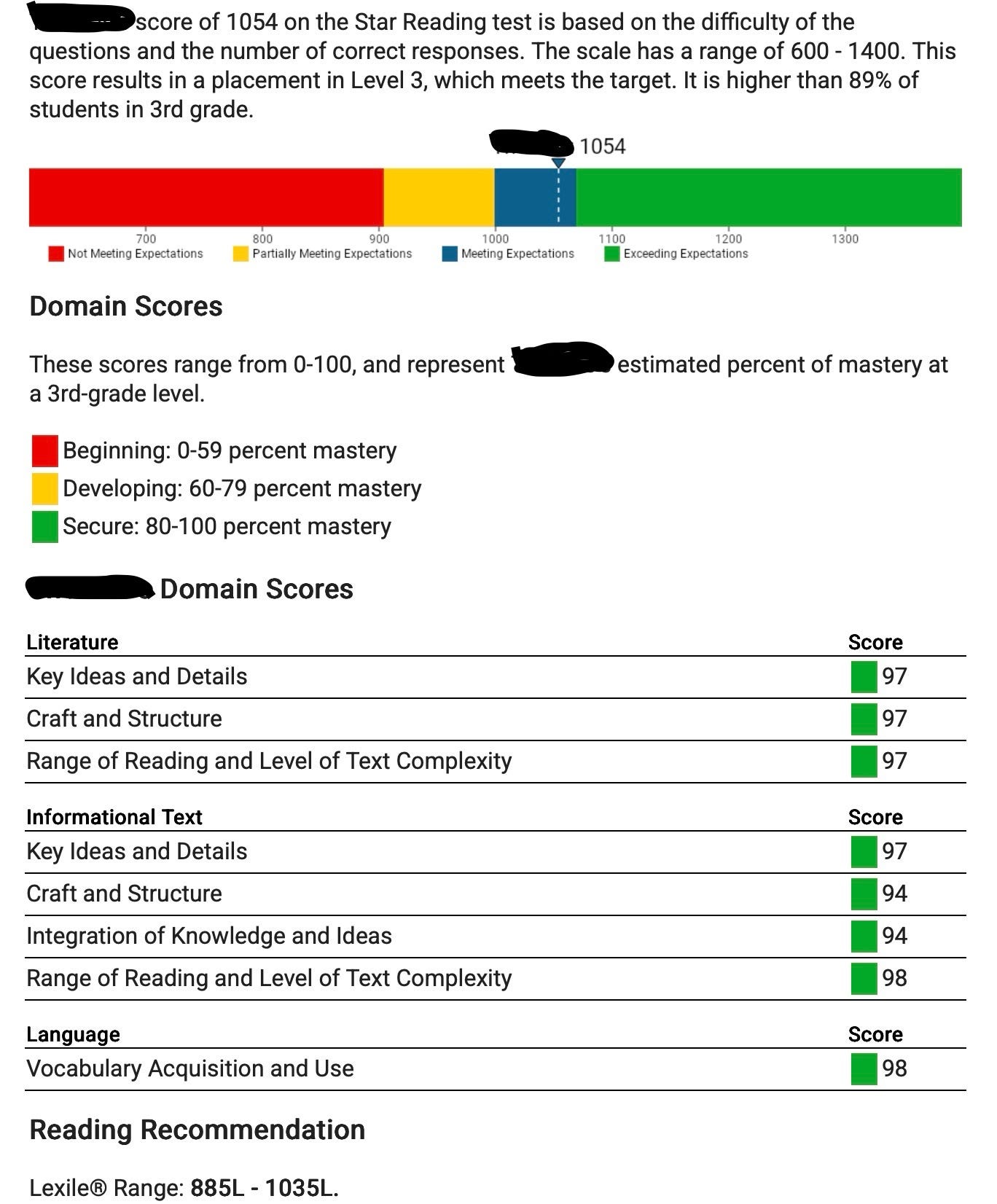
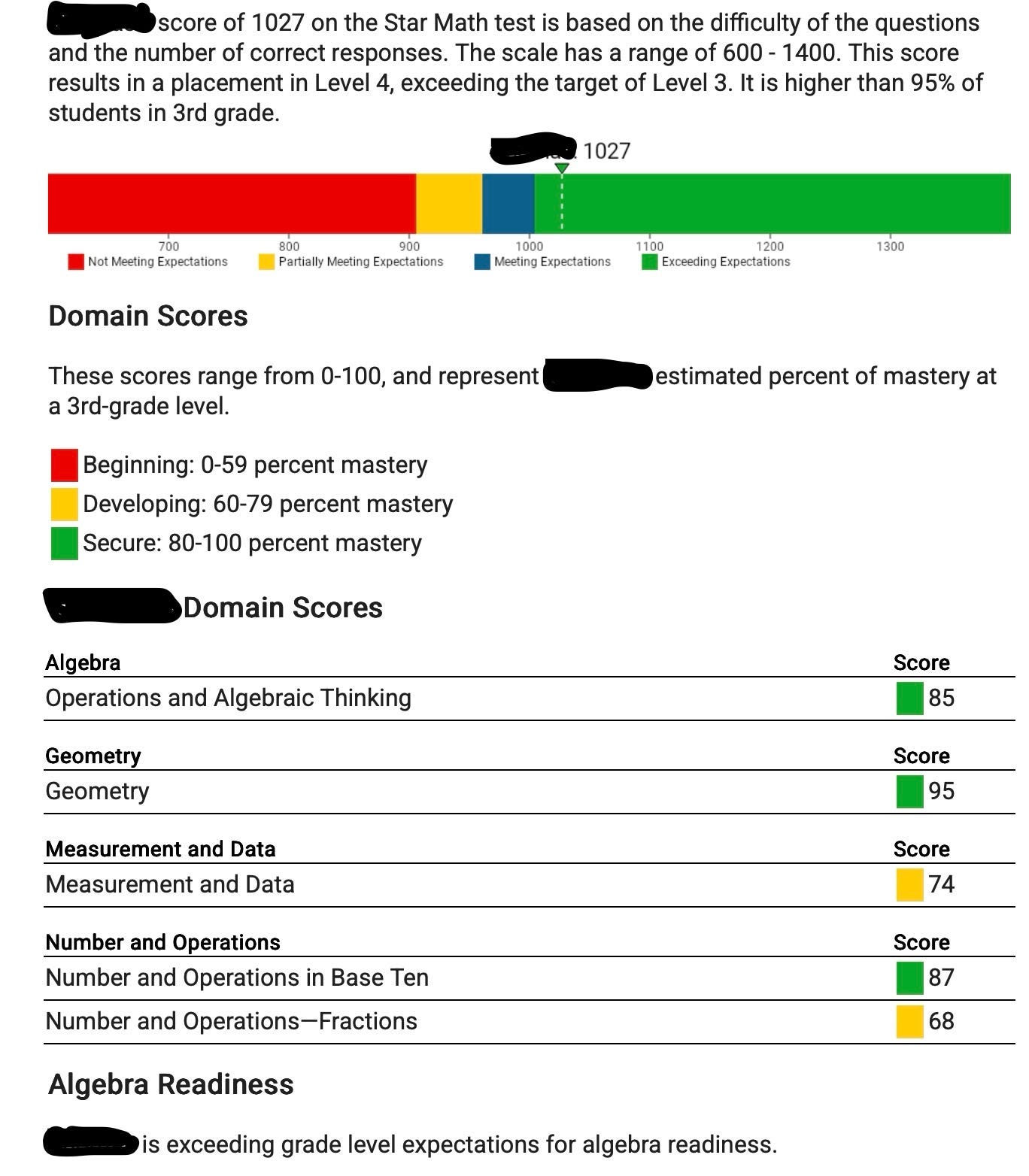
As a parent, you’re left wondering: What does this actually tell me? What skills should we practice at home? What misconceptions does my child have? Those are the kinds of questions a traditional classroom assessment often answered naturally because students brought their work home, teachers provided written feedback, and families could see exactly where learning broke down. With these digital assessments, that feedback isn’t readily available. Instead, I have to know my child took the assessment, request the report, and then follow up with the teacher to understand what it means. Most families aren’t going to navigate that process, and teachers simply don’t have the time to hold individual data conferences after every benchmark or common assessment. If the value of an assessment is the feedback it provides, then that feedback should be easy for students and families to access, not something they have to work to obtain.
Teachers have always assessed students by creating quizzes, reading student writing, listening to classroom discussions, and adjusting instruction based on what they observed. Those assessments were immediate, personal, and directly connected to classroom learning. Today’s standardized digital assessments are designed to produce comparable data across classrooms, schools, and the district. Data that can be valuable for identifying trends, evaluating curriculum, monitoring interventions, and measuring district progress. But if students, particularly those receiving interventions, spend hours each year taking these assessments only to receive little meaningful feedback, it’s fair to ask who benefits most from the data being collected. I don’t think the question is whether Star or the common assessments are “good” or “bad.” The question is whether they provide better feedback than the assessments teachers already create and use every day, and whether the additional instructional time devoted to district benchmarking produces enough educational value to justify it.
Assessment should serve students first. Districts need data, and schools need ways to measure progress. But if students and families can’t understand the results, if the feedback isn’t meaningful enough to improve learning, or if the primary value lies in district dashboards rather than classroom conversations, then it’s worth asking whether we’ve shifted from assessment for learning to assessment about learning.
Air Conditioning and Facilities.
This wasn’t on the School Committee agenda, but after the early dismissal for heat at the end of the school year, I heard from a lot of frustrated parents asking the same question: why don’t all Worcester schools have air conditioning?
The short answer is that many of our school buildings are old, and only 12 schools have air conditioning throughout the entire building. As temperatures continue to climb in June and September, heat-related early dismissals have become increasingly common. Trust me when I say these buildings can get hot.
What often gets left out of the conversation is why. For decades, Worcester and other high-needs districts were underfunded by the state and federal government. Faced with difficult budget decisions, districts prioritized keeping teachers in classrooms and protecting student programs, while major building maintenance and upgrades were deferred year after year. Our school buildings didn’t get this way overnight, and they won’t be fixed overnight either.
Upcoming Dates.
All school committee meetings have virtual options with Spanish translation, see the school committee site for more information.
School Committee Meeting, August 13, 4pm
Operations and Governance, August 18, 3pm
Also.
West Tatnuck students will now have sidewalks adjacent to the school! A happy update to the February story where Public Works committee members then-councilor Mero-Carlson and then-councilor Russell voted against the sidewalks. There’s three new members (Fresolo, Economou, and Mitra) and all three voted in favor. (ICYMI: Snowbanks, no sidewalks make it tough to walk to this Worcester elementary school: If you have children in WPS, I caution you before you watch the video from the meeting. Seeing why they originally voted down installing sidewalks-that the city is willing to pay for-adjacent to an elementary school will infuriate you!)
Thanks for reading. See you in August.
Fantabulous work as usual. Great discussion of assessment. I'd like to bring into the conversation the background framework of formative vs. summative assessment. Those assessments that teachers create are formative: they are used in the teaching & learning cycle to inform the teaching & learning -- we learn from them. Summative assessments aren't typically used this way: they're a measurement used to quantify, place, etc. (final exams, grades, etc.) Standardized assessments are overwhelmingly summative. MCAS is summative. Here's my question re: STAR: is it intended to be used as a formative assessment, as you suggest, informing instruction, or is it strictly summative? If it's strictly summative, why is it being used 3x a year? That timing suggests it's being used as a pre- and post-test, with an intermediary point as well.