


Welcome to the June 2026 issue of WPS in Brief. This month covers key topics from two school committee meetings, two budget meetings, and three standing committee meetings.
Before we get started, I want to say thank you.
Last week’s agenda preview included a personal note about the Worcester Elementary School Library Coalition and our goal of helping the district open seven elementary school libraries this fall. I was genuinely blown away by the response. So many WPS in Brief readers donated, shared the fundraiser, reached out with words of encouragement, or offered to volunteer. Thank you. Your support means more than you know, and it’s a reminder of just how much this community cares about our students.
If you missed last week’s post, we’re in the middle of a community-wide effort to help launch libraries in seven Worcester elementary schools before students return in August. The biggest need we have right now is books. We’re hoping every child walks into a library that feels exciting and welcoming, with the kinds of books kids are eager to pick up.
If you’d like to help, we’re still looking for donors, volunteers, and people willing to spread the word. Every contribution, whether it’s a donation, sharing the campaign with a friend, or connecting us with someone who may want to support the effort, helps bring us one step closer. Thank you for being part of it.
Ok, let’s dive into what happened this month:
The 2026-2027 School Year Budget.
The FY27 budget was approved largely as presented (see last month’s budget preview for a deeper breakdown), with one notable change.
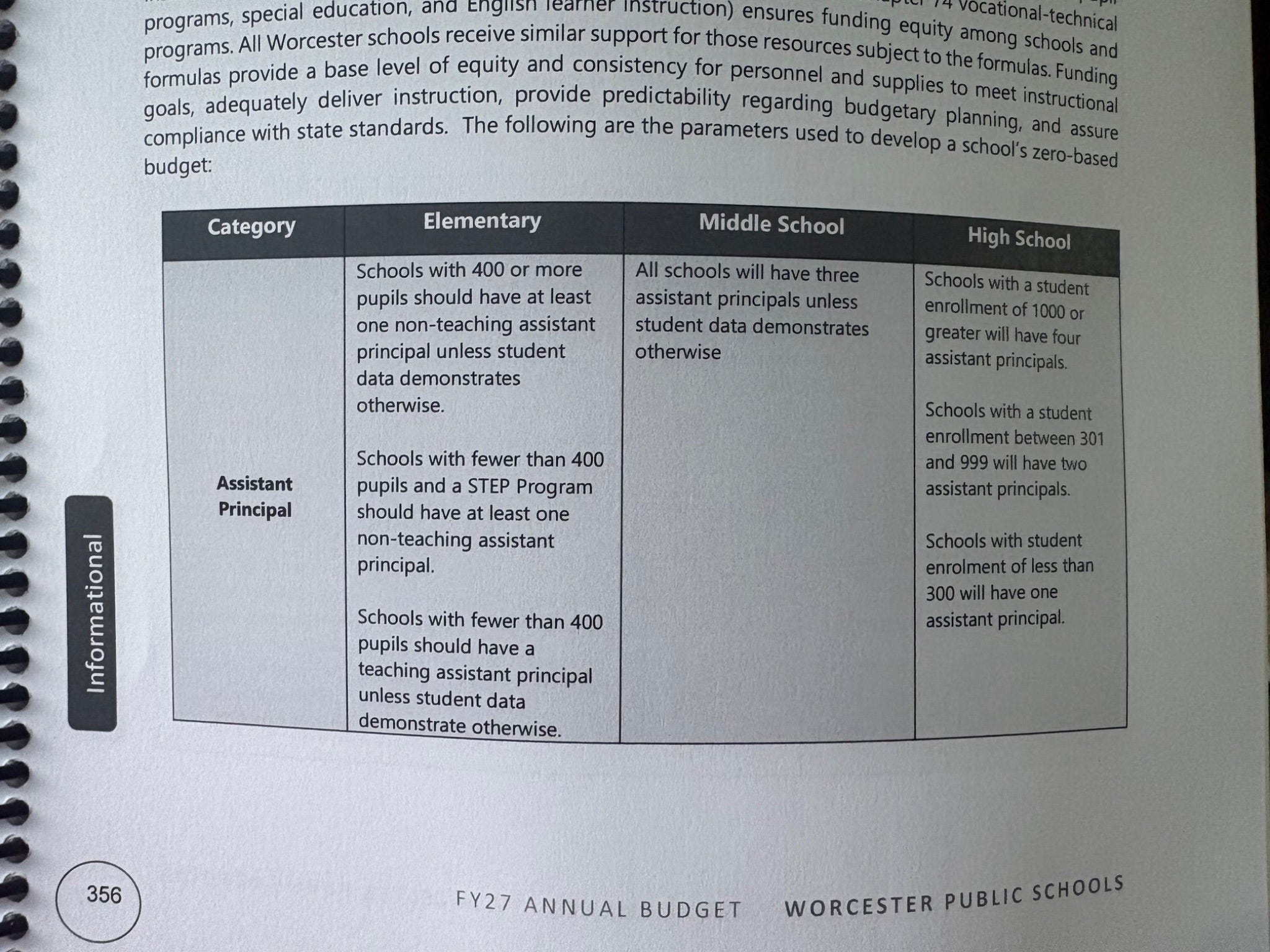
Member Jermaine Johnson (District F) proposed transferring $225,000 from the Miscellaneous Education – Instructional Technology account, moving $200,000 to the elementary teacher salary line and $25,000 to instructional materials. Johnson said his intent was to fund two full-time assistant principal positions at two schools that do not have them: May Street and Heard Street, while the instructional materials funding would be used for library books for the elementary schools opening libraries this fall.
Over the past school year, the district used free cash from the city to add an assistant principal at May Street after the assistant principal from Nelson Place was transferred there. Funding to maintain that position was not built into the FY27 budget. Also, it’s important to understand that elementary assistant principals are budgeted under the teacher salary line rather than school-based administration, where the secondary assistant principals salaries live. Superintendent Brian Allen explained that this dates back decades, when most elementary assistant principals were “teaching assistant principals” who maintained their own classroom while taking on administrative responsibilities when the principal was absent. The budget classification has remained even though the role has changed.
The discussion raised some interesting points. Member Sue Mailman (at-large) offered a substitute motion directing the entire $225,000 toward library books instead, arguing that adding permanent positions could put the district in a more difficult position next year as Worcester faces projected budget deficits. Johnson argued that elementary assistant principals play an important role supporting students with IEPs and 504 plans while allowing principals to focus on overall building operations. Vanessa Alvarez (district B) questioned why Woodland Academy, a significantly larger school with higher student needs, is going into its second year without a principal (the Claremont principal has been split between the two schools). In response to Alvarez’s question, Superintendent Allen said, “I’ll come forward with a recommendation [about Woodland] at some point in the future.”
Johnson’s motion ultimately passed 7-2, with Mailman and Alvarez voting no. The district noted that, with these additions, Wawecus will be the only elementary school without a full-time, non-teaching assistant principal.
The rest of the budget conversation included questions about transportation overtime (staff absences were an issue) and custodial overtime (the tough winter and the repeated freeze-thaw cycle played a big part). As well as building substitute staffing (which is increasing to 24 positions), and the role of positive youth development paraprofessionals (the district felt the need was in a different place, so those positions were reallocated).
My Take.
After watching budget deliberations for years, I walked away this year with a familiar sinking feeling. Worcester isn’t debating whether to fund “nice to have” programs. We’re debating whether students get consistent special education services because there are enough building substitutes. Whether teachers get common planning time because there are enough paraprofessionals to cover classrooms. Whether we can open elementary school libraries AND sustain middle school athletics. Whether we can expand full-day preschool while maintaining everything else our students need. These aren’t choices any district should have to make.
Six years into the Student Opportunity Act, Worcester is unquestionably in a better place than we would have been otherwise. The $22 million reduction two years ago would have been a bloodbath of $38 million without that funding. But it also hasn’t been the panacea many of us hoped for. We are still making impossible choices because the underlying resources don’t match the needs of our students.
Here’s what else happened this month:
District Boundary Realignment.
A representative from Dillinger Research and Applied Data provided a short presentation of the current status of the district realignment process, which will eventually redraw school boundaries and feeder patterns across WPS. Since the spring, the district has analyzed enrollment and building capacity data, formed an advisory working group (of which I am a member), and held community meetings that generated more than 300 survey responses. Initial boundary scenarios are expected to be presented in August, followed by public hearings this fall, with a final School Committee vote anticipated in December and implementation scheduled for the 2027-28 school year. (For a more detailed background on the topic, check out what I wrote back in March, also highly recommend this interview on Unity.)
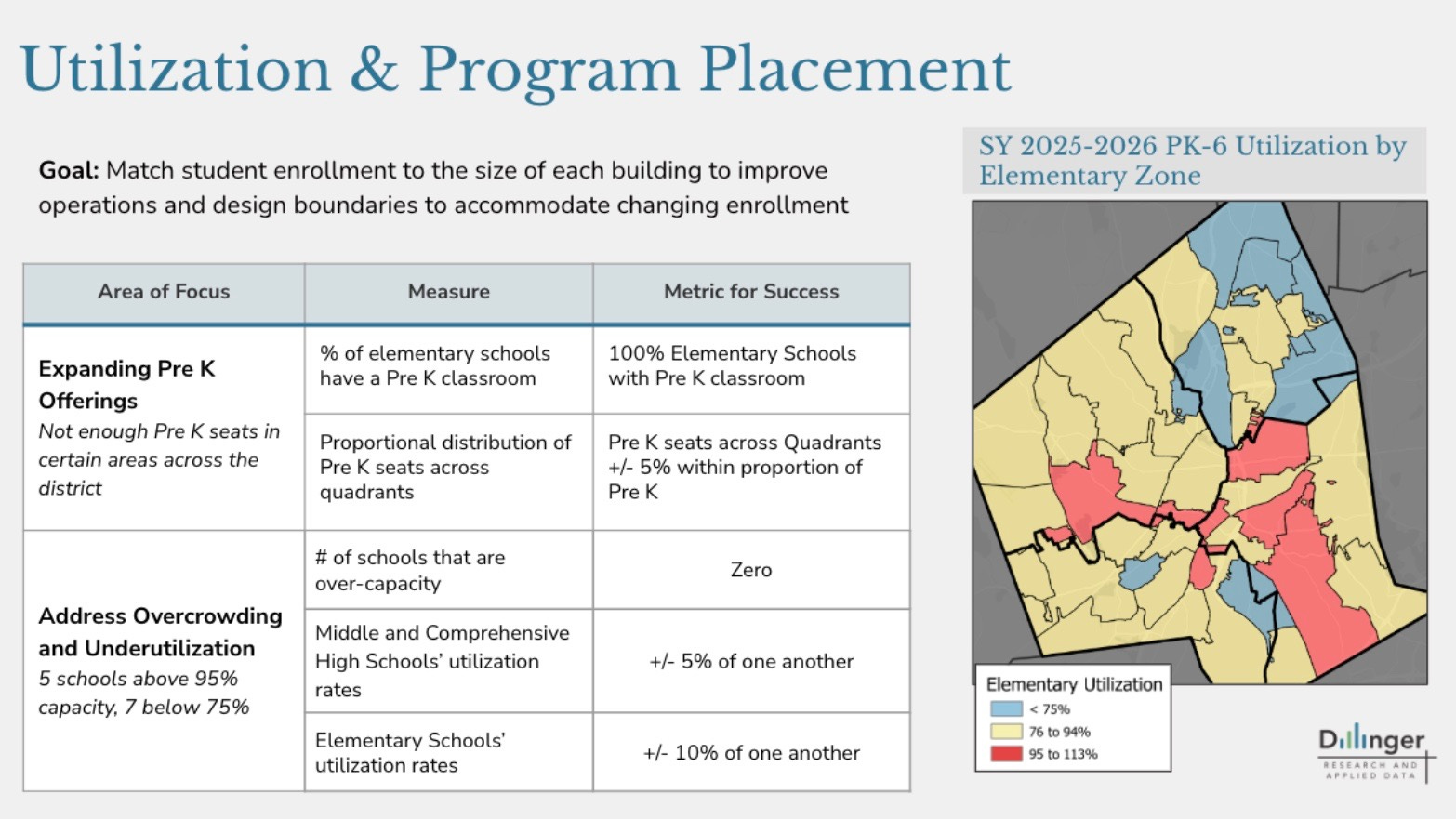
Key areas I want to highlight that I think families and students will be happy about: the district is looking at expanding transportation options, creating more compact boundaries that could allow more students to attend schools closer to home, and making adjustments to middle school bell schedules. They’re also exploring opportunities to expand full-day preschool as the district moves away from half-day programs, and increasing access to after-school care through community partnerships. While there are still a lot of details to work out, these are all issues that came up repeatedly during community meetings and have the potential to make a big impact for students and families.
The administration is also proposing several school name changes to better align school designations with current programming. The proposal would remove the “Community School” designation from Belmont, Elm Park, Quinsigamond, and South, arguing that all Worcester schools should function as community schools. It would also remove the “Magnet” designation from Canterbury, Jacob Hiatt, and Tatnuck, saying these schools no longer operate distinct citywide magnet programs. Jacob Hiatt, in particular, would be intentionally redesigned as a neighborhood school under the proposal. These recommendations will be considered alongside broader redistricting proposals this fall, with public feedback opportunities before a final School Committee vote expected in December.
Limiting individual device use in PreK through Grade Two.
Kate Johnson, Lakeview Elementary parent whose youngest child will graduate from high school in 2042, speaks during public comment.
At the June 25 meeting public comment was dominated by parents advocating for a petition filed by Worcester for Safe Student Technology (of which I am a member), asking for limits on individual internet-connected device use in Pre-K through second grade classrooms and for policies that prioritize hands-on, teacher-led, screen-limited learning. The petition, which has gathered 468 signatures from members of 51 schools across the district, includes exemptions for students who require assistive technology and for technology enrichment classes. Public comment pointed to growing national concerns about screen time in schools, including recent action by the Los Angeles Unified School District and parents argued that young children benefit most from direct interaction, play, movement, and hands-on learning.
Relatedly, in response to a report request from Sue Mailman (at-large), the administration is recommending a shift to a 3:1 student-to-iPad ratio in pre-K through first grade (which I think is a typo, because first graders in the district get Chromebooks). While modest, it is one of the first tangible changes to emerge from ongoing parent advocacy around technology use in the early grades and freed up $100,000 in the budget.
Bullying Policy.
At the June 25 meeting the School Committee approved a revised Bullying Prevention and Intervention Plan (BPIP), a document that must be updated every two years for the district to remain in compliance with state law.
During earlier public comment, several parents asked that the item be held in order to update other areas of concern in the policy. Sue Mailman made the same request, but Deputy Superintendent Marie Morse explained that the BPIP is the implementation plan that supports the policy, and that the district needed to approve it that evening to remain in compliance with the state. Morse added that the School Committee could separately request a review of the policy.
This is where I got confused.
The agenda item they were discussing read:
“To review and update, if necessary, Policy JICFB (Bullying Prevention), in accordance with M.G.L. c. 71, § 37O), requiring biennial review of such.”
That language appears to open the policy for review.
To address both concerns, Mailman then made a separate motion to refer the bullying policy to subcommittee as soon as possible. Vice Chair Molly McCullough (district A) raised a point of order, saying there was already a bullying item pending in committee, which meant another referral couldn’t be made.
There was some discussion over whether an existing bullying item was already pending in TLSS or Operations & Governance, with McCullough stating it was in TLSS. After the meeting, I reviewed both committees’ outstanding item lists, updated June 26. The only bullying-related item I found was a request, made during discussion of wellness rooms, for “a report on the collaboration of bullying mitigation and wellness rooms.”
That appears to be a different issue than Mailman’s request to re-examine district’s bullying policy, and it would also go to Operations & Governance, so I’m not sure why it prevented the motion from moving forward.
Here’s the video.
Public bodies only work well when everyone is operating from the same information and decisions are made through a transparent process. When facts become unclear, tempers get shorter, and disagreements start feeling personal instead of procedural, it’s much harder for the committee to move its work forward.
I’ve watched hundreds of hours of School Committee meetings over the years, and the June 25 one felt different. There was far more visible frustration: eye rolling, sighing, head shaking, curt responses, expressions of disbelief, and side conversations behind covered mouths. Patience seemed to be in much shorter supply.
And I just keep coming back to the question that I think should anchor every difficult decision: What is the best choice for students, even if it’s the harder choice for the adults?
I’ll leave you with that.
Upcoming Dates.
All meetings have virtual options, see the school committee site for more information.
School Committee Meeting on July 16, 4 p.m. at City hall
Subcommittees have no scheduled meetings until August.
Happy summer vacation! Lots of new families are joining WPS this fall. If you find WPS in Brief valuable, please share it with them! Last day to get the half off for a year subscription deal. Please support our work! See you in July.