


Writing about Worcester Public Schools while also advocating within the district has always been complicated. I have relationships with many of the same people whose decisions I sometimes question publicly, and I would be lying if I said I never calculate the consequences of what I write. But I keep coming back to the belief behind this newsletter: knowledge is power. Families deserve to understand the systems shaping their children’s education, and they should not have to be quiet, agreeable or endlessly collaborative to be heard. Advocacy does not become less legitimate simply because it is persistent, uncomfortable or inconvenient.
That feels especially important right now, as Worcester makes decisions that could shape our schools for years to come: redistricting. Another scenario is expected in October, with final recommendations in December. These decisions could shape school assignments, specialized programs, transportation, preschool, integration and feeder patterns for years. Now is the time to pay attention and I strongly encourage you to look at what is proposed for your neighborhood and for neighborhoods beyond your own. If you know someone with kids, even if they’re not school-aged yet, share this with them!
Welcome to the September issue of WPS in Brief. Lots to cover, so let’s get to it.
Breaking News! Please read Tracy Novick’s blog post about the City trying to scare us into thinking a new Burncoat High School and Middle School will be too expensive. She writes, “I am, frankly, angry that all of this concern over fiscal capacity was nowhere to be found when we suddenly were using local resources to build a ballpark to earn money for those who already have much. When we need funding to meet the needs of local students, a constitutional obligation, suddenly we have scary memos.”
Meeting Moment.
Every so often there’s something that happens at a meeting that I think is worth watching, and this is one of them, which is why I’m starting out with the meeting moment. At the September 3 School Committee meeting, a public petition asked the district to restrict the flags displayed in schools primarily to the United States, Massachusetts, City of Worcester and POW/MIA flags. While Pride flags were never explicitly named in the petition, that was very clearly where much of the public conversation went.
This is one of those moments when I think it is important to stop listening to the adults for a minute and listen to the students. Konstantin Kibe, a senior at Burncoat High School, told the committee what visible support means for transgender and queer students: “A pride flag in a classroom can be the difference between a graduation and a suicide.” That is an extraordinarily stark thing for a teenager to have to explain to a room full of adults. His words are worth a listen.
The agenda recommendation was to send the petition to the Operations and Governance subcommittee. Instead, after public comment, the School Committee took it up that night and voted to “reject” it. Technically, “reject” is not an option available to the committee; if members did not want to advance the petition, the proper action was to file it. But whatever procedural language was used, I was glad to see the School Committee stop the petition in its tracks.
Gender Support Plan Petition.
At the September 24 Teaching, Learning and Student Supports meeting, the subcommittee finally heard a Burncoat High educator’s 2024 public petition asking WPS to consider using DESE’s gender support plan. During public comment three trans students relayed their experiences: of being outed by teachers without their permission, about repeatedly having to come out to adults because systems like attendance sheets still do not reflect a student’s chosen name, and about being bullied and feeling unsafe. They spoke directly to the fundamental question underneath the petition: What happens after a student tells one trusted adult their name and pronouns? How does that information follow the student appropriately and safely so they do not have to start over in every classroom?
When the item came up for discussion, Tom Toney, administrative director of positive youth development, essentially said ‘as it reads’ and not one single school committee member asked a question. Maureen Binienda (at large) moved to file the item, and asked for a written report about what the district currently does. I’m not sure why she didn’t ask the question to the people in the room? In the end, they spent just two minutes on this item, and most of that time was on a procedural question.
What makes me the most livid, though, is that not a single adult in that room publicly thanked the teenagers for coming to speak, in what I imagine was a really hard thing for them to do. It’s unacceptable.
The good news is that the gender support plan item is not dead. The subcommittee did vote to file it (2-1, with Guardiola [district D] and Binienda voting yes, and Alvarez [district B] voting no), but it has not completed the full School Committee process yet. There is still an opportunity for the full committee to ask those questions and change course at the next school committee meeting on October 8.
Girls Flag Football.
Also at the September 24 TLSS meeting was a proposal to start girls flag football as a club or intramural sport, with up to two paid coaches at each high school. Coaching stipends would cost up to $12,180, and the department asked to increase its daily bus allocation from 10 to 14. Uniforms, equipment, officials and other costs would have to fit within its existing budget.

I love flag football. Twenty years ago, I played weak side linebacker on my college intramural team. It was the biggest women’s sport on campus, and three times we reached the finals and got to play in Notre Dame Stadium. Some of my teammates are still my closest friends. I would love for WPS girls to have that kind of experience. But I’m hesitant to add costs when existing teams are fundraising for proper equipment and uniforms, and WPS cannot fully fund its academic needs. Community fundraising and volunteers seem like the right way to get this started.
The athletic director also pointed out that, because flag football would be a club sport, students could play it alongside another spring sport. Technically, perhaps. But when is a high school student supposed to play two sports in one season, keep up with schoolwork and sleep? The phrase is “student-athlete,” with student first, for a reason.
What struck me the most from that September 24 TLSS meeting, though, was that the committee spent ten minutes asking questions about flag football and no time asking questions about the proposed gender support plan. This is called bikeshedding, which is the tendency of groups to spend disproportionate amounts of time debating relatively simple or familiar issues while giving far less attention to complicated, consequential ones. This was a painful example.
Democratic City Committee Chair hired by WPS.
On September 18, WPS announced that former City Councilor Sean Rose, who is also the current chair of the Worcester Democratic City Committee, had been appointed the district’s new Chief of Access, Opportunity and Equity. The Cabinet-level position is focused on opportunity gaps, family engagement, recruitment and equity. The job oversees areas including Family and Community Engagement, student and family advisory councils, the Parent Information Center and community outreach.
Rose has most recently served as president and CEO of Thrive Support & Advocacy, which provides services to people with intellectual and developmental disabilities. The district’s announcement said Rose has more than two decades of experience in “education” and “diversity, equity and inclusion,” but provided few details about that work. When I asked WPS specifically about his experience working within a public school system and leading academic-equity initiatives, a district spokesperson declined to answer.
The posting listed a salary range of approximately $192,000 to $197,000, which would be a significant pay cut for Rose, with Thrive’s most recent nonprofit filing listing his compensation at $296,231. The posting also required a Massachusetts administrator license. Rose holds initial licenses as a principal/assistant principal, issued almost 13 years ago. Initial licenses are valid for five years of employment, not five calendar years; the clock begins only when someone starts working in a position requiring that particular license. Rose therefore holds the required credential, but the licenses themselves do not demonstrate prior experience as a public school administrator.
Rose has also long been a public figure in Worcester. He served three terms on the City Council from 2018 through 2023, becoming the first Black councilor elected to represent District 1. Rose credits current School Committee member Molly McCullough, his cousin-in-law, with encouraging him to run. As Bill Doyle—no relation to me—reported in 2023, Rose married into a family with deep roots in Worcester politics:
“His father-in-law, Tom White, was a longtime state senator, state representative and city councilor. School Committee member Molly McCullough is a first cousin to Rose’s wife. James O’Brien, his wife’s grandfather, used to be mayor of Worcester. His wife’s uncle, also named James O’Brien, served on the Governor’s Council.”
None of that establishes that McCullough or Rose’s other relatives played any role in this appointment. But it illustrates that Rose has extensive political relationships in Worcester, which makes transparency around the hiring process particularly important.
Still, a district spokesperson declined to answer every follow-up question I submitted about its press release. That included who represented parents and the community during the multistep hiring process. The district has been similarly vague about the funding. Its June press release said the new position would be paid for through “an upcoming vacancy in another administrative position,” but did not identify that position. The director of the Office of Innovation subsequently left the district, and WPS did not refill that job, making it appear likely that the vacancy is funding Rose’s position, but the district declined to confirm that as well.
None of this establishes that Rose cannot do the job. His nonprofit leadership, human services background, political experience and extensive relationships across Worcester may all prove valuable. But an office charged with building trust should not begin by asking the public to take its hiring process on faith. That is especially true when the appointee is a prominent local political figure and the district refuses to answer basic questions about his relevant experience, who participated in his selection or how the position is being funded.
Superintendent’s Goals.
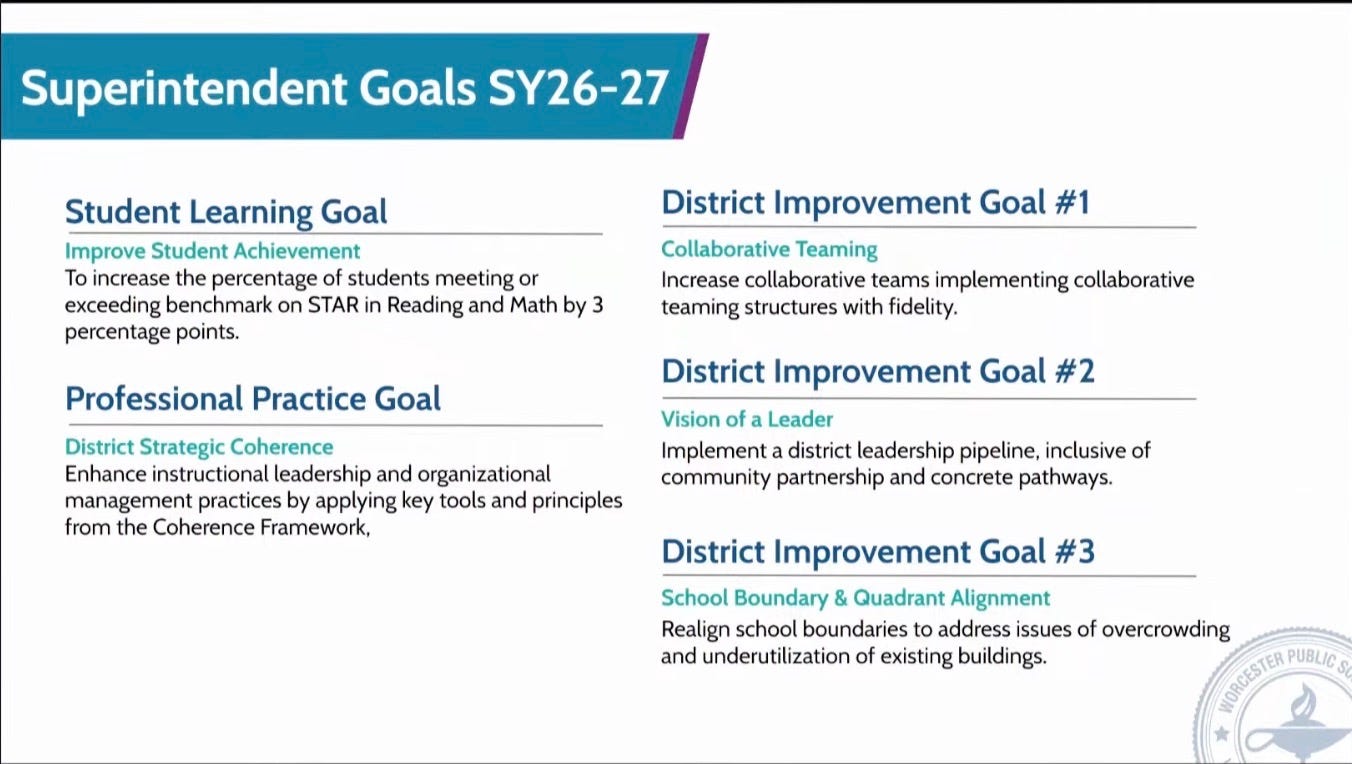
The School Committee approved Superintendent Brian Allen’s goals for the 2026–27 school year this month. If they sound familiar, that’s because most are continuations of work he started last year. Each fall, the School Committee approves goals for the superintendent and then uses them as part of his evaluation.
For the most part, you can see Allen’s progression. The student-achievement goal picks up almost exactly where last year’s left off: WPS got the percentage of students meeting or exceeding Star benchmarks in reading and math from 33% to 35%, just short of the 36% goal. This year, the target is 38%.
The collaborative teaming goal moves from establishing the practice to making it consistent across more schools. Last year, 84% of meetings reviewed included all four expected practices, but only 38 of 49 schools met the overall fidelity standard. This year, the goal is for 85% of schools to consistently implement the model. And last year’s Grow Your Own teacher pipeline, which enrolled 41 students against an initial target of 15–20, has a counterpart this year aimed at developing WPS’s own instructional coaches, deans, assistant principals and principals.
Redistricting also moves from analysis to implementation. Allen’s goal is to carry out the School Committee’s eventual boundary decisions, reduce overcrowding in at least 85% of schools currently over capacity and bring under-enrolled schools to at least 85% utilization. It explicitly includes feeder patterns, program placements and magnet/ citywide designations, which, once again, is why you need to pay attention to redistricting.
The genuinely new goal is around “strategic coherence.” Allen is participating in Harvard’s Public Education Leadership Program and plans to use that work to examine whether structures, systems and spending actually support what happens in classrooms. By June, he is supposed to present a revised strategic-coherence plan.
Taken together, there’s a pretty clear theme here: systems, structures and implementation. But that’s also why I was surprised by what’s missing. In his own 44-page self-assessment last year, Allen repeatedly identified communication and stakeholder engagement as areas where WPS needed to improve. He acknowledged problems around the Nelson Place principal selection, the proposed Worcester Alternative/ACT merger, and the equity reorganization. He talked about improving transparency, stakeholder engagement and the district’s advisory structures. There is no measurable goal asking whether families feel better informed and meaningfully involved in decisions—or, more simply, whether the district is just hearing the community or actually listening to it.
And there was very little School Committee discussion about any of this. Just one member asked any questions about the Superintendent’s goals (Sue Mailman). And there’s something to be said for having those conversations in public.
Too Much Testing?
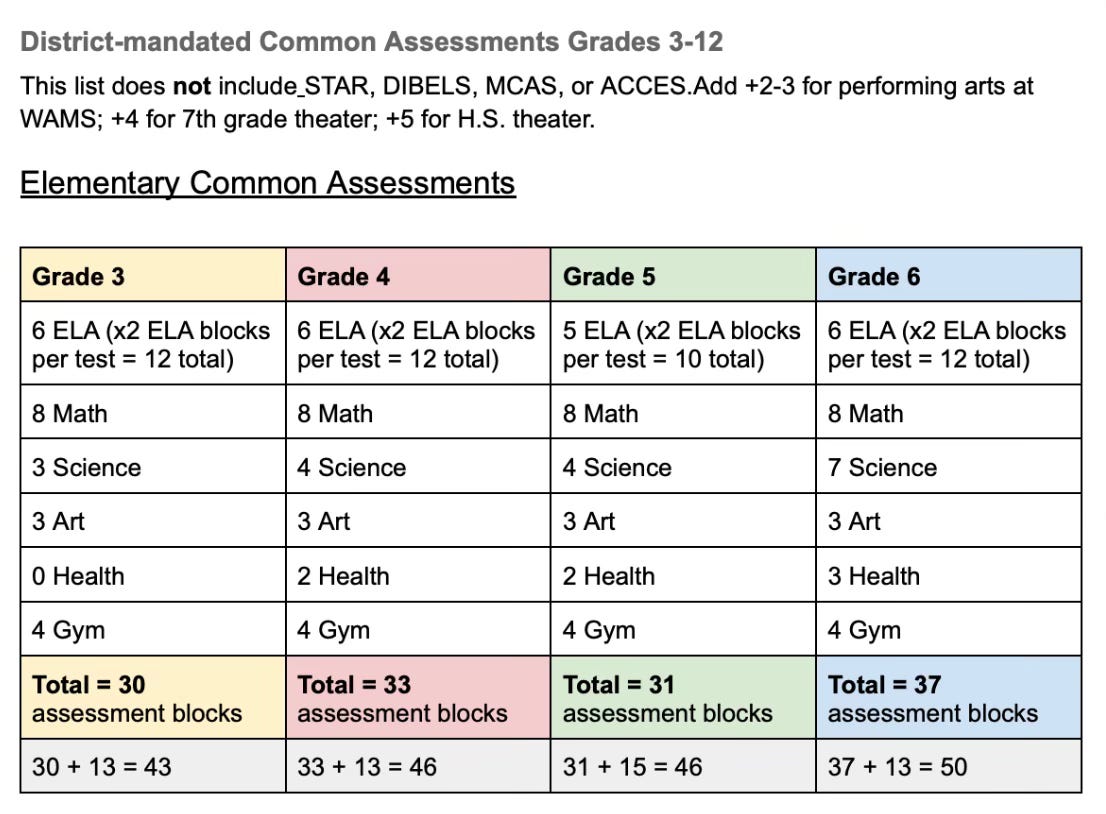
The TLSS committee received a report on district assessments this month and depending on grade level, students may have roughly 30 to 50 (!) district assessments scheduled during the year, in addition to state testing and regular classroom assessment by the teacher. Parent Shawna Sylvia looked through the assessment calendar and counted 49 assessments for her third grader, who is reading below grade level. She told the committee:
“As a parent it’s hard to hear the district say there isn’t enough time in the day for teaching, and then to see how much of his time is being spent on assessments instead of learning.”
Maureen Binienda (at-large) pushed back on the idea that common assessments necessarily consume enormous amounts of time, explaining that they generally take part of a class period rather than days or weeks. Vanessa Alvarez (district B) captured an important part of this tension: families aren’t raising these concerns because they don’t care about academic progress. They’re raising them precisely because they do pay attention to their children’s education.
As an elementary parent, I have asked repeatedly for access to my child’s common assessments. Parents still cannot simply log in and see the questions their child was asked, how they answered or what the assessment supposedly tells the district. If these assessments are useful for understanding my child’s progress, I would like to see the results and understand what they mean, just like I would if they took the test on paper and brought it home.
Alex Guardiola (district D) framed the issue even more clearly: Does every assessment have a clear purpose? Are students taking too many? Do families know what assessments are happening? Are teachers getting results quickly enough to actually use them? And can the district demonstrate what it is doing differently because of the data it collects?
All great questions. Will we get the answers?
What happens if WPS gets hacked?
Sue Mailman (at large) requested a report on what systems the district has in place to make sure school could continue if it experienced a cyberattack. It’s not a theoretical question, as this month a severe cyberattack on Springfield Public Schools by an organized criminal group blocked access to systems the district needs for basic operations, including student medical information. Springfield lost four days of school while staff prepared to operate with limited technology. When students returned, some systems still required paper-and-pencil workarounds. The Boston Globe confirmed that the hackers stole student and staff data. As a parent, it’s hard to see what can happen when a district’s systems are breached, knowing how little control families have over the data collected about our children, where it is stored and who can access it.
Upcoming dates.
All school committee meetings have virtual options with Spanish translation, see the school committee site for more information.
Citywide Parent Planning Advisory Council October 6, 6-7 p.m. at the Fanning Building
School Committee meetings are October 8 and October 22, 6 p.m.
Finance is October 21 p.m., time TBD at the Durkin Administration Building
Operations and Governance is October 16, 5 p.m. at Vernon Hill
Teaching, Learning and Student Support is October 16, 5 p.m. at Durkin Administration Building
Also.
Believe it or not, next year is another municipal election year. But the race I’m most interested in watching isn’t necessarily the School Committee, it’s mayor. (Remember Worcester’s mayor also chairs the School Committee.)
Mayor Joe Petty has served as mayor since 2012 and is currently in his eighth mayoral term. There is already political chatter about whether he’ll run again in 2027, but Petty has been rumored to be done before, so I would put approximately zero dollars on any rumor until he says something himself.
What is interesting is the possibility of School Committee members becoming part of that conversation. I’ve heard the names Sue Mailman, Molly McCullough and Maureen Binienda floated locally, although none has publicly announced a mayoral campaign. A mayoral race involving people with substantial School Committee records would put public education much closer to the center of Worcester’s citywide political conversation.
In terms of who runs for School Committee itself, my read of where parent organizing in Worcester right now is we may see more parents of younger children decide to run—people experiencing WPS day-to-day and navigating all the little systems you don’t fully understand until you’re trying to navigate them for your own kid. And that would be a great thing.
Thanks for reading, see you in October.