

Got a special one for ya today: Worcester Sucks’ first foray into sports reporting, courtesy Roberto Solis-Byxbee, who, if all goes according to plan, will be the go-to sports guy for this outlet! Let me know what you think. I for one think it sure beats another post about the god awful goings on at City Hall.
Not much to report on that front. The council meeting this week was a quiet one, the election continues to be a snooze for the most part, the police haven’t done anything especially awful (that we know about), Kate Toomey has disappeared from the news for the time being, though I suspect that’s temporary. Over on the ‘school side,’ the redistricting stuff is very interesting. Our very own Aislinn Doyle has you covered on that. Read the latest: “WPS in Brief: Redistricting, Round Three.” And the Worcester Education Justice Alliance is holding a few forums on the matter coming up, first one being next Monday, Oct. 19.
One more thing to get in front of you before we get to the main event: There’s a new run of very cool custom-made items on the merch store!!!
The multi-talented Katie Nowicki went into a manic fit making “bleach-dye” versions of the “Outdoor Cat” logo and they came out sooooo good.
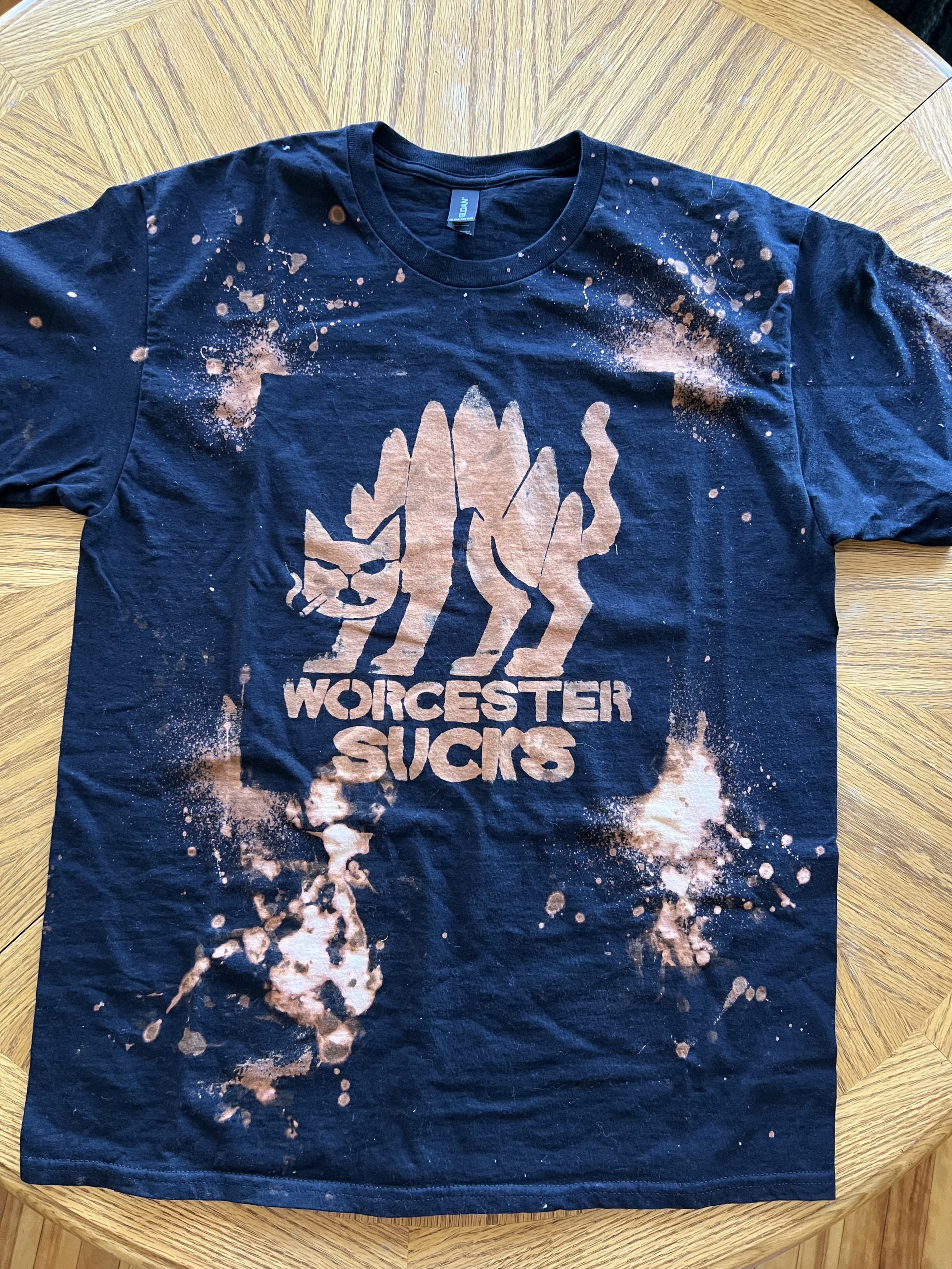
There are only 40 of these that are ever going to exist.
And there’s four (only four!!) tote bags in the same fashion.
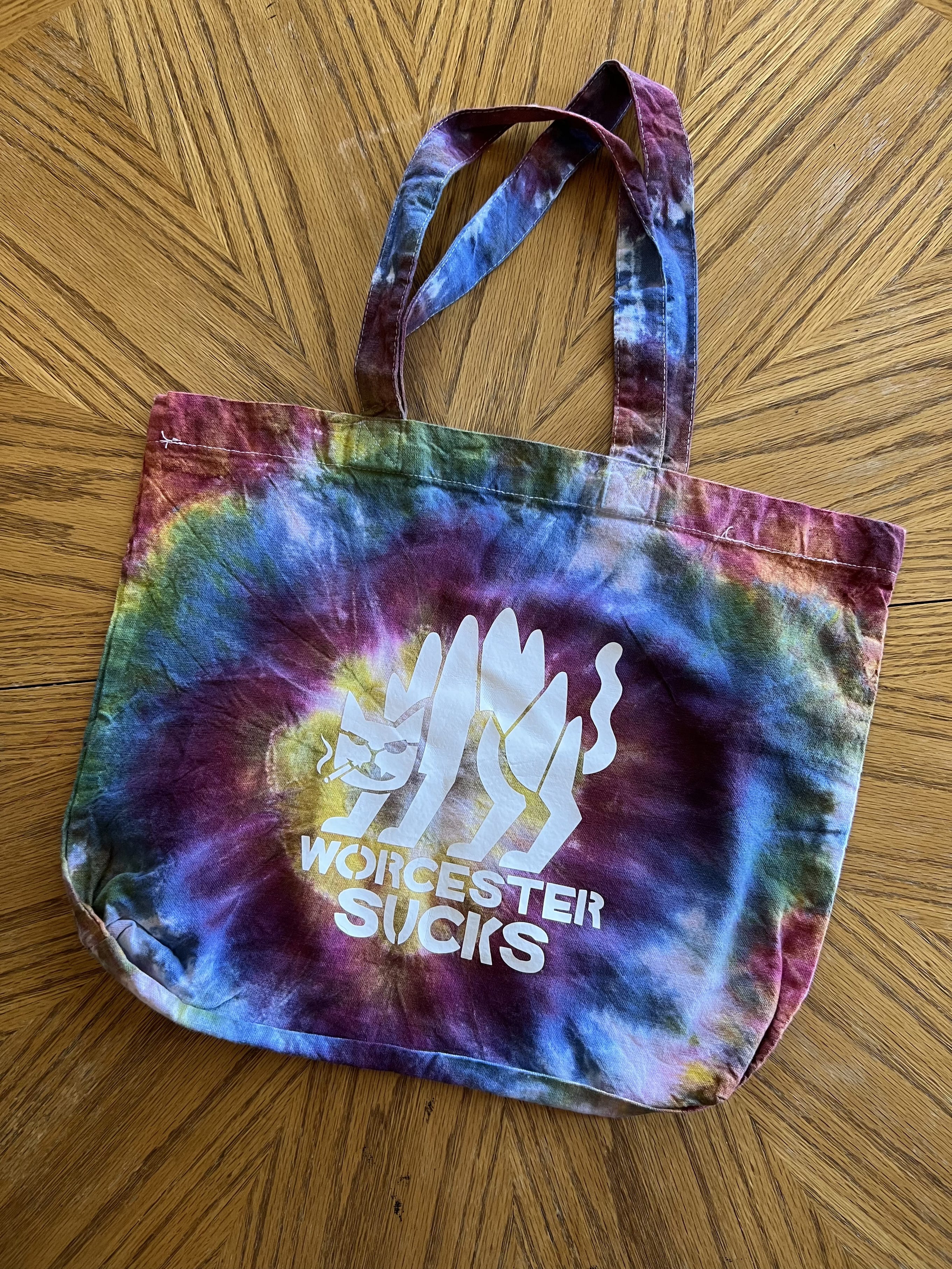
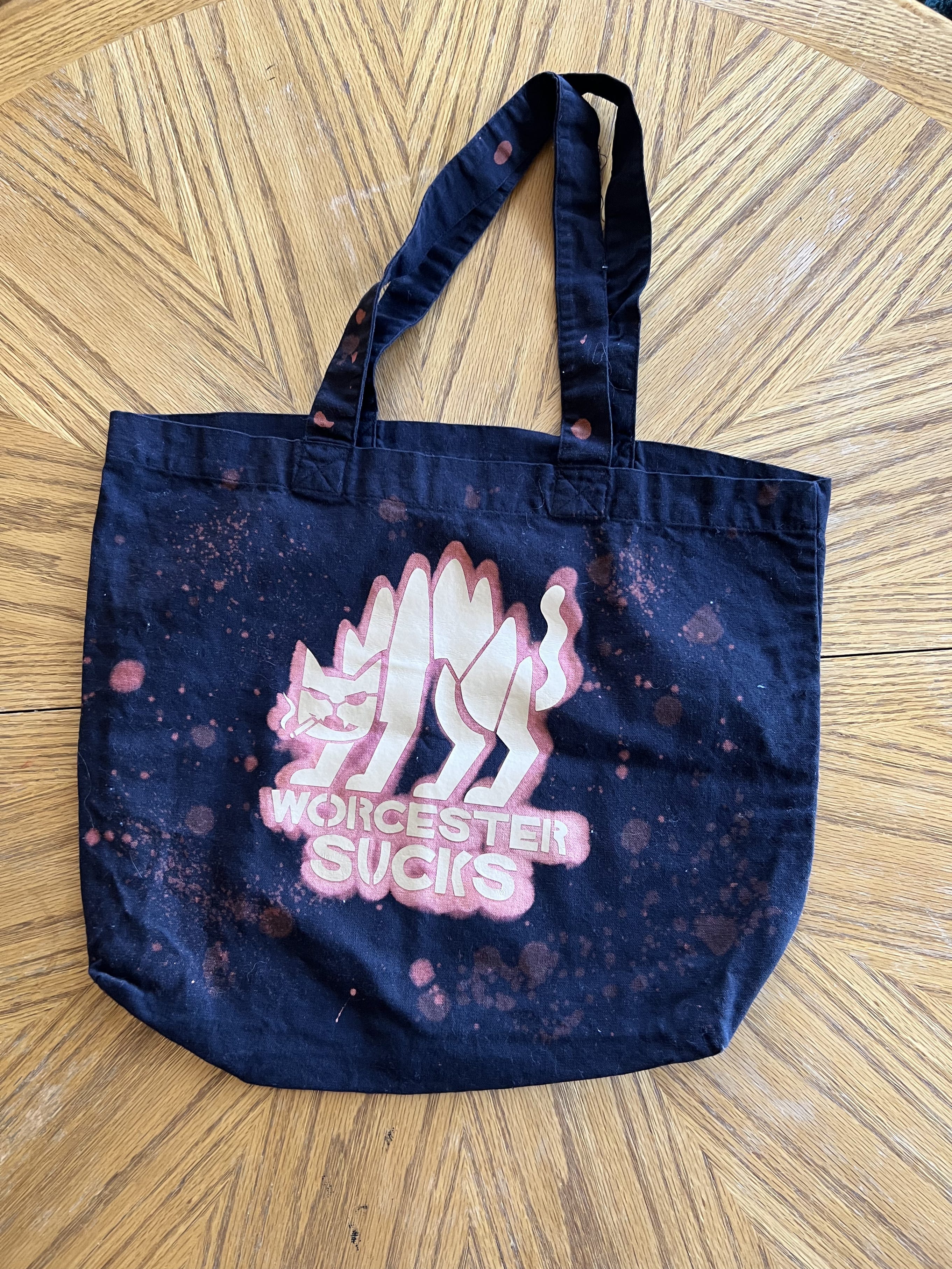
A bit more expensive than other items have been, but they are all each of them unique works of art. So. Think of it that way, it’s a deal.
What’s more, paid subscribers get free shipping! You can grab the code from behind the paywall at this link, where you can also subscribe if you aren’t already: Post with the free shipping code.
Think of it this way: you sign up to give me $5, I hand that $5 over to the post office, a few days later you get a cool piece of completely unique swag over which your friends will gawk, go ooooh and ahhhhh and you’ll go “I know!”
Also have to do the requisite “regular pitch”: All the money that comes in, via subscriptions and merch orders and tips, ensures that this outlet stays afloat.
It takes an insane amount of work, the donning of a good deal of uniquely silly hats, in succession and at once, and that includes wrangling an ever growing roster of great writers like Roberto, who you’re about to read…
Okay, that’s all for me this week. Podcast coming soon. Roberto’s piece is long so I’ll let him play us out. Now to take the silly editor hat off and put on the even sillier podcaster one… talk soon!
Cat Scratch Fever
Worcester’s tumultuous relationship with professional hockey
By Roberto Solis-Byxbee
It’s October, there’s a chill in the air, and most importantly–it’s hockey season. Our city’s very own professional hockey team, the Worcester Railers, plays their season opener on October 17th. And yet, I often yearn for simpler times. For the 30-something-year-old Worcester kids who grew up watching hockey like me, nothing screams nostalgia quite like our glorious city’s first taste of professional hockey: the IceCats.
Over thirty years ago (ouch), businessman Roy Boe—known for making a lot of money from a clothing franchise in the 60s then parlaying his wealth into partial ownership of multiple sports teams—bought the rights to an American Hockey League (AHL) team in Springfield, one of the oldest around, and made the fateful decision to move the team to Worcester. A couple of months later, the Worcester IceCats were born. The origin of the name was never exactly clarified, but with or without meaning, the team was hitting the ice.
Their inaugural season in 1994-95 was a rough one. See, the AHL kind of acts like a feeder league to the NHL, and the two leagues have a very symbiotic relationship. Without an NHL affiliation, the IceCats were forced to sign free agents and operate as an independent organization. Since the nineties, only one other team has operated under this business model. So, it’s safe to say this is akin to playing in hard mode. The IceCats struggled, winning only 24 of 80 games during that first season, so the team quickly made finding an NHL affiliation a priority. That’s where the St. Louis Blues came into play. While this would ultimately lead to their downfall, having the Blues as their NHL affiliate allowed the IceCats to gain some steady momentum. The team rostered competitive squads and qualified for the postseason for nine seasons straight, from 1996 to 2004. This is the era of IceCats hockey that most of us remember.
I remember waiting in line at the Centrum, either in the overly spacious lobby or outside in the cold at one of the various entrances into the arena. Once inside, I was hit with an assortment of subtle yet distinct smells competing for real estate in your nostrils. The faint and fleeting smell of industrial floor cleaner as my sneakers padded through the overly large yet somehow too small hallway surrounding the arena. The floor wasn’t wet, but I could tell by the surface tension of my steps that it had recently been. Other scents hit me as I rounded each corner: a whiff of fried oily goods, revolting, yet appealing in the best kind of way. Stale popcorn somehow scattered everywhere. God, there was so much popcorn. The unfortunate aroma of body odor from a hardcore hockey fan who traveled far to come watch their team play in my city. Or even in the very olden times, when I’d round a certain side of the arena, and be overwhelmed by the floating smell of nicotine in the air as the excessively large smoking section was among the most visited parts of the Centrum. All these smells were present for every game, but even combined, they paled in comparison to what I would be met with upon walking through the clumsily hung black curtains and coming out onto the other side, face to face with the ice rink.
I could feel the cool bite of the air immediately, and the bright white lights, illuminating and bouncing off the somehow brighter rink, caused my pupils to shrink. No matter where I was, it was a sight to behold. And if I timed it right, the teams would be there, in all their glory, going through the motions out on the ice, warming up for their big game. In the time before safety netting, people would be lucky enough to spectate and come away with a souvenir, as plenty of vulcanized rubber would careen off players and goal posts alike out into the crowd. The delay-soaked guitar riffs of Slash echoed through me, Axl Rose’s sharp yet sultry vocals start, I’m in the jungle, and it’s beautiful. The puck is about to drop, and the game is about to begin. Life is good.
Whoa, but let’s hold here for a moment. While the Worcester IceCats arguably had the biggest cultural impact on our city out of any of our hockey teams, they weren’t the first hockey team to call Worcester their home. That honor belongs to the Worcester Warriors. If we’re going to do this, we’re going to do it right, so join me on a dive into the city’s hockey history that reaches deeper than most realize. Cue theme song.
Warriors Come out and Play
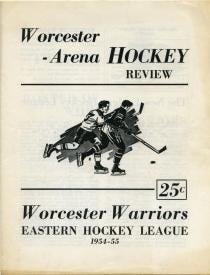
In 1952, a man named Larz Anderson bought a roller-skating rink in Worcester, and he had big plans for it. Anderson promptly converted what was known as Webster Square Arena into the Worcester Ice Arena. Though it was used by multiple colleges in the city over the years for their Men’s Hockey programs before being converted back to a roller rink in the 80s, it was this ice rink, slightly smaller than an NHL regulation rink, that helped Anderson swing the deal to bring the Warriors to Worcester in the first place.
The Worcester Warriors played their first and only season in 1954-55. They struggled, only winning three games, but they were ours. It was an interesting situation: the team was filled with regional college hockey standouts but had to compete mostly against more legitimate professional teams. The players weren’t compensated as professionals, which eventually led to the in-season collapse, but in one December game against the New Haven Blades, the 1014-capacity Worcester Arena sold out. The team made some attempts to move to a different semi-pro league, but it never worked out.
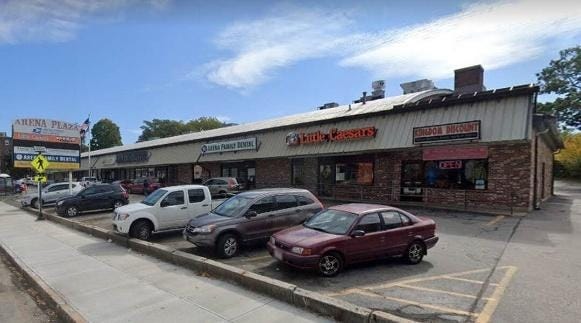
The ice rink remained for a couple of decades before undergoing several makeovers. The building’s structure is still mostly intact today. It’s the Post Office and Little Caesars plaza, right down the road from the Webster Square Speedway, and although Arena Plaza may now be home to multiple unrelated businesses, if you look closely, you can still see the curved roof behind the brick overlay on the front. There’s a metaphor buried in there somewhere.
While professional hockey wouldn’t return to the city for nearly half a century, the standing up of a hockey team in the post-World War II era wasn’t a random act. The city and its surrounding area are rife with relevant hockey history. For example, early in the 20th century, Worcester was the center of ice skate manufacturing worldwide. In the late 1800s, two brothers, Seth and Samuel Winslow, started a machine shop that became a giant skate manufacturing enterprise, eventually shipping skates internationally and employing more than 200 people. One of those brothers played an even more significant role in Worcester’s history, as Samuel Winslow was elected mayor in 1886 and reelected for two additional terms. Worcester also claims to be the birthplace of youth hockey. It’s one of those things where people all over the world may have had a similar idea, but with no internet or Guinness World Records, and no equivalent to footprints on the moon or a flag waving dubiously, there’s no way to really know who got there first. Still, our very own Eddie Bates, who earned the nickname “the father of youth hockey,” organized North High’s first hockey team in 1917 and helped spread the organized game among adolescents.
From Felines to Aquatic Life
With all of the above as a blueprint, it’s really no surprise that Roy Boe brought an AHL franchise here in the 90s. The beginning was rough, with both media members and the players questioning the future of the franchise. At the time, a player commented “I’ve never been anywhere like this, where everyone expected everything to go wrong all the time.” This is just such a classically Worcester sentiment, though the city did grow to love its own professional hockey team.
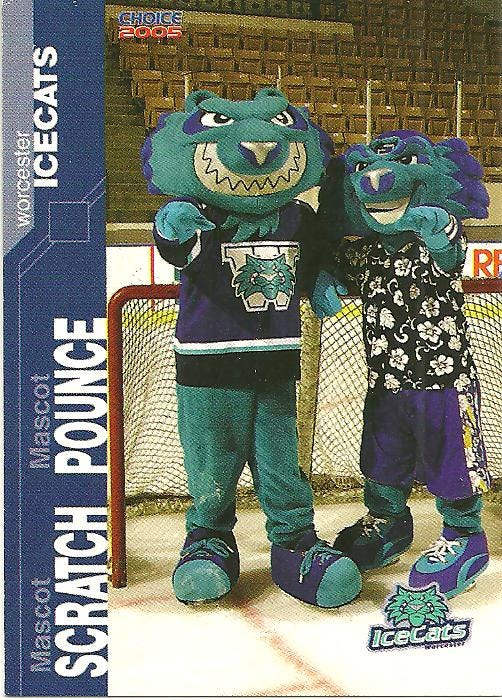
As the decade passed by, the IceCats created tons of lasting memories that I’ll never forget, and I’m sure I’m not alone in that. There’s “Rock N Roll Part 2” by Gary Glitter, better known as the “Hey Song” that played whenever the IceCats scored a goal. I’ve been in the building for hundreds of renditions of that song and know every single word (there’s literally only one word…and it’s “hey”). Or even better, scoring Four for Fries. I would constantly hope the team would get to that magic number, so that upon leaving, I’d be handed a red voucher card, immediately redeemable at any local McDonald’s for a free small fry. I was never turned away. And of course, I’ll never forget the iconic mascot Scratch and his lesser-known younger brother, Pounce (created later in the IceCats years) all supported by the Mountain Dew Ice Crew to get the crowd engaged and raucous.
There are also the on-ice moments: from winning the divisional title twice, to trouncing the Providence Bruins 11-0 on the team’s first ever Teddy bear toss—even more fun is the fact that goalie Tim Thomas was replaced and put back in after the suffering Providence took all night. Yes, that’s 2011 Conn Smythe winner Tim Thomas, who possibly had the best playoff goaltending performance in history to lead the Bruins to their only Stanley Cup championship in the last 54 years. The IceCats even had the AHL’s most valuable player when Eric Boguniecki scored 84 points in the 2001-02 season. I could go on for days. I was heartbroken when Roy Boe sold the team, and everything changed.
Up until this point, the St. Louis Blues and Boe had a partnership where the Blues acted as the parent hockey club, and the IceCats fed talent through them. In 2001, the Blues bought the team from Boe and then turned around and sold it again in November of 2004, relocating them to Illinois. It was a depressing year for sports fans in Worcester County. But the IceCats Booster Club and the people of Worcester organized and negotiated with several NHL teams, seeking a replacement for professional hockey in their hearts. This is a great example of people banding together to find a way because in January of 2006, the San Jose Sharks announced they would be moving their AHL franchise to Worcester. Renamed the Worcester Sharks, the city embraced the return of professional hockey with a sold-out crowd on opening night at the DCU Center.
The Sharks would go on to have close to their own decade of middling success in Worcester. Many well-known NHL players cut their teeth here, and the Sharks hosted the AHL All-Star Game in 2009, which is often spoken of reverently. But there was a consensus in the air that the Sharks were always coming up short of expectations, never quite matching the vibe of the heyday of the city’s AHL debut cool cat team.
The Sharks were like a younger sibling doing everything they can to make their parents stop comparing them to their smarter older brother. They established the Worcester Hockey Hall of Fame, inducting various folks, some discussed in this piece, and many others for their important achievements to furthering the game of Hockey in Worcester, but alas, the magic would dry out as the parent team, the San Jose Sharks, secured a deal to move the Worcester Sharks to California in 2015.
Worcester’s Steel Resolve
The city found itself in a hockey void again. Despite the Sharks’ relocation being cited as purely logistical, it was hard not to question whether we were really the problem. Was the relocation part of a concerning trend? But Worcester persisted. Just a year later, in 2016, it was announced that Worcester would become the home of the newest ECHL expansion team. While this is a step down in talent and caliber from the AHL, the ECHL is still recognized by the players’ union and is known as a professional league that feeds directly into the AHL.
I personally attended a ceremony for the unveiling of the new team’s name. There was electricity in the air as many wondered if the franchise would find a way to secure the rights to the IceCats’ name. As we know now, they didn’t. The name instead would be the Worcester Railers, alluding to the city’s long history of involvement in the metal industry. The team debuted in 2017, and qualified for the postseason that first year. They haven’t had much success since, failing to even make the playoffs since their debut, but that hasn’t stopped the team from having fun. They’ve embraced their identity as an ECHL franchise and have engaged fans by hosting a variety of theme games, such as “Star Wars Night”, “Princesses and Pirates Day”, and even a whole weekend paying homage to the invention of the Monkey Wrench (who knew that was yet another thing Worcester can take credit for?).
The Railers have a great pulse on the local hockey scene. Several years in a row now, they’ve held an IceCats Weekend, where the team wears special IceCats jerseys, and they sell IceCats apparel and have alumni present at several games throughout the weekend. The event is a hit.
While the Sharks and then Railers have gone on to try and fill the hole in our heart the IceCats left, there was just something special about that first AHL team. The Railers have a savvy marketing team and capitalize on it. The team has also signed two local hockey players, Nick Pennucci and Matt Myers, to its roster over the last few years. This is something the IceCats did as well with the Campbell brothers.
Pennucci grew up playing youth hockey in the city. His dad was a well-known face in the local community, having managed Buffone’s Skating Arena, a rink known affectionately as “Lake Ave” to the many locals (myself included) who have spent countless hours skating there. After playing for the Worcester State Lancers, Pennucci attended a training camp in the fall of 2023. The Railers reached out to bring Pennucci in to play a couple of games in early 2024. Myers has a similar story, but he grew up even closer to Worcester professional hockey, with his dad working for the Worcester Sharks’ back-office team and now as the Railers’ chief operating officer. He debuted in two games earlier this year, and the future of his career and relationship with the team is yet to be worked out.
Whether it’s good business or philanthropy, it almost doesn’t matter: the Railers immediately plugged in and began building a community. Their “Skate to Success” program has enabled elementary schools across the city to send fourth graders to the Fidelity Worcester Ice Center, where they receive hockey gear, a brief skills clinic, and the chance to skate with Worcester Railers players and staff. This has happened every Tuesday since 2017 and is a small part of why the ECHL named the Railers the “Community Service Team of the Year” five times since they’ve been around.
The Blades Come Down the Pike
For a short period of time, the Railers weren’t the only professional hockey team in Worcester. In 2010 the Canadian Women’s Hockey League expanded into the United States, establishing a franchise in Boston, called the Boston Blades. That’s where the team initially operated but after competing with the totally separate National Women’s Hockey League, who had their own Boston team, the Pride, the Blades made the decision to relocate to Worcester, where they’d be playing their home games at the Fidelity Worcester Ice Center. On par with all the other Worcester hockey teams’ inaugural season debut, the Worcester Blades were bad—really bad. They didn’t win a single game all year and were outscored 155 to 22. But the team still had some fun and are the source of some fun facts about hockey and the city of Worcester.
One: While the team was consistently clobbered, the games they played brought some legendary opposition to the city. Anyone familiar with hockey should know the name Hillary Knight or Marie Philip-Poulin. These two players are arguably USA and Canada’s greatest players of all time and recently clashed on the international stage at the 2026 Olympics. The fact that they played multiple games in the city of Worcester is so fun, and those are just two names of many legendary women’s hockey players.
Two: A few years prior to Worcester getting their team, the CWHL had expanded into China. Whether it was just a gimmick for publicity, or a real push to grow the game, every year a select number of teams would make the trip out to China to play hockey, and in 2018, the Worcester Blades got to do just that. As far as I’m aware, they’re the only Worcester based franchise that has played their sport outside of North America, let alone travel almost 8,000 miles to China to do so.
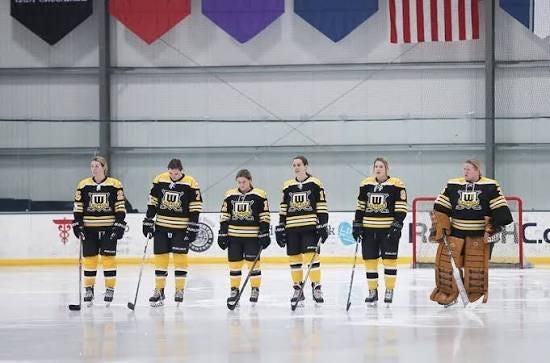
The Blades’ time in our great city was unfortunately limited. The struggling team never got a second season, a byproduct of the CWHL closing in 2019. The league was struggling financially, and faced a lot of criticism for its business model. Women’s professional hockey had needlessly gotten complicated; multiple leagues in the same regional area split the fanbase, talent pool, and resources that were needed to help create a sustainable organization. The NWHL, which eventually rebranded as the Premier Hockey Federation, had long discussed merging the two leagues, but the talks never came to fruition. A day after the league and the Worcester Blades announced they were folding, 200 players including most, if not all, of the Worcester Blades, released a joint statement to boycott playing hockey in North America.
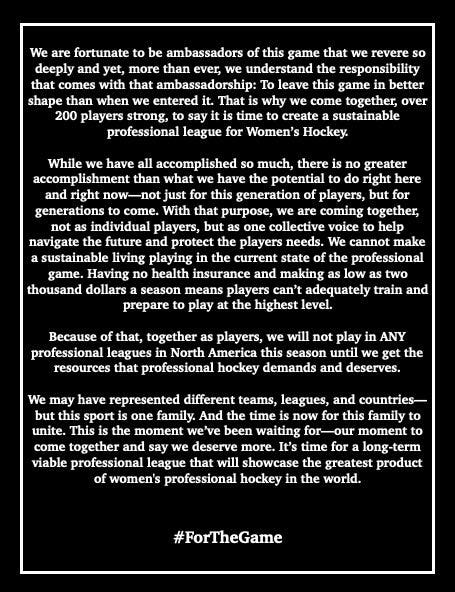
It was never perfect, and there were certainly stumbles, but over four years, the #ForTheGame movement picked up steam, especially when the players then joined forces and began organizing as the Professional Women’s Hockey Players Association. In 2023, they formed a union, ratified a collective bargaining agreement that guaranteed health insurance, other benefits, and a minimum salary of $35,000 for a new women’s hockey league that would be kicking off on New Year’s Day 2024. While the minimum salary is still extraordinarily low compared to most professional athletes, this was a gigantic step in the right direction, as the previous women’s hockey leagues provided either a small stipend or struggled to pay $5,000 as a minimum for players. Sadly, the new league wouldn’t have a team in Worcester, but our wonderful fucked up smelly city and its players were intimately involved in the effort that led to the current professional women’s hockey league, the PWHL.
The Future of Worcester Hockey
Though lacking on-ice success, the Railers are committed to staying. Like the people in Worcester, the team will refuse to throw in the towel. Earlier in the year, it was announced that the Islanders and Railers were mutually ending their agreement, likely because the Islanders moved their AHL developmental team to Ontario. That left the Railers once again without a parent organization and NHL affiliation, something, as we’ve discussed, that is incredibly hard to pull off successfully. But much like the downtrodden-yet-resilient mentality of a Worcester citizen, the Railers refused to look defeat in the eye. The team sought another affiliation and secured a deal, bringing in a familiar face in the St. Louis Blues as their NHL parent organization. The agreement with the Blues runs through 2031, so the team will again have some guaranteed longevity.
This change does mean the roster will look quite different, as the St. Louis Blues prospects and the Springfield Thunderbirds, their primary AHL developmental team, will have players report to Worcester in place of the Islanders’ overflow of players and contracts. So a few fan favorites who have made their home here will now be moving on, but that’s just the nature of professional sports, unfortunately.
Professional hockey has had a tumultuous journey in our beloved city. But the chaos brought an innumerable amount of action, characters, and memories along with it. At first, it may seem resistant, but that’s Worcester’s way of accepting you. If it were all sunshine and roses, that’d be fake of us. Yeah, professional hockey, you can stay. Worcester’s not only adopted you with open arms, but we’ve fought tooth and nail to bring you back here. But remember, that doesn’t mean you still won’t catch an earful.
Roberto Solis-Byxbee is a Worcester-based hockey historian and fan. He writes about hockey at Blueshirt Banter and drinks hot sauce just to feel something.
Mass Electric Power Play!!!
Man I miss the IceCats… this was a great read!