

Happy Halloween, everyone. As I post this, we’ve got “Bride!” on the TV—what a film, folks. There’s three or four stories crammed into this one, some are a little old… but to that I ask you to name one thing that has improved as a result of the ever accelerating 24-hour news cycle. And also to please subscribe! So we can continue to do things differently here.
Subscribe / Tips / Merch Store
ICE detentions surging in Worcester
Yesterday about 60 people gathered at the federal courthouse, marched to City Hall, then to the district court, to protest ICE activity that has quietly increased through the month of October.
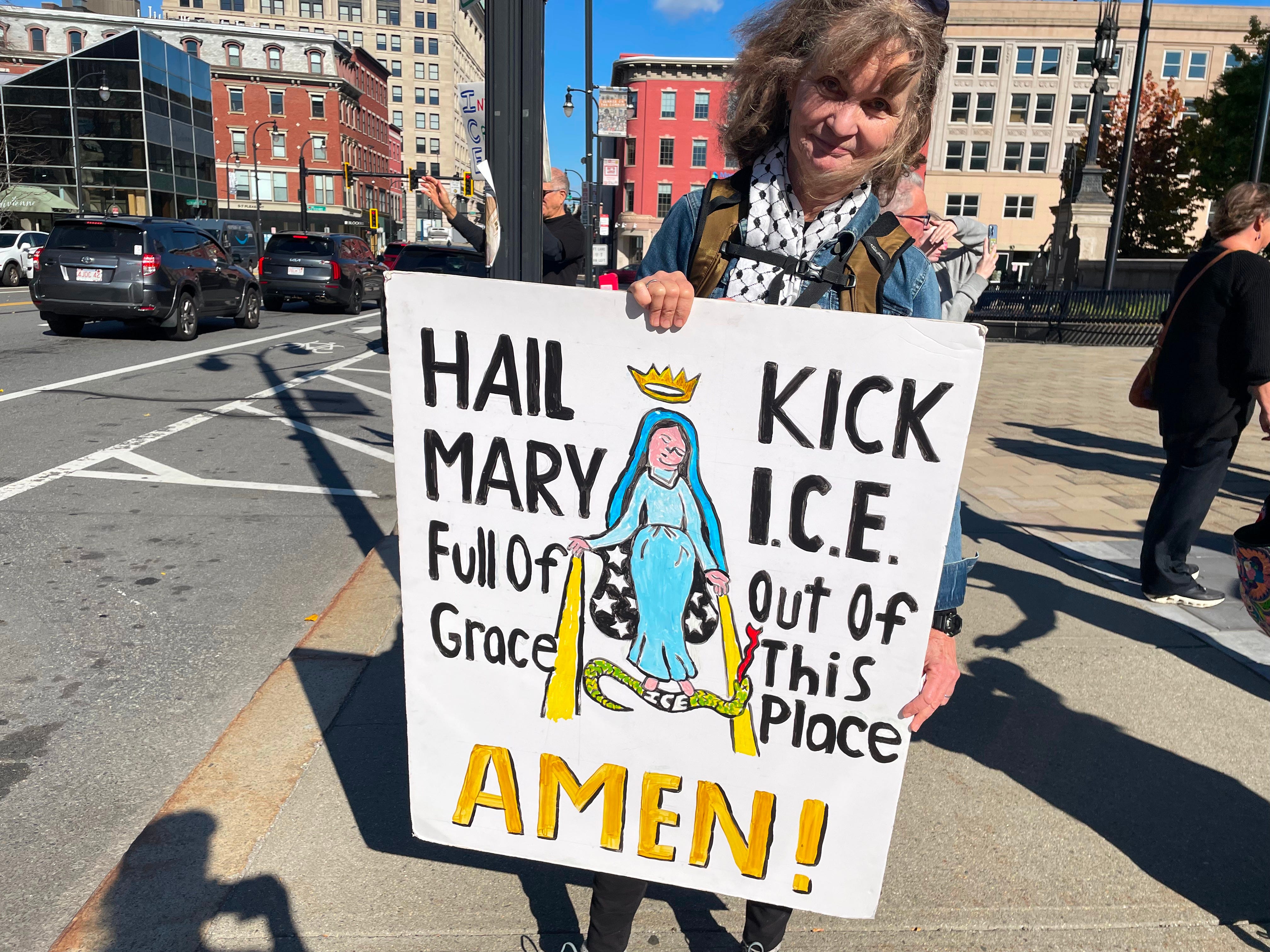
First at the mic on the windy (my poor poor tape recording) sunny afternoon was Marie H., a volunteer with the LUCE Immigrant Justice Network. She read a series of data points, compiled by Todd Palmer, a local activist who runs a good ICE tracking newsletter called Justice For All.
Since January, she said, almost 10,000 people have been detained by ICE in Massachusetts. Only 13.6 percent of the people detained by ICE have had criminal convictions of any kind, and only 2.6 percent have been convicted of violent crimes, per the data Palmer assembled.
October has been an especially busy month for ICE arrests in Worcester, with 31 known detentions, up from 16 in September and 21 in August. The spike, LUCE warns, is indicative of a “surge,” which they say may continue for the next few months. “Most of the arrests have been at or near the Worcester District Courthouse,” concluded the fact sheet organizers passed out in the crowd.
“We cannot look away. We must continue to shine this light and to demand an end to this cruelty,” said Marie.
Walking to the courthouse, I was reminded of the brutal arrest in Dan’s Rockin Cafe, the small coffee and lunch counter built into the Palladium, in May. Five agents throw a man to the ground in the middle of a busy establishment. Young women with lattes in hand scurry out the door as the man is tackled, glancing back nervously. Others film with their phones. The ICE agents all wear balaclavas of different kinds, in “plain clothes” except for the more-or-less standard issue tactical green vests that serve to distinguish the secret police from the regular police. “You can’t go around beating people with baseball bats,” one agent says, more to the crowd than to the man. As if to say ‘I’m the good guy here.’
I’m not the one going around beating people, says the man actively beating someone.
Whether the man in question beat anyone with a baseball bat is an extremely open question—you need look only at how ICE described Rosane Ferreira De Oliveira to see how easily they’ll lie to justify their actions, how little the truth matters to them—and it’s besides the point anyway. This one interaction caught on film is more or less what happens at or around the courthouse on a regular basis. ICE swoop in to catch people in a trap laid by the routine business of the district court—the life-altering consequences of an auto-generated “failure to appear” warrant from one punishment bureaucracy used as bait by another punishment bureaucracy, one with a tighter deadline and larger quota for new scalps and a longer proverbial leash for how they go about getting them. Onlookers mostly do what the two women in this clip did: pretend nothing is happening. A strategy that, famously, works until it doesn’t.
In October, that happened 31 times in 28 days. And, as Marie said, Worcester isn’t even the biggest regional hot spot for ICE arrests. In Framingham, there have been 323, compared to Worcester’s 170. In Milford, a town considerably smaller than Worcester or Framingham, there have been 374.
Milford is possibly the most racist place on Earth. I can attest... I was born there and, more importantly, went to high school there, my secondary socialization coming at the same time the town was absorbing a new diaspora from a rural community in Ecuador. The dominant townie Irish-Italian culture into which I was born was coming to terms with it—poorly, at times fascistically, always within an insufferable victimhood... what “they’re doing” to “our town.” The Illegal becoming that which stands between Milford and its historically richer, whiter neighbors: Hopkinton, Holliston, etc. If we could just get rid of them, we’d finally be clean. Holliston clean. There’s no explaining to people in Milford that Holliston Clean only exists because of Milford Dirty, that the market needs both poles to assign value to real estate, that this pattern in the socioeconomic geography is the same everywhere... that The Illegals are in Milford and not Holliston because the labor market puts them there, where the labor market also put you, Milford White, so...
With no one bothering to offer a class analysis that the Milford White could digest, the place was primed for fascism. Years before Trump, “The Illegals” and what to do about them was the axis on which Milford arrived at and administered its de facto caste system. I first observed this as a student in the public high school, where the children of these new arrivals were more or less sequestered to a separate program, the contours of which I’d only learn when, years later, it was my job to cover the town for the daily paper... when I had to figure out its strange lexicon enough to repeat it in print: for instance, what school committee members were really saying when they complained about the “unfunded mandate” to provide ELL services. Central Massachusetts “going red” is not some enigma. It’s easily explained in the way “The Illegals” slots into the local discourse in Milford.
All’s to say two things: One, it’s easy to imagine the good folks at Milford Police Department and Milford District Court and Town Hall and all the regulars at Town Meeting bending over especially backward to help ICE disappear The Illegals. Two, whether or not the disappeared are “criminals” is entirely beside the point. In the calculus of Milford Fascism, the crime is that they’re there, justice is that they’re gone. There’s no winning anyone back by tweaking ICE policy to increase the criminal to non-criminal ratio of detainees.
But anyway.
At the event, Councilor Khrystian King read a poem by Ruth Rodriguez Fay, a longtime city activist and preeminent voice on the plight of the city’s Latino communities, who recently passed. The poem is entitled “Lady Liberty: Dream Deferred.”
America has turned its back on the poor souls
Who dreamed of the golden door but instead found
The iron wall along the southern border
After reading it in full, King led the crowd in a short chant: “ No fear, no hate. Keep ice out of our state.”
Later, talking to King on the walk over to the district court, he explained why he read the poem.
“The thing about her was she always fought for justice in Worcester and she did not waiver in her beliefs.” It’s that resolve that we need right now, he said.
“During these times you have to be very clear where we stand. Right. And we’ve seen right here in this courthouse people coming to pay things. People are accompanying others coming here and they’re carried out. We don’t know where they go. Their families are disrupted.”
The third speaker was Pastor Judy Hanlon who ended her address by quoting a poem written by an evangelical pastor by the name of Brian McLaren, who made the miraculous switch from fashy to progressive, describes the moral panic around the “illegal alien” as part of a lashing out: white supremacy, backed into a corner, baring its teeth. Symptom of an order about to die.
“If you only look at what is dying, you’ll feel despair. But something else is trying to be born. Don’t forget about it. It’s not as loud and angry as what is dying, but it’s far more important.”
A thought that is perhaps overly optimistic, I think, but nonetheless comforting. In any case it covers roughly the same terrain as “End Times Fascism,” a new book by Naomi Klein and Astra Taylor that I’d highly highly recommend.
The People’s History of the HRC
The Human Rights Commission meeting earlier this week is well worth a watch. I’m still working my way through the back half but found the first segment very interesting: Mel Greenberg, a retired judge and one of the Human Rights Commission’s first members, way back in the 1970s, was invited in to speak about the origins of the body and its long, rocky history. In case you thought any of the current chicanery around the Civilian Review Board was a new thing, or that the slow, quiet dismantlement of the HRC by City Manager Eric Batista wasn’t part of a much longer, deeper project...
Greenberg’s comments take up the first hour of the three hour meeting, which you can watch here.
The key thing the HRC as currently constructed is missing, also the thing that would make a civilian review board worth the time and effort, is subpoena power. The HRC, Greenberg explained, started with broad subpoena power.
“The problem arose when the Worcester Police Department, in its wisdom, came to the council and with came to the city council with their lawyer councils and made the argument before the council that the insertion of the subpoena power and the whole structure of the human rights commission, which the council had passed, was a violation of the Home Rule Amendment. “
This contest went all the way to the state’s Supreme Judicial Court, but the HRC actually won, and for a number of years kept its subpoena power. That was 1972, when Nixon was bombing Cambodia, and, as Greenberg explained, Worcester was dealing with its share of civil rights issues. One of the first cases it took up will read familiar: the police coming down in force to rough up and jail a few dozen protesters.
I could go on and on but I don’t have the time at the moment. It is important testimony because for about a decade, Worcester had independent police review with subpoena power, and the body used it, and cases were sent to mediation and changes were made but everything was fine. It’s also important to note that subpoena power quietly disappeared in the 1980s, by some sort of creative bureaucratic rug pull, the details of which Greenberg didn’t fully explain. But he did leave a few tips for how to get that info, so it’s on the list for future stories.
There are so many gems to quote but here’s a few:
If you read anything about the history of police departments in the world, the police department is for the most part right through, really right through the early part of the 19th century, their purpose was to protect the establishment whether it was a president, a king, or the powers that be, whatever title you wanted to vest on them, they needed their praetorian guards, the Romans had what were called praetorian guards who were also police officers so you have to understand that even though police departments take the position that they are out there to protect the citizens of the community from being preyed upon by these terrible criminals, which our president now claims are coming in from all these countries that for some reason seem to be brown and black people, that the government needs this protection from these terrible people and during the Vietnam War, which was the genesis, the setting of the Human Rights Commission of Worcester, there were a lot of people being arrested all over the place.
And
But the question is will the body, the Worcester City Council, in its wisdom, ever realized the importance of another ordinance independent with subpoena power to take the place of unfortunately the the now-defunct Human Rights Commission of the City of Worcester in 1972-73.
To which I can pretty safely say “not as currently composed.” Luckily, it’ll only be composed this way for another year, tops. And the cranks aren’t getting any younger, nor any smarter.
Recognize the janitors’ union!
During a relatively tame public comment on Tuesday night, a janitor named Santos approached the podium, dressed in his Pro City Facilities Services uniform... suspiciously similar to the vests worn by Amazon delivery drivers, what you might call ‘permanent gig worker kitsch’... and accompanied by a translator.
On the meeting tape, you can see it: as they approach the podium, Batista, at his misleading second-in-command desk, a foot or so lower than the mayor, stage left, scratching his head in a specific way, head cocked slightly to the side... a tell of his, I’ve noticed, when he’s put in some sort of bind—his way of saying, like George Clooney before him, ‘Damn, we’re in a tight spot.’ File this particular ‘damn-we’re-in-a-tight-spot’ under: morally shameful treatment of a set of city workers who are at once the most underpaid and necessary, “essential workers” when called on to scrub the contagion away, “unskilled” when the hourly rate is set.
City janitors do not enjoy the full status and rights of other municipal employees, it turns out. The work is subcontracted via an open bidding process, meaning a third-party company manages the janitors as per the conditions of a contract. One of the conditions, per documents available on the city website, is that the same janitors be given the same shifts in the same areas where possible—”a selective ‘delegated core’ of Professional Maintenance and Cleaning operations personnel assigned ‘exclusively and on a regular basis’ to each facility”—a condition which amounts to imposing the appearance and expectations of steady municipal employment without the protections or benefits of a bona fide position in the municipal bureaucracy.
Cue Batista scratching his head in that certain way as one of these janitors, who’s been with the city the longest, over 10 years, through the pandemic, approaches the podium to explain that his new boss has gotten rid of his pension, won’t recognize their union, and has already, in just a month at the proverbial wheel, let two staffers go, presumably spreading their workload among the remaining team. Another worker and a union representative file in behind them as he speaks and the translator repeats.
My coworkers and I proudly serve our community, by ensuring the cleanliness and hygiene of municipal buildings. That is why the last few weeks have been so heartbreaking for us, as we have gone from a cleaning contractor that treated us with dignity to a contractor who has so far refused to maintain our wages and benefits. As you may know, since the beginning of September, Pro City Facility and Services has taken over the cleaning work for several of Worcester’s buildings. Since their arrival, we have lost our pension and benefits, and we are even down two members from our original crew.
To be treated this way by the city of Worcester is demoralizing and unacceptable. We urge the council to encourage the city to ensure that Pro City provides the benefits with union standards, so we can continue providing for our families as always, thank you so much
A few minutes later, the council moved to a petition from Councilor Khrystian King that the city ensure fair wages, benefits and safe working conditions for all city workers. He called on the manager to “make sure there’s bargaining in good faith with workers unions,” such as the janitors’ chapter of the SEIU.
Every city job is valued. We have budgetary constraints. But when you have folks who as testified been working here for 10 years in their bottom line, their compensation not just in terms of salary, but also in terms of benefits is less than it once was, during these times it is something that we should take note of.
Unlike the resolution before it—a nauseatingly dumb debate on supporting recreational weed in the state ahead of the ballot question to get rid of it, all the hemming and hawing over minutiae before five councilors, who all told voters to vote for them this time last year, abstained on the grounds they shouldn’t be telling voters how to vote—King’s resolution was quietly and unanimously passed. However, the manager was not made to speak on the matter, and we were left with the sense there wouldn’t be much in the way of reevaluating this contract with Pro City.
I reached out to the city spokesman later in the week and he said...
In the past, we have seen the new cleaning company hire some of the same people that were cleaning the buildings with the previous company. Given that these are private companies that are hired as contractors for the municipality, benefits, etc. are facilitated through those private companies and do not involve the municipality. Let me know if you need any clarity.
It’s the same line he gave the Telegram, who added that the spokesman “clarified in a statement that bids are not required to go to unionized contractors.”
Kudos to the Telegram‘s Adri Pray, who checked in with the National Labor Relations Board, finding a complaint filed by the SEIU against Pro City on this matter in September.
In the complaint, the SEIU alleges that Procity has refused to recognize the union, refused to bargain, and refuses to recognize the contract. All other details are unavailable. The NLRB makes you put in a FOIA for that. A search of the agency’s database shows this is the only complaint filed against Pro City, at least in the Boston region. The company, based in New Hampshire, advertises to prospective employees that it believes “in treating our employees with respect, offering fair opportunities, and recognizing those who go above and beyond. Our company culture is built on teamwork, accountability, and growth, and we make it a priority to invest in those who represent our values.”
This apparently does not include recognizing existing employee unions when scooping up a new contract. But they do have an “employee of the month” program!
“One way we celebrate our team is through our Employee of the Month program: each month, we recognize an outstanding team member with a bonus as a thank-you for their dedication and performance. When you work with Pro City, you’re not just taking a job—you’re becoming part of a company that truly values your work and is committed to your success.”
And, of course, they’re a family:

In the document awarding the bid, the city lists Pro City as “the most advantageous” among six applicants, including ABM Industries, the previous contractor, of whom Santos spoke more highly.
ABM was awarded the bid in 2023 for a year with an option to renew for two, and in 2022. And that’s as far back as the city’s bid database goes. (They note they only keep them for three years.) Pro City didn’t apply either year. The amount charged monthly doesn’t appear to be available. The section is blank in all the bid documents I looked at.
Per the application document “advantageous” is decided by five criteria: qualifications, relevant experience, quantity and quality of staffing, plan of service, references. Nowhere in the criteria is the treatment of workers listed, though it does indicate the city prefers workers that have been with the vendor for more than 7 years.
Another interesting thing in the document: this line about immigration status, on page 16...
“Vendor must be able to prove that all employees are legally documented workers upon the request of the city.”
...that is incongruous at best with the messaging from the city manager’s office post-Eureka Street.
It seems to me it would be easy to write into this same document that any contractor must recognize the workers’ unions. Failing to do so, then, would make such a company not the “most advantageous bid.” But the city does not do that, and so Pro City remains in that position.
ABM, the company that the workers were previously contracted under, did recognize the union and, as Santos said, treated the workers with dignity. ABM was one of the bidders. The city found Pro City’s bid more advantageous, per a criteria that doesn’t factor in the recognition of existing collective bargaining agreements.
The case here that the city is engaging in a de facto union busting is pretty clear.
Police clear police in police investigation of police
The WPD’s investigation into Toomey’s not-drunk driving incident was released last week and—surprise, surprise!—it clears the officers and, by extension, Toomey. The only consequence outlined in the report is a reprimand of sorts for one officer’s over-use of the Axon body camera’s mechanical mute feature.
You can read the full report here.
Here are some highlights.
Lt. Sean Murtha, writing to Police Chief Paul Saucier:
“The dispatcher who broadcast the call did not relay any information about possible alcohol involvement.”
BOPS “contacted the household on two separate occasions to request formal interviews about what they observed, and to ask questions about any interaction they had with Mrs. Toomey. They declined. Because of that, the Department was unable to examine or verify the basis for the statements made to the call-taker and at the scene, and those statements remain unverified.”
This doesnt make it better. Throwing out the important bits on a technicality to make what you were already going to do anyway look better on paper. Further down in the report, there’s a moment showing exactly why.
Riley: Okay. Um, so regarding the scene, um, did you hear any of the witnesses state that Ms. Toomey was intoxicated?
Winbush: Yes.
Riley: And what did they say?
Winbush: Um, I think right when we arrived, uh, a bunch of them... a bunch of people on scene were saying, She’s, she’s drunk. She’s drunk.
Riley: Okay.
Winbush: Um, and that was that.
Riley: Did you hear anyone at the scene or ... witnesses or officers discuss Ms. Toomey’s physical state? Um, and I should direct that more to the officers. Did any of the officers discuss the fact that she was intoxicated?
Winbush: Any of the officers?
Riley: Yeah.
Winbush: No.
I’ll give it to Riley that he was inaccurately using the figure of speech, but it is quite funny he out-and-out said “the fact that she was intoxicated.” Because no shit. We all know she was.
The main point: you had a veritable gaggle of neighbors screaming, like some Greek chorus, “she’s drunk / she’s shithoused / she’s ohhhh-so-hammered!” and the cops apparently refused to even discuss the idea among themselves during those long stretches of muted-body-camera sidebar conversations that occurred after Toomey failed to spell her own first name.
The amount of disbelief these jokers call on us to suspend... insulting.
The coalition for a civilian review board has taken the opportunity to renew calls for police oversight.
Advocates renew call for PD review board after release of Toomey crash report
Also as an aside, absolutely hilarious character detail from this report:

At one point during one of the interviews with the officers on scene, the investigating officer refers to Thomas B. Duffy II, the whiniest and most outwardly self-important of our police union officials, “Mr. President.”
The question becomes: do they all do this? Does Duffy expect this? Because my god. That’s hilarious.
Apropos nothing, Stavros Halkias has a good bit about why cops’ customer service is so bad.
Odds and ends
Thanks for reading! Please consider a paid subscription, a tip, or check out the merch store. All of the above help keep this outlet in business.
Election guide will be out before Tuesday but to be honest, man, this election, on a local level? Boring and stupid. So here’s the condensed version: Vote yes on 2, no on 8 and other than that have fun. Keep all your weird, hilarious, probably worrying anti-Andrea James mailers and take pictures of them and throw them in the chat. One day we’ll be like “remember that?!”

On Wednesday I did a few numbers at an event put on by the one and only John Keough. I was particularly stoked on a version of “In The Pines” I cooked up by synthesizing the lyrics of a few different versions to make it a straight ghost story. Maybe I’ll record it and share here sometime in the future. For now, suffice it to say it spins around the most haunting line in any version of the song:
I asked my captain for the time of day
He said he throwed his watch away
In the pines, in the pines,
Where the sun never shines
And you shiver when the cold wind blows
Huge round of state investment in the city announced just ahead of the election... might mean there’ll finally be some movement on the Denholm building but we’ll just have to wait and see about that.
Cool author talk coming up at the Mustard Seed!
Author Talk: Jeremy Varon, Our Grief Is Not a Cry for War
When: Friday, November 6, 2026, 7pm
Where: The Mustard Seed, 93 Piedmont St, WorcesterHistorian Jeremy Varon (The New School) will speak about his new book, Our Grief Is Not a Cry for War: The Movement to Stop the War on Terror, the story of the Americans who organized against the wars that followed 9/11. Discussion and refreshments will follow. Free and open to all.
Of which I was informed by Mike Benedetti, whose council meetings preview newsletter is a must-subscribe for any Worcester politics follower!
Recycle bins maybe getting a change? Cue months of obnoxious, dead end complaining on the council floor.
A lot of great feedback on the Ice Cats story Roberto Solis Byxbee cooked up for us the other week! “Cat Scratch Fever” Looks like sports reporting will indeed ‘become a thing’ in this newsletter.
One last plug for the merch store. The Bleach Dye Run is going fast but we’ve stoll got some inventory left. We’re sold out of larges and extra larges but there are mediums, smalls, and 2xls remaining of these bad boys. For the cool Worcester person in your life.
If you ordered, it’s either out in the mail or getting there. Patience!
Closing music this week is gothy, to keep it in the Halloween wheelhouse. Mouth Ulcers is a new band that sounds like the best of the old bands. Big Bauhaus Energy (BBE) on this track:
There is only one thing missing: The fact that Bill was one of the first ever costume contest winners at Hollybooo!! And he WON A GNOME. I demand an investigation into the whereabouts of the gnome!!