

Hey hey everyone. I’m in a terrible rush and feeling crazy. Going down to Katie’s parents’ house in Virginia for a week for some good old fashion southern fun (going to a, I shit you not, “Righteous Rodeo.” Cue the Baby Billy Bible Bonkers theme.) Landscaped all weekend. Hands are sore like they haven’t been since I worked at a moving company when I was a kid. After this I edit and post the podcast Chris and I recorded yesterday, caked as I was in mulch and dirt, in the Green Hill Community Garden.
Please subscribe so I can feel good about saying no to my good friend Tim when he asks me to pick up shifts lol. (Just kidding, Tim. Hit me up whenever as always.) There’s only two days left to take me up on this six year anniversary deal I’m running!
Thank you to everyone who has newly subscribed or resubscribed in the past couple weeks—the disaster scenario I articulated in my state of the newsletter report has blissfully not come to pass and we’re going to be okay knock on wood for at least another year it looks like.
While I’m on the subject let me just say it’s fascinating at times to be a landscaper, to be crawling around like a bug in dirt that is not yours and never will be—a fact made especially plain in the private community off Salisbury Street we spent the day in yesterday, where you are reminded by several signs in succession that the video surveillance cameras are running, that there is no outlet, that you need a reason to be there, and as you drive, weaving around massive concrete planters in the middle of the road seemingly designed to make it difficult for the work trucks coming in to maintain the HOA’s standards, you pass stately homes on rolling hills overlooking a green valley. The only indication to be found you are within city limits comes via the far-off whistles of CSX trains. It is otherwise serenely quiet. The chirping of the birds punctuated briefly by the chatter and plopping footsteps of homeowners walking their dogs. You smile as they pass, nod and/or wave, and they nod back, satisfied by the demonstration you are not a threat to them. And you think about all the social dynamics built into that interaction, the polite decorum of the ritual but also the expectation that the ritual occurs, all of which exist here but do not exist where you live. You think about that for a fleeting moment and drop it. There’s work to do. You re-mulch the bed under a gorgeous weeping hemlock tree, its thick mesh of bright green nettles cascading down to the curb, its canopy otherwise high, and on the interior intricately defined, an igloo-like geometry, and you do the best job you can making the mulch around that tree beautiful, because you respect that tree and decide it deserves the best of your abilities. So you sculpt the edges of the bed and the way the mulch falls down the hill, between its roots and how it catches naturally on the rock below it, keeping it upright. For an hour or so you do this. And when you’re done you look at your work with pride, that’s some nice looking mulch right there, and then you leave, knowing you are not allowed near that beautiful weeping hemlock again, not without a contract to point to—that this is a world in your city that is entirely off limits to you the second you are no longer a servant to it.
The Worcester Sucks promise is that there will be writing in here an AI not only couldn’t but wouldn’t bother to write. See above. Summarize that, Grok. You coward.
Today’s main piece is one I’ve been plugging away at for the better part of a week. It was difficult to put together and is perhaps “not ready” but feeling like a piece is ~ready~ is a luxury the present circumstances do not afford! Big whoop.
Before we get to it, a few things you should be aware of:
Council is reviewing the city manager tomorrow, an annual ritual only slightly less pointless than the budget review. It’s still a waste of time don’t get me wrong. The city manager review will begin to matter when and (big) if the city council sets any benchmarks or even expectations against which to evaluate Batista’s performance. So long as we hire city managers the fundamentally corrupt way that we do the review process, such as there is one, will also happen in a fundamentally corrupted way. In both circumstances it will not be the process that exists on paper i.e. the city council does it openly and democratically by a transparent and carefully defined process. But there’s palace intrigue to be spotted around the edges, as I wrote about last time I wrote to you, in a way I think was pretty good in retrospect. And don’t much feel like repeating right now.
The most important thing to watch for is how hard the old guard councilors are willing to “go after him.” And, then, how enthusiastically the mayor “stands by his guy.” There’s a certain point, one that will be subtle and hard to notice, where the mayor recognizes he has to drop his current guy and go searching for a new guy. None of that will occur in the way it’s supposed to, but rather with public winks and nods to what’s always going on just off screen, usually in the conveniently located back rooms of the third floor, where councilors have been seen slipping quietly in groups small and, at times, large, to have their “real” conversations.
Anyway here’s the agenda. You’ll notice the evaluation is the only item. And here’s the city manager’s self evaluation, itself worth a read. I will remain blissfully unaware of all of it until next Monday.
Ok now to what the freakin fuck happened with rent control.
Subscribe / Tips / Merch Store
The Frontier Meets the Unforced Error
The frontier and the unforced error—two uniquely American themes, the former derived from our uniquely bloody and direct inversion on the tactics of European colonialism… a gift that keeps on giving… and the latter from the sport that defined America until America couldn’t be slaked by it, turned instead to a more instantly gratifying and violent spectacle. I’m talking about baseball and football by the way. Baseball gave us the unforced error, a specific mechanic among mechanics in the byzantine rulebook of the sport, now a part of the American lexicon due to how accurately it captures “failing at a simple task for a stupid reason.” The Billy Buckner example being the most famous, and fittingly happening in Boston.
This is what the authors of the rent control bill did when they wrote in a very specific and pointless religious exemption.
Neil Smith’s theory of gentrification as a continuation of the American “frontier” is perhaps another context in which you haven’t read someone frame the battle over rent control in this state, now comi-tragically concluded by way of a Supreme Judicial Court ruling on a ridiculous lawsuit. Allow me to change that.
First, the news in case you haven’t heard by now: the state’s Supreme Judicial Court tossed the rent control ballot initiative off the ballot by unanimous vote, answering in the affirmative, by a unanimous vote, to a complaint that the question violates an archaic state law about putting religious questions up for public vote. The complaint was made by the opposition campaign, a collection of developers, landlords, and lobbyists for developers and landlords. The rent control ballot measure has nothing to do with religion. It’s about capping rent increases at 5 percent annually or the annual increase in the consumer price index. Secular stuff, I think we can all agree. But there is one clause of one sentence in the proposed bill in which the term “religious organizations” appears in a list of other organizations that would be exempted. The SJC judges all agreed that hey it has the word “religious,” so…
While the main opinion of the court takes great pains to speak legal circles around the immutable fact of their position being ridiculous, a secondary opinion authored by Justice Kafker, takes the “you fuckin idiots would have been fine if you didn’t use the specific word religion” approach.
Although most of the initiative, which proposes to limit residential rent increases for large for-profit landlords, clearly has nothing to do with religion or religious institutions, its exemption for “[d]welling units in facilities operated solely for . . . religious . . . purposes” requires application of a test based on religion (emphasis added). This religious test also invites an intrusive review of religious beliefs and practices proscribed by art. 48 of the Amendments to the Massachusetts Constitution, as the test whether a rental unit is being operated “solely for . . . religious . . . purposes” requires an inquiry into the internal affairs of, and even the motives and purposes of, a religious institution, as well as its finances. That, in my opinion, is prohibited by art. 48.
Which is where I’m at as well. A generational opportunity tossed on an easily avoidable technicality. The campaign shot itself in the foot so hard I can’t help but wonder if it was somehow on purpose. Who was this carveout for? What religious organizations are raising rents on tenants more than five percent a year? And, adding all those holy rollers up, are they of a size or influence that losing them breaks the coalition?
It was very dumb to include that language. Perhaps too dumb. Given the amount of attorneys who worked on this, up to and including the state’s attorney general, it becomes difficult to see the inclusion of that language as a little whoopsies and comparatively easy to see it as an act of sabotage. A poison pill laid early on. Not that I have any proof or would even make such an accusation I’m just saying it stretches credulity that no one flagged the religion thing, given the “no religious ballot questions” law apparently on the books, and the mind wanders to conspiratorial places. How I would love to get a good look at the version history of that bill, ideally in Google Doc style with names attached to updated text. Never will, but a boy can dream.
So yeah, rent control is dead in the near future. The proponents may bring it back for 2028 but we’ll just have to wait and see on that.
But the real estate lobby has been pretty clear about the negotiating period being over post-SJC decision. Which is obvious, intuitively. The ballot questions was where the leverage started and ended. The CEO of NAIOP Massachusetts, one of the real estate lobbyists heading the campaign against rent control, minced no words in an interview with WBUR late last week. “Because there is no question appearing on the ballot, there is no compromise to be reached,” said Tamara Small, the CEO.
The rent control ballot question, tepid as it was, would allow voters to decide on a fundamentally important question: should the state government use its authority to make an intervention--just one!--in the real estate market on behalf of its citizens. The significance of this question comes from the grim reality that people my age or younger have never not once even seen that happen. Rent control wasn’t made illegal in a vacuum. That small moment in 1994 was part of a larger decades-long shift away from regulating and toward “facilitating” the financial engines of real estate. The ballot initiative had the potential to serve as a popular referendum on that very fundamental piece of how our state is currently run, how it ran itself straight into this housing crisis, gleefully and unrepentantly. That is, to my mind, the reason why the real estate lobby pulled out every last trick in the book. It’s pathetic, frankly, that this is the trick that worked.
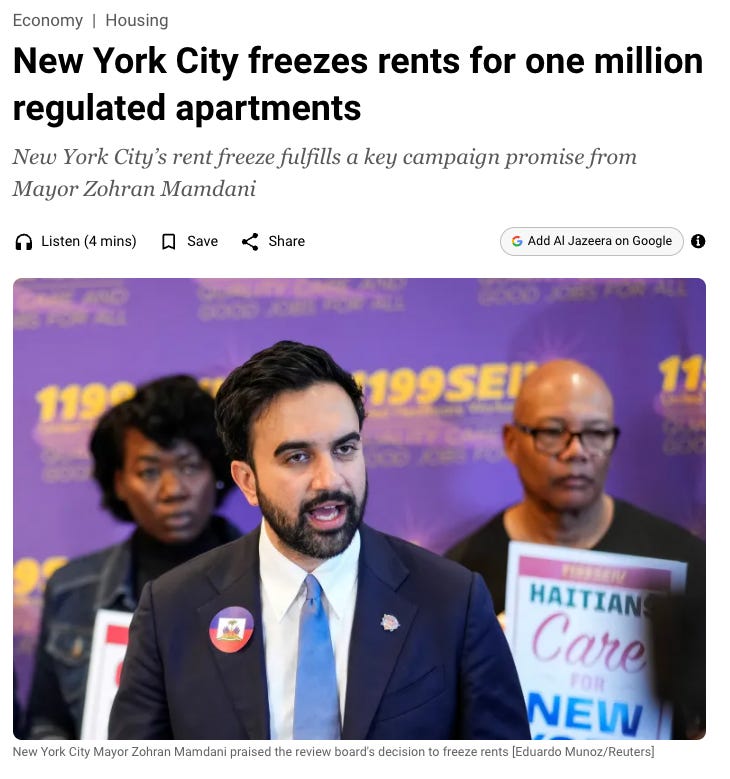
The generational talent of the Democratic Party is down in New York freezing rents to extreme popular support. If people up here in Mass are allowed express the same sentiment in a quantifiable way, such as with a yes or no question put to all voters, the real estate lobby could stand to lose its total regulatory capture of state and local government.
They looked out at their little field mice scurrying around their silly little Statehouse and they were struck by a vision of what would happen if someone else were to swoop in and give one of them a cookie.
It’s interesting to note the spirit of the law used in bad faith to kill this ballot question. Referred to as Article 48, the SJC pulled out a few specific lines in their decision: “The people for their own protection have provided that the initiative shall not be employed with respect to certain matters” because “[s]ome matters are naturally unsuitable for popular lawmaking.”
There is a way of reading this passage, looking at how it was just applied, as an attempt to define housing writ large as such an “unsuitable”matter. Like a religion, the free market cannot be put to the test of popular support. For our own protection, the argument follows.
But how does all this relate to the frontier?
Smith writes:
Whereas the myth of the frontier is an invention that rationalizes the violence of gentrification and displacement, the everyday frontier on which the myth is hung is the stark product of entrepreneurial exploitation. Thus whatever its visceral social and cultural reality, the frontier language camouflages a raw economic reality. Areas that were once sharply redlined by banks and other financial institutions were sharply “greenlined” in the 1980s.
The frontier was, and remains, a construct for prying open new financial markets. Like everything else it has simply become more abstract, as an idea, as a financial instrument, as a set of settler colonial practices. But its logic, its goals, its outcomes remain the same. Westward expansion never stopped, it just stopped moving west, stopped moving in one concise direction at all, and instead it felt around for the many micro-frontiers in the interior. The “free real estate” of manifest destiny became the “cheap real estate” of the “inner city.” The frontiersman became the free market fundamentalist. The pioneer became the landlord. The Indian became the drug dealer, the thug, the inner city youth, the welfare queen, the criminal, the drug user, the unhoused person. The cowboy, the cop. The trail of tears to mass incarceration. The reform schools to the school-to-prison pipeline.
This new and abstracted frontier is one that the financial elite can open and close at will, loading up new frontiers like fresh maps in The Sims.
The perverse rationality of real estate capitalism means that building owners and developers garner a double reward for milking properties and destroying buildings. First, they pocket the money that should have gone to repairs and upkeep; second, having effectively destroyed the building and established a rent gap, they have produced for themselves the conditions and opportunity for a whole new round of capital reinvestment.
This is what city officials mean when they gloat about Worcester being “on the map.” The only reason it’s “on the map” is because it was left off the map for enough time to create the undervalued property needed to extract value from putting it on the map. It was through no fault of its own that Worcester was taken off the map, and it is likewise on the map again for reasons that have nothing to do with the city’s power elite or the decisions they’ve made, other than their total submission to the logic of gentrification, which is entirely unremarkable–the stock standard approach to municipal government for the last few decades at least. The process is overseen, managed, and executed elsewhere, by people for whom there is almost no democratic accountability. They can be sued, and they have in recent memory, but that’s about it. Truly remarkable city leadership, on the other hand, would be shown if local leaders spoke plainly about how the thing works, first of all, and second of all used the new “on the map” reality as leverage to negotiate more revenue and workforce housing.
Instead, we operate nearly exclusively on the premise that if we don’t fully bend over backward we’ll scare the capital off. This is good for the real estate industry, and good for the city officials who leave government to work in the real estate industry, like the two city managers before Eric Batista have. (Where do we think he’ll end up? Webster Five? Trinity Financial? Should we get a pool going?!)
At the time Smith wrote his book, gentrification was a nascent phenomenon, hitting neighborhoods like New York’s Lower East Side and its analog in other global cities, places that are now the almost thoroughly sanitized and effectively gated domains of an elite caste: where they park their capital and, for a time, their children. In the two decades since Smith wrote the book, the theory has borne out. Cities like Worcester have patiently waited their turn, quietly greasing the rails with “opportunity zones” and other such deregulatory schemes, and now the frontier pried open in the 90s in the first tier cities is fully “civilized,” the second tier cities of the 2000s have just about reached full extraction (Boston), and now it’s the third and fourth tier cities like Worcester who are next, either being put on the map or desperately scratching for position. Provincial backwaters neglected by capital for so many decades, they happily roll over at the prospect of “attracting” it, and fear, desperately, the thought of turning it away.
Joe Petty’s uncharacteristically hard and public stance against rent control is a sterling example of this: how he seemed to hardly bother concealing his relationship with the real estate lobby’s opposition campaign, allowing them to put their words directly into his mouth and under his byline in the newspaper. How he happily laundered their logic as common sense... the only available choice.
The lawsuit that led to rent control ouster from the ballot was filed in February, by four plaintiffs handpicked by the real estate lobby, as is made clear by the reams of “amicus briefs” (the legal equivalent of a “letter of support” type document) submitted by a rogues gallery of real estate industry organizations. The Pioneer New England Legal Foundation,
MassLandlords, Inc, Greater Boston Chamber of Commerce, National Association of Realtors, the good old fashion U.S. Chamber of Commerce, etc etc. even the California apartment association had to weigh in. had to check whether they were a landlord group or tenant group, very much a landlord group. Sheesh
Scrolling through the list, on the hunt as always for the “Worcester connection,” one of these documents caught my eye: “amicus brief filed for Millbury National Bank by attorney Kevin J. Powers.”
And boy oh boy am I glad I took the time to read it. It was what we like to call a “good pull.” There’s one section in particular that ties the whole proverbial room together. But we need a bit of setup to understand why.
Number one: Millbury National was the only bank to directly file their own brief. Not a stretch to think banking executives had a hand in crafting other briefs. But it is a noteworthy fact that this one small bank has its own brief in this case.
Number two noteworthy fact: Millbury National Bank’s brief was prepared and paid for by Mass Landlords, INC., an organization that also filed their own brief. “This brief is funded wholly by MassLandlords, Inc., which has also submitted a separate amicus curiae brief in its own name.” The reason for filing their own, rather than including their input in the MassLandlords brief, is chalked up to a scheduling issue. But, they note, “Millbury National Bank would not have been able to promptly retain counsel without the financial assistance of MassLandlords, Inc.” A worrying thing to hear a bank say, no matter how small.
The overall argument presented by Mass Landlords via and/or on behalf of Millbury National in the 42-page document is that small community banks need small community landlords to demonstrate they will increase rents over time in order to write mortgages for them. This is also a notable and rather grim fact, if true. Big “if.” But still, it’s worth flagging for the underlying point that the banks control the landlords in many cases, and in ways that are little known outside the industry.
Millbury National’s financial future depends on the outcome of 9 this case. Rent control would have devastating effects on Millbury National, its ability to continue to service loans, its borrowers, and its borrowers’ ability to be successful landlords.
So now, with all that in mind, let’s read one of the anecdotes included in the brief to illustrate the bank’s hardship in a theoretical world where renters have some protections.
The Petition jeopardizes loans predicated upon renters leaving and rents increasing between tenants. Millbury National has issued a loan secured by twelve rental units—in the form of three four-family Worcester properties—the rents of which must increase as tenants leave. The borrower is a Worcester police officer. The units are now renting well below market rates, and the borrower plans to increase rents for those units, but will maintain below-market rents for long-term tenants who 18 remain in their units. Millbury National’s loan was not made on the basis of current rents alone; instead, Millbury National entered into the agreement on the assumption that the borrower will be able to quickly raise the rent to market rate as each legacy tenant departs. (”The net cash after debt on these twelve units total $30,000, pro
A police officer who owns three four-unit rental properties? Sounds a lot like our old friend Anthony Petrone!
More interestingly, it isn’t. Petrone financed his four-unit rentals through Unibank or some other one (I suffer from Bank Blindness). That means there’s another Worcester police officer who owns at least three rentals of the four-unit variety, which are decidedly less common than three units.
It’s theoretically possible to figure out who this other officer is, but it would be annoying and time consuming and it’s beside the point.
The point is the loans written to this police officer are contingent on their ability to “quickly raise the rents” once legacy tenants move out. What happens if legacy tenants have no plans of moving out goes unstated. But do we really need to state it?
Up to and including a no-fault eviction order, landlords have a swiss army knife of tactics to annoy, cajole, force a renter out of their unit. Police officers are uniquely suited to this work. Indeed, for the financiers of the microfrontiers of urban gentrification, the “cop who is also a landlord” is the ideal frontiersman. Who better to carry out the dirty work of displacement than those who already do it, in slightly different ways, as an occupation. Not only do they have the ability to threaten and intimidate with more oomf than your average mon-n-pop, they are deeply enmeshed in the byzantine world of city workers, sheriff’s deputies, cops, and housing court staff that carry out evictions. They are among the most likely people to be let in on the “tricks of the trade” as it were. And the least likely people to be kept in check by what authorities there are watching out for abusive landlords–if there are any at all, an open question in my opinion.
Of course the city council could and should be that authority, but remember that Kate Toomey was able to get the entire city to change course on a mundane sprinkler ordinance that would have affected landlords of four to eight unit buildings like Anthony Petrone, who happens to be one of her police union handlers. She did so without being able to explain why publicly–it was all winks and nods and wrapped up in the overall project of dicking down on progressives. The most cartoonish surfacing I can remember of the sort of low-grade corruption that we can trust to be humming along at all times in the background.
While outside the scope of this particular post, it would be worthwhile–perhaps a future project for a slow week–to cross reference a few databases to suss out how many Worcester police officers are landlords. Far as police officers go, Petrone’s a rare breed. More of a politician than a cop, savvy enough to secure the most powerful and least democratic political position in the city, as head of one of the three police unions.
That there’s another officer out there who’s vested in what the suits would call our “naturally occurring affordable housing”–the polite way to say this is
“being a slumlord”–raises the possibility that more cops than you think are spending those six digit overtime earnings on down payments.
Writing this I returned to the images scarred in my brain from “Blood Meridian,” the most accurate (I would know) fictional portrayal of westward expansion in how thoroughly dismal and disgusting it is. And there’s a line from it that sends chills down my spine and especially so because the real life man Cormac McCarthy based the book on is buried in Worcester and I want to leave it here to chew on as we think about the way the American frontier has cycled through history, iteratively and abstractly, but has never gone anywhere, in fact has only come in closer to home.
“You can find meanies in the least of creatures, but when God made man the Devil was at his elbow. A creature that can do anything. Make a machine. And a machine to make the machine. And evil that can run itself a thousand years, no need to tend it.”
Odds and Ends
If you made it this far you must like what’s going on here! Please help me keep it going if you can.
Subscribe / Tips / Merch Store
Related to the main post today, there’s a Worcester mention in a really good Boston Globe Spotlight investigation into MassDevelopment that came out a few days ago. The piece documents how a few landlords and an official at MassDevelopment seemingly conspired to bilk the state for work they never did, mostly on low income rental properties. Like so:
Jenkins, who lives on the second floor of the three-family in Worcester, said his unit has hardly been improved. While the first- and third-floor units are in better shape, the only occupants in the last three years have been squatters, Jenkins said.
Worcester officials had given Acquah a separate grant of $134,750 to fix up the triple-decker. The city now wants its money back because of his failures; the building was sold at a foreclosure auction in late March.
“It is definitely disappointing seeing the units not come to fruition, and seeing that opportunity not delivered to Worcester families that need affordable housing,” said Peter Dunn, the city’s chief development officer.
In both Pittsfield and Worcester, officials expressed concerns late in the process about whether the apartments will be able to be rented to people with Section 8 vouchers because of their condition, a frustrating outcome for a program that aims to help low-income residents.
A little something special for the musical dessert this week. Sturgil Simpson put out a record a few weeks ago, under the moniker Johnny Blue Sky & The Dark Clouds, called Mutiny After Midnight, and he took the remarkable step of pulling all of it from streaming. So of course I bought a cassette and of course, audio geek that I am, I took a recording of the cassette and made an Mp3 version for playing it on my upcoming trip to Virginia. Here’s the first track. It absolutely rips. It’s called “Make America Fuck Again” how could it not rip?! Paid subscribers can find the whole record here via the same password I used for the merch discount code. And if you’re not a paid subscriber well buddy here’s a little deal.
This is a gift for friends by the way in case anyone from Warner Brothers’ legal department is reading. All Subscribers Are Friends (ASAB). Everyone else reading this let’s just keep it between us ok? The ASAB Compact.
Have a good week everyone see you when I get back!
According to Wikipedia, while Chamberlain died in Worcester, he's buried in Cambridge at Mt. Auburn Cemetery. See at the bottom of the article:
"Chamberlain died on November 10, 1908, in Worcester, Massachusetts, and was buried in Mount Auburn Cemetery.[2]"
https://en.wikipedia.org/wiki/Samuel_Chamberlain