

I know I said I’d have this out on Sunday but what you have to understand is that during the summer Sunday and Monday are the same day—a super day, like Friday and Saturday but sort of the opposite in every way.
Thanks to everyone who came out on Saturday it was a nice little time! What follows is what I’d planned on delivering as a speech, before realizing there’s no way I’d be able to get through the whole thing with our self-appointed DJ on the third floor of a nearby triple decker playing DMX from his porch at a volume you simply wouldn’t believe.
As I said in the short tease of this report last post, survival, for a local journalism outfit such as this one—in this Internet 4.0 hellscape, this economy, this world—is success. We here at Worcester Sucks have survived and will survive. For a long time if we play our cards right. And even if we don’t—because who really ever does? We’re not going anywhere any time soon. Much to the chagrin of the haters and the losers.
Survival in local journalism is not only success, it’s bucking the trend, beating the odds. This world is one that despises the local journalist. A local journalist who takes the mandate of afflicting the comfortable seriously? Even worse. This world wants all local journalists gone but especially the ones who don’t dutifully rewrite the press releases, slot themselves into the public relations machine informally before making it formal, inevitably leaving the profession for an overt public relations gig, usually after a few short years ‘in the shit,’ having done essentially that very thing their entire time as a reporter.
This world doesn’t even want those journalists, but it especially does not want the journalists who resist the public relations current, who try to do good work with the time and energy they have to do it, who get off on the negative reinforcement of a power elite who despise them, who approach the work with an actual analysis, and respect that analysis enough to be honest about it, who will not compromise on the matter of the truth, will not be made to say ‘uncle.’
The opportunity I and my growing team have had over the past five years, heading into our sixth, is a rare and beautiful gift and it is thanks to the hundreds of you who’ve chipped in to make it happen.
Times are tough right now and I can’t blame any of you for dropping off. Here’s a deal to get some new people over into the light.
Subscribe / Tips / Merch Store
Consider this: The 2026 Local Journalist Index from Muck Rack and Rebuild Local News found that there’s been an 81 percent decline in working local journalists across the country since 2002.
Where there were five local journalists, there is now one. Across the board. And in many places it’s worse, Worcester being one of them. Correlation does not imply causation in most cases but the totality of the evidence here shows local news to be a clear victim of the the War On Terror and its redefining of American life over the past twenty five years. The polar opposite of what it did for the local police departments…Really makes you go hmmm if you sit with it for a few minutes. Perhaps we’ve been headed down the road we’ve all just suddenly realized we’re on for quite some time actually.
The decline in local news is often regrettably cast as a rural problem. Big non-profit programs like Report For America are likely to blame for the misconception. The study found urban and suburban counties to be just as lacking. “The local reporting capacity was nearly universal.” Approximately 70 percent of counties fall below a national average of 7.8 LJE per 100,000, an average they described as “already anemic.” Worcester is one of those counties, sitting at a shoddy 6.8 per 100,000 working local journalists. Back of the napkin math, Worcester as a city would appear to be lower still. The national average, applied to Worcester’s population, would mean 16 local journalists.
Telegram: 5
Masslive: 3
Worcester Sucks: 2 (me and all the part timers put together)
The Worcester Guardian: 1
This Week In Worcester: 2
Worcester Business Journal: 1***** (updated at 9 p.m. Monday I knew I was missing someone. My b Eric.)
Total: 13
They use the term “local journalist equivalents” as a catch-all for the many new forms reporting has taken in recent years. The term encompasses your traditional print reporters, online outfits like MassLive, local TV stations, local radio stations, newsletters like ours, podcasts like ours. From the study:
The new study puts that at 7.8 Local Journalist Equivalents per 100,000 residents, an 81% decline since 2002, when there were about 40 journalists per 100,000. Last year, we found 8.2 LJEs per 100,000.
More obvious: states with fewer local journalists suffered from higher costs of municipal borrowing. According to the report, this dynamic in the data reaffirms studies showing that news deserts raise such costs by at least $1.1 billion across the U.S. annually. As was made clear though never overtly stated during the budget hearings of the past few months, Worcester City Hall has basically maxed out its credit lines. Two or three city officials made two or three passing references to the “negative impact on our bond rating” that any more borrowing, now or in the future, would have.
While I don’t know much about it, there’s something called a “civic participation index.” The study shows that counties with higher concentrations of local journalists core better, which is intuitive.
This is the core of our work. The philosophy underpinning the newsletter since I started it is that the community suffers from a lack of substantive reporting: work that gives readers a way in to the byzantine world of the municipality, that illustrates reality versus possibility. One of my calling card lines over the years, only having gotten more true, is that the municipality is the last arena in which “democracy” as an ideal could conceivably exist. The job, then, becomes illustrating how it currently doesn’t, and I think my coverage of the city council’s budget review process did a good job of that.
The “reporter reduction,” nationwide, is hardest felt in the area of education…
In our sweep of websites, nearly 77% of U.S. counties produced zero education articles mentioning a local community during those three months. Some 76% had no local articles about health.
This underscores the perhaps little understood significance of what Aislinn Doyle does with WPS In Brief, a fantastic and necessary addition to the newsletter, one I have been grateful to edit, written by someone who has really emerged as a true talent—the genuine article of a local education reporter, despite, or because of, her insistence on saying she isn’t that, a reporter.
Conversely coverage of “crime”—as isolated incidents, usually in the form of cosmetically altered press releases, and not of the workings of the criminal justice system as a whole, as we try to do—has increased.
…it appears that counties with less local news put even more emphasis on crime than on other civically important topics.
Stuff like “Worcester woman reported yelling in Leominster arrested on warrant, charged with possessing heroin & crack,” a story up recently from News Link Live, as opposed to our recent work on the county sheriff’s scheme to use a non-profit shell corporation to tuck away fees collected from various types of process serving including evictions. The former, I can say from my years of doing them, took the reporter a half hour or so. The latter, I can say because I did it, took a few full days.
This is bad bad bad for community. It has the “Law and Order” effect: scaring people to death about the world, their neighbors, their communities. Isolating them via a warped perception of dangerousness.
This narrativization of fear then fuels the swings of property values needed by the real estate industry to create the “economically depressed” areas they can then “revitalize.” It’s in the best interest of the massive hedge funds carrying out most of the development around the country that local news spits out as many crime stories as possible, creating the perception of a “hard scrabble” area that the developers can then “put on the map.” The “on the map” stories, it just so happens, are about as easy to write as the crime stories. Good reporting, on the other hand, makes this real estate game harder. A conspiracy theorist would do well to look into how vested media companies like Gannett are in real estate interests. Could it be the companies that buy up local news outlets in bulk, then systematically lay off its staffers, starting with the ones who have the most institutional knowledge—your veteran reporters, assignment editors and copy desks—have an interest in creating the conditions where a newsroom can really only churn out press release rewrites, be it from the cops or the local chamber of commerce?
Other areas of coverage that suffer: health, environmental issues, and transportation.
Like reporting on the criminal justice system versus “crime,” these are subjects that take a certain expertise to report on with clarity—both over the subject matter and in the craft of local reporting. It is one thing to know a subject like, say, traffic calming, and another thing entirely to reach people who do not, to illustrate the hinge points and contested terrain and the stakes, the problem with the reality and the possible solution, the barriers to getting there, and, most importantly and most often neglected, what people can do to help—how they can slot themselves into actual participation, and in that way reclaim a sense of citizenry—of selfhood in a community wider than immediate family or workplace—in a world that would otherwise have you isolated and atomized actors in a world that appears before you as a spectacle to consume rather than a reality to shape. The project of awakening a broad consciousness of the spectacle as a broad and diffuse panopticon, disabusing people of their agency before they even know it, is in my opinion the struggle of our time. Real life, real community, versus the spectacle. The municipality is perhaps the best-suited arena for engaging in this struggle, because it’s inseparable from “the city,” a polity older and stronger and more durable than anything the spectacle has produced, and also frankly because it’s fuckin pretty boring most of the time. The spectacle has a hard time with “boring.” That the spectacle can’t find much in the municipality to extract and feed a consumptive audience the way it can in the nation’s capital is our greatest strength. What the spectacle finds too difficult to turn into a mass consumer product is the same thing that ties real community around real political agency. There is nothing salacious about pedestrian safety improvements or updating the city’s zoning map. They are, however, things that directly improve life in a city, and require sustained pressure from an engaged local citizenry to coerce a municipality into moving on them.
To demonstrate that a city can beat back the spectacle and awaken its people out of a consumerist spell is a profoundly radical and important act. Every time we try, even if it looks like we failed, as is the case with the last election, we get closer.
With all that in mind, there’s a factoid I found very interesting: the study makes a direct link between low rates of LJEs and high rates of loneliness, especially in rural counties.
It’s worth thinking very hard, I think, about loneliness and local journalism. It’s not something you hear every day and may make most people scratch their heads. But what I’ve found in my decade or so doing it is that local journalism done right can fan the fire of a community awakening to itself, that in some rare and magic moments it can be the thing that lights it.
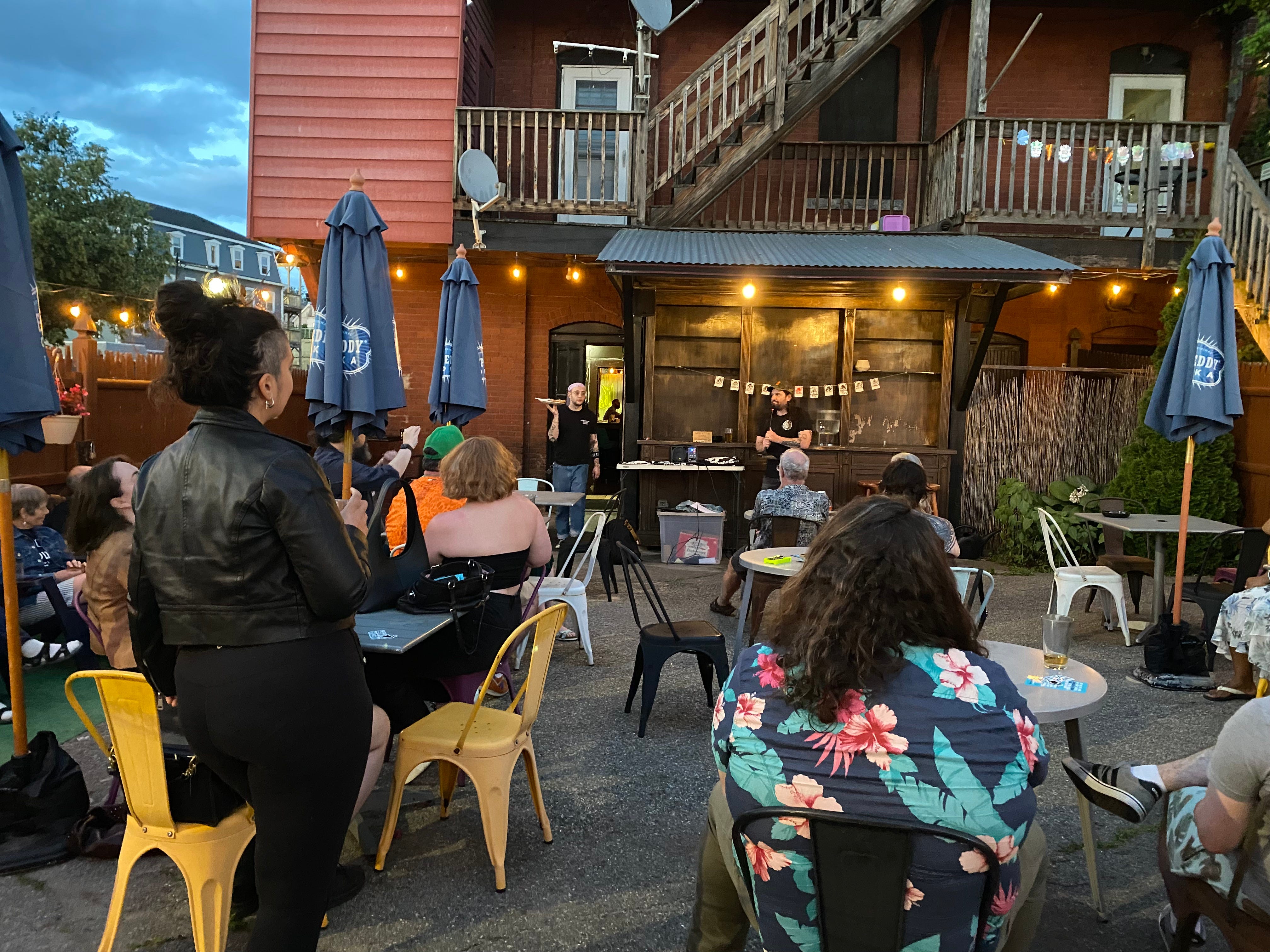
A small and admittedly self serving example was right on the patio of Steel & Wire Saturday night. A group of people that would have otherwise been total strangers if not for their reading, listening, interacting with my silly little blog. And who are now aware of Free Press Action and the great work they’re doing in Massachusetts, courtesy Sarah Stone, an organizer with the organization working on a campaign to replicate the New Jersey Civic Information Consortium here, with the help of the state legislature. She spoke a little bit, hung out, met some good people in Worcester to know… the more connected Worcester media is with world outside the shadow of The Dome the better. That’s what I say.
Ok so now with the appropriate context, let’s look at a scary graph:
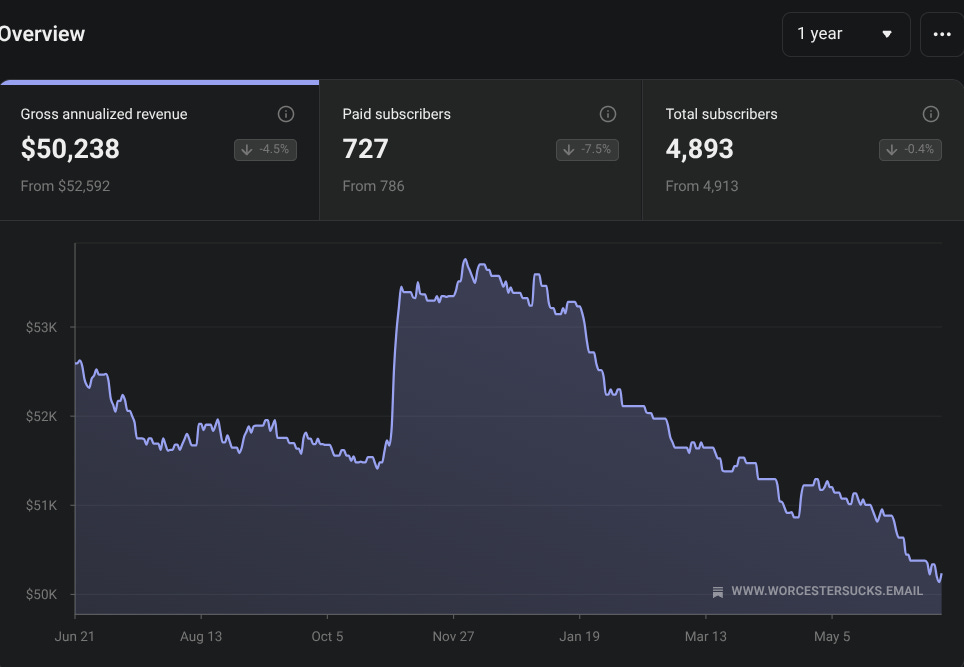
Yoikes! This makes me panicky to the point I look around the room while my Substack dashboard is loading so I can skip to a different menu without actually looking at it.
This is the year on the whole for “gross annualized revenue,” meaning how much you’d make in a year if your subscribers stayed static to that point in time. Last June, that figure was about $52,500. This June, it has dropped to $50,200.
Paid subscribers are down from a high of 786 to where they currently are, 727, and I have it in my head that if the number hits 600, I have to get my ass on LinkedIn. Not to say the newsletter will disappear or anything, but there will reach a time if this trend continues that I can no longer treat it as a “full time job.” I think we’ve got at least a year of runway, though, before I’m really there.
And it could very well turn around. Hope it does! But I’m not naive enough to get by on faith. It could well be that the “Substack moment” reached its zenith a few years ago and is now headed to the dustbin of history like so many Internet trends before it. Remember Medium? Remember Blogspot? Remember the confessional essay moment around outlets like “Thought Catalog”?
My goal is to cement Worcester Sucks into a durable institution, and that means being clear-eyed about the lifespan of media trends, and how they relate to the “see what sticks” economics of venture capital in Sillicon Valley, where the runway of seed capital often surreptitiously dries and everyone involved in a given project quickly jumps to some other ship, letting the current one sink. This could happen to Substack tomorrow.
Let’s look at a less scary graph. The “all time” view, 2020 to present, of the same “gross annualized revenue” figure.
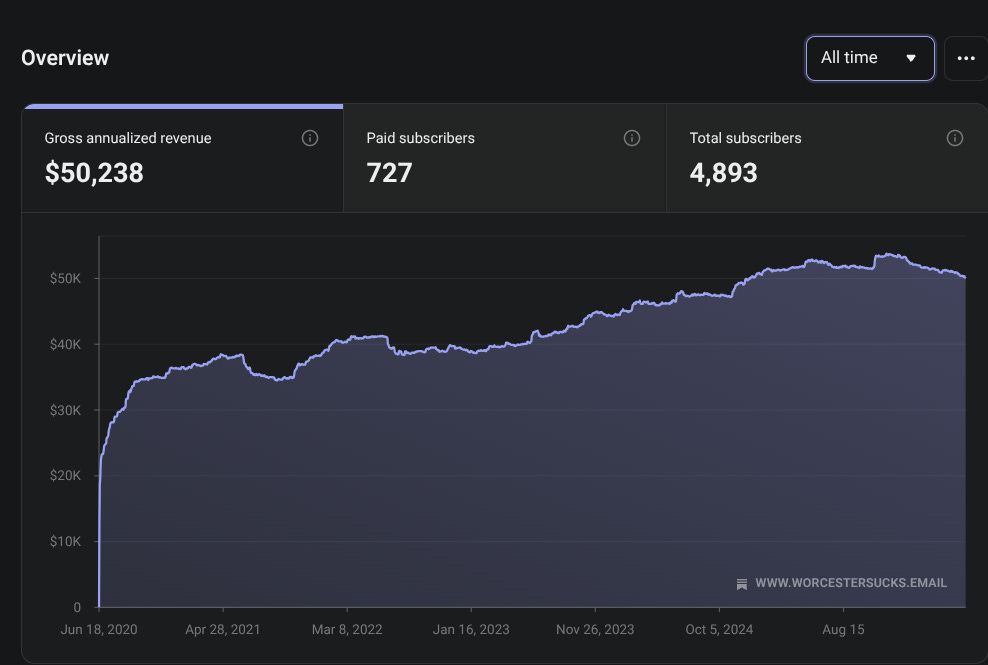
On this graph we can see the current moment more clearly as a natural dip in an overall pattern of stead growth. And I’d love to believe that. I just can’t help but be scared about the Graph 1 interpretation, that the thing is in a tailspin, soon to crash.
One thing we can take from both graphs I think is that we’re not in a boom time, and that the peak I hit last November of 780 paid subscribers is where the newsletter plateaus. The limit of the subscription model for the type of newsletter I run in a media market the size of Worcester.
I don’t make a big deal of this fact because I don’t consider it an accomplishment, but Worcestrer Sucks is in the top 100—I think we hit 67 at one point but don’t quote me—of Substacks in the news category.Globally. Of all the newsletters on Substack that do “news,” not even “local news,” there are only 50-100 at any given time that do better than Worcester Sucks financially.
Now, on the one hand, feather in the cap, sure. I’ll take it as an affirmation we have something uniquely special on our hands with this institution.
On the other hand, though, that fuckin’ sucks, man! To be honest with you, $50,000 is really not a lot of money. I am grateful for it, obviously, and proud of it. But in the grand scheme of things it is a low salary for one person. It is not the foundation on which to build the real newsroom in my heart and in my imagination. The conclusion I’ve arrived at is there’s nowhere further Substack could take Worcester Sucks, that it’s time to part ways and try something different.
That I am among the top earners in the world for news reporters and I struggle to make rent means I serve as a living example of an industry that is not being saved, as Substack executives will say, but rather systematically gigified. Really, it’s a continuation of the slash-and-burn model of Gannett and Alden Global Capital. “Disrupting” the industry really means “destroying” it. It is taking the career path, the labor category, eventually the public memory, of “local news” out of play. Into the dustbin of history.
The direct contribution model has worked for me, will continue to work for me, but it’s in the outlet’s best interest to try and disentangle it from the valences of “tech disruption.” To be clear-eyed about what it is they actually offer and what they actually take.
That’s where we are right now. And I want to talk about what comes next. But first, let’s look at some metrics that have nothing to do with money and are, as far as the journalism itself is concerned, the most important.
Average of all posts since this time last June
Reads: 3,138
Open rate: 42 percent
Monthly web traffic has been steadily growing year over year. In 2025, we hit an average of 65,588 views a month. Up from 56,0173 in 2024 and almost four times better than 2022’s 16,902 average monthly views.
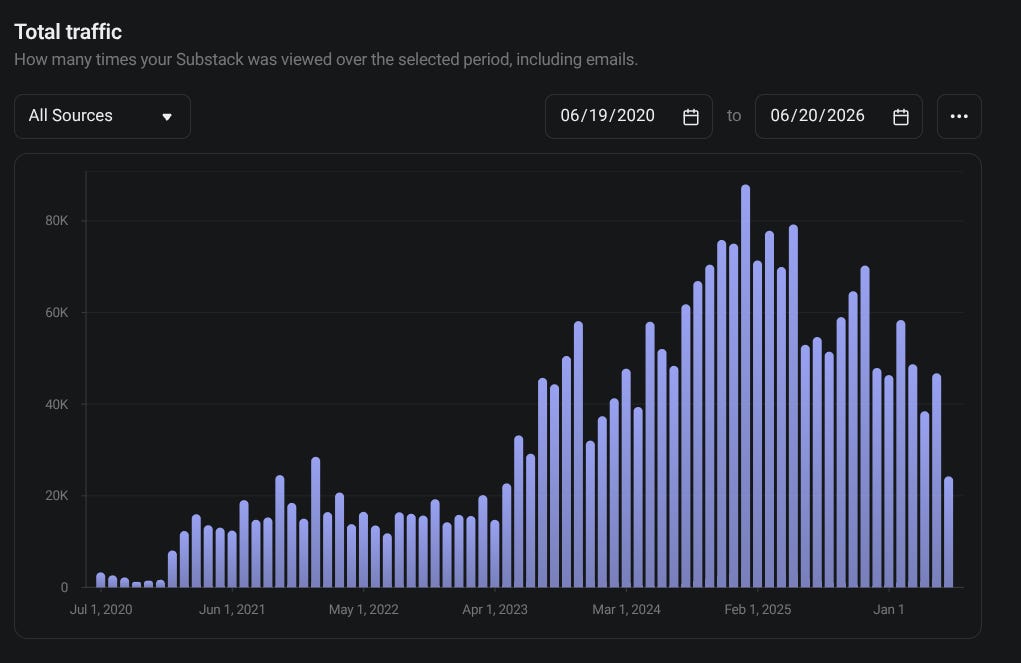
The increase in traffic is due to readership growth and retention, as well as an increase in the volume of posts.
This outlet started as one post a week give or take from me, now we have 1 post a week from me, 1 podcast a week from Chris and I, a post a week from Shaun, about three posts a month from Aislinn, as well as monthly posts from Dani, via Worcester Speaks and Gillian, with their new How Did We Get Here column, and you may hear about it soon but we’ve got a new one in the works as well!
Here are the top posts of the past year, June 2025-June 2026, ranked by views.
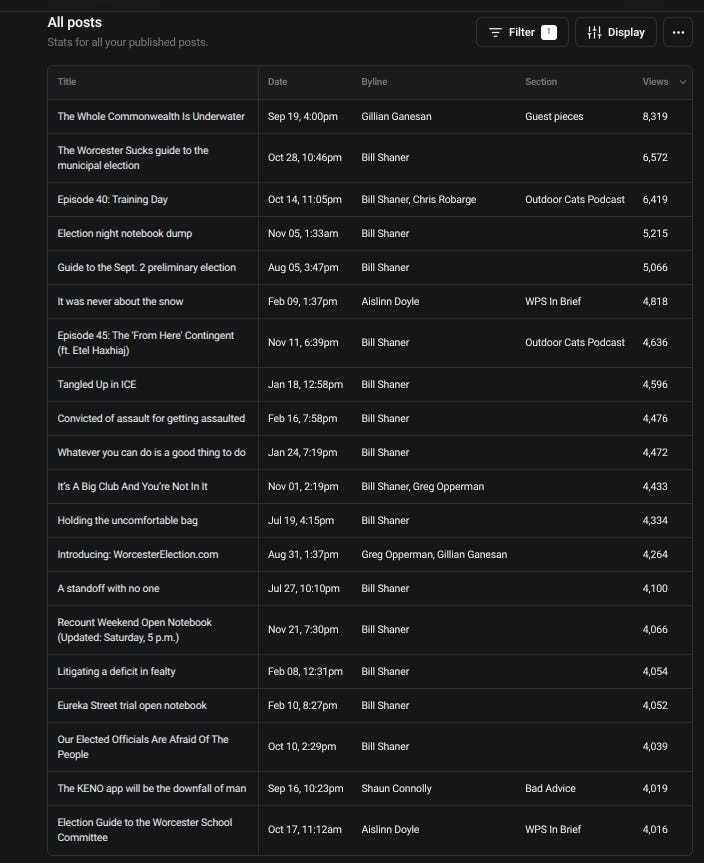
Firsts this year: First live podcast, back in May. New people on board: Dani Killay, Gillian Ganesan, Greg Opperman.
Gillian and Greg’s work on campaign finance data ahead of the election made a huge splash. That work was born out of conversations had at the first Election Squad event last summer, proving that those live events, loosey goosey affairs that didn’t serve much purpose besides getting people the same room, were useful and worthwhile—a novel approach to the sort of community building I talked about earlier, yielding tangible results.
The Instagram is under new management as well. Kelly Cashman has brought a unified aesthetic and consistent posting schedule, turning it into our most important social platform. It has more followers than the newsletter has subscribers and our posts get a lot of reach there. Every time we post a reel it does very well, so I’m trying to build that into my workflow, but no promises. While the Instagram meets people where they are, it doesn’t in and of itself generate revenue.
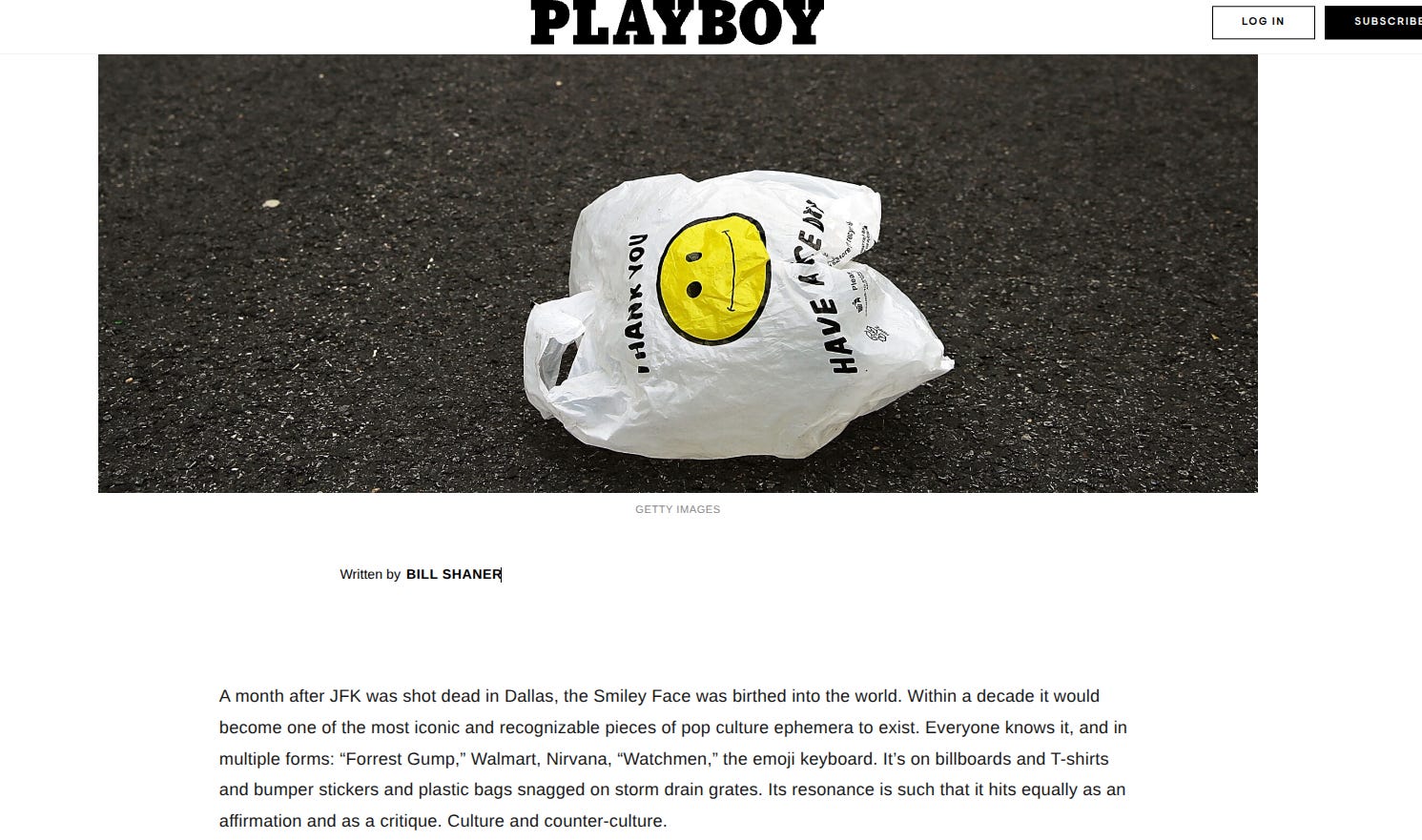
Oh yeah and I got a piece placed in Playboy about the Smiley Face haha. Pursuing more freelance opportunities like this is good for the newsletter as it increases the reach of the brand.
Now, as mentioned, what to do about the audience plateau the data suggests?
Well, I’d be open to any suggestions anyone here might have first of all.

Second of all I think it’s time to move to a better and cheaper and less Silicon Valley-derived and shareholder-beholden hosting service: Ghost.
Ghost is one of two main competitors to Substack in the general “independent newsletter” game. Where Substack aims to provide a social media landscape, akin to something like a mashup of Bluesky, Youtube and Patreon, with a writerly aesthetic and an unaddressed Nazi problem, Ghost has no such ambitions. They are coders who offer well-built, highly customizable and open source software. The main drawback is its lack of a social media-style ecosystem, but our newsletter, given its audience is tied more to a real life place than an Internet “space,” never got much from the Substack ecosystem anyway. By leaving the app, we stand to lose 109 subscribers, six of which are paid. A drop in the bucket.
Here are some websites I like that are hosted by Ghost: Welcome To Hell World, Forever Wars, The Mass Dump.
The difference in the deal is ridiculous. Substack takes 10 percent of every subscription. Ghost charges a flat fee that increases over several tiers as the audience increases. For us it would be about $200 a month.
That means going from $5000 to $1200 in costs annual platform costs, which in turn leaves me $3,800 more to put back into paying local writers for their local stories. A no brainer on that front.
The trade off is there’s no app, and if we want a chat function we’d have to rebuild it elsewhere. The most widely used option is Discord, but man there’s just something about that site that irks me. I just won’t do it.
There are some lingering tech questions I have that have so far delayed the move. The biggest one is how to migrate the podcast without losing the RSS feed. If there’s anyone reading this who knows RSS hosting inside and out please reach out to me I have some very specific questions. Billshaner at substack dot com.
I also want to get people’s feelings on whether we should think about a print product, launching and distributing it through Kickstarter. It could be a nice little revenue source and a way to think about taking on limited local advertising.
The live podcast was well attended and a good time. There is potentially a revenue source in doing more of those events.
And then there’s merch, which I’ve been slacking on lately but is a decent revenue source. Last year it was a few thousand in profit I don’t have the number in front of me. Scaling that part of the operation up slightly is possible, but the prospect of getting it to make even $10,000 a year is pretty slim, and even then it’d be a whole other pretty-much-full-time hustle, either taking my time away from doing journalism or taking all the money it makes and putting it into a “merch guy” type position. So either way there are limits to scale and it’s probably best thought of as a neat little side hustle. On the matter, I’m in the market for a few new designs and I have a few loose ideas. So any artists out there reading this who’d like to draw up a shirt, hit me up!
Otherwise, it’s just about staying the course. Continuing to do what we do with the time and energy afforded by our paid subscribers—that’s you! Or it could be you! For the low low price of $34 for a year if you take me up on the sweet sweet deal I’m offering until July!
Subscribe / Tips / Merch Store
Thanks for reading, anyway. If you believe in what we’re doing find a way to share our work with new people who you think might also get something from it. That’s the one weird trick to this whole thing: what the suits call “word-of-mouth advertising” and what I call giving em somethin’ to talk about.
14 journalists, Bill! I'm not dead yet.
Comments seems like a tough one to solve. Maybe a What's App group for subscribers? Meta will probably make that horrible in the near future, but it seems to be a method that can work for the time being.
And here's to the plateau being a blip on the way to bigger numbers and brighter days.