

Welcome to the third anniversary edition of WPS in Brief! When I published my first post in January 2023, I wasn’t sure who would read it, or whether it would last. But I saw the need for a place to share what I was learning as a parent trying to understand how our schools are governed. Over the years I’ve spent countless hours following meetings, reading documents, and watching decisions. And I’ve tried to translate that work into something useful and readable for you. From the monthly updates and agenda previews to deeper projects like my two-part series on literacy in Worcester or the profile of our new superintendent, Brian Allen, I am proud of this work. WPS in Brief is, at its core, an act of care: for our children, for families trying to navigate a complex system, and for a city whose public schools matter deeply to its future.
Thank you to everyone who has read, shared, asked thoughtful questions, or engaged with this work along the way. Your trust over the last three years means more than I can say. And a special thank you to my husband, for the steady encouragement and countless small acts of support that allow me to do this work.
And one last thing before we get into this month’s brief–an op-ed I wrote was published in the Telegram this weekend (here’s a free link), and it’s about two petitions I filed with the school committee on student data and privacy. Give it a read, and if you’re so moved, please email school committee members your thoughts. My petitions are on the agenda for the Teaching, Learning and Student Support meeting this Thursday, January 29 at 5 p.m.
Ok let’s dive into what happened this month, which covers key topics from three school committee meetings.
School Buildings.
The January 22 report of the superintendent focused on facilities and how the district is planning and prioritizing the gargantuan task of getting our school buildings in better shape and maintaining them. A long term plan to improve facilities is one of the strategic plan goals, as many WPS buildings are in desperate need of work, mostly due to deferred maintenance for many, many, years. Chief Financial Officer Sara Consalvo stressed the fundamental shift in the district from being reactive to proactive when it comes to the district’s 57 buildings, 4.6 million square feet of interior space and 1,700 classrooms. Fundamentally, the main catalyst of this shift is increased funding due to the Student Opportunity Act. I cannot stress this enough. The reason that Worcester is able to spend more money on our buildings versus six years ago is because the state of Massachusetts changed to a more equity based funding model (which is still imperfect, but has been incredibly impactful for districts like Worcester).
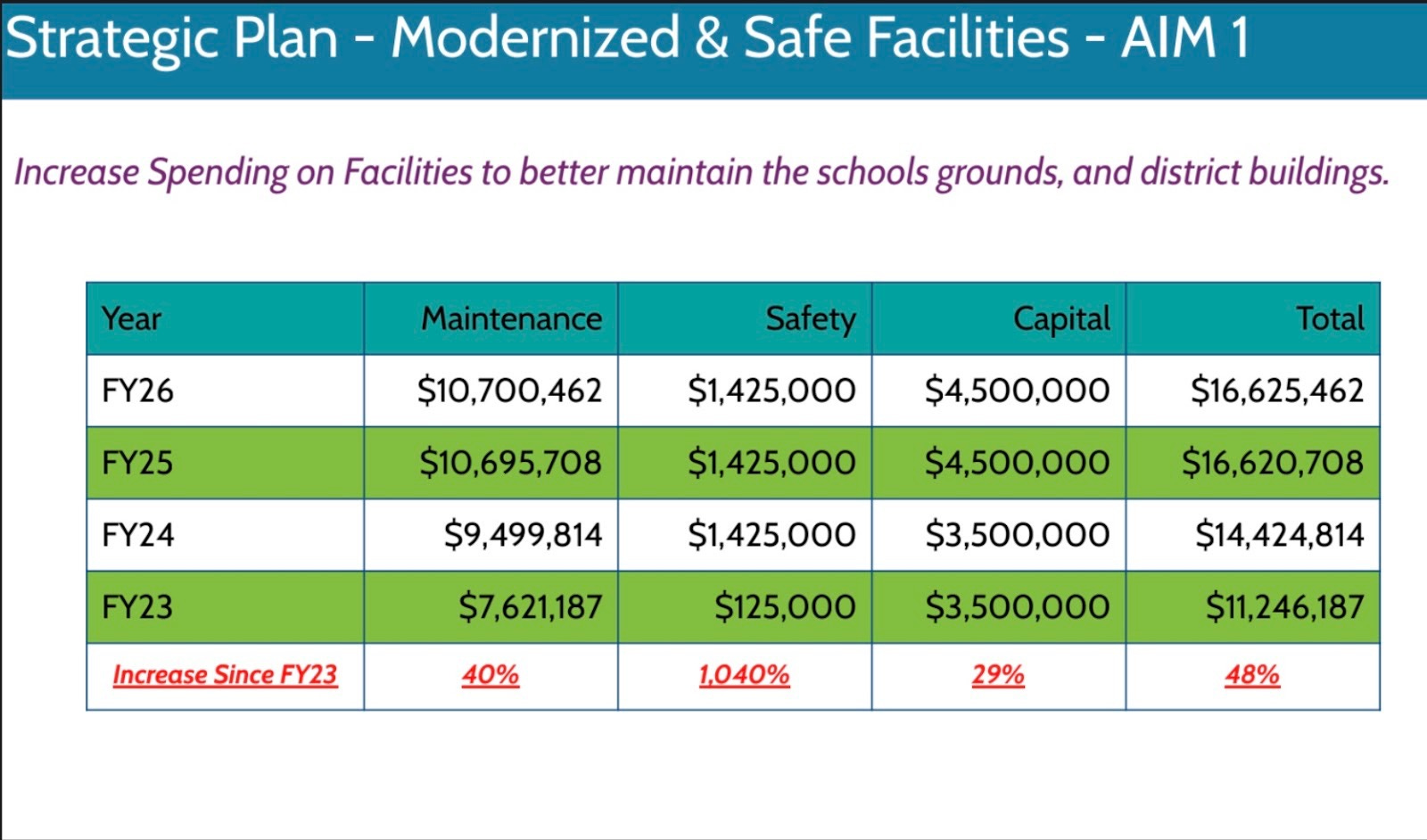
The presentation was an overview of safety priorities, an overview of the five year capital plan, an update on the new Burncoat High/Middle School, and an update on the facilities master plan process, which is a joint effort with the city. According to Consalvo, the district is taking a high-level, strategic approach. “By coordinating our master plan with public facilities, city investments, MSBA partnerships and our school boundary realignment goal we will ensure every building will be utilized at capacity for students and staff” she said. Here are some highlights from the presentation:
Burncoat High (and potentially Burncoat Middle) has entered the feasibility phase of the Massachusetts School Building Authority (MSBA) process, and that phase is expected to last through 2028. The MSBA will then decide whether the middle school can also be replaced since they share mechanical systems (typically the MSBA will not fund two buildings within one district at a time). The projected opening is 2031–32, when current first graders are in 7th grade. Here is the most updated list of the 39-person school building committee appointed by Mayor Petty.
The district completed $1.1 million in classroom door lock and hardware upgrades, establishing a new standard lock type districtwide. Intercom replacement is next, with the goal of standardization.
The district believes that schools should be a hub for the community, and are working to support partnerships to expand opportunities. For example, they are collaborating with YMCA and the Guild of St. Agnes to expand out of school care using a hub model.
The response to repair requests has increased significantly, with 100% response or completion time within 72 hours. The district says this is due to both an increase in funds and improved systems.
Superintendent’s Mid-Year Review.
The superintendent’s January 8 report provided a midyear progress update on his yearly goals. Evaluating the superintendent is, arguably, one of the school committee’s most important responsibilities. Last year, committee members Dianna Biancheria (district C), Maureen Binienda (at-large), and Kathi Roy (district E) voted against accepting then-Superintendent Monárrez’s midyear goals report without offering amendments. This year, those same members voted to accept Allen’s report, despite the goals and progress being largely similar. That contrast is hard to ignore. Let’s look more closely at Allen’s goals:
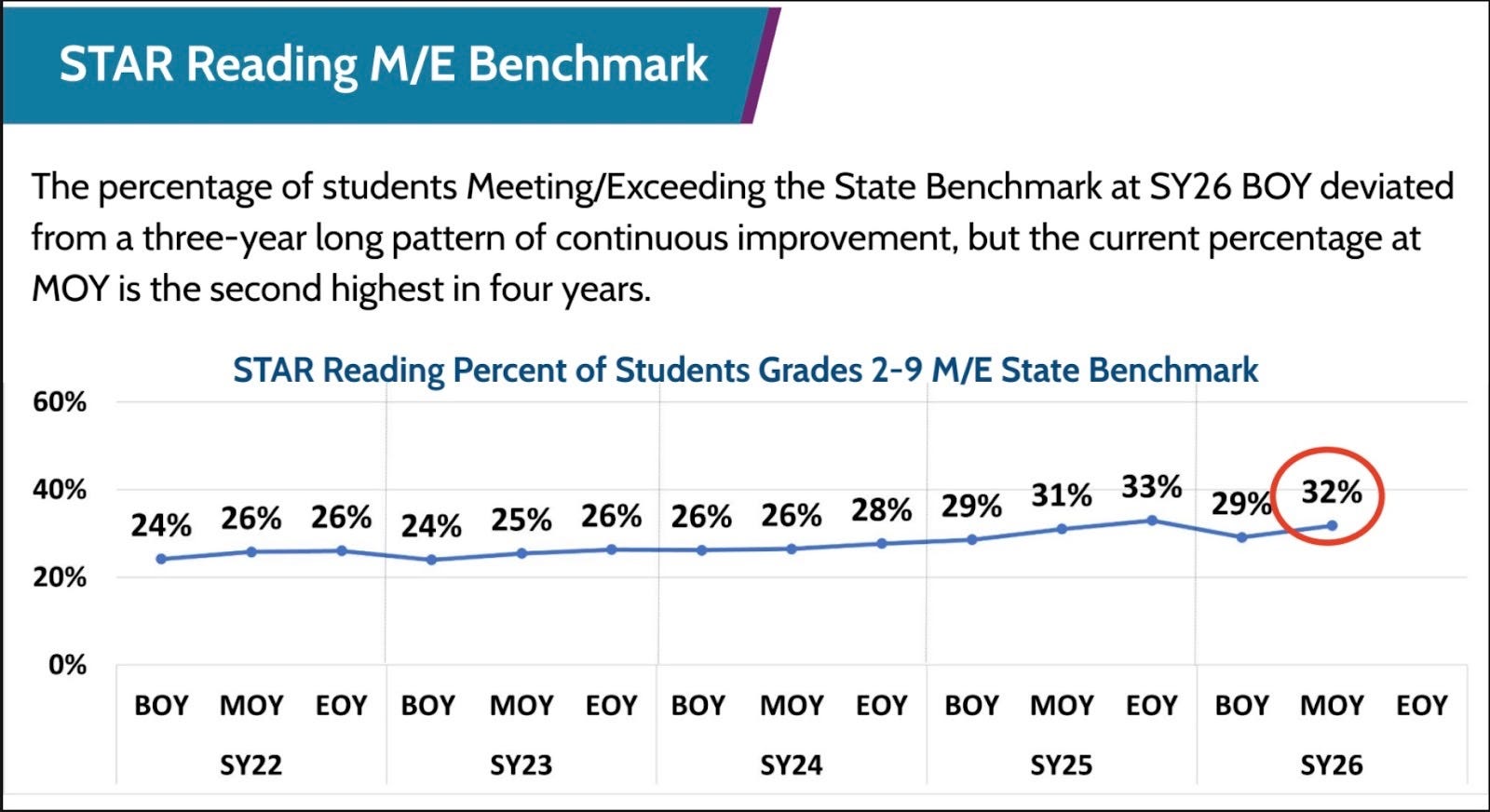
Student Achievement Goals
According to Star assessments1 for grades 2 through 9, reading and math both increased by three percentage points at midyear. Reading remains at its highest midyear level to date, though the district will need an additional four-point gain by the end of the year to meet its target. Math performance is also at its highest level since tracking began.
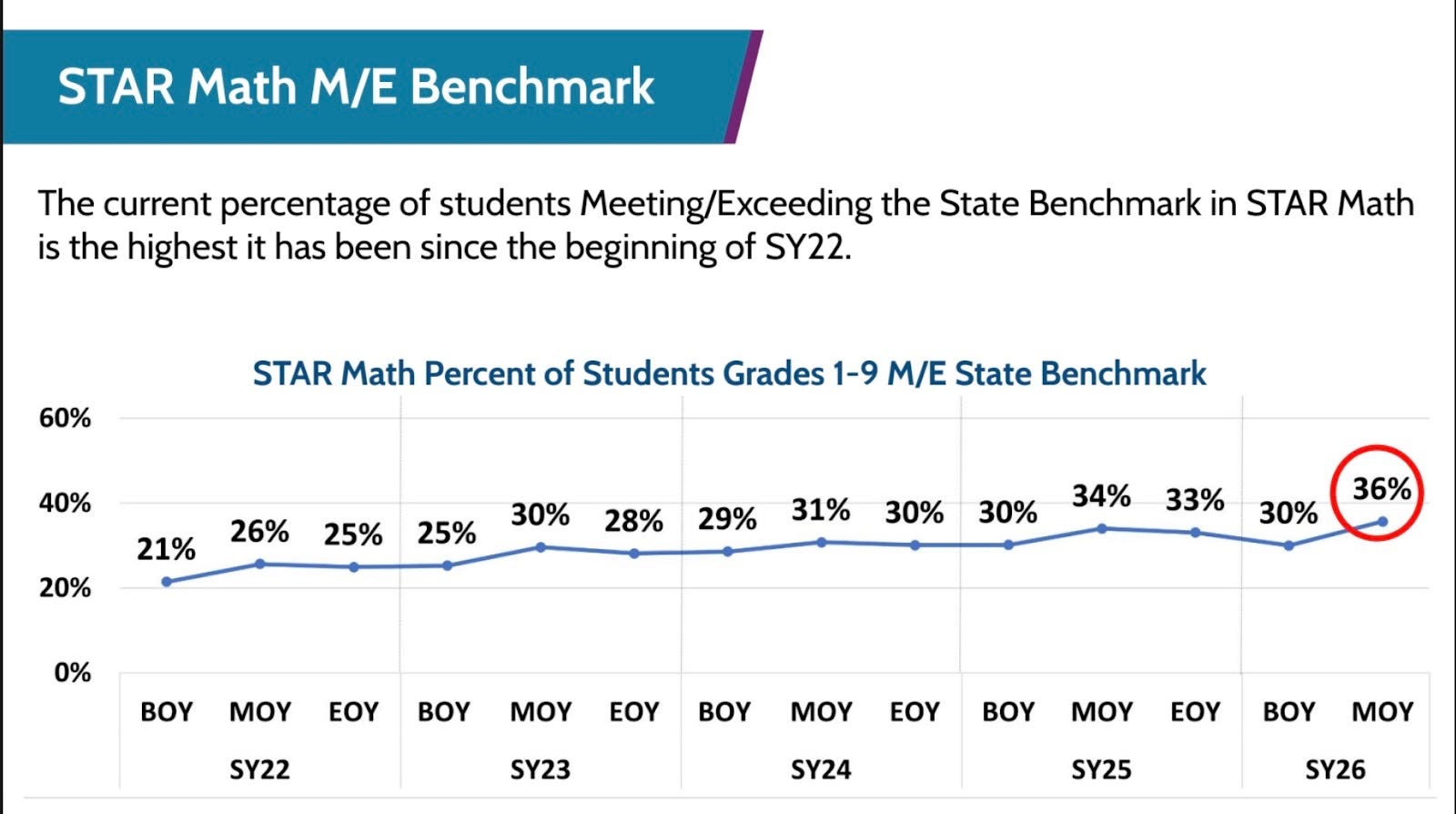
While results typically peak at midyear and dip slightly by year’s end (with no clear explanation why), this year’s gains are notable: math scores are 15 percent higher than when the district began using Star assessments, and the six-point increase from beginning to middle of year is the largest observed so far.
Professional Practice Goals
The district continues to strengthen professional learning communities (PLCs) and implement them with greater fidelity. A new data system now captures feedback after meetings, and the use of PLC structures has steadily increased. Participation by multilingual and special education staff has improved, though it remains an area for growth. Allen emphasized that research consistently shows PLCs are among the most effective strategies for improving student achievement.
District Goals
Communication strategy: Efforts are underway to streamline internal communication, reduce one-off emails, and prevent conflicting messages to staff.
Grow Our Own: The program to recruit WPS students to become WPS teachers has reached capacity with a group of 32 students enrolled, drawn from six high schools across the city.
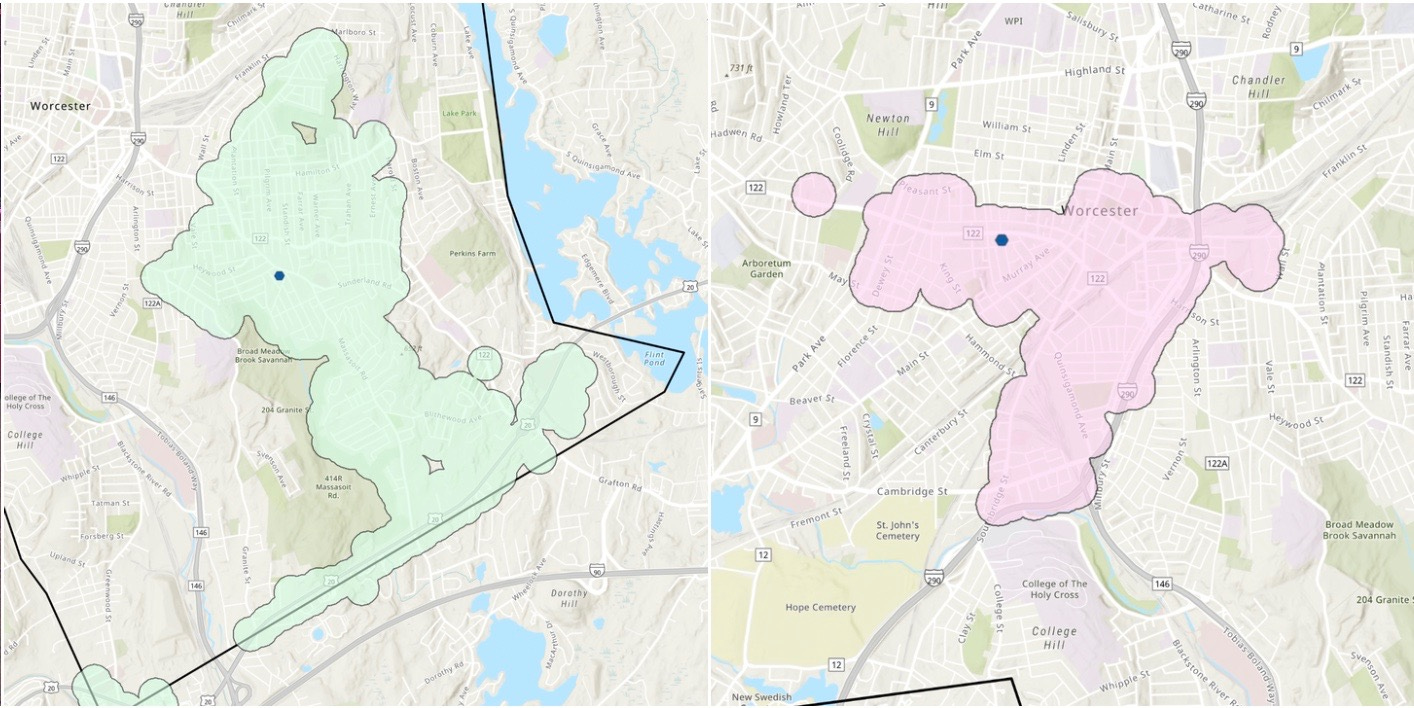
School boundary and quadrant alignment: In his report, Allen cited overcrowding at Belmont, Rice Square, and Chandler Elementary, as well as capacity concerns at Sullivan Middle, Forest Grove, and South High. He also highlighted confusing quadrant feeder patterns (for example, Chandler Elementary students feed into three different middle schools or McGrath students go to Burncoat Middle, despite being on the same campus as Forest Grove). Next steps include scheduling community forums to gather feedback and then developing recommendations for implementation in the 2027-2028 school year.
Which leads us to:
Meeting Moment.
In this meeting moment Superintendent Allen responds to a question from Alex Guardiola (district D) about how the school boundary assignment realignment may impact high school students who may be assigned to a different school than they currently attend, especially if they’re on a sports team or in a club. Allen reiterates that the realignment will mostly impact the elementary schools and he is going to highly recommend that students get “grandfathered in” to their current schools. He also says that could mean it might take 6 to 7 years to alleviate the overcrowded schools. That would take us to the 2033-2034 school year, when fourth graders are entering their senior year of high school. I get that we don’t want to make kids transition too many times, but as a parent whose child was forced to transition to a new school building in first grade, I think it’s manageable for elementary-aged kids, especially if it means expediting equity across the district in classroom sizes. This also isn’t just a redistricting issue. When students move within Worcester, they are required to change schools unless a parent can provide transportation. For those who do not have housing stability, the concern about students’ education being interrupted by moving to another school boundary assignment is a common occurrence in the district already.2
Budget Update.
Every year the school committee votes on the district budget in June, often before the final state budget is known, which can lead to midyear adjustments. This year, charter school and school choice tuition costs came in higher than projected, creating a $2 million gap. To cover it, the city manager allocated free cash, directing $3.8 million to the school department’s general fund for the remainder of the year. This fully closes the gap without cuts and leaves an additional $1.7 million to allocate. The district proposed using the funds for items including a new secondary ESL curriculum, high school graduation costs, classroom furniture, and several staffing additions. For details see my January 8 agenda preview. The school committee voted unanimously to approve the allocations.
New Committees Assignment and New Vice Chair.
Committee assignments were released shortly after I sent my January 8 agenda preview, where I noted that, if based on experience, subcommittee chairs would likely be Jermaine Johnson, Maureen Binienda, and Sue Mailman (vice chairs typically do not also chair subcommittees, which is why I did not include Molly McCullough). I also warned that if Mayor Petty prioritized political allegiance over experience, Binienda and Mailman would be passed over.
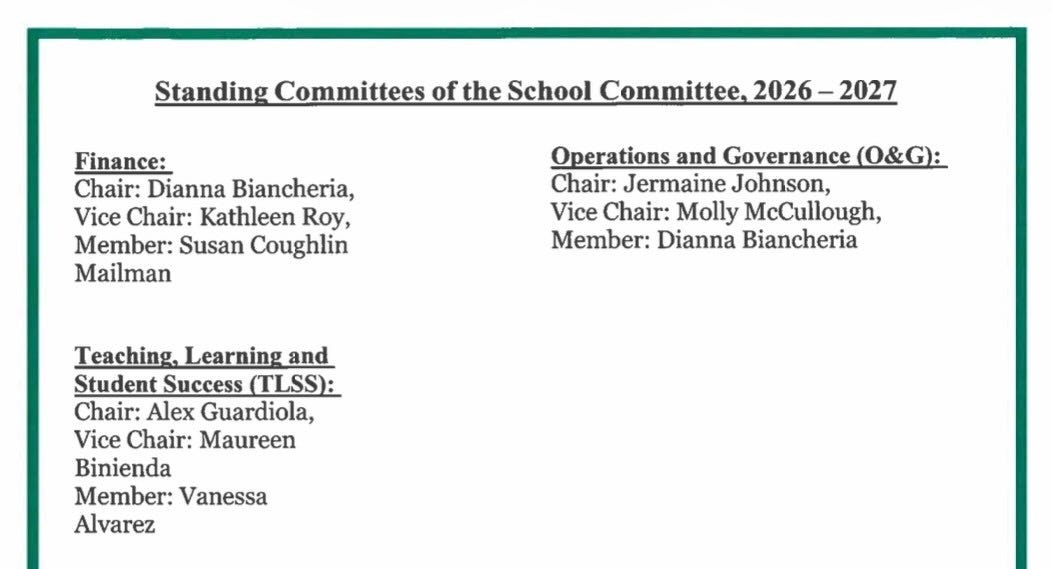
The reality was worse than I expected. Mayor Petty demoted Vanessa Alvarez from vice chair of TLSS, awarded Dianna Biancheria two committee assignments (everyone else received one) and named Biancheria chair of the new Finance Committee. Biancheria’s record raises serious questions about the rationale for that decision: she is frequently late to meetings (including arriving more than 30 minutes late on January 2), has disparaged climate and culture specialists as “glorified bouncers,” delivered an objectively unreasonable evaluation of former Superintendent Rachel Monárrez, and told Brian Allen he “better not screw this up” before voting to appoint him superintendent. These are not leadership behaviors to be rewarded.
At the January 2 meeting, Molly McCullough (district A) was elected vice chair in a 7-2 vote (Vanessa Alvarez and Sue Mailman voted for Mailman, and coincidentally are the only two school committee members who are not chairs or vice chairs of a subcommittee).3 McCullough is the granddaughter of a Worcester mayor and has worked on Joe Petty’s Mayoral campaigns for many years. She is the second longest serving school committee member, after Dianna Biancheria. This is McCullough’s second time being vice chair (she was vice chair in 2019, although the vice chair position back then was not the same as it is now.) The main job of the vice chair is working with the clerk and the superintendent to assemble the school committee agenda and to make sure the committee meets with the Student Advisory Council.
Roosevelt Parking Ban.
At public comment at the January 22 meeting, two grandparents who pickup their grandchildren every day came to speak against the Roosevelt Parking ban approved by the city council. In response to questions asked by Jermaine Johnson (district F) and Sue Mailman (at-large), Superintendent Allen emphasized that the district knew from the outset that the new parking lot would alleviate some of the issue, but not address the whole issue.4 One positive is that the parking lot work separated school buses from car traffic, which was an issue because once the bus lights were deployed cars couldn’t pass them. Now the challenge is how to utilize space on school grounds to get cars off the street. There are, on average, about 170 cars that pick up students every day, about the length of 7 soccer fields. Allen said he believes everyone is working quite hard to find a solution and help keep kids safe. He also mentioned that in the past, the district offered transportation to families even if they wouldn’t typically be eligible. Allen said, “For example there are a number of students at Roosevelt who are there due to voluntary transfer to help alleviate Rice Square overcrowding a couple of years ago. We’ve offered them transportation before, we could certainly try to do it again.” There was also a suggestion to have more police officers at school drop-off and pickup to help direct traffic, but that would come at a cost since the district would be charged by the city.
Recommended Reads.
Check out my op-ed in the Telegram about petitions I submitted with school committee around student privacy, biometric data, and AI.
It’s been a year since the legislature passed a law allowing cameras to catch people passing buses and ticketing them. It’s been a slow rollout across the state, but Brockton is doing it: Drivers caught on camera passing Brockton school buses face police fines.
Google’s work in schools aims to create a ‘pipeline of future users,’ internal documents say
Poll shows most Mass. K-12 students have used AI for schoolwork
Upcoming dates.
All school committee meetings have virtual options with Spanish translation, see the school committee site for more information.
Teaching, Learning and Student Support is January 29, 5 p.m.
School Committee meetings are February 5 and 26, 5:30 p.m.
Operations and Governance is February 9, 5 p.m.
Also.
It is Kindergarten enrollment time! If your kid was born in 2021 it’s time to enroll them in kindergarten. I strongly encourage you to check out the Spanish/English dual language program. As a dual language parent and a dual language graduate, I can say from personal experience that it is an incredible way to be educated. And you don’t have to take my word for it, because longitudinal research over decades has shown that dual language programs have an “astounding effectiveness” for ALL students, especially students with disabilities and monolingual students of low socioeconomic status, not just English learners. If you want your kid to achieve at the highest levels, be bilingual and biliterate, and have cultural competency, apply for the dual language program lottery.
That’s it for this month. Enjoy the snow, send your girl a tip, and see you in February!
To get your student’s Star scores emailed to you when they take them, login to their Clever account and then click on the Renaissance app. If you scroll to the bottom it says “For parents and guardians” and click “get email updates.”
In 2024 North High’s churn rate was 21%, and Chandler, Grafton, Canterbury and Rice Square all had churn rates of 30%.
McCullough was nominated by Dianna Biancheria (by phone, because she was late) and seconded by Alex Guardiola. Mailman was nominated by Vanessa Alvarez and seconded by Mailman.
For some context read what I wrote back in September.. https://www.worcestersucks.email/i/174854682/a-new-parking-lot