

I’m horribly burnt out and every minute of writing this was agony haha. Lol!
First thing’s first: some stuff coming up.
Worcester Sucks is both an official corporate sponsor and also will be a vendor at the Worcester Punk Rock Flea Market’s holiday market this coming Saturday and Sunday. It’s gunna be a good time.or at the Worcester Punk Rock Flea Market’s holiday market this coming Saturday and Sunday. It’s gunna be a good time.
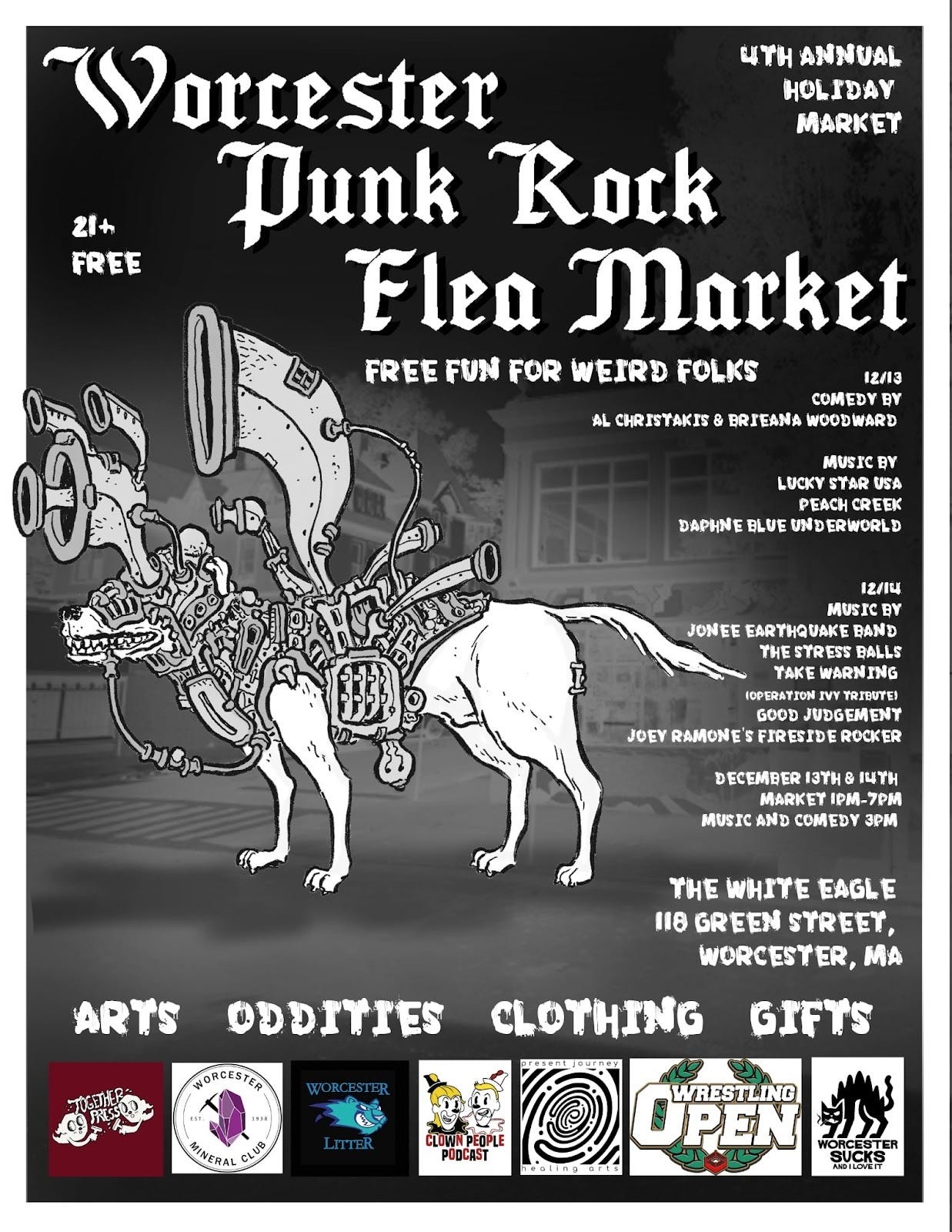
I’ll be boothing on Sunday. Katie’ll be with me, bringing a bunch of holiday themed stained glass pieces (check out Big Sass Glass!). I will have a new shirt! Fresh off the presses look at this bad boy...
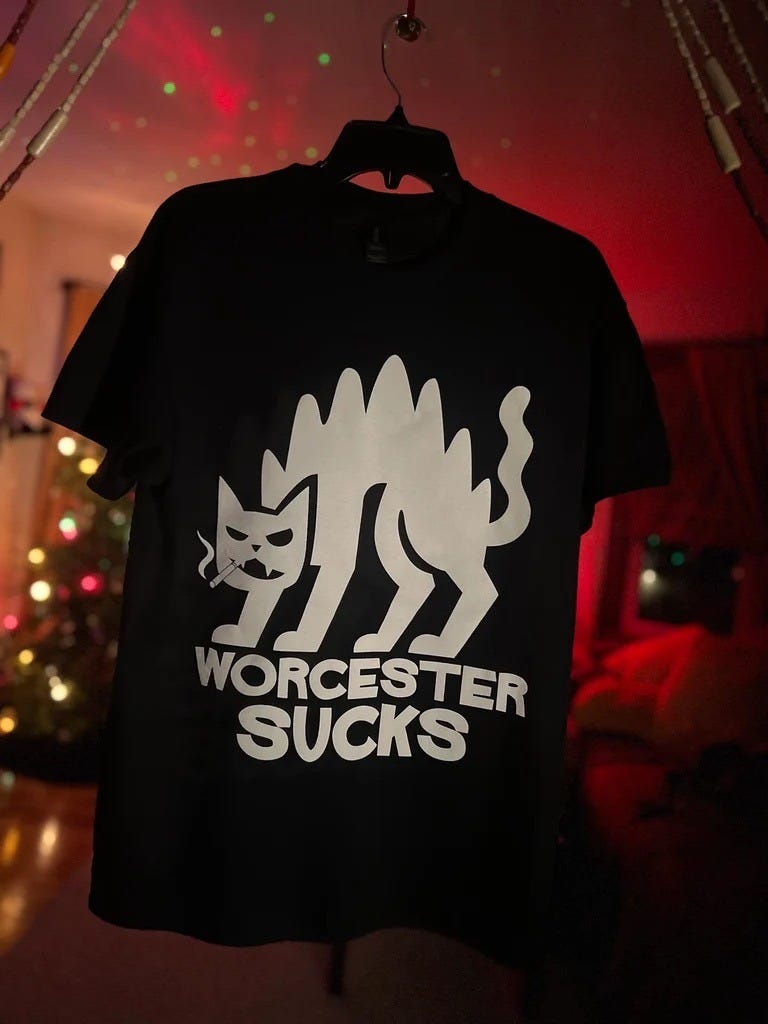
You know it you love it: the Travis Duda-designed Outdoor Cat, baby. I ordered a shit ton so they’re also up on the merch store right now! Smalls to 3XLs.
But it will be more fun to come down and get one on Sunday I think. Come say hey anyway!
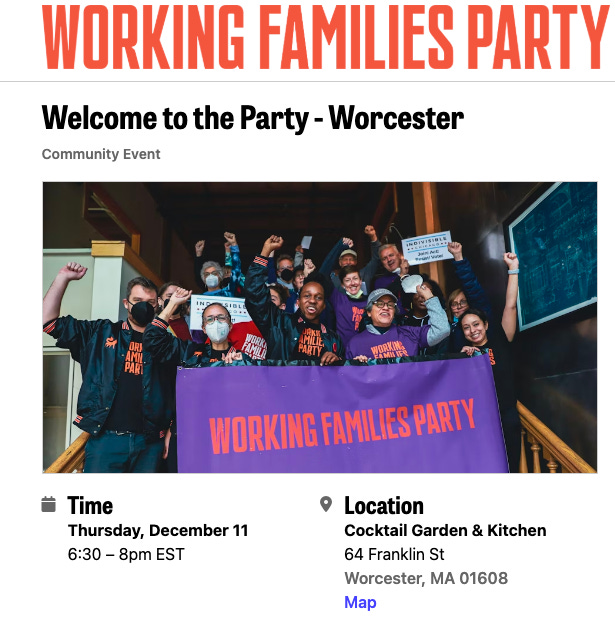
Also this week: the newly formed Working Families Party, a statewide outfit looking to get more active in the Worcester municipal politics cesspool god bless them, is having a little bash on Thursday at what used to be called “The Beer Garden” but is now called the “Cocktail Garden.”
There’s a council meeting on Tuesday (tomorrow). Here’s the agenda.
There’s only three orders and they’re metaphorical taken together. Etel has a forward-thinking order on about cuts to HUD funding and how it’ll impact our shelter system. Moe Bergman is complaining about the city’s snow plow operation, a few weeks after he complained about paying a more competitive rate for snow plow operators to reach adequate staffing levels. Nothing helpful will come of this line of inquiry but that’s not the point of course. The point is being able to complain on camera, which Bergman et al will likely do for several hours. Jenny Pacillo is asking the city manager to ask National Grid informational questions on a recent power outage in the Burncoat Neighborhood. If—big if!—National Grid ever responds to these questions, the council will ???????.
There’s tax rate stuff but I don’t care about that and neither should you. Non-issue made a perennial issue for stupid reasons.
Now onto the main event… but first, I gotta ask for money. Because I can’t keep this outlet running without you!
Thank you! You can also give the special freak in your life a gift subscription to this fine little outlet.
You Talk About Things That Nobody Cares
I’m reading Kingdom Came, a later J.G. Ballard novel, that projects a new fascism, one that’s leaderless, rooted in consumerism, ambient. A piece of clothing—the St. George Shirt—marks the “in” group, who terrorize the “out” group (immigrants, mostly) because they can, mostly. Such mob violence comes routinely, almost always after professional sports, and as a rule it’s explained away by the authorities. Tossing over Bangladeshi take-out shops is the party after the after party, but it also upholds a delicate social order that swirls around a gleaming new shopping mall mega development. At the helm is a bombastic afternoon talk show host, taking his cues from an advertising man deliberately testing out his social experiments. The directives of this new suburban fascism come in the form of TV commercials, concocted by the ad man and performed by the talk show host, depicting indulgences of violence for the sake of it. Both of them fail to see what they’re doing in full. Their visions of themselves and who they actually are remain at worsening odds. They lament the street violence while remaining resolute in the belief they’re ushering in a new and more verdant social order. In other words they’re making it great again. If only the out group could be made to just... disappear. Then we’d be perfect, we’d be clean, we’d be big and beautiful.
Politics for the age of cable TV. Fleeting impressions, an illusion of meaning floating over a sea of undefined emotions. We’re talking about a virtual politics unconnected to any reality, one which redefines reality as itself. The public willingly colludes in its own deception.
Hmmm the public willingly colluding in its own deception? Would be crazy, I think, if any of this happened in real life right now in front of our eyes.
Anyway completely and totally unrelated: John Keough’s reporting on ICE raids of churches over the holidays has been vindicated. This time last week, the DHS announced to much fanfare they’d be sending officers into a church during Christmas worship down in New Orleans, already raiding one church and promising to flood the city with more than 200 immigration officers to raid more. New Orleans seems to be a target because of its “sanctuary city” status—a clear out-group demarcation, a tacit sanction of all mob violence to follow. From the DHS release:
“Sanctuary policies endanger American communities by releasing illegal criminal aliens and forcing DHS law enforcement to risk their lives to remove criminal illegal aliens that should have never been put back on the streets,” said Assistant Secretary Tricia McLaughlin.
Just today the Baton Rouge area bishop waived the obligation to attend mass for members of his church. Area politicians are crying out for accountability and transparency that we here in Worcester know won’t be coming, not that most of ours even bothered to ask for it.
The DHS rationale on offer in these press releases is one of pure theater. The raw material from which the TV Show for a Death Cult is sourced. The first draft of the ongoing fiction psychopathically fed to otherwise bored consumers in the safest suburbs the world has ever known, slaking their thirst for violence done in their names. Back to Kingdom Come:
No slogans, no messages. New politics. No manifestos, no commitments. No easy answers. They decide what they want. Your job is to set the stage and create the climate. You steer them by sensing their mood. Think of a herd of wildebeest on the African plain. They decide where they want to go.
Ballard wrote the book in 2006. In fact it was the last book he wrote before he died, in 2009. In his vision of fascism it spreads like a virus along the nothing towns that line major highways.
The future is going to be a struggle between vast systems of competing psychopathies, all of them willed and deliberate, part of a desperate attempt to escape from a rational world and the boredom of consumerism.’
I’ve got about 100 pages to go but I’m pretty sure I know how it ends. I have a window, after all. And I do look out of it from time to time.
Let’s take a look around town.
Welp, according to Racism Free WPS there was another routine encampment sweep about a week ago, when, if you’ll remember, it was bitingly cold. The group put a post up directing people to send money to SOS Worcester (@buildwyc on Venmo) for immediate triage relief to our unhoused neighbors who lost everything, as happens every time police decide to arbitrarily tear down an encampment. Of late it’s more often than not a response to a 311 complaint. ACAB includes 311 turns out.
At a forum on Pleasant Street road improvements on Wednesday, a woman told councilor Etel Haxhiaj she should be wearing an orange jumpsuit. Didn’t say what for, of course. Asked to, I’m sure she’d struggle to form a coherent thought.
Ballard’s fascists “feel they are defending (their town), though they have no idea against what.”
At that same meeting, Crank Par Excellence Wayne Griffin argued against the addition of a sidewalk in the Pleasant Street redesign for a reason that I’m unable to make sense of. I wasn’t there, but stalwart transportation advocate Oliver Chadwick was.
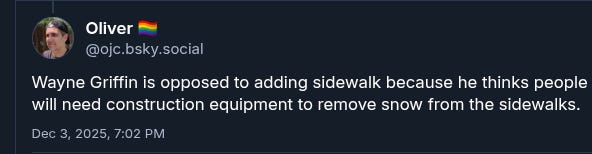
To read the Telegram’s reporting on the issue leaves you with a sense Griffin’s was a reasonable issue shared by a majority of concerned residents. After a brief description of the proposed project (it’s so mundane I can’t bring myself to type out a summary. Here’s the MassDOT handout. ) the opening line of scene is:
The proposal divided those in attendance. One, Laura Foster, yelled out, “We don’t want this” during the presentation.
While some attendees spoke in favor of the planned changes, many were concerned the project would cause more harm than good.
The trouble with “objectivity” is you get the confirmation bias of “controversy.” If a few idiots think sidewalks are the end of the world, and they’re the only ones who show up to an objectively boring meeting on an objectively boring topic, the “objective” news article is going to naturally elevate the concerns of the squawking idiots. Most people, myself included, would have to be dragged at gunpoint to a sidewalk meeting. Most people probably have neutral to mostly positive thoughts about sidewalks and bike lanes. But not enough to go shout about it to some state employees in a rec hall.
While in the rules of standard news reporting anything said during the meeting is fair game, it would be un-objective on the other hand to include some sensible information from outside the bounds of this one public meeting. So nowhere in this article are the string of deadly pedestrian crashes mentioned. Instead, we’re made to believe the main concern on the public’s mind when it comes to road redesigns is shoveling sidewalks. A small minority of the public with fringe concerns are centered as the constituency. From the city manager on down city hall orients itself around how initiatives will “play” in the Telegram. The distorted perspective provided in service of “objectivity” allows a fringe minority to seize the mandate of “concerned residents.” For some reason only white homeowners are allowed to use that cheat code though. It doesn’t work the same on affordable housing or trans rights or institutional racism or routine homeless encampment sweeps or anything else slotted into the vague category of “Activism” in the objectivity calculus.
When I’m being “biased” on here I’m doing it on purpose as a pointed critique of all that by the way.
The Washington Post last week had a fantastic data piece on pedestrian safety, Vision Zero, and the uniquely American problems we’ve had with a concept that European countries adopted with little incident. The townie backlash on display in this city, while particularly acute, is far from uncommon.
Vision Zero’s failures in more than two dozen cities fit a predictable pattern, according to the Post analysis and interviews with experts in traffic safety. Motorists are hostile to measures that slow traffic and favor pedestrians. Local leaders give token or tepid support. Spending on pedestrian-friendly improvements is not prioritized. The U.S. government, meanwhile, never backed up its pledge with federal action or significant funds.
A Post analysis found that of 27 cities that had at least five pedestrian deaths each year before adopting Vision Zero, all but one now have the same or higher pedestrian death rates than when those declarations were made.
Worcester hasn’t gotten to the point in the process—filing an official Vision Zero planning document with the appropriate agency—to have been considered in this story. But just think about the furor over Mill Street, and now Pleasant Street, and every other street in the future barring some mass exodus of cranks (inshallah). There’s a “future roadwork” type report on the council agenda Tuesday. Dreading the possible conversations it might spark already.
As the Post has it, there’s a veritable national movement of anti-roadwork backlash. The following anecdote from LA was eerily similar to how Mill Street went down.
On the Tuesday after Memorial Day 2017, Karla Mendelson would later tell a local paper, her husband came home from work late and looking distraught.
“Who died?” she asked.
His answer: “They closed lanes on Vista Del Mar.”
Soon she had founded a group, “Keep LA Moving” (KLAM), that became the face of the opposition to the lane restrictions in the area known as Playa del Rey. They said the changes had caused chaos: lengthening commutes, creating confusion and sparking conflicts between drivers.
Groups like KLAM (lol) are forming organically in cities around the country, without any directive or any real leadership. And they’re very effective. I can’t help but see the Ballard in it: these people, so blinded by their consumptive habits and allegiances—Jeep People and Pick Up Truck Guys and all the luxury brands—that any state intervention in their careening as fast as they can in the steel cage they’ve made themselves debtors for and they flip out. It’s as if the pedestrian deaths don’t even register as a matter of concern, let alone a related one.
In Kingdom Come the roving mobs of fascist thugs are a leaderless operation. “No one was organizing these displays of local pride. But violence and hate, as always, were organizing themselves.”
You don’t say.
I’m reminded of a drive back from New York City a few weeks ago, and three different unhoused people I encountered along the way.
First guy, in Brooklyn, by the on ramp in a wheelchair, I handed him two butts. He goes, “You’ve done this before.” He stood up out of his wheelchair and apologizes for that while he’s doing it. He goes, “I can stand, but I can’t, but I just can’t walk.” He reached into his pocket. Said, “Buddy, I got something to show you.” I got a green. So I gotta go. I was trying to get over one lane to get onto the highway exit and everyone was rushing past me to the point I had to stop between the two lanes at the raised median, when one of the drivers pointedly slammed on the gas so that I could not get past him. Hostile for the sake of it.
That’s where that guy in the wheelchair spends all of his time, in this space where courtesy doesn’t exist. Where the id of the driver has no counterweight of human ego.
I was just about out of the city a few white knuckle minutes later. Traffic’s backed up on the Huntington Parkway heading onto I-95. I could see ahead of me two police cars with these pairs of 10-foot-tall raised blinking light sticks—something we don’t have in Massachusetts yet—to indicate danger up ahead. I assumed there was an accident of some kind. But I got closer and realized that there wasn’t an accident at all. There was an elderly man pushing a shopping cart overstuffed with trash bags and suitcases in the breakdown lane and he was in between the two police cruisers. They were crawling along at his pace with their caution sticks up in the wind, just letting him walk. I drove past in a gawking amazement.
What a world we’ve built that this is a thing that could happen. A person in the richest country in world history, effectively living in the universe of The Road. And the best solution on offer is to have two police officers idle alongside him, their caution sticks a buffer between his world and ours. Patching the crack he opened between the realities when he stepped onto our most sacred space with all his earthly belongings and momentarily inconvenienced us and our careening boxes of steel.
A few hours later I was at a rest stop in Connecticut, and a middle-class-looking white guy was standing by the doorway. And I see him hold up the classic two fingers, “Can I bum a butt? Can I get a dollar?” thing, which I thought was strange. Then he actually asked somebody for a dollar. And I looked down and saw that his leg was cut off below the knee. And the stump was just resting on a peg, loose. And his pants were dirty in the specific all-over way that indicates destitution.
One of the most insightful and subtle elements of Paul Verhoeven’s satirization of fascism in Starship Troopers is the sheer amount of characters with missing limbs—how it’s an assumed and unremarkable fact to the characters in the story that limbs go missing. And everyone knows where they go missing. And how. And still it’s a badge of honor—one of many ways that the “citizens” distinguish themselves from the less-worthy proles.
I went to Trans Siberian Orchestra at the DCU like Katie and I do every year and this year there was a new feature: little synchronized drones. A grand finale, the buzzing little things flew over the guitar players as they both soloed over the main riff of Sweet Emotion, the unofficial Massachusetts townie anthem, the riff we can’t all help but to love, having just moved to the “big finish” second stage in the middle of the crowd for the wildest set piece of the night, (in past years, a scantily clad opera singer in a human-sized snow globe. Halfway through the unexpected “Sweet Emotion” etude and these these kitschy toy versions of America’s most defining weapon of empire come buzzing out on cue. Our phalanx, our testudo formation, our trebuchet, our ship of the line. That which we have used to decimate our Bugs, in the Verhoovian sense. The Wedding Busters. The one thing anyone will remember about America in 1,000 years when, god willing, the agitprop wears off and people look at the thing clearly. They’re doing a little figure eight pattern and then they idled in the shape of a single cutaway Les Paul and we’re all going oooo and ahhhhh while The Trans Siberian Orchestra puts their bombastic take on our most beloved folk tune, the bass line taking on a baroque stiffness for branding purposes.
Directly to the right of me, across an aisle, there was a burly, bearded man dressed in an operator aesthetic. One step past Punisher Skull if you feel me. Under his dull green cargo shorts was a bionic leg. It went past the knee, featuring an elaborate joint mechanism in its place. Like the rest of us he watched the drones hover above the musicians—synchronized swimmers in a pool of data, unaware of and unbothered by the crowd below, executing on orders without needing to consider them. Cold, calculated, precise. Inanimate but for our designs and so they’re killers of world historic proportion.
I don’t know how this Operator lost a limb but a safe guess would be it happened in one of the unfortunate places where the whirring of a drone carries a different implication than it did in the DCU Center. Where people do not go oooo and ahhhhh but rather run for cover or think their last earthly thought before the whiz bang and the black. Did it fill him with a dull boredom? A dread? Did he feel pandered to? Did he think about it at all? Connect it to the circumstances that led to his losing a limb? Or did he nod along to the familiar riff, shout out the words burned into his brain... into my brain...
You talk about things that nobody cares
Did he bang his head like I did? Did it make him feel like he was home?
Odds and Ends
Ok thank you for reading everyone. I need a serious recharge of my “caring about this city” battery. So maybe just one or two more posts from me before the new year. Don’t forget about the new shirts in the merch store and the Punk Rock Flea Market this weekend! (We’re vending on Sunday!)
Also please subscribe!
And don’t forget about the new shirts!
Before I leave you, I want to direct you to two really really great comments on the most recent podcast episode, about the antagonistic relationship between local journalism and “the platforms.” First one, from Keith Linhares:
Inspiring discussion — especially the parts about Woopedia and building our own local internet network. Hearing this episode was validating, because I’ve fantasized about these same ideas, but have lacked the drive, time, and tech know-how to push them forward. This feels like a call to action to get more serious about them.
I love the idea of Woopedia, but I haven’t had the motivation to go beyond glancing at the MediaWiki page. Still, the need is obvious. There’s so much misinformation spreading on social media, and accurate information is hard to access when we have so little journalism to begin with — and so much of what exists is behind paywalls.
During my campaign, I actually thought about building a Wiki for exactly this reason. People would ask about development projects they saw around town — things like 50 Oriol Drive, the Quality Inn being converted into supportive housing off Lincoln Street. Trying to understand the history and narrative around projects like these was incredibly difficult because I hadn’t followed the details closely, and I don’t pay for all the websites that cover them (Worcester Business Journal, MassLive, T&G).
On top of that, trying to use the city’s shitty website to find instances where 50 Oriol Drive came up at City Council or the Planning Board felt almost impossible. We have community meetings where I’m not even sure minutes or notes are captured unless a media outlet happens to cover them. City officials push their narrative about what a project accomplishes and how well it’s going, and then you talk to a resident who has been following closely and their account is totally different from what a City Councilor or a WBJ article might say.
It’s easy to imagine a Wiki page that describes the project; summarizes the information available beyond paywalls; notes when it was discussed at various city meetings and the outcomes; and even includes a section capturing resident criticism or feedback.
Now imagine scaling this up: John Monfredo, Polar Park, Mill St, the Day Resource Center — anything. You could build a real “people’s perspective” on what goes on around here. It would help document the narrative that we’re living in a city run by hardcore crony capitalists who are doing a great job making Worcester unlivable for so many. It’s hard to explain to people how bad things are when they haven’t been paying attention, but if someone could go down a wiki rabbit hole of local corruption, I imagine we’d get a lot more people on our side.
The idea of a local network is something my wife and I, and a few friends, have also fantasized about, mostly in the context of getting our digital history off places like Google. We want to boycott streaming services we’ve become dependent on, like Spotify. We’ve imagined building a shared repository of media like MP3s or movies for friends, but it’s easy to see how this could grow into a way of sharing information and organizing outside the Metaverse. Simple message boards (like the ones from earlier internet) could replace a lot of discussion that currently happens on Facebook. A local network could even help organize, surface, and scale up the disparate conversations happening across the Go List, Signal, Discord, etc.
Overall, I really share the sentiment that we could use a little more tech optimism — and we could be doing a much better job using the tools available to pull people away from corporations that just want to use us and suck our data and money away from us.
And another from David Thompson:
Finally catching up on this episode. This is like a spiritual successor to the episode with Joanne McNeil and I love it. The unmet needs of local communities and extractive nature of big social platforms is what drives my work at the Spritely Institute (https://spritely.institute/). Bill’s anecdote of trying to host a media server and being immediately overwhelmed is a critical problem that we collectively need to figure out. Why does it have to be so difficult? Most web software simply isn’t built to empower the average person to run and understand, it’s built for professional software people to deploy, and even then a lot of those professionals don’t know how to do it and it has become an increasingly specialized skill. The focus of the software industry is to build things that scale up in cloud data centers, not things that scale down for local communities. Tech is increasingly user friendly, but only on the surface because you can’t peel back the layers of the onion to learn things work like in the early days of computing. Even the projects that are trying to be deployable (like SecureDrop, something Bill has brought up in the past) can be overwhelmingly complex even for Linux sickos like myself.
I like the term “local internet” a lot. The big platforms throw everyone in the same big soup (context collapse), and since they are silos they have created the “breakdown in shared reality” problem that Bill mentions. The “global town square” concept of Facebook, Twitter, etc. has been great at capturing our attention but hasn’t improved society (something Joanne McNeil explained well in an past episode). It’s simply not how human community works in the real world. Society is formed by a large collection of overlapping small communities, but our social media doesn’t reflect that at all! I think the rising popularity of small Discord communities is an indicator that web 2.0 social media may be starting to wane. There’s value in a broadcast medium like Twitter (RIP) and Bluesky, but community needs to happen elsewhere. Unfortunately, Discord is a centrally controlled platform, with all the usual pressures from governments to censor/spy on their users and pressure from capitalism to enshittify. They recently were breached, exposing a ton of PII they are legally required to retain due to age verification laws and this trend is likely to only get worse in the near future. Platforms also have a lock-in effect that makes it hard to take your data and go somewhere else. I’m sure it would be extremely painful to leave Substack, for example. Removing these big central gatekeepers is a focus of my research/development work.
The discussion around the empowering aspects of technology, like with the little hardware synth, was so refreshing. It’s so easy to fall into tech doomerism and “computers were a mistake” feelings because we have so little agency over the tech we use these days. But little DIY hardware kits and open source projects like MediaWiki show that it doesn’t have to be this way. We *can* reclaim some autonomy over the tech we use. Someone should setup Woopedia!
Ultimately, though, I really don’t think that the tech we have today is enough to get us out of the hole we’re in. We should still make the best out of it, of course, but if anyone reading this has tech skills then I recommend checking out what’s happening in the decentralized web (DWeb) movement and consider getting involved. We need people who can help build the foundation for a decentralized, secure, collaborative internet that puts user agency and autonomy first!
A question I have for Bill is: What do you consider to be the essential features of a local journalism “platform” (for lack of a better word)? I like to gather use cases from real people with real needs to inform my own work.
To answer David’s question: Easy to read, easy to search, light & loads fast, intentionally Not Doing Any Annoying Shit.
But I share both these to say: we do a really good job around here of elevating the discourse, despite the smears we’re hit with about being naysayers or whatever the fuck. Cultivating a better, more serious conversation is essential in this city because where we’re currently at is… my god. We’re below sea level. Here’s an amazing recent Kate Toomey screenshot to serve as Exhibit A:
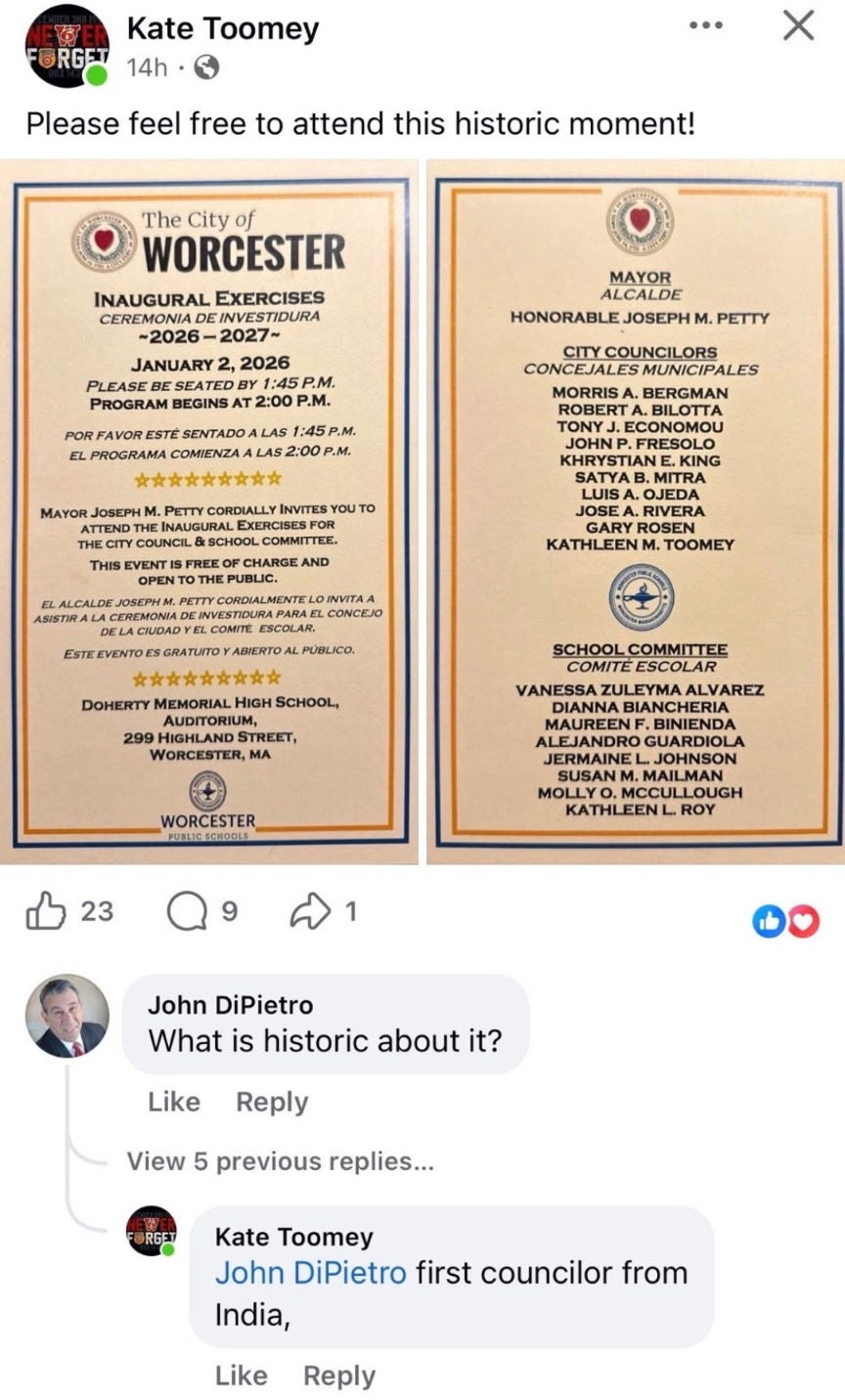
That comma… man. This next council is going to be sooooo funny. Anyway…
Thanks for sticking with me through this horrible and insane year. Talk soon!
Thanks for the plug for the Working Families Party event this Thursday! Here's some more context: the Working Families Party is a national political party mobilizing for real governing power for working people. They've been around since 1998, and have been growing state-by-state. Across the country, WFP has organized for some real wins (for example, they were part of the Zohran win in NYC, where they've been building for a long time). This event is the first public event of the newly formed MA chapter!
"Whatever it is, I'm against it!" Like, I hate it and I hate you. I hate your family, and I hate your friends. No outro music? Could've used Wu-Tang Clan "Protect Ya Neck".
I had a dream last night that two - (2) working women in Worcester came down with Monkey Pox. Anyone else have that dream? Worcester Blows.